
Knowledge library
Articles for independent inquiry.
Shorter entry points into the questions explored across THY-REALITY. Browse by field or search directly by title and description.

SeriesMedia
How to Recognize Propaganda Without Calling Everything Propaganda
Seven questions for distinguishing propaganda patterns from ordinary bias, persuasion, error, or legitimate political communication.
Read article
SeriesMedia
Who Decides What Is True?
Fact-checkers, platforms, and algorithms can correct errors, but labels, editorial judgments, and distribution decisions are not the same thing as truth.
Read article
SeriesMedia
The Anatomy of a Slovenian Headline: How Information Becomes an Impression
How a headline can remove a qualification, turn association into causation, or increase certainty and present a stronger claim than the article supports.
Read article
SeriesMedia
Slovenian Media During the Epidemic: How the Reality of COVID Was Created
What Slovenian media emphasized during the epidemic, how claims changed, and when reporting moved from informing toward moralizing and behavioural pressure.
Read article
SeriesMedia
Who Decides What Is Disinformation?
How error, disinformation, and open questions differ, and what happens when expert labels are combined with the distribution power of platforms.
Read article
SeriesMedia
When Many Media Outlets Speak with One Voice
A hundred logos do not mean a hundred independent newsrooms: agencies, ownership, costs, and centralized distribution can create an appearance of plurality.
Read article
SeriesMedia
Fear Sells
Why negativity, records, shocking images, and relative risk attract attention, and how journalism can become an industry of anxiety.
Read article
SeriesMedia
One Voice, One Message
When useful crisis coordination crosses the line into management of the information environment, uncertainty, and public behaviour.
Read article
SeriesMedia
When the Media Do Not Merely Report Reality, but Shape It
How gatekeeping, framing, sources, ownership, and algorithms determine which part of reality becomes news and what picture of the world audiences receive.
Read article
Schumann Resonance: Does Earth Have an Electromagnetic Heartbeat?
When we encounter the term Schumann resonance online, it is often accompanied by an alluring image of Earth surrounded by glowing waves.
Read article
432 Hz and 440 Hz: Why Some Musicians Hear the Difference
Search the web for “432 Hz” and a powerful story quickly appears. Music tuned to A = 432 Hz is said to be “natural,” “Pythagorean,” aligned with Earth, the human body, the heart, water or even DNA.
Read article
DNA as an Antenna: Biology or Metaphor?
DNA absorbs electromagnetic radiation, transports charge and has measurable resonances. Does that mean the genome is a natural antenna for external or “cosmic” information?
Read article
Masaru Emoto and the “Memory of Water”: What Did the Experiments Actually Show?
Masaru Emoto claimed that words, music and intention affect ice crystals. What do blinded tests, crystal-growth physics and the older “memory of water” debate actually show?
Read article
Solipsism: Can We Prove That a World Exists Outside Our Mind?
Solipsism asks an extreme question: if we always access the world through experience, how do we justify belief in an external world and other minds independent of us?
Read article
Electric Universe: Plasma, Electromagnetism and Alternative Cosmology
Space plasma, Birkeland currents, and magnetic reconnection are real physics. But they do not automatically show that galactic currents power the Sun or that electromagnetism replaces standard cosmology.
Read article
Are We Living in a Simulation? From a Philosophical Argument to Digital Physics
The simulation hypothesis, digital physics, and informational descriptions of nature are not the same claim. Bostrom’s argument, physical tests, and new constraints show what can be tested — and what cannot yet be established.
Read article
The Holographic Universe: Physical Principle or Metaphor of Consciousness?
The holographic principle is a serious idea in quantum gravity, but that does not mean our universe is literally a projection or that holography proves cosmic consciousness.
Read article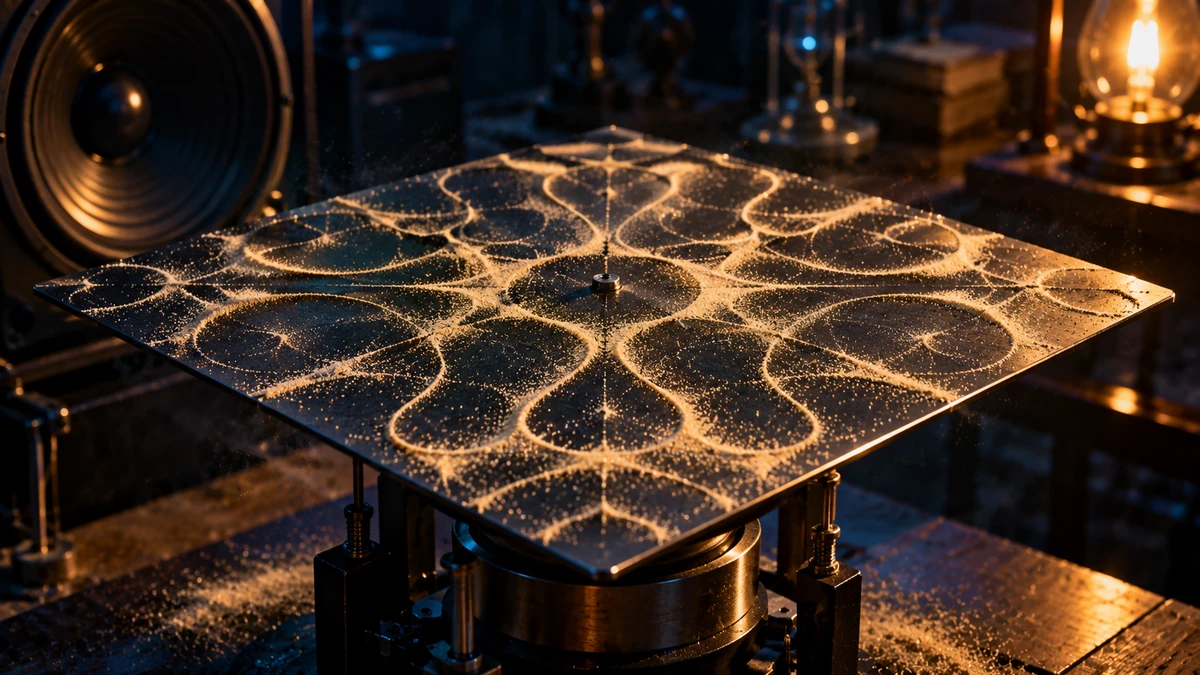
Cymatics: When Sound Becomes Pattern
Sand, liquid, and sound can produce striking geometric patterns. What does the physics actually show — and what is added only by later interpretation?
Read article
SeriesWho decides what is true?
Shincheonji Church of Jesus
When Revelation becomes a map of reality — and the question is not only what you believe, but who gets to explain what has already been fulfilled
Read article
SeriesWho decides what is true?
Twelve Tribes
When faith, home, work, upbringing, and belonging become one life system
Read article
SeriesWho decides what is true?
FLDS
When the prophet decides marriage, family, and belonging to the community
Read article
SeriesWho decides what is true?
Children of God / The Family International
When prophetic authority reaches into family, body, and everyday life
Read article
SeriesWho decides what is true?
Scientology
When spiritual progress is simultaneously a path, an organization, and a system of authority
Read article
SeriesWho decides what is true?
NXIVM
When “Personal Growth” Becomes a Hierarchy of Obedience and a Secret Structure Becomes a System of Coercion
Read article
SeriesWho decides what is true?
Order of the Solar Temple
When Initiation Becomes a Hierarchy of Reality and “Transit” Merges Murder with Suicide
Read article
SeriesWho decides what is true?
Heaven’s Gate
When the Body Becomes a “Vehicle,” the World a “Classroom,” and Death “Graduation”
Read article
SeriesWho decides what is true?
Waco
The Branch Davidians Between Apocalyptic Theology, a Failed Raid, a 51-Day Siege, and a Deadly Fire
Read article
SeriesWho decides what is true?
Jonestown
From the Promise of Racial Equality to Mass Murder and Suicide
Read article
SeriesWho decides what is true?
When Apocalypse Becomes a Program: Aum Shinrikyo, Sarin, and the Transformation of a Spiritual Movement into a Terrorist Organization
From a small yoga group to the chemical attack on the Tokyo subway—and why Aum’s successors still remain under special state surveillance in 2026
Read article
SeriesWho decides what is true?
The World’s “True Parents”: The Unification Church, Messianic Theology, Mass Weddings, Money, and Political Influence
How Sun Myung Moon built a global network of churches, businesses, media organizations, and political projects from a Korean religious movement—and why Japan stripped the organization of its religious-corporation status
Read article
SeriesWho decides what is true?
From Golden Plates to a Global Church: Mormonism, Revelation, Historical Change, and Institutional Authority
What the Church of Jesus Christ of Latter-day Saints actually teaches, what it acknowledges about its own history, and where the major historical, textual, and institutional questions arise
Read article
SeriesWho decides what is true?
From 1914 to “New Light”: Jehovah’s Witnesses, Prophecy, Doctrinal Revision, and Organizational Authority
How a small American Bible-study movement became a global religious organization—and what its history reveals about failed predictions, changing rules, and the authority of those who interpret “truth”
Read article
SeriesWho decides what is true?
When the Group Becomes the Whole World: Apocalyptic and High-Control Movements
From Jehovah’s Witnesses and Mormonism to the Unification Church, Jonestown, Waco, Heaven’s Gate, and Aum Shinrikyo—what a “high-control group” is, what apocalypticism is, and why unusual belief does not by itself cause violence
Read article
SeriesWho decides what is true?
When Prophecy Fails: From the Great Disappointment of 1844 to 1914, 1975, and “New Interpretation”
Why a failed prediction often does not destroy a movement—and how failure can become new doctrine, stronger identity, or a lasting institution
Read article
SeriesWho decides what is true?
How Do We Live with Uncertainty?
Probability, calibration, decision-making without complete knowledge, and the ability to change our minds
Read article
SeriesWho decides what is true?
What Does “Proven” Actually Mean?
Proof, indications, probability, statistical significance, causation, testimony, and degrees of certainty
Read article
SeriesWho decides what is true?
How Does Expert Consensus Form?
Peer review, replication, meta-analysis, paradigms, minority views, and why consensus is not the same as truth
Read article
SeriesWho decides what is true?
Who Pays for Expertise?
Research funding, conflicts of interest, industry science, and the boundary between sponsored research and a purchased result
Read article
SeriesWho decides what is true?
Who Watches the Watchers?
Regulatory capture, the revolving door, conflicts of interest, and the problem of independent oversight
Read article
SeriesWho decides what is true?
When an Institution Cannot Admit Error
Organizational silence, normalization of deviance, whistleblowers, and the difference between legitimate secrecy and concealment of responsibility
Read article
SeriesWho decides what is true?
How Is an Enemy Made?
War propaganda, dehumanization, “atrocity stories,” and the creation of public support for conflict
Read article
SeriesWho decides what is true?
When Doubt Becomes Identity
Conspiracy theories, real conspiracies, pattern-seeking, and self-sealing explanations of the world
Read article
SeriesWho decides what is true?
How Is Reality Shaped?
Agenda-setting, framing, repetition, propaganda, and the boundary between informing and steering
Read article
SeriesWho decides what is true?
Who Decides What Is True?
Authority, evidence, belonging, and the psychology of belief
Read article
SeriesPath to the Abyss
Fourth Step: Break Their Trust
When a person no longer believes anyone, someone can begin deciding what is true for them
Read article
Propaganda (2012): A Mirror of Western Media and Consumer Culture
Propaganda pretended to come from North Korea in order to show Western society through an outsider's lens.
Read article
Happiness and Entertainment: Why Pleasure Is Not the Same as Meaning
Fun, pleasure, happiness and meaning can overlap, but they are not the same. Philosophy and psychology show why a pleasant moment can improve life without, by itself, answering what makes a life worth living.
Read article
Karma: Action, Consequence, Intention and Free Will
Across Indian traditions, karma is not one formula but several models of action, intention, consequence, rebirth and freedom.
Read article
From Reading to Action: When Knowledge Becomes Wisdom
Information is not yet knowledge, knowledge is not yet judgment, and judgment is not yet wisdom. Aristotle, the Stoics and modern psychology show how to move an idea from the page into action, feedback and responsibility.
Read article
The Matrix: Science Fiction as a Map of Reality, Control, and Awakening
From Plato’s cave, Descartes and brains in vats to Baudrillard, Gnosticism, algorithms and synthetic media: what did The Matrix actually draw from philosophy, and why does its metaphor feel even stronger today?
Read article
Occultism in Music: Documented Influences, Ritual Aesthetics, and Marketing
From Crowley on Sgt. Pepper and Jimmy Page to JAY-Z, Beyoncé, Kanye West, Lady Gaga, Doja Cat and Playboi Carti: where is an occult link documented, where is symbolic aesthetics deliberate, and where must the question remain open?
Read article
Symbols of Power in Plain Sight: Tradition, Branding, or Hidden Meaning?
Some modern logos and older ritual emblems are not merely vaguely similar: they share strikingly close silhouettes or internal geometry.
Read article
Materialism: scientific method, metaphysics, or a prison of worldview?
Science methodologically seeks natural, testable explanations. But does its success prove physicalism as an ontology? A distinction between method, data, model, and metaphysics.
Read article
Human Bioelectricity and Biomagnetism: The Measurable Body and Unmeasured Interpretations
Humans are measurably bioelectric and biomagnetic organisms. But ECG, EEG, MEG, cellular voltages and wound electric fields do not by themselves show that an aura, qi or a therapeutic biofield is the same physical category.
Read article
Quantum Mechanics Without Mystification: What Does Physics Actually Say About the Observer?
Does the quantum “observer” really mean a conscious human? Measurement, wave functions, the double slit, decoherence, Bell entanglement, and the quantum eraser without jumping from physics to manifestation.
Read article
Free Will and Determinism: Could We Have Chosen Otherwise?
Do our brains decide before we do, does randomness rescue freedom, and what does “could have chosen otherwise” actually mean? A guide to determinism, compatibilism, Libet-style experiments, and practical self-government without premature conclusions.
Read article
Observer and Model: How Much Does Our Description Shape What We See?
Observation, measurement, and modeling are not assumption-free windows. This article shows how variable selection, operationalization, scale, and measurement procedures shape description without implying that reality is arbitrarily created by the observer.
Read article
Causality: What Does It Mean for One Thing to Cause Another?
Causality is not a hidden label that can be read directly from data. This article separates correlation, temporal order, common causes, counterfactuals, interventions, mechanisms, and study designs used to build a causal inference.
Read article
Time: Does It Flow, or Do We Measure Change?
We measure time by using change, but it does not follow that time is nothing but change. This article separates clocks, relativity, the entropy arrow, subjective time, and the still-open metaphysics of temporal passage.
Read article
Where Does Fact End and Interpretation Begin?
A practical method for distinguishing traces, observation, measurement, sources, reconstruction, interpretation, hypotheses and speculation—without pretending human inference can be eliminated.
Read article
How Do We Know What We Know? Evidence, Belief and Certainty
An epistemological map distinguishes belief, knowledge, evidential strength, probability, trust in sources and certainty, showing why good knowledge is not the same as feeling infallible.
Read article
Perception Is Not Reality: How the Brain Builds Our World
Perception is not a passive photograph of the world. This article shows how the senses transduce and select signals while the brain combines them with context, attention, prior experience and expectations into a usable perceptual model.
Read article
What Do We Mean by Reality?
A foundational map of reality distinguishes world, experience, model and description, and shows why empirical fact, philosophical interpretation and speculation are not the same level of claim.
Read article
When Society Becomes an Interface: Measuring Collective Reality
Measurement helps us see patterns, but indicators can also reshape behavior, allocate power and determine what counts as reality. This article shows how to measure without mistaking the map for the territory.
Read article
How to Evaluate a Source
A prestigious source can be wrong and an unknown source can be right. Evaluate sources by authorship, relevant expertise, traceability, creation process, evidence, independence, and transparency.
Read article
Openness Without Gullibility, Skepticism Without Dogma
An open mind does not mean accepting every claim, and skepticism does not mean rejecting everything in advance. How can we apply the same standards in both directions?
Read article
Fact, Interpretation, Hypothesis, and Speculation Are Not the Same
We observe an event and almost immediately assign it meaning. How can we separate what we know from what we infer, test, or merely imagine for now?
Read article
Truth Sets Us Free — in Practice
Discovering that we were wrong does not mean that we have corrected the error. What changes when new understanding is carried into decisions, acknowledgment, and action?
Read article
One Reality, Many Maps
The same reality can require multiple maps and models. Explore the difference between territory and representation, the role of purpose and idealization, and why model plurality is not relativism.
Read article
The Blind Men and the Elephant: Mistaking the Part for the Whole
A true piece of information can still produce a false picture when we mistake one part for the whole. Learn how context and multiple perspectives improve understanding.
Read article
“I Don’t Know” as the Beginning of Knowledge
Admitting “I don’t know” is not the end of thinking. It is the beginning of more precise inquiry, intellectual humility, and better verification.
Read article
Perception Is Not the Same as Reality
Perception is our first point of contact with reality, but not a perfect copy of it. How can we separate perception, interpretation, and what we can verify?
Read articleNo article matches your search.