How Is an Enemy Made?
War propaganda, dehumanization, “atrocity stories,” and the creation of public support for conflict
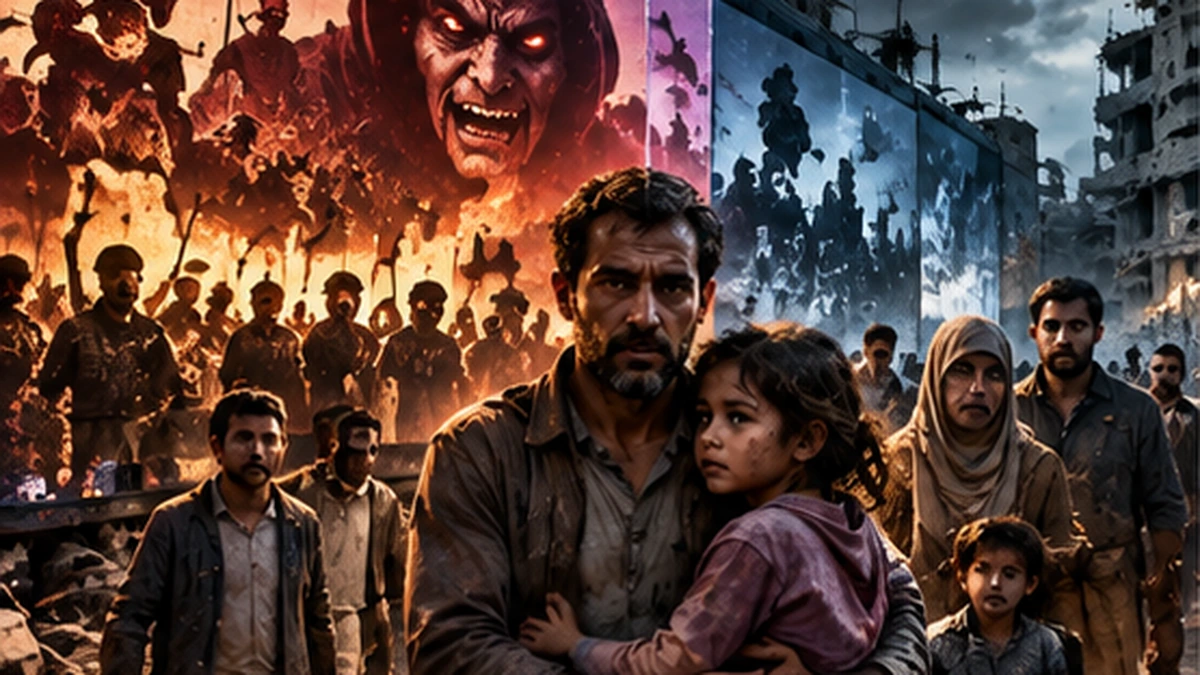
Wars do not begin only on the battlefield. Before a state asks its citizens for:
- money;
- mobilization;
- sacrifice;
- restrictions;
- acceptance of civilian losses;
- a prolonged conflict,
the war has to become an intelligible story. Who is the aggressor? Who is the victim? What is at risk? Why are the ordinary rules of peaceful life no longer enough? Who are “we”? Who are “they”?
And above all:
why is continuing the conflict presented as necessary, legitimate, or unavoidable?
This does not mean that every war is merely the product of propaganda. States can actually be attacked. War crimes can be real. Threats can be genuine. That is precisely why war propaganda is so difficult to analyze.
The most powerful propaganda often does not need an invented story. It can take a real event, place it inside a selective moral frame, and turn it into an explanation of the entire conflict.
War needs a story
Already after the First World War, Harold Lasswell analyzed propaganda as one of the key instruments of modern war. A state must explain at the same time:
- why the war is being fought;
- why the enemy is dangerous;
- why sacrifices are necessary;
- why its own side is morally justified;
- why opposition to the war can be presented as dangerous.
This does not mean every such argument is false. It means that in wartime information and mobilization become inseparably linked.
Democracies use propaganda too—but in a different institutional environment
Propaganda is often associated only with totalitarian regimes. History shows otherwise. After the United States entered the First World War, President Woodrow Wilson established the Committee on Public Information (CPI) in April 1917 under George Creel.[1]
The U.S. National Archives today officially states that the CPI:
- issued government news;
- sustained morale;
- administered voluntary press censorship;
- carried out activities at home and abroad.[1]
The Office of the Historian describes CPI representatives around the world:
- opening reading rooms;
- distributing translations of Wilson's speeches;
- cooperating with local journalists;
- showing films about U.S. preparedness for war.[2]
This matters. Propaganda does not have to mean only:
“the state tells people a lie.”
It can be the organized management of information, morale, and the interpretation of war.
Censorship and public information can operate together
Documents surrounding the creation of the CPI are especially interesting. The U.S. Secretary of State, Secretary of War, and Secretary of the Navy recommended to Wilson a system combining:
- censorship of information that could help the enemy;
- active public information.[3]
That has a legitimate military logic. A state at war cannot publicly release:
- troop movements;
- planned operations;
- all intelligence information.
But this creates a structural problem:
the same institution can simultaneously decide what the public may not know and shape the messages the public does receive.
That does not by itself prove deception. But it creates a greater need for later independent review.
“Us” and “them”
War communication often reduces complexity. On one side:
our soldiers our families our civilians our freedom
On the other:
the enemy.
This asymmetry has consequences. Our dead have:
- names;
- photographs;
- stories;
- families.
The enemy's dead may become:
- numbers;
- “targets”;
- “elements”;
- “forces”;
- “collateral damage.”
This is not only semantics. Language affects how much psychological distance we feel from the consequences of war.
Sanitized language
An experimental political-psychology study by Stephen Utych examined two kinds of foreign-policy language:
- sanitized language, which obscures the human consequences of conflict;
- dehumanizing language, which diminishes the target group.[4]
In his experiments, sanitized language reduced emotional responses to civilian casualties and increased support for military intervention. Dehumanizing language likewise increased support for intervention and greater acceptance of deaths among the designated adversaries.[4] This does not prove that one expression automatically causes a war.
But it shows:
language can change the moral weight of the same event.
Dehumanization: a powerful but not simple concept
Dehumanization is one of the concepts most often used to explain mass violence. The enemy may be described as:
- rats;
- parasites;
- disease;
- filth;
- a swarm;
- a virus.
Such language can place a group outside the ordinary moral circle. But contemporary academic debate warns that the concept is not so simple. Perpetrators do not always describe victims only as nonhuman. They may also describe them as intensely human moral enemies:
- traitors;
- criminals;
- murderers;
- conspirators.[5]
It is therefore often better to speak of the broader process of:
moral exclusion and the devaluation of the lives of another group.
Nazi propaganda: an extreme historical example
Nazi Germany is an extreme example of systematic state propaganda. After taking power in 1933, the regime established the Reich Ministry of Public Enlightenment and Propaganda under Joseph Goebbels.[6] Propaganda:
- defined the “national community”;
- determined who did not belong;
- presented Jews as both an internal and external enemy;
- used the press, radio, film, posters, and education;
- helped create an atmosphere in which discrimination and later violence became more acceptable.[6]
The USHMM emphasizes that propaganda did not only spread hatred. It helped create passive acceptance of measures that became increasingly radical.[6]
The enemy as conspirator
A particularly important feature of Nazi propaganda was its depiction of Jews as the hidden coordinator of Germany's different enemies. In propaganda imagery, the Jew appeared:
- behind the United States;
- behind Great Britain;
- behind the Soviet Union;
- behind capitalism;
- behind communism.
Mutually contradictory political forces were thus folded into a single grand conspiracy.[7] This is an example of the mechanism discussed in When Doubt Becomes Identity:
different and even contradictory pieces of information can be connected by one underlying explanation about a hidden enemy.
Propaganda before violence
The USHMM documents how intensive propaganda campaigns often preceded new repressive measures. Before the Nuremberg racial laws and before further escalation of antisemitic measures, propaganda campaigns helped define Jews as a danger and increase tolerance for exclusion and violence.[6]
This does not mean:
propaganda by itself causes genocide.
Mass violence requires:
- political institutions;
- a repressive apparatus;
- ideology;
- organization;
- opportunity;
- war;
- many other factors.
But propaganda can alter the moral terrain on which people interpret later measures.
Atrocity stories: the hardest case for fact-checking
Almost every war includes reports of:
- murdered civilians;
- rape;
- torture;
- killings of children;
- attacks on hospitals;
- desecration of bodies.
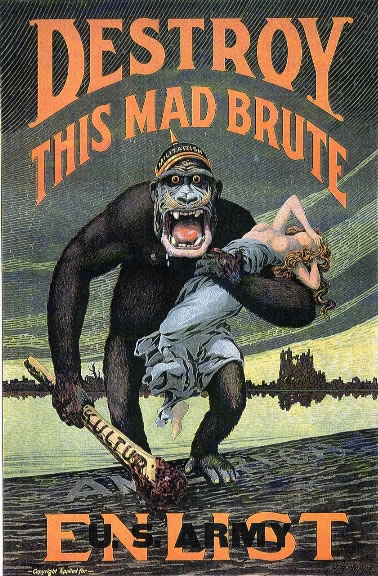
Such stories have extraordinary mobilizing power. The literature uses the term atrocity stories, and when they are systematically incorporated into mobilization, atrocity propaganda.[8] But the term can mislead.
“Atrocity propaganda” does not automatically mean the atrocity was invented.
The First World War: real atrocities and propagandistic amplification
For a long time there was a simplified view that stories about German atrocities in Belgium were mainly fabricated wartime propaganda. More recent historiography has substantially complicated that picture. Research shows that German forces during the 1914 invasion of Belgium and France did carry out serious violence against civilians. Those events then became material for Allied propaganda.[9]
At the same time, there was:
- exaggeration;
- rumor;
- fabrication;
- moral simplification.[9]
This is an extremely important example. It can simultaneously be true that:
an atrocity occurred
and:
the presentation of that atrocity was used for propagandistic mobilization.
One does not exclude the other.
Why are atrocity stories so effective?
Francis Wilcox analyzed the wartime use of atrocity stories as early as 1940.[8] Their communicative power is clear. If the enemy:
- kills children;
- attacks civilians;
- tortures prisoners,
the war is no longer merely a conflict of interests. It becomes:
a moral duty.
Such a frame reduces space for the question:
“Is there another option?”
because the conflict is translated into:
good versus evil.
The problem of a false atrocity story
If an atrocity story is false, it can directly affect support for a conflict. But even when a story is wrong, the correction often arrives:
- later;
- with less media attention;
- after the political effect has already occurred.
This is connected with the continued influence effect discussed in the previous article. The first emotionally powerful explanation can continue to shape the mental model of an event even after a particular element is later corrected.
For wartime atrocity claims, the standard is therefore especially important:
speed of publication must not substitute for the degree of certainty.
But false stories from the past are not a reason to automatically deny new atrocities
Here the opposite danger appears. If a person discovers that a historical atrocity story was exaggerated or false, they may develop the rule:
“Wartime atrocities are always propaganda.”
That is equally dangerous. Real mass atrocities are often well documented. The proper standard is therefore not:
believe every story,
nor:
reject every story.
It is:
check the concrete evidence.
Rally around the flag
When a country experiences:
- an attack;
- a major external crisis;
- a military confrontation,
support may temporarily increase for:
- leadership;
- government;
- national institutions.
Political science calls this the rally-around-the-flag effect.[10] John Mueller's classic model emphasized that such events are usually:
- international;
- dramatic;
- clearly visible;
- directly connected to the state and its leadership.[10]
More recent research shows that the size and duration of the effect vary substantially. It is not an automatic psychological law.
Why can space for dissent shrink during a crisis?
During an external crisis, political criticism can be interpreted differently than in peacetime. The same question:
“Is the strategy good?”
may ordinarily mean political debate. During war, however, it can be presented as:
- lack of patriotism;
- undermining morale;
- helping the enemy.
Sometimes protecting operational information is a legitimate necessity. But the boundary between:
protecting a military secret
and
restricting political criticism
is a fundamental democratic question.
Our side has “mistakes”; the enemy has a “nature”
A common asymmetry in wartime storytelling is:
When someone on our side commits a crime
- an individual failed;
- rules were broken;
- the system does not permit this;
- it was an exception.
When the enemy commits a crime
- this shows who they are;
- their culture is like this;
- their military is like this;
- their leadership is like this.
Contemporary literature on war-crimes apologia analyzes the different narratives through which moral responsibility is reduced or displaced.[11] An important test is therefore:
Do we use the same standard for a crime committed by an ally and one committed by an adversary?
A civilian victim is no less dead because of a flag
That sounds banal. Informationally, it is not. The public usually receives far more:
- names;
- photographs;
- personal stories
about civilian victims on its own side or among close allies. Enemy civilian victims may be presented mainly as statistics. This asymmetry of identification affects moral intuition. One named person is psychologically different from:
“47 civilian casualties.”
War produces informational uncertainty
Carl von Clausewitz already warned in the nineteenth century that much wartime information is:
- contradictory;
- false;
- doubtful.
Modern warfare has not eliminated this problem. It has added:
- satellite imagery;
- phones;
- social media;
- OSINT;
- drones;
- deepfake technologies;
- propaganda networks.
We have more data. We do not necessarily have more certainty immediately.
The first information is often the worst—and the most influential
After an explosion, attack, or mass death, we usually do not initially know:
- who attacked;
- with what weapon;
- from where;
- how many died;
- what the target was.
Yet the first hours are communicatively the most important. That is when:
the first frame
is created. If a later investigation changes the attribution, the correction is often less dramatic than the original event. That is why THY-REALITY should use the category:
PRELIMINARY / ATTRIBUTION NOT YET ESTABLISHED
for current wartime events when the evidence is not yet strong enough.
Attribution is separate from the event
This is a fundamental rule. We may know with high confidence:
an explosion happened.
But know much less confidently:
who caused it.
We therefore separate:
EVENT CONFIDENCE
Did the event occur?
ATTRIBUTION CONFIDENCE
Who caused it?
INTENT CONFIDENCE
Was the result intentional?
COMMAND CONFIDENCE
Who ordered it? In public debate, these four levels are often fused into one.
A photograph of a dead child proves tragedy—not necessarily attribution
This is a difficult but important rule. A photograph can strongly support:
a civilian died.
By itself it does not tell us:
who fired the weapon.
Nor:
whether the civilian casualty was intentional.
For those conclusions we need other evidence. The emotional power of an image must not increase the evidentiary value of a claim the image itself cannot establish.
Iraq 2002–2003: communication, intelligence failure, and a political dispute over how the threat was presented
The case of U.S. prewar assessments of Iraqi weapons of mass destruction is useful because extensive official investigations were later conducted. In 2004, the Senate Intelligence Committee unanimously found that several key intelligence-community assessments of Iraqi WMD programs:
- overstated the available data;
- or were not sufficiently supported by the underlying intelligence reporting.[12]
The report also identified groupthink within the intelligence community as an important problem.[12] At the same time, that phase of the investigation found no evidence that political officials had pressured analysts to alter the WMD assessments.[12]
A later investigation of public statements reached a sharper conclusion—and there was political disagreement with that conclusion
In 2008, the majority of the Senate Intelligence Committee, in its Phase II report, concluded that a number of prewar public statements by the administration were not supported by the available intelligence or did not reflect its uncertainties.[13] Among other things, the report questioned:
- some claims about the Iraq–al-Qaida relationship;
- the possibility of transferring WMD to terrorist groups;
- the degree of certainty regarding chemical capabilities.[13]
But the report was not unanimous. The committee's then vice chairman, Senator Kit Bond, called it political and emphasized the conclusion of the earlier unanimous report:
the main problem was flawed intelligence analysis, not proven political direction of those assessments.[14]
This is a good example of how THY-REALITY should present contested political history: distinguish what the committee found unanimously, what a later majority concluded, and what objections the minority recorded.
“The government lied” is a different claim from “the claim was wrong”
This distinction is extremely important. Different scenarios are possible:
A. The information is correct
B. The information is wrong, but the speaker sincerely believes it
C. The information is uncertain, but the speaker presents it as certain
D. The speaker knows the information is wrong and deliberately presents it as true
All four require different evidence. For the claim:
“they lied”
we must also establish the speaker's knowledge or intent, not merely that the final statement was false. This rule must apply equally to:
- politicians;
- journalists;
- military representatives;
- alternative media;
- our own articles.
The danger of moral compression
When war becomes:
good versus evil,
important distinctions can disappear:
- civilian and soldier;
- leadership and population;
- supporter of a regime and resident of a country;
- critic of the war and supporter of the enemy.
This is moral compression. An entire society becomes one unit. It then becomes easier to accept:
- collective punishment;
- hatred toward civilians;
- racism;
- measures against diasporas.
Language about “the enemy” must therefore be exceptionally precise.
A state is not a nation; a government is not a population
This is one of the simplest and most frequently violated principles. When we say:
“Russia did ...” “America wants ...” “Israel thinks ...” “Iran wants ...”
we may be collapsing very different actors:
- the government;
- the military;
- the opposition;
- civilians;
- institutions;
- individual officials.
Sometimes such shorthand is practical. But in moral attribution it can be dangerous. More precise is:
which institution, which leader, which unit, which document?
The defending side also uses propaganda
If a state really is attacked, it does not follow that:
its communication is not propaganda.
It can simultaneously be true that:
- the attack is real;
- the defense is legitimate;
- the communications apparatus selects stories that increase morale;
- it downplays its own losses;
- emphasizes the enemy's losses;
- withholds some information.
Propaganda is not proof that a side lacks a legitimate reason to fight. It is a description of a mode of communication and mobilization.
And an aggressor can use genuine grievances
A state that starts an unlawful or aggressive war may use as propagandistic material:
- real discrimination;
- a real historical dispute;
- an actual incident;
- a genuine violation by the other side.
That does not mean the facts are invented. It means that a true fact by itself does not establish:
the legitimacy of the entire war.
This protects against the argument:
“Because the opponent really did something wrong, every response by our side is justified.”
Creating consensus is not always centrally directed
As in the previous article on propaganda, wartime mobilization does not have to be directed from one “command room.” Politicians, journalists, activists, and audiences can reinforce one another. At a moment of high threat:
- media want fast information;
- official sources have the greatest access;
- audiences want clarity;
- opposition figures do not want to appear disloyal;
- platforms reward emotional content.
The result can be a homogeneous information frame, even without a single central planner.
Embedded journalism and the problem of access
A war reporter depends on access. If they can reach the front only:
- with a military unit;
- under specific safety rules;
- within a defined area,
their perspective is inevitably limited. That does not mean the reporter is a propagandist. It means we have to analyze:
the structure of access to information.
Who can see what? Who sets the safety rules? Which part of the war remains outside the frame?
Propaganda and censorship are not always opposites
A wartime information strategy often has two sides:
Negative
What must not get out?
Positive
What do we want to emphasize? The CPI from the First World War is a good historical example of this dual system.[1][3] A modern democracy needs both:
- protection of genuine operational secrets;
- the possibility of public oversight and criticism.
The problem arises when:
“national security”
becomes broad enough to prevent scrutiny of a political decision.
What makes good war reporting?
The right standard is not “neutrality” in the sense that:
both sides are always equally right.
If one side commits a documented crime, we can say so clearly. The right standard is a symmetrical method. For both sides we ask:
- what is the evidence;
- who collected it;
- what is its provenance;
- what is confirmed;
- what is not confirmed;
- is the event separated from attribution;
- is attribution separated from intent.
The method is symmetrical. The evidence does not have to be.
False balance is not the solution
If we have:
- ten independent sources on one side;
- one anonymous post on the other,
it is not fair to say:
“both explanations are equally possible.”
Neutrality does not mean a mathematical 50:50. It means:
adjust the degree of confidence to the quality of evidence, not to political sympathy.
How to verify a wartime atrocity claim
For THY-REALITY, I would lock a special protocol.
What exactly is being claimed?
The precise event.
When and where?
Geolocation and time.
What is the primary evidence?
Photograph, video, satellite image, bodies, medical documentation, witnesses.
What is the provenance?
Where did the evidence come from?
Has the material been independently geolocated/verified?
Are the event and attribution treated separately?
What do the weapon type or direction of attack show?
Only if forensically reliable.
Are there independent witnesses?
What do international or forensic investigations say?
Their methodology must also be assessed.
Is there a competing explanation that accounts for the same data?
Which facts remain unexplained?
Degree of confidence
- EVENT CONFIRMED
- ATTRIBUTION HIGH / MEDIUM / LOW
- INTENT ESTABLISHED / NOT ESTABLISHED
- COMMAND RESPONSIBILITY ESTABLISHED / NOT ESTABLISHED
A media error does not become a conspiracy merely because it is repeated
During war, multiple outlets may publish the same wrong information because they rely on:
- the same news agency;
- the same official statement;
- the same local source.
That can be:
shared-source failure.
It is not necessarily:
coordinated deception.
A claim of coordination requires additional evidence. This rule is directly connected to When Doubt Becomes Identity.
But a late correction does not erase responsibility for a poor standard
Conversely:
“we did not know at the time”
is not a universal defense. We have to ask:
- Was the uncertainty known?
- Was it communicated?
- Was the headline more certain than the evidence?
- Was contrary evidence ignored?
- Did the outlet correct the claim with appropriate visibility?
Error is human. How an institution handles an error tells us a great deal about it.
The most dangerous sentence in an information war
It may be:
“Now is not the time for questions.”
In the first minutes of an attack, there truly may not be time for complete philosophical analysis. People need:
- safety instructions;
- crisis management;
- rapid decisions.
But if “now” becomes:
- a week;
- a month;
- a year,
a crisis measure can become permanent immunity from criticism. A mature society must be able to:
act under uncertainty
and
later check whether the reasons for acting were correct.
Why correction must be part of the history of war
After a war, when:
- archives;
- intelligence documents;
- minutes;
- court files
are opened, the picture of the conflict may change. That is not necessarily “rewriting history” in a bad sense. It is normal historical method. The problem arises when a society does not allow:
retroactive scrutiny of its own wartime myths.
THY-REALITY and war: what is our goal?
We do not want to produce:
“the correct propaganda against the other side's propaganda.”
That would destroy the purpose of the series. In every wartime article, the reader should be able to see:
- what is documented;
- what one side claims;
- what the other side claims;
- what evidence supports each claim;
- where the evidence is asymmetric;
- what remains unresolved.
If the evidence is stronger on one side, we say so. If there is not enough information, we say:
a reliable conclusion cannot be reached.
Conclusion: the enemy can be real—but the image of the enemy is always constructed
An opposing army can really exist. An attack can really happen. A war crime can be entirely real. But the public image of “the enemy” is always built from:
- selection of events;
- words;
- images;
- historical references;
- moral frames.
We therefore need to separate:
a real threat
from
the communicative architecture through which we understand the threat.
This is hardest precisely when the threat is real. Then the greatest temptation is to say:
“Because we are right about the basic conflict, we do not need to verify the details.”
That is exactly when the details require the most scrutiny. A democratic society does not lose its capacity for judgment only when it believes enemy propaganda. It can also lose it when it becomes convinced:
that its own side has no need for propaganda.
Methodological note
This article does not use the term propaganda as a synonym for a lie. Nor does it claim that:
- both sides in every war are morally equivalent;
- all claims carry equal evidentiary weight;
- dehumanizing language by itself causes war;
- an “atrocity story” means an invented atrocity;
- rally-around-the-flag means the public is being manipulated;
- incorrect prewar information by itself proves an intentional political lie.
In politically contested historical cases, the article distinguishes between consensus findings, majority findings, and recorded dissenting views.
Sources and further reading
- U.S. National Archives, Records of the Committee on Public Information (RG 63). Used for the establishment of the CPI on April 13, 1917, its functions, morale work, and voluntary press censorship. Source 1 Source 2
- U.S. Department of State, Office of the Historian, Foreign Relations of the United States, Public Diplomacy, World War I, preface. Used for CPI activities abroad. Source
- Office of the Historian, documents on the establishment of the CPI and cooperation with Military Intelligence. Source 1 Source 2
- Stephen M. Utych, “Human or not? Political rhetoric and foreign policy attitudes,” Political Science Research and Methods 10(3), 2022, 642–650. Source
- “Assaulting ‘diversity as such’: The ontology of dehumanisation in mass violence,” European Journal of International Security, 2022. Used for conceptual limitations of simplified dehumanization models. Source
- United States Holocaust Memorial Museum, Nazi Propaganda and Defining the Enemy. Used for the Propaganda Ministry, mass media, antisemitism, and the gradual normalization of exclusion. Source 1 Source 2
- USHMM, Nazi anti-Jewish propaganda and The Protocols of the Elders of Zion. Used for the propaganda motif of an alleged Jewish conspiracy controlling hostile forces. Source 1 Source 2
- Francis O. Wilcox, “The Use of Atrocity Stories in War,” American Political Science Review 34(6), 1940, 1167–1178. Source
- Adrian Gregory, The Last Great War, chapter “Defining the enemy: Atrocities and propaganda 1914–1915”; David Monger, Press and Propaganda, 2023; Christophe Prochasson on the Horne/Kramer research. Used to distinguish real atrocities, propagandistic framing, and fabricated/exaggerated elements. Source 1 Source 2 Source 3
- Research review “Rally around the flag effects in the Russian–Ukrainian war,” European Political Science, 2026, with historical discussion of Mueller's model and conditions for rally effects. Source
- “Dirty hands, savage enemies, and bad apples: A taxonomy of war crimes apologia,” Review of International Studies 52(4), 2026. Used for different narratives that reduce or displace responsibility for war crimes. Source
- U.S. Senate Select Committee on Intelligence, overview of committee activity and unanimous findings of the 2004 report on prewar Iraq assessments. Source 1 Source 2
- Senate Select Committee on Intelligence, Final Phase II Reports on Prewar Iraq Intelligence, June 5, 2008. Used for the majority findings regarding inconsistencies between some public statements and the intelligence evidence. Source
- Senator Kit Bond, minority/vice-chair response, June 5, 2008. Used for the opposing interpretation of the Phase II report and emphasis on the findings of the unanimous 2004 report. Source