One Voice, One Message
When useful crisis coordination crosses the line into management of the information environment, uncertainty, and public behaviour.

When crisis communication becomes management of the information environment
In a crisis, no one wants ten officials giving ten different instructions to ten television stations. One says stay at home. Another says the danger is not serious. A third says masks are unnecessary. A fourth says they are essential. A fifth predicts catastrophe. A sixth reassures the public. The result is predictable: confusion. Distrust.
And a question that, in a health crisis, can affect life itself:
Whom are we supposed to believe?
That is why the desire for coordinated crisis communication is understandable. One central point. Clear instructions. Uniform definitions. Consistent data. A rapid response. But this is exactly where the more difficult question begins. What happens when the goal is no longer merely to ensure that the population receives verified information, but also to ensure that it does not receive too many alternative interpretations? What happens when authorities do not merely want to explain a risk, but need to achieve a particular behavior?
When does:
“let us say the same thing clearly”
become: “let us make sure everyone mainly hears the same thing”? That is the boundary between crisis communication and management of the information environment. And that boundary is much thinner than it appears.
Communication is part of the health intervention
The World Health Organization does not treat crisis communication as an add-on to public health. It treats it as part of the response. WHO defines risk communication as the exchange of information, advice, and opinions between experts, authorities, and people exposed to a hazard so that they can make informed decisions to protect their health. Its key elements include trust, listening to the public, and providing timely information. But crisis communication does not have only an informational goal. It also has a behavioral goal. People should stay at home. Reduce contact. Wear protection. Get tested. Get vaccinated. Evacuate. Observe quarantine.
There is nothing unusual about this in itself. Public health has used communication for decades to reduce smoking, encourage vaccination, promote seat-belt use, and influence other behaviors.
The problem begins with the question:
which communication methods are permissible in order to achieve the desired behavior?
“One voice, one message”
On January 22, 2019, Belgian virologist Marc Van Ranst spoke at an ESWI and Chatham House conference in London. The meeting focused on preparedness for future influenza pandemics; participants included representatives of WHO, ECDC, the European Commission, national ministries, regulators, and the pharmaceutical industry. Van Ranst was not speaking hypothetically. In 2009, he had participated in Belgium's response to the H1N1 pandemic. Ten years later, he was explaining primarily the communication lessons of that experience to a professional audience.
His basic rule:
“One voice, one message.”
One voice. One message. In the lecture, he emphasized the importance of the first days of a crisis. In his view, the central expert should then be continuously available to the media, as visible as possible, and reliable enough to become their main source. Van Ranst then made an especially interesting statement: if you achieve that, the media “will not be looking for alternative voices.” Belgian media later also reported on the content of the presentation and its H1N1 context, noting that excerpts should not be misrepresented as evidence that he had planned a pandemic; the lecture was a retrospective account of his crisis communication in 2009.
That context is exactly what makes the statement interesting. We do not need a conspiracy theory. The strategy was publicly described.
Why would that make sense?
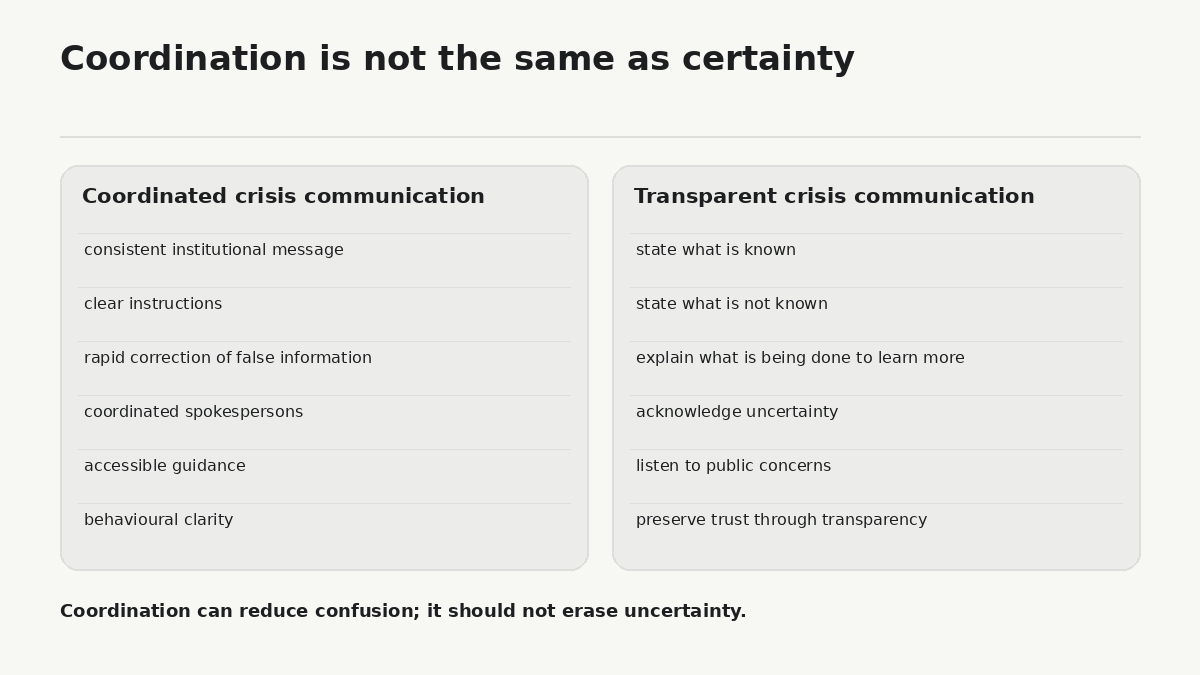
Consider the position of a crisis manager. A new virus appears. There are little data. Journalists demand answers. Politicians demand answers. People demand answers. Rumors spread across social media. If ten experts simultaneously present ten scenarios to the public, the result may be complete communication chaos. Centralized communication therefore has obvious advantages: speed, consistency, fewer contradictions, easier correction of false information, clearer instructions. WHO itself also supports the principle “Speak as One WHO”: the organization wants different departments to use coordinated core messages because it believes this strengthens credibility. In emergencies, WHO also recommends coordinating key messages with partner organizations.
Therefore:
“one voice” is not in itself evidence of manipulation.
It can be a reasonable crisis mechanism.
But the question remains:
What happens to the voice that disagrees?
Coordination is not the same as a monopoly on interpretation
We must distinguish two things. The first:
a ministry should not claim one thing in the morning while its spokesperson says the opposite in the afternoon.
That is normal institutional coordination. The second:
journalists do not need other experts who might check or challenge the official explanation.
That is something different. The first reduces chaos. The second can reduce the plurality of verification. An alternative voice is not automatically disinformation. It may be another epidemiologist. A statistician. A doctor. A pharmacologist. A public-health expert. A psychologist. A lawyer. An ethicist. A researcher who interprets the same data differently. Science does not progress with one voice. It progresses through: hypothesis, evidence, criticism, replication, error, correction. A crisis does not abolish that process. It simply compresses the time available for it brutally.
But politics must decide today
This is where the real conflict emerges. A scientist can say:
We need another six months of data.
A government, however, must decide today whether schools will close tomorrow. A hospital must prepare beds today. A health authority must define priority groups today. Decisions in a crisis therefore necessarily arise under uncertainty. That is not an error. The error occurs if the uncertainty disappears on the way to the public. Current WHO recommendations acknowledge this quite directly: effective crisis communication should state what is known, what is not known, and what is being done to learn more. Acknowledging uncertainty is presented as a condition of trust, not a threat to it.
Unity of message therefore should not mean:
unity of certainty.
When the purpose of information is also behavioral effect
Van Ranst also spoke very openly about death in relation to H1N1. Part of the communication problem, in his view, was that the population did not necessarily perceive influenza as a disease from which people can die. So drawing attention to deaths was part of creating a sense of seriousness. The information:
people die from this disease,
can be entirely accurate. But if a communicator selects it partly because they want to increase the perception of danger and thereby change behavior, the same information becomes both:
a fact
and a behavioral intervention. That distinction is essential. Propaganda does not necessarily require false data. Sometimes a true fact, selected and emphasized for its expected psychological effect, is enough.
Footballers and the desirability of a vaccine
In the same lecture, Van Ranst described an even more direct example. During Belgium's H1N1 vaccination campaign, some top football clubs vaccinated their players ahead of schedule even though they did not belong to the agreed priority groups. Van Ranst said he communicatively “misused” the event. The logic was simple. If the public sees famous footballers wanting the vaccine strongly enough to obtain it outside the queue, the vaccine can begin to look like a scarce and desirable good. No longer:
the state is trying to persuade me to get vaccinated,
but:
privileged people want this thing so badly that they are jumping the queue.
His description shows conscious use of a real event to create a behavioral effect.
At this point we are already well beyond the simple idea:
“we are giving the public data.”
Is that propaganda?
It depends on the definition. If propaganda means only:
fabricated information,
then no. But if it means:
deliberately shaping communication in order to change the perceptions and behavior of a large group of people,
the boundary becomes less clear. Public health uses terms such as: behaviour change communication, behavioural insights, social and behavioural change. All of these can serve legitimate goals. If an alert persuades people to leave an area before a hurricane, it can save lives.
But the ethical question remains:
Are we openly presenting people with arguments and risks, or deliberately managing their psychological responses?
H1N1: the reckoning after the crisis
The H1N1 pandemic proved milder than many early concerns and scenarios had suggested. After the crisis ended, critical review followed. In June 2010, the Parliamentary Assembly of the Council of Europe adopted Resolution 1749, Handling of the H1N1 pandemic: more transparency needed. It warned of serious shortcomings in the transparency of decision-making and concerns about possible pharmaceutical-industry influence. It also warned that such lack of transparency could undermine trust in major public-health institutions.
That same year, the British Medical Journal and the Bureau of Investigative Journalism showed that some experts involved in developing WHO pandemic recommendations had done paid work for pharmaceutical companies with an economic interest in medicines and vaccines, while those relationships had not been disclosed transparently enough.
But a later independent review of WHO found an important countervailing limitation:
it found no evidence of an attempt by commercial interests to influence, or of actual commercial influence on, specific WHO decisions.
At the same time, it criticized the way conflicts of interest were handled. That is exactly the kind of distinction we need.
Documented:
conflicts of interest and an insufficiently transparent system.
Not proven:
that the pharmaceutical industry therefore controlled WHO decisions.
But the question remains:
How can the public trust one voice if it cannot see clearly enough the interests of the people shaping it?
The greatest danger of one voice is one large error
Imagine two systems. In the first, twenty experts argue publicly. The system is slow. Awkward. Difficult for journalists. But another expert can quickly challenge one expert's mistaken conclusion. In the second system, there is one central voice. The message is simple. The response is fast. The public knows what to do. But if the center is wrong, the same error can spread through the entire communication system. Centralization reduces noise.
But it can increase:
the reach of a single error.
The question is therefore not:
Do we need coordination?
We do.
The real question is:
Who checks the coordinated center?
COVID: a crisis in which communication became almost as important as medicine
When SARS-CoV-2 appeared, the information situation was extreme. A new virus. Little direct data. Uncertain mortality. An uncertain share of asymptomatic infections. Uncertain transmission routes. Shortages of protective equipment. Models with very wide uncertainty intervals. At the same time: Facebook. YouTube. Twitter. WhatsApp. Telegram. Billions of people reading preliminary research almost in real time. WHO described such an environment as an infodemic — a large volume of information containing accurate, inaccurate, outdated, and misleading material, making it more difficult for the public to find useful guidance. That is a real problem.
But the response to it raises another question:
Who determines what the correct voice is while science has not yet reached a final answer?
A British document: increase the perceived level of personal threat
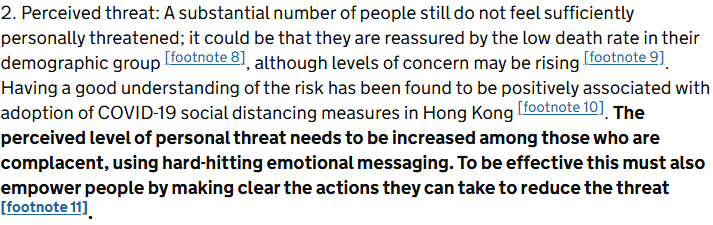
On March 22, 2020, the British behavioral advisory group SPI-B prepared a document on increasing adherence to social-distancing measures. The document is officially published on the UK government's website. It states:
“The perceived level of personal threat needs to be increased among those who are complacent, using hard-hitting emotional messaging.”
In other words: among people who do not take the danger seriously enough, perceived personal threat should be increased through hard-hitting emotional messaging. The document also warns that such messaging should provide people with clear actions through which they can reduce the risk. This matters because we are not speculating about a hidden intention. The intention is written down. Communication was not merely supposed to transmit information. It was also supposed to help change people's perception of their own danger.

Fear is a behavioral tool
That is not surprising. Psychology has long known that fear influences behavior. But the fact that something works does not answer whether a particular use of it is ethical.
In crisis communication, at least three different possibilities exist:
warning people about a real danger;
emphasizing the worst plausible real scenario;
or
deliberately increasing perceived danger in order to obtain greater compliance.
The boundary between them is not always clear. But the public has a right to know which mechanism authorities are using.
A number is not neutral even when it is correct
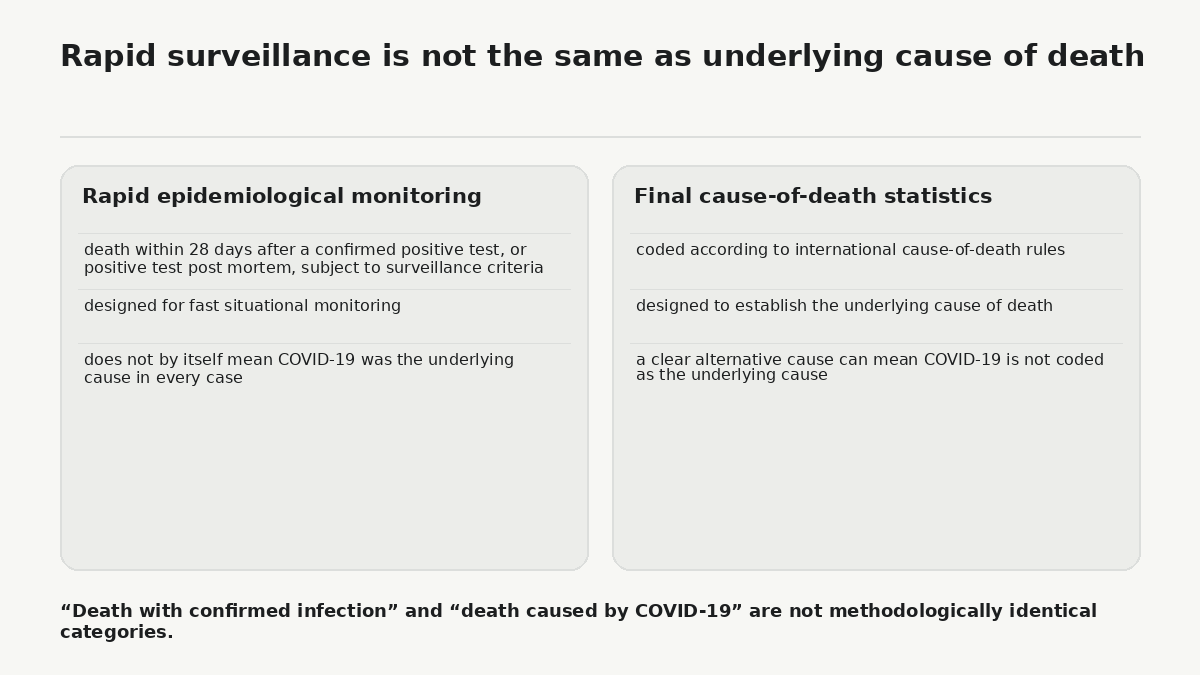
During COVID, people followed daily figures for: confirmed infections, hospitalizations, intensive care, deaths. But every number requires a definition. Slovenian data illustrate this clearly. For rapid epidemiological monitoring, NIJZ counted a person among deaths with confirmed SARS-CoV-2 infection if death occurred within 28 days after a positive test or if the test was positive after death. This rapid epidemiological definition was not the same as the later statistical determination of the underlying cause of death.
In a later methodological explanation, NIJZ explicitly stressed this distinction: because rapid data had to be published promptly, they did not take the underlying cause of death into account, while each death was later coded according to international rules. Where there was a clear alternative cause — for example trauma — COVID was not the underlying cause merely because the person had tested positive.
This means that the statements:
“X people with confirmed infection died in the past 28 days”
and
“X people died because of COVID”
are not methodologically identical. This does not mean COVID mortality was invented. Later NIJZ data show thousands of deaths in which COVID was determined to be the underlying cause: 3,390 in 2020 and 3,062 in 2021.
It does mean:
a journalist must understand the definition of a number before turning it into a headline.
From methodological category to emotional message
Imagine a television headline:
“Another 30 COVID patients died today.”
For the average viewer, the meaning is fairly clear: COVID caused 30 deaths. But if the underlying data are actually the rapid epidemiological category “death within 28 days after a positive test,” a journalist should know that the formulation is more complicated.
The same problem that runs throughout this series appears again:
what is lost when complex information is compressed into a striking headline?
We will conduct a detailed analysis of Slovenian reporting separately.
For this article, only the principle is essential:
when a number is part of a behavioral campaign, its definition should be more transparent, not less.
“Safe and effective”: when a complex medical claim becomes a slogan
A similar problem appears with vaccines. The initial Pfizer–BioNTech vaccine trial reported at the end of 2020 roughly 95 percent efficacy against symptomatic COVID after two doses under the conditions of the trial at that time. That was a highly important and legitimate result.
But in public communication, the number could be reduced to:
“the vaccine is 95 percent effective.”
The crucial question then disappears:
effective against what?
Infection? Symptomatic disease? Transmission? Hospitalization? Intensive care? Death?
And:
for how long?
Effectiveness was not one unchanging number
The data changed with continued follow-up. In one U.S. cohort of health-care and other exposed workers, the CDC estimated mRNA vaccine effectiveness against infection at approximately 91% before Delta predominance, and approximately 66% during the Delta period; uncertainty intervals around the second estimate were wide, so it would not be accurate to turn those two numbers into a perfectly precise universal curve. Qatar offered an even clearer example.
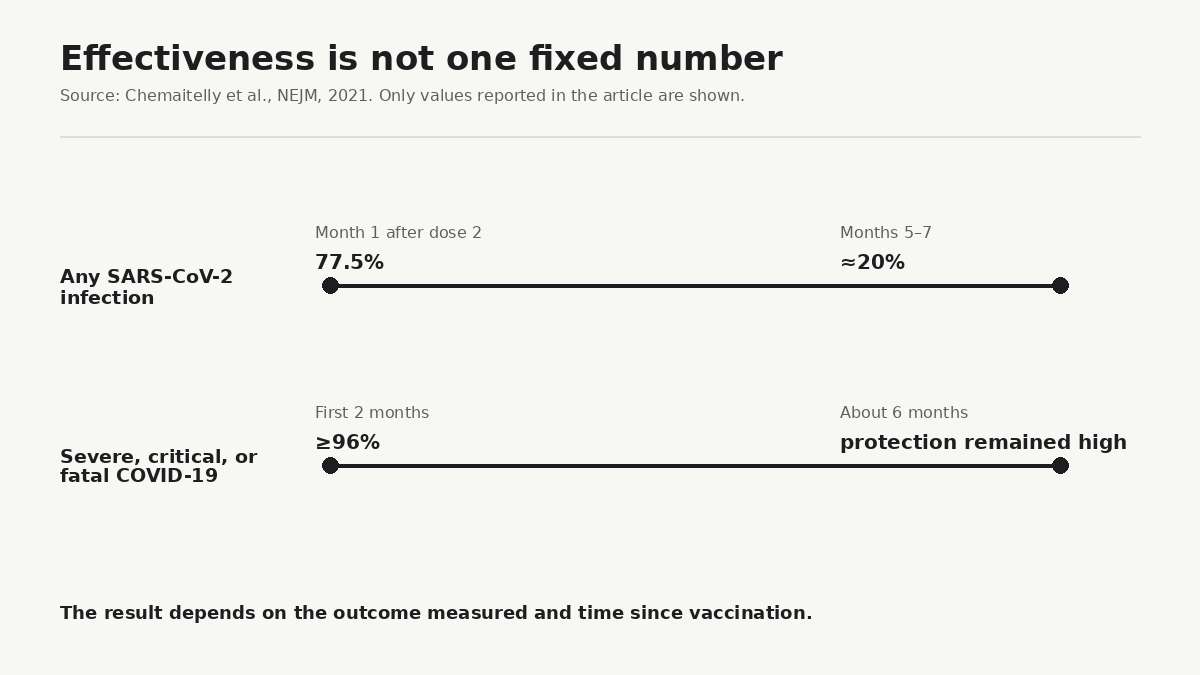
A large study there of the Pfizer vaccine found that protection against any infection reached approximately 77.5% in the first month after the second dose, then gradually declined, falling to roughly 20% in months five through seven. At the same time, protection against severe, critical, or fatal COVID remained much stronger during the first six months.
That means:
the vaccine did not have one effectiveness.
It had different effectiveness: against different outcomes, at different times, against different variants of the virus. During Omicron, data likewise continued to show much stronger protection against severe outcomes than against infection itself, especially after booster doses. Scientifically, this is entirely understandable. The communication problem arises if the message does not change quickly enough as the evidence changes.
When the evidence changes, the slogan must change too
If in January the public is told:
“the vaccine is 95 percent effective”
and over the following months it becomes clear: that effectiveness against infection is declining, that a new variant has appeared, that protection against infection is not the same as protection against hospitalization, then the public should be told about those distinctions with the same energy with which the initial figure was presented. It is not enough to say:
science changes.
Of course it does.
That is precisely why crisis communication must continually show:
what has changed.
The problem is not that the original estimate was later different. The problem would arise if, because of the need for a simple behavioral message, the communication system preserved the old level of certainty even after the evidence became more complex.
“Safe” is not an absolute category either
The same problem exists with safety. No medicine is absolutely without risk. A vaccine can have a very favorable benefit-risk ratio and at the same time cause a very rare, serious adverse effect.
If public messaging translates this into:
“completely safe”
or into a sense that a serious complication is practically impossible, the communication is too simplistic. This does not mean that every event after vaccination should automatically be attributed to the vaccine. Quite the opposite. In medicine, causal claims require more than temporal sequence. If someone dies after a positive test, the positive test alone does not prove the cause of death. If someone dies after vaccination, temporal proximity likewise does not prove the cause of death.
The same evidentiary standard must apply in both directions.
We will examine this issue in greater detail — including the documented Slovenian death following the Janssen vaccine and the way the media reported before and after it — in the analysis of Slovenia's COVID information environment.
Why can an absolute slogan be dangerous even if the general policy is reasonable?
Imagine that for most of the target population a health intervention has a positive benefit-risk ratio. That still does not mean the risk is: the same at every age, the same for men and women, the same for all vaccines, the same for all variants, or unchanged over time.
Mass communication wants:
one short message.
Medicine often requires:
multiple qualifications.
The tension between these needs is real. The problem begins when communication efficiency almost always defeats medical precision.
What happens to the person who asks an uncomfortable question?
One voice works only as long as other voices do not have the same reach. At this point, crisis communication touches the next stage: information management. What is a legitimate scientific question? What is dangerous false information? Who decides? And when? History is full of medical ideas that were wrong. But also ideas that began as minority positions and later proved correct.
There must therefore be a distinction between:
demonstrably false information
and
professional disagreement about still-incomplete data.
If we call both by the same word — disinformation — protecting the public from falsehoods can also become a way of protecting the official message from criticism. We will return to this question in detail later in the series.
“Follow the science”
During the pandemic, one phrase was used frequently:
“follow the science.”
But science is not a person. It is not a minister. Not a national institute. Not a television doctor. Not an expert committee. Science is a method. Its results contain: confidence intervals, limitations, conflicting studies, different models, and findings that may change. Politics, however, must make decisions on the basis of those incomplete data.
When a political decision becomes:
“the science says”
an important boundary can blur between: scientific evidence, expert judgment, a value judgment, a legal decision, and a political compromise. That is dangerous for science as well.
Because if the political decision later fails, the public may conclude:
“science lied.”
Even though the decision was a mixture of science and politics from the beginning.
“We don't know” is not a defeat for science
With a new virus, the most honest answer may be:
we do not know yet.
We do not know the exact mortality rate. We do not know how many infections remain undetected. We do not know how long protection lasts. We do not know how the virus will change. We do not know the full adverse effects of a particular intervention. The public may dislike uncertainty. Politicians even more so. The media need a headline. But false certainty has a cost. When people later see that a confident claim has changed, they do not necessarily hear:
we obtained new data.
They may hear:
earlier you told me something that was not true.
Current WHO recommendations therefore emphasize transparent communication of uncertainty.
When the goal becomes compliance
Here we come to the most important distinction.
Public health has a legitimate aim:
reduce harm.
But a citizen is not a laboratory mouse. If the only measure of successful communication is: how many people followed the measure, how many were vaccinated, how many stayed at home, a communicator may begin using every mechanism that increases compliance. Fear. Social pressure. Shame. Authority. Exclusion. Scarcity. Status. But an effective behavioral tool is not automatically an ethical tool.
Indirect coercion and the question of free choice
A particular problem appears when authorities formally say:
the decision is voluntary,
while access to the following depends on it: work, study, travel, hospitality venues, events, or ordinary social life. That is not the same as physical coercion. But neither is it a communicatively neutral environment.
A real analysis therefore must not stop at the question:
Was vaccination formally mandatory?
It must also ask:
What consequences followed if an individual did not make the choice the system expected them to make?
We will examine legal disputes around COVID certificates and Slovenia's specific PCT system in detail in the separate article on Slovenian media during the epidemic.
One voice can protect the public
We must not forget this. Poor communication during a real epidemic can cause harm. If authorities conceal an outbreak, valuable time is lost. If institutions directly contradict one another, people do not know what to do. If a dangerous rumor spreads faster than its correction, it can cause death. Therefore: coordination, clarity, speed, consistency, accessibility, and correction of false information are legitimate goals.
The problem is not:
unified communication.
The problem begins when it is joined by:
concealment of uncertainty,
management of fear without transparency,
simplification that changes the meaning of data,
exclusion of legitimate professional disagreement,
or
demands for trust without the possibility of independent verification.
Where is the boundary?
| Crisis communication | Management of the information environment |
|---|---|
| Coordinates official data | Coordinates the permitted interpretation |
| Clearly states what we know | Creates more certainty than the evidence allows |
| States what we do not know | Hides uncertainty because it could reduce compliance |
| Corrects demonstrably false information | Automatically labels an uncomfortable expert opinion as disinformation |
| Warns of a real danger | Deliberately increases perceived danger without clearly disclosing that purpose |
| Encourages protective behavior | Uses social pressure as a substitute for informed choice |
| Discloses conflicts of interest | Demands public trust without sufficient transparency |
| Accepts journalistic scrutiny | Seeks to reduce journalists' need for alternative sources |
| Changes the message when the evidence changes | Keeps the original slogan even after reality becomes more complicated |
The boundary is not always clear. But if we do not look for it, we will always notice it only after it has been crossed.
The real test comes after the crisis
During an emergency, almost any authority can justify greater control by invoking necessity. Time is pressing. Data are scarce. Mistakes have consequences. The real test comes later. Are the documents opened? Can we see how the decision was made? Are conflicts of interest disclosed? Is an incorrect prediction acknowledged? Are adverse effects investigated? Are the harmful consequences of measures also examined? Can a critical expert later show that they were right about something without being permanently followed by a label from the past? H1N1 showed why retrospective transparency matters. The Council of Europe demanded greater transparency. WHO's procedures for conflicts of interest were criticized.
Current WHO guidelines place much stronger emphasis on acknowledging uncertainty and maintaining trust. Institutions can learn too.
The greatest paradox
“One voice, one message” can be a very good crisis strategy. That is exactly why it can also be very dangerous. If the message is correct, useful information can rapidly reach millions of people. If the message is wrong, the same infrastructure can spread the error with equal efficiency. If the message is too confident, a legitimate question can begin to look like disobedience. If fear is used deliberately, it may improve compliance in the short term while damaging trust in the long term. If journalists do not seek alternative voices, there is less confusion.
But we also lose one of society's main ways of discovering that the official voice was wrong. That is the cost of a centralized message.
The goal cannot be compliance itself
A citizen is not merely the object of behavioral policy. They have a right to understand: what the risk is, how reliable the assessment is, who made the decision, what is scientific evidence, what is political judgment, what evidence contradicts it, and how all of this changed over time.
The most ethical goal of crisis communication therefore cannot be:
achieve the greatest possible compliance.
It should be:
enable the most informed and responsible action possible under conditions of uncertainty.
The difference is fundamental. In the first model, the public is something to be managed. In the second, it is a partner.
And this is where the media enter
So far, we have spoken mainly about authorities and experts. But “one voice, one message” can work only if someone distributes the message to a mass audience. This is where the media enter. A journalist's task is not to serve as the state's crisis press office. Nor is it to automatically oppose every official measure. The task is to: verify. Understand definitions. Compare statements over time. Distinguish fact from model. Test absolute slogans. Ask about risks. Say when an estimate is uncertain. And return to earlier headlines when they later prove wrong or overly confident.
If a journalist merely repeats the official message, the public does not have two safeguards. It has one.
And this is where fear enters
When a state needs to change the behavior of millions of people quickly, it has one communication tool that works faster than almost any other:
fear.
Fear attracts attention. Raises perceived importance. Can increase willingness to act. But fear is not interesting only to governments. It is also interesting to media. Because we watch what we fear. We click what we watch. And what we click generates revenue. This is where two different interests can meet: government wants to change behavior, media want attention.
The result can be the same information environment:
more danger, more urgency, more emotion, less space for calm explanation of uncertainty.
That is exactly what the next article will examine.
Sources and further reading
- European Scientific Working Group on Influenza (ESWI). 2019 Activities Summary — ESWI/Chatham House conference on pandemic preparedness, January 22, 2019.
- Marc Van Ranst. Communication and public engagement, lecture on Belgium's H1N1 response; the context and content of the talk were also summarized in Belgian media.
- World Health Organization. Communicating risk in public health emergencies.
- World Health Organization. Speak as One WHO and guidance on coordinating crisis messages.
- WHO/Europe. Communicating uncertainty in health emergencies – guidance and tips. 2025.
- Parliamentary Assembly of the Council of Europe. Resolution 1749 (2010), Handling of the H1N1 pandemic: more transparency needed.
- Cohen, D., Carter, P. WHO and the pandemic flu “conspiracies”. BMJ 2010;340:c2912.
- BMJ. Report on the independent review of WHO's H1N1 pandemic response: criticism of conflict-of-interest procedures, but no evidence found of actual commercial influence on decisions.
- Scientific Pandemic Influenza Group on Behaviours (SPI-B). Options for increasing adherence to social distancing measures, March 22, 2020.
- NIJZ. C19-stat – Metodologija. Definition of a death of a person with confirmed infection within 28 days for rapid epidemiological monitoring.
- NIJZ. Število umrlih v povezavi s COVID-19 za leta 2021, 2022 in 2023. Difference between the rapid epidemiological definition and the underlying cause of death.
- NIJZ. Data on COVID-19 as the underlying cause of death in Slovenia in 2020 and 2021.
- Polack, F. P. et al. Safety and Efficacy of the BNT162b2 mRNA Covid-19 Vaccine. New England Journal of Medicine, 2020.
- Fowlkes, A. et al. CDC/MMWR. Effectiveness of COVID-19 Vaccines in Preventing SARS-CoV-2 Infection Among Frontline Workers. Data before and during Delta predominance.
- Chemaitelly, H. et al. Waning of BNT162b2 Vaccine Protection against SARS-CoV-2 Infection in Qatar. New England Journal of Medicine, 2021.
- CDC/MMWR. Analyses of mRNA-vaccine protection against the most severe outcomes and its waning over time during the Omicron period.