Israel and Gaza: How the Media Shape the Permissible Image of War
How narrative starting points, language, victims, sources, and legal terms shape the permissible media image of the war between Israel and Gaza.
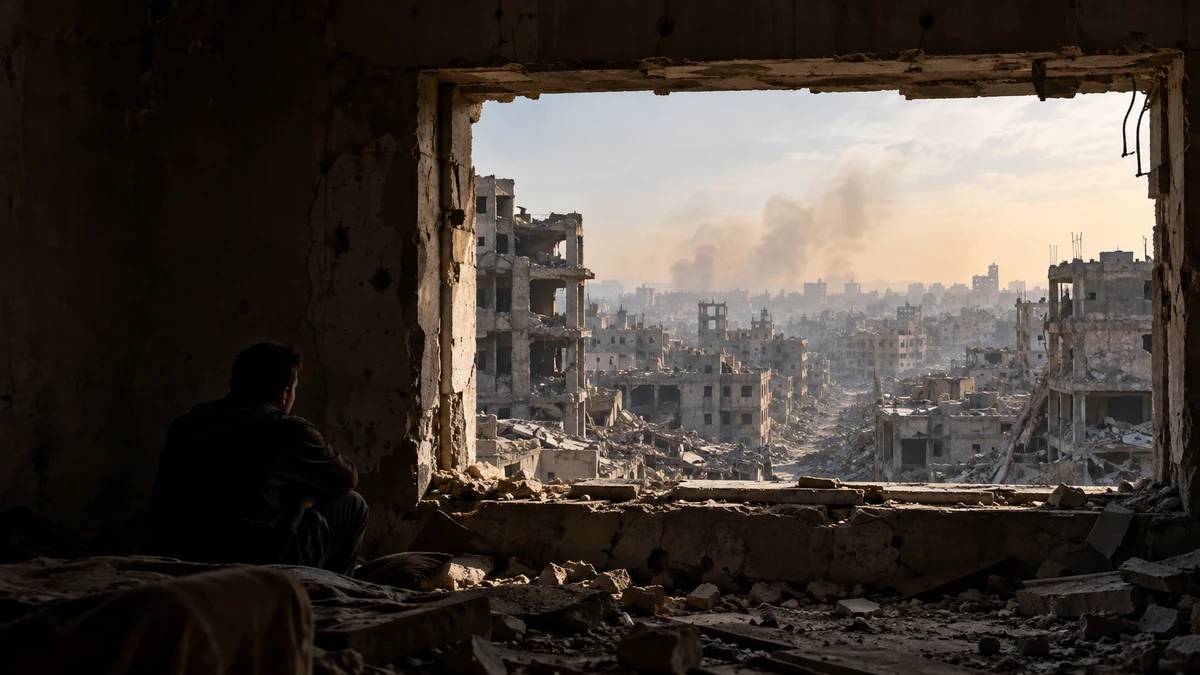
The same war can be seen as two different stories
On October 7, 2023, Hamas and other Palestinian armed groups carried out a large-scale attack on Israel. They killed civilians. Set homes on fire. Abducted people. A United Nations independent commission of inquiry later found reasonable grounds to conclude that Hamas and other Palestinian armed groups committed war crimes, including intentional attacks on civilians, murder, hostage-taking, inhumane treatment, and sexual violence. Israel responded with a military operation in Gaza whose scale in the months that followed exceeded all previous Israeli operations in the territory. Large parts of Gaza were destroyed. The population was repeatedly displaced.
Hospitals, water systems, schools, roads, and other civilian infrastructure were damaged or destroyed on a massive scale. Tens of thousands of people were killed. Hunger, shortages of medicine, and the collapse of basic systems became part of the war itself. Yet if we followed the same conflict only through two different information environments, we could end up with two almost irreconcilable realities. In the first, October 7 is the central point. Israel is a state that was attacked. Hamas is an organization that killed civilians and kidnapped hostages. The Israeli military is responding.
Civilian casualties in Gaza are a tragedy of war for which Hamas bears a large share of responsibility because it operates among the civilian population. In the second story, the central image is Gaza. Palestinians live under bombardment, mass displacement, destruction, and food shortages. Israel is not only a state defending itself, but a militarily far more powerful force that has controlled important aspects of Palestinian life for decades and is politically, financially, and militarily supported by the most powerful state in the world. Both stories contain real elements. The problem begins when one becomes the entire permissible story.
Where do we begin the story?
Every journalistic narrative needs a beginning. But the Israeli-Palestinian conflict has no single natural starting point.
Does it begin:
on October 7, 2023?
with the blockade of Gaza?
with Hamas's victory in Palestinian elections and its takeover of Gaza?
with the Second Intifada?
with the occupation in 1967?
with the establishment of Israel and the Palestinian Nakba in 1948?
with the British Mandate?
Choosing a starting point is not merely a historical question. It is a moral frame.
If the story begins on October 7, we get the structure:
attack → response.
If it begins decades earlier, we may get:
dispossession and occupation → resistance → repression → another cycle of violence.
No historical context justifies the intentional killing of civilians. But the absence of context can change the meaning of an event. When investigating crimes by both sides in 2024, the UN Commission explicitly warned that October 7 and the events that followed did not arise in a historical vacuum. At the same time, it stressed that violations by one side never justify violations by the other.
That is an important distinction:
context is not justification.
But without context, the response can begin to look like the beginning.
The word “war” already assigns roles
Even the name of the conflict says something.
Israel–Hamas war.
Israel–Gaza war.
Israel's war in Gaza.
Attack on Gaza.
War against Hamas.
Genocide in Gaza.
Each formulation selects a different subject. If we speak of the “Israel–Hamas war,” two political-military organizations are foregrounded. If we speak of the “Israel–Gaza war,” Gaza can begin to function as a belligerent side even though the overwhelming majority of its residents are civilians. If we speak of the “Israeli offensive in Gaza,” the actor behind individual military actions is named more clearly. If we speak of “genocide in Gaza,” we are using a highly specific legal and moral category. Language is therefore not decoration.
It determines:
who acts, who reacts, who causes, and who merely suffers.
Who kills, and who merely “dies”?
Compare:
Thirty Palestinians were killed in an Israeli attack.
with:
Thirty Palestinians died in Gaza.
The number is the same. But in the first sentence, there is an actor. In the second, the actor disappears.
The same applies in the other direction:
Hamas killed Israeli civilians.
is not the same as:
Israelis died on October 7.
Grammar can assign responsibility before the reader even reaches the second sentence. This does not mean a journalist should assign responsibility before it can be verified. The explosion at Al-Ahli Hospital in October 2023 showed precisely the opposite: some media outlets repeated initial claims of an Israeli strike too quickly and later had to revise headlines when conflicting evidence emerged.
The rule must therefore work in both directions:
where we know the actor, we do not hide it.
Where we do not know the actor, we do not invent one.
The key is not political neutrality. The key is verifiability.
Whose death gets a face?
One of the most powerful ways the media shape war requires not a single piece of false information. It is humanization. Compare:
a 32-year-old teacher and mother of two who loved playing the piano ...
with:
another 27 Palestinians were killed in the attack.
In the first case, a person died. In the second, a statistic. A peer-reviewed study by Mohamad Hamas Elmasry published in 2026 analyzed coverage by The New York Times and The Washington Post from 2023 to 2025 and found significant asymmetries favoring the Israeli side: Israeli victims were more often humanized, articles relied more heavily on Israeli sources, and Israeli use of force was often placed within a self-defense frame. But another peer-reviewed analysis, examining 1,559 New York Times articles from October 2023 through June 2024, reached a different conclusion.
Edieal Pinker found that after the initial Hamas attack the newspaper much more frequently depicted Palestinian suffering, while later Hamas involvement, Hamas losses, and continuing Palestinian violence received significantly less coverage. Personal stories of Palestinian suffering were very common in this analysis, while comparable Israeli stories were less frequent. This is not a reason to discard one study. It is a reason to abandon an overly simple concept of “bias.” A media outlet can be asymmetric in one direction along one dimension and in the opposite direction along another.
So the question should not simply be:
Is this outlet pro-Israeli or pro-Palestinian?
A better question is:
In what respect?
In source selection? In headlines? In the description of victims? In historical context? In the attribution of responsibility? In the choice of photographs? In legal terminology? That is how bias is measured rather than merely declared.
Who has the microphone?
War is not a communicatively equal space. A state has: ministries, an army, intelligence services, press officers, diplomats, briefings, satellite imagery, professional communications teams. Israel has a highly developed state and military communications infrastructure. The United States has an even larger one. When the Israeli military gives an explanation of an event, it can be repeated by U.S. officials minutes later and then summarized by the largest television networks and news agencies. A Palestinian civilian in a destroyed building has no comparable infrastructure. Their story must pass through a local camera operator, journalist, translator, international agency, and editor.
This does not mean an official Israeli source is wrong. But it does mean that one side of the conflict possesses an industrial infrastructure for producing and distributing information. And that is a form of power.
Gaza: a war foreign journalists cannot enter independently
Here we arrive at one of the most troubling facts of the entire war. Since October 7, 2023, Israel has not allowed foreign journalists independent entry into Gaza. Limited visits have been possible mainly through tightly controlled military embeds. In June 2026, the Israeli state again told its Supreme Court that it would maintain the ban on independent journalistic entry for security reasons. CPJ, the Foreign Press Association, Reporters Without Borders, and other organizations opposed the restriction and demanded independent access. This is not a marginal technical detail.
It means:
one of the belligerent parties controls whether an outside journalist can independently enter the territory that party is bombing.
A controlled military visit is not the same as independent journalism. On such a visit, a journalist sees: where the military takes them, when it takes them there, and under conditions defined by the military. That does not mean everything they see is false. But it does mean that they cannot independently choose the full terrain of their verification.
.jpg&width=1200)
When a person with a camera is killed, part of the documentation disappears too
Because foreign reporters could not enter independently, the world became heavily dependent on local Palestinian journalists and media workers. Those very people, however, were dying in numbers without historical precedent in the records of the Committee to Protect Journalists. Following an extensive review completed in September 2026, CPJ documented 247 journalists and media workers killed across Israel, Gaza, and related regional conflicts and attributed the great majority of those deaths to Israeli forces. During the review, CPJ removed some individuals previously included, reinstated others, and tightened verification — which gives the final number greater, not lesser, weight. This has a double effect. The first is human.
A journalist is dead. The second is informational.
The camera goes dark.
When a local reporter dies, a life is not the only thing lost. The person who could have documented the next attack the following day is also gone. In an environment where independent foreign journalists are not allowed to enter, this matters even more.

“Hamas-run Health Ministry” and the power of one adjective
In almost every report on Palestinian casualties, one formulation repeatedly appeared:
“according to Gaza's Hamas-run Health Ministry.”
The source of the data is, of course, important. But the label can serve two very different functions. The first is legitimate:
we tell the reader who collects the data.
The second is suggestive:
we imply that the data are politically compromised and therefore probably inflated.
But that second conclusion cannot be drawn from the political affiliation of the governing authority alone. In 2026, The Lancet Global Health published the first independent population-based mortality survey in Gaza. Using a representative sample of 2,000 households, researchers estimated approximately 75,200 violent deaths between October 7, 2023 and January 5, 2025. That was roughly 35 percent higher than the central official Health Ministry figure for a comparable period.
The authors explicitly wrote that their findings contradicted claims that the ministry inflated the death toll; according to their data, the official numbers were instead conservative or too low. This does not mean every daily list is infallible.
But it means something very specific:
“Hamas-run” is not a methodology for verifying data.
If we want to challenge a number, we need to show that the number is wrong. Politically labeling the institution that published it is not enough.
The United States is not an observer of this war
One of the most misleading ways to describe Gaza is to portray the United States as an outside mediator trying from a distance to calm two warring sides. That is not a complete description of the actual relationship. The United States is Israel's principal long-term military backer. In 2025, the Congressional Research Service calculated that from 1946 through 2025 the United States had provided Israel with approximately $175 billion in bilateral assistance and missile-defense funding in current dollars. In inflation-adjusted dollars, the total was substantially higher.
The current ten-year U.S.–Israel memorandum for 2019–2028 provides for $38 billion in security assistance: $33 billion in military financing and $5 billion for missile defense. When it was signed, the U.S. State Department described it as the largest military-assistance commitment to a single country in U.S. history. And after October 7, the assistance was not merely continued. It was increased. For fiscal year 2024, CRS reports approximately $12.5 billion in U.S. military aid and missile-defense funding for Israel, including the supplemental package passed by Congress in April 2024. This means the United States was not merely commenting on Israel's war.
It helped finance the military capabilities with which that war was fought.
Washington was sending ammunition while criticizing civilian casualties
The contrast between U.S. rhetoric and material policy was even clearer in December 2023. The Biden administration publicly spoke about the need to reduce civilian casualties. At the same time, U.S. Secretary of State Antony Blinken twice in one month used an emergency legal authority that allowed an immediate arms sale to Israel without the normal period of congressional review. On December 8, a sale of approximately $106.5 million in tank ammunition was approved. On December 29, another sale of approximately $147.5 million in equipment and ammunition for 155-mm artillery shells followed.
CRS explicitly describes both decisions as uses of emergency legal authority that waived the normal congressional review. The U.S. administration stressed that the law permits such an exception and that it expected Israel to comply with international humanitarian law.
But the political fact remains:
while Washington publicly called on Israel to reduce civilian casualties, it was simultaneously accelerating the delivery of ammunition for continued military operations.
This is not a contradiction the journalist must resolve for the reader. It is a contradiction the journalist must show.
.jpg&width=1200)
U.S. support was not only weapons
Material support was only half the story. The other half was diplomatic. By September 2025, the United States had used its veto six times in the UN Security Council on resolutions related to the war in Gaza. The latest of these called for an immediate, unconditional, and permanent ceasefire, the release of all hostages, and the removal of restrictions on humanitarian aid. The other 14 members of the Security Council voted in favor. Only the United States voted against.
Washington had already blocked similar resolutions in December 2023, February 2024, November 2024, and June 2025. Some called not only for a ceasefire but also for the unconditional release of hostages and humanitarian access. The U.S. position was that certain versions of a ceasefire would allow Hamas to survive, rearm, or separate an end to fighting from the release of hostages. That is a relevant explanation of U.S. policy.
But the vetoes also had a concrete effect:
they prevented those resolutions from being adopted.
The United States was therefore not only a state supplying Israel with weapons. At critical moments it also used its special institutional power in the Security Council to block international demands it opposed.
.jpg&width=1200)
But U.S. policy was not completely one-directional
Here too, the article must remain precise. In June 2024, it was the United States that drafted Resolution 2735, supporting a phased ceasefire and hostage-exchange plan; the Security Council adopted it by 14 votes in favor, with Russia abstaining. U.S. administrations also publicly criticized Israel over civilian casualties, humanitarian aid, and individual military decisions.
But this does not erase the other part of the record:
the criticism occurred at the same time as arming, financing, and repeated diplomatic protection of Israel.
The relationship must be seen in full. If a media outlet reports only a U.S. call to “protect civilians” without mentioning that the same country supplies weapons and blocks certain international measures, it is not giving the reader the full political context.
“Israel has the right to self-defense”
After October 7, one of the most frequently repeated political statements became:
Israel has the right to self-defense.
After a large-scale armed attack, the killing of civilians, and hostage-taking, it is understandable why this sentence became central to the Western political response. But the right to defense is not a right to unlimited force. International humanitarian law still requires: distinction between civilians and combatants, proportionality, precautions, protection of medical facilities, humanitarian access.
The sentence:
“Israel is defending itself”
may describe a state's political objective.
But it cannot answer the question:
is a particular attack lawful?
If “self-defense” is used as the answer to every question about civilian casualties, a legal and political concept becomes a rhetorical shield.
Hamas does not erase the laws of war
A similar problem appears with another frequently used explanation:
Hamas operates among civilians.
That is an important fact. Gaza is densely populated, and Hamas has placed military infrastructure within civilian environments as well. But the presence of a military target does not erase the civilians around it. International humanitarian law does not say:
if a combatant is among civilians, civilian protection ceases to apply.
We still have to ask:
What target was attacked?
How important was it?
How many civilian casualties were expected?
What alternatives existed?
What precautions were taken?
So the journalistic question:
“Was Hamas there?”
is not enough.
We must add:
“And what does that legally mean for this specific attack?”
When a legal word changes the entire story: genocide
The most explosive word in the debate over Gaza became:
genocide.
That is precisely why it requires the greatest precision. In December 2024, Amnesty International concluded after an extensive investigation that Israel had committed and was continuing genocide against Palestinians in Gaza. The organization analyzed killings, destruction of civilian infrastructure, forced displacement, restrictions on life-sustaining necessities, and statements by Israeli political and military officials. In September 2025, an even more institutionally significant finding was published by the Independent International Commission of Inquiry on the Occupied Palestinian Territory, including East Jerusalem, and Israel.
The Commission concluded that Israeli authorities and security forces in Gaza had committed four of the five acts listed in the Genocide Convention and that the required specific intent to destroy the Palestinian group in whole or in part was also present.
Its finding was direct:
Israel is responsible for committing genocide in Gaza and for failing to prevent and punish genocide.
For that reason, by 2026 it was no longer accurate to write only:
“critics of Israel speak of genocide”
or
“activists accuse Israel of genocide.”
Such formulations omit the fact that this is also the formal finding of an independent UN commission of inquiry and a major international human-rights organization.
But the ICJ has still not issued a final judgment
At the same time, it would be incorrect to write:
“The International Court of Justice ruled that Israel is committing genocide.”
It has not. In the case South Africa v. Israel, the ICJ ordered several sets of provisional measures under the Genocide Convention in 2024. The Court found that some rights of Palestinians under the Convention were sufficiently plausible to require provisional protection and that there was a risk of irreparable harm. But provisional measures are not a final judgment on the merits. On the ICJ's current case page there is no final judgment determining whether Israel bears legal responsibility for genocide; the latest listed procedural developments concern written pleadings and extensions of deadlines.
The following statements must therefore remain separate:
Amnesty International concluded that Israel is committing genocide.
The independent UN Commission concluded that Israel committed genocide.
The ICJ has not yet issued a final merits judgment on Israel's state responsibility for genocide.
All three statements are simultaneously true.
Israel rejects these findings
The Israeli government rejects the allegations of genocide. Its position is that the purpose of the war is to destroy Hamas's military capabilities and free the hostages, not to destroy Palestinians as a group. Israel points to Hamas's operations in civilian areas, warnings before attacks, evacuation measures, and humanitarian deliveries. Its representatives have described the UN Commission's conclusions as biased and politically motivated. That position must be included. But presenting Israel's denial does not mean both sides of the evidentiary dispute are automatically equally strong. The journalist's task is not:
one side says X, the other Y, therefore we know nothing.
The task is to show:
what evidence X has and what evidence Y has.
ICC: not an accusation against a state, but against individuals
Two institutions are often confused. The ICJ deals with disputes and the legal responsibility of states. The ICC deals with the criminal responsibility of individuals. In November 2024, the ICC issued arrest warrants for Israeli Prime Minister Benjamin Netanyahu and then-defense minister Yoav Gallant. According to the ICC's current record, both are still listed as at large with active warrants. The Court states that there are reasonable grounds to believe they bear responsibility for war crimes and crimes against humanity, including starvation as a method of warfare, intentionally directing an attack against the civilian population, murder, persecution, and other inhumane acts.
The ICC also issued a warrant for Hamas military commander Mohammed Deif for alleged war crimes and crimes against humanity; proceedings against him were terminated after his death was confirmed in 2025.
The same principle applies here:
the crimes of one side do not erase the responsibility of the other.
What does a “permissible image” mean?
The phrase can sound as if someone in a dark room decides what the world is allowed to see. Sometimes direct censorship does exist.
In Gaza there is a very concrete example:
independent journalistic access is restricted.
But most of the “permissible image” is created less spectacularly. It is shaped by: access, security, military rules, government sources, political alliances, editorial habits, language, photographs, algorithms, time, money, and the audience's existing assumptions. There does not have to be a single director. It is enough for the same filters to work in the same direction every day.
When the photograph outruns the editor
Gaza has also shown that traditional media no longer hold a monopoly over images of war. A Palestinian journalist can publish footage minutes after an attack. An Israeli soldier can publish their own video. A hostage's family can address millions of people directly. OSINT researchers can geolocate a video. Satellite imagery can reveal changes on the ground. The Reuters Institute documented how, in the absence of direct access, newsrooms used satellite imagery, open sources, geolocation, and local networks to verify events in Gaza. But more images do not automatically mean more truth. A video can be: real, old, from another country, cropped, misdescribed, or artificially generated.
The problem of the traditional media filter has therefore not disappeared. It has merely moved.
The greatest manipulation can be made entirely of true stories
Imagine two media outlets. The first reports every day on: Israeli hostages, October 7, Hamas tunnels, rockets, Israeli victims, and the security threat. All of those stories are true. The second reports every day on: Palestinian children, destroyed hospitals, hunger, displaced families, killed journalists, American weapons, and settlements. All of those stories can also be true. After a year, readers of the two outlets may be living in almost completely different moral worlds. Neither outlet had to invent a single news story.
It was enough to decide:
what deserves a headline every day.
That is agenda-setting.
To decide:
what context surrounds the event.
That is framing.
To decide:
who gets the microphone.
That is source selection.
To decide:
whose death gets a name and a photograph.
That is humanization.
To decide:
what remains outside the frame.
That is media power.
What must a serious media outlet do?
In a conflict this polarized, it is not enough to say:
“both sides claim something different.”
If a claim can be verified, it should be verified. If it cannot, its uncertainty must remain visible.
That means asking:
Who carried out the attack?
What is the evidence?
Who is the original source?
Is the source direct, or a political intermediary?
What is the methodology for counting casualties?
Did the legal institution really make the decision the article attributes to it?
Is the person accused or convicted?
Was the photograph geolocated?
Is the video complete or edited?
Who financed the weapons?
Who has access to the ground?
And above all:
who is missing from the story?
Objectivity is not a mathematical 50:50. Objectivity is the same evidentiary standard for all sides.
A person must remain a person even on the other side of the border
An Israeli child who lost their parents on October 7 is not a political symbol. Nor is a Palestinian child who died under rubble. An Israeli hostage is not merely an argument for continuing the war. A Palestinian mother looking for food is not merely an argument against it. When the media give one side: a name, a face, a family, an occupation, a history, a final phone call, and a future, while the other side gets only: a number, the moral map of the news has already changed.
The United States and Israel must not disappear from the sentence
One of the greatest dangers of media language appears when political and material responsibility is replaced by abstract formulations. “Fighting continues.” “People are dying in Gaza.” “The humanitarian situation is deteriorating.” Sometimes such sentences are justified.
But sometimes they conceal what matters most:
who is making the decision.
The Israeli government makes Israeli military decisions. The Israeli military conducts Israeli operations. Hamas makes Hamas's decisions. The United States makes decisions about American weapons, funding, and vetoes.
When responsibility is documented, it must not disappear behind words such as:
“tragedy,” “crisis,” or “developments.”
A natural disaster has no prime minister. A bomb has a chain of decision-making.
The permissible image of war is not necessarily what someone explicitly prohibited
Some things the public does not see because access is forbidden. Others because journalists are dead. Some because a newsroom has no one on the ground. Others because domestic politics grants greater legitimacy to a particular frame. Some stories have no photograph. Others have no institutional spokesperson. Some are incompatible with an already established narrative. And some are too uncomfortable for the political camp with which the audience identifies. The “permissible image” is therefore often not the product of a single censor. It is the sum of all the filters through which reality must pass before it becomes news.
What does Gaza show us about the media?
Gaza does not show us that we should believe one side. It shows why we must demand more from all sides. The documented crimes committed by Hamas on October 7 do not disappear because of later Israeli actions. The documented destruction of Gaza does not disappear because of Hamas's crimes. U.S. funding and arming of Israel are not theories. A U.S. veto is not an opinion. Restrictions on independent journalistic access are not a theory. The ICC warrants are not a political slogan. The UN Commission's genocide finding is not the same as a final ICJ judgment.
Israel's denial of genocidal intent is a documented state position. And an independent mortality study can show that an official casualty figure that was often discredited may even have been too low. All these facts can exist at the same time. Reality is large enough to contain several uncomfortable facts. Propaganda has to reduce them to a single story.
The question is therefore not “Whom should we believe?”
A better question is:
What can we prove?
Who is the original source? What document exists? What has been verified from several independent sources? Does the legal institution really say what the media outlet attributes to it? Is the figure a statistical estimate or a named list? Is a death attributed to a specific actor, or is the actor only assumed? Was a U.S. call to protect civilians accompanied by a change in U.S. arms-supply policy? Did criticism of the Israeli government also translate into political pressure on it? These are verifiable questions. And when we know the answer, we should write it clearly.
Sharpness is not the opposite of objectivity
Objectivity does not mean using softer words for the more powerful state. It does not mean weakening a documented fact merely so that it sounds politically balanced.
If Hamas kills civilians, we write:
Hamas killed civilians.
If Israeli forces kill a journalist and responsibility is documented, we write:
Israeli forces killed the journalist.
If the United States sends weapons, we write:
The United States sent weapons.
If the United States uses a veto, we write:
The United States blocked the resolution.
If a UN Commission finds genocide, we write:
The UN Commission found genocide.
If the ICJ has not yet issued a final judgment, we write that too. That is not activism. That is precise language. Sometimes reality itself is sharp enough.
And that is precisely why Gaza is a test of the media
In war, it is easy to be skeptical of the enemy. It is harder to be skeptical of an ally. Harder to scrutinize claims from a government your own state supports. Harder to humanize people whom domestic political language presents primarily as a security problem. And harder to acknowledge that a state can simultaneously be the victim of a grave attack and the perpetrator of grave violations. This is where the quality of journalism becomes visible. Not in whether it knows how to choose the correct side.
But in whether it is willing to apply the same standard even when the facts become uncomfortable for its own political environment.
The next question: when power needs a single message
In war, fragmented information is a problem for every authority. Different experts. Different data. Different interpretations. Different media. But under crisis conditions, authorities may decide that effective management of the population requires communicative unity.
One voice.
One message.
As few alternative interpretations as possible.
That logic does not appear only in war. It appears in public-health crises as well. And there the boundary between legitimate crisis communication and management of the information environment is especially sensitive. That will be the subject of the next article:
Sources and further reading
- Independent International Commission of Inquiry on the Occupied Palestinian Territory, including East Jerusalem, and Israel — documentation of the crimes of October 7 and subsequent actions by Israeli forces.
- Elmasry, M. H. (2026). Surrogate Ethnocentrism in U.S. Media Coverage of the 2023 to 2025 Israel–Gaza War. Journalism & Mass Communication Quarterly.
- Pinker, E. (2026). How the New York Times Framed the War Between Israel and Hamas. Studies in Conflict & Terrorism.
- Committee to Protect Journalists — documentation of the ban on independent journalistic access to Gaza and the September 2026 review of journalist deaths.
- Congressional Research Service. U.S. Foreign Aid to Israel: Overview and Developments since October 7, 2023. Data on approximately $175 billion in cumulative assistance, FY2024 support, and emergency arms sales.
- U.S. Department of State. Memorandum on $38 billion in security assistance to Israel for 2019–2028.
- United Nations Security Council — documentation of U.S. vetoes on Gaza-related resolutions, 2023–2025.
- The Lancet Global Health. Violent and non-violent death tolls for the Gaza conflict: new primary evidence from a population-representative field survey. 2026.
- Amnesty International. You Feel Like You Are Subhuman: Israel’s Genocide Against Palestinians in Gaza. 2024.
- Independent International Commission of Inquiry. Legal analysis of the conduct of Israel in Gaza pursuant to the Convention on the Prevention and Punishment of the Crime of Genocide. 2025.
- International Court of Justice. South Africa v. Israel. Procedural documentation and provisional measures.
- International Criminal Court. Situation in the State of Palestine. Current record of the warrants for Benjamin Netanyahu and Yoav Gallant.