The War We Do Not See: When the Journalist Becomes Part of the War
Embedded reporting, restricted access, and camera framing can create a misleadingly incomplete picture of war even without proof of deliberate censorship.
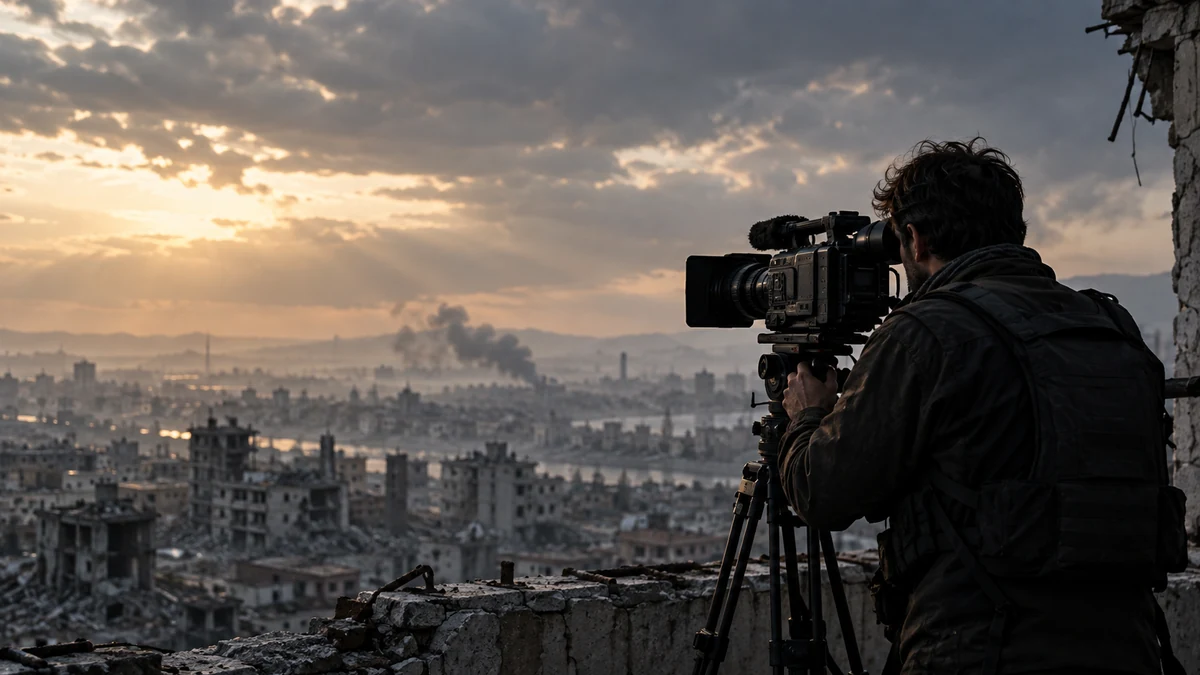
The camera can be on the battlefield and still fail to see the war
In the past, people sometimes learned about a war only weeks after a battle. A soldier's letter. A newspaper report. A photograph that first had to reach a newsroom. Today, a viewer can follow a column of armored vehicles almost live. The camera is mounted on a vehicle. A microphone captures an explosion. A correspondent ducks as a projectile passes overhead. The image travels by satellite into a living room on the other side of the world.
It can seem as if the distance between war and the audience has almost disappeared. But proximity is not the same as completeness. A journalist can be only a few meters from a battle and still see only a small part of what is happening. They may know almost everything about the ten soldiers around them and almost nothing about the family two streets away. They may see where their unit is firing from, but not where the shell lands.
They may hear the commander's radio traffic, but not the person whose house the unit will search five minutes later. War reporting therefore contains a paradox:
the closer a journalist gets to one part of the war, the easier it becomes to lose sight of the whole.
From locked doors to a journalist inside a tank
Before the 2003 invasion of Iraq, the U.S. military and the media had decades of conflict behind them over journalists' access to military operations. After the experience of Vietnam, the U.S. military generally restricted access much more tightly in some later conflicts. During the 1991 Gulf War, journalists were often dependent on organized press pools, military briefings, and controlled access.
In the first months of the war in Afghanistan in 2001, direct access to U.S. ground operations was also highly restricted. The Committee to Protect Journalists documented that the Pentagon only began allowing journalists access to some ground forces at the end of November, and that their reporting remained heavily restricted. Journalists at Camp Rhino complained that colleagues in Washington, through official briefings, sometimes learned important information about U.S. operations before reporters accompanying the units themselves. For Iraq, the Pentagon chose a different approach.
Instead of keeping journalists away from the military, it placed them inside it. At the start of the 2003 invasion, approximately 600 journalists were deployed with U.S. and British units. They lived with soldiers, traveled with them, and reported on operations directly from the field. The large-scale system of embedded journalism was born.

What did a journalist accept in exchange for access?
An embedded journalist did not become a soldier. They were not issued a weapon. They were not subordinated to a military commander in the same way as a member of the unit. But they had to accept rules. Those rules restricted publication of information that could reveal a unit's position, future operations, certain intelligence, tactics, precise troop numbers, or other information that could endanger soldiers and operations.
It is also important to note what the system generally did not provide for: routine prior approval of every journalistic report before publication. The problem of embedding therefore cannot simply be described as:
“The military writes the journalist's story.”
The more interesting mechanism is different:
the military helps define the environment within which the journalist is able to see and gather the story in the first place.
Looking through 600 straws
The program had major advantages. Journalists were close to events. They saw soldiers before and after battle. They heard their doubts. They saw fear. Mistakes. Death. Chaos. War was no longer merely a map at a general's briefing. But precisely this proximity creates the danger of the so-called “soda straw” view — looking through a narrow straw. A reporter has excellent insight into their own unit. Not necessarily into the entire battlefield. Every such straw reveals a real part of the war. But no single one shows the whole.
What did television actually see?
The Project for Excellence in Journalism analyzed 108 television reports by embedded journalists during three of the first six days of the U.S. invasion of Iraq. The result matters because it undermines an overly simple idea that embedded reporting was merely propaganda commentary. As many as 94 percent of the reports were predominantly factual. Journalists mostly described what they actually saw. But this is where the more important question begins.
What were they able to see?
Almost half of the analyzed reports described military action or its immediate results. A large share of the remaining coverage dealt with movements, preparations, and the operation of military units. That is logical. The journalist was with the military. So they primarily saw the war as the military saw it.
A war without the moment of death
In 21 percent of the analyzed reports, television footage showed weapons being used. In about half of those cases, viewers could see a non-human target, such as a building or vehicle, being hit. In the other half, viewers saw the firing, but not the result. In none of the 108 analyzed reports was there a direct depiction of a fired weapon striking, wounding, or killing a person. This creates an unusual television experience. A tank fires a shell. A cannon roars. A helicopter launches a missile. A building explodes in the distance.
The camera shakes. The reporter says the unit is under fire. The war looks dangerous, intense, and real. But the causal chain is often broken. We see:
weapon → explosion.
More rarely:
weapon → person → wound → death → family.
This is not necessarily the result of deliberate censorship. There are many reasons: newsroom ethical rules, the difficulty of filming, the chaos of combat, security, limited access, and decisions about how graphic the material shown to audiences should be. But the result matters.
The technology of war is often easier to show than its human consequences.
Who speaks?
The same study also examined which voices the audience actually heard. In 77 percent of the analyzed embedded reports, the reporter was the only person whose voice viewers heard. Officers were interviewed in 15 percent. Ordinary soldiers in eight percent. This does not mean the reporter was saying something false. But it does mean that the story was very often limited to what the reporter could see, hear, and understand inside the military environment. The Iraqi civilian outside that environment existed on the other side of the frame.
“If they're shooting at the soldiers, they're shooting at me”
Embedded journalism also contains a deeper psychological problem. Imagine sleeping for weeks with the same group of people. Eating with them. Talking with them about their children. When shooting starts, you take cover behind the same armored vehicle. The person next to you is wounded. Another helps you over a wall. A third may save your life. The attacker shooting at them may also be threatening you. Formally, you are still a journalist. Psychologically, you are no longer a completely external observer.
That does not mean an embedded journalist automatically loses professional integrity. It means that we ask something psychologically extraordinarily difficult of them:
to analyze the person who may be protecting them from death the next morning with the same distance as the person on the other side of the front.
Precisely because of this, an embed can also show what the military does not want shown
Here the story becomes more complicated. If an embedded journalist were merely a propaganda tool, we would never have seen some of the most important images of the war. In November 2004, the U.S. military was conducting a major offensive against Fallujah. Journalist Kevin Sites was embedded with U.S. Marines. In a mosque, his camera recorded a wounded Iraqi lying on the ground and a U.S. Marine shooting him. The footage spread around the world and triggered an official investigation.
This is one of the most important lessons of embedded journalism. The same system that restricts a journalist's perspective can bring them directly to an event that the military itself would not want appearing in global news coverage. Without the journalist's presence, the public might never have seen the scene. Embedded journalism therefore is not a simple relationship of:
the military controls the journalist.
It is more accurate to speak of a permanent tension between:
access and dependence.
Fallujah: exceptional proximity, an almost blind whole
The Second Battle of Fallujah in November 2004 is almost a perfect laboratory for this problem. Security conditions were so dangerous that many Western journalists outside military units had very limited freedom of movement. Some local Iraqi journalists and collaborators remained closer to the city, but for many international newsrooms embedding became one of the few ways to get a reporter directly into the area of operations. BBC reporter Paul Wood was embedded with U.S. Marines. His access was extraordinary. He attended a sensitive pre-battle briefing. He saw combat up close.
He spoke with Marines immediately after fighting. But he described his central limitation very clearly:
an embedded reporter sees what their unit sees.
When he wanted to know what was happening to the civilians of Fallujah, he simply could not leave the unit and go find them. That is almost a perfect definition of the problem. A journalist can produce an extraordinarily precise report about the street in front of them. But they do not necessarily know what is happening ten streets away.
What did we hardly see during Fallujah?
Fallujah was not an empty military zone. Many residents left the city before the major U.S. offensive, but not everyone could or wanted to leave. Yet because of the security situation, international images from the battlefield itself were largely tied to journalists accompanying military units. This created an imbalance. We could obtain very direct information about military movements. We had far less information about how civilians experienced the operation in areas without independent journalistic access. That does not prove a deliberate effort to conceal civilian consequences.
But we do not need to prove deliberate censorship in order to conclude that the resulting media picture can be misleadingly incomplete. Intent becomes decisive only if we want to claim that someone knowingly concealed civilian consequences. But it demonstrates something broader:
if journalists physically cannot reach a particular group of people, that group's part of the war begins to disappear from the media picture.
Invisibility can result from censorship. But it can also result from danger. Logistics. Language. Money. Newsroom decisions. For the viewer, the final effect is the same:
they see less of that part of the war.

When the state also defines the language
During the Fallujah offensive, the Committee to Protect Journalists documented another form of influence on reporting. In 2004, the Iraqi media commission sent newsrooms instructions about how to describe events and distinguish between civilians and groups the government classified as criminal or insurgent. Media outlets were also warned that failure to follow the guidelines could have consequences. Here we are no longer dealing only with physical access. We arrive at the question:
who defines the vocabulary of war?
Insurgent. Terrorist. Guerrilla. Fighter. Liberator. Militant. The same person can become several different political figures in different media. Even before describing an action, the word tells the audience how to understand the person.
Firdos Square: a camera can change the size of an event
One of the most famous images from the invasion of Iraq is the fall of Saddam Hussein's statue in Baghdad's Firdos Square on April 9, 2003. Iraqis really did try to bring the statue down. Some clearly celebrated Saddam's fall. U.S. Marines then helped pull the statue down with an armored vehicle. The event was real. But the camera created something additional.
The square was directly beside the Palestine Hotel, where a large number of international journalists were concentrated. As a result, the event was exceptionally well documented and broadcast live around the world. Later reconstructions described it as an event involving a relatively small crowd in a large square that acquired enormous symbolic significance because of its location in front of the world's cameras. That is the essential lesson. The camera did not need to fake anything. The event was real.
But a tight shot of the crowd and the statue can create a different impression than a wide view of the entire square.

When one event becomes the whole war
Footage of the statue being toppled was repeated many times that day. A later analysis stated that, during a particular period, Fox News aired the footage roughly every 4.4 minutes and CNN roughly every 7.5 minutes. Repetition gave the event a meaning that extended far beyond the square itself. Saddam has fallen. Iraqis are celebrating. The regime is finished. The war has achieved its objective. But the war did not end that day.
Fighting continued, the insurgency was only beginning to develop, and Saddam Hussein was not captured until months later. One real event thus became a symbol of the entire conflict because it was visually powerful, easy to understand, and directly in front of the world's cameras.
When most of the story is still about us
By 2007, the Project for Excellence in Journalism had analyzed more than a thousand U.S. stories about Iraq. In the first three months of 2007, approximately 84 percent of U.S. coverage of the Iraq war focused primarily on Americans — U.S. political debate, U.S. troops, or other American aspects of the war. Only about 16 percent of coverage focused mainly on Iraqis. This does not mean U.S. media consciously decided to ignore Iraqis. An American media outlet has an American audience. U.S. political debate matters to it.
It has better access to U.S. officials and soldiers. But the consequence still matters:
for an American audience, the war in Iraq could become primarily a story about America.
The war outside the frame
On the same day that the world watches spectacular images of military advances, less photogenic things are happening elsewhere. A hospital receives the wounded. A family searches for a missing relative. The electrical grid is down. There is no water. A child is afraid of the sound of aircraft. Someone has lost their home. Someone is trying to find out who is lying in the morgue. None of this is less real than a tank. But the tank has a press officer, a communications system, and a camera traveling with it.
A civilian often has none of those things. This creates an asymmetry of visibility. The military has maps. Briefings. Satellite imagery. Missile videos. Camera crews. A civilian has their story. And often needs a journalist to physically reach them. If that journalist cannot get there, the story can almost disappear.
Afghanistan: when access itself became a battlefield
The problem was not limited to Iraq. During the first months of the U.S. war in Afghanistan in 2001, access to military operations was heavily restricted. The Taliban restricted the work of foreign journalists, but in some cases the U.S. military also prevented direct reporting. On December 5, 2001, a misdirected U.S. bomb killed three U.S. special-forces soldiers and five Afghan anti-Taliban fighters.
Journalists at Camp Rhino were locked in a warehouse while the wounded arrived and were taken out of Afghanistan that same night. After protests, the Pentagon acknowledged that the matter had not been handled properly. In war, therefore, it is not enough to ask:
What is true?
We must also ask:
Who is allowed to get close enough to verify it?
When the camera is attacked too
A journalist in war is not only an observer. They can become a victim. On April 8, 2003, a U.S. tank fired a shell at the Palestine Hotel in Baghdad, where approximately one hundred international journalists were staying. Reuters cameraman Taras Protsyuk and Spanish cameraman José Couso were killed, and three other journalists were wounded.
After its own investigation, the Committee to Protect Journalists concluded that according to the available evidence the attack was not deliberate, but could have been prevented. Pentagon officials and senior commanders knew that the hotel was full of international journalists, but that information apparently did not reach the tank crew in time. CPJ also found no evidence supporting the initial official claim that the U.S. tank was returning direct hostile fire from the hotel. That is an important distinction.
We do not need a theory of a deliberate attack on journalists for the incident to demonstrate the danger of informational chaos on a battlefield.
Al Jazeera: a known location, an unexplained attack
On the same day, a U.S. missile also struck Al Jazeera's Baghdad bureau and killed journalist Tareq Ayyoub. Before the war began, Al Jazeera had provided the Pentagon with the precise coordinates of its office. U.S. command said American forces were responding to hostile fire in the area, while Al Jazeera journalists denied that fire had come from their building. CPJ later reported that the U.S. military did not conduct any publicly known investigation of the attack.
The case therefore cannot fairly be closed with a certain answer about intent. But we can say something else:
the location of the media office had been provided to U.S. authorities in advance, a journalist was killed, and the circumstances of the attack were not satisfactorily clarified through a public investigation.
Where have the most journalists been killed?
The death of a journalist in a war zone does not necessarily mean they were intentionally targeted because of their work. They may die in crossfire. In an air strike. While carrying out a dangerous assignment. Or they may be deliberately murdered. That is why CPJ distinguishes between the circumstances of death in its records and verifies cases with at least two independent sources. It may also later correct or remove a case if new evidence appears.
The following table therefore is not a simple “ranking of armies that kill journalists.” It presents several major contemporary conflicts and what the available data actually allow us to say about responsibility.
| Conflict or area | Period | Documented number | What we know about responsibility |
|---|---|---|---|
| Israel–Gaza and related regional conflicts | 2023–2026 | 247 journalists and media workers | Following its September 2026 review, CPJ attributes 241 deaths to Israeli forces. Four Israeli journalists or media workers were killed by Hamas, one Palestinian journalist by an armed group in Gaza, and one death in Iran occurred in a joint U.S.–Israeli strike. |
| Iraq | 2003–2011 | 150 journalists + 54 media support workers | In a detailed analysis of journalist deaths through October 2009, CPJ attributed 105 cases to insurgents or other armed groups, 16 to U.S. fire, four to Iraqi armed forces, while responsibility in 14 cases was unconfirmed. CPJ found no evidence in the U.S.-attributed cases that journalists had been deliberately targeted. |
| Syria | mainly 2011–2023 | 157 journalists and media workers in CPJ's broader record through 2023 | Perpetrators came from multiple sides of the conflict. CPJ documented deaths caused by Syrian government forces, opposition armed groups, Islamic State, and crossfire; it does not publish one simple final perpetrator breakdown for the entire war. |
| Afghanistan | since 2001 | 65 journalists and media workers | Perpetrators included the Taliban, Islamic State, and other armed actors; individual journalists also died in combat and attacks where responsibility cannot always be assigned to a single perpetrator. |
| Wars in the Balkans | 1991–1995 | 36 journalists in an older comparative CPJ record | They died in different parts of the Yugoslav wars and at the hands of multiple belligerents. The older CPJ review does not provide a comparable comprehensive perpetrator breakdown. |
| Russian invasion of Ukraine | 2022–February 2026 | 23 journalists and media workers | CPJ does not attribute all 23 deaths to a single perpetrator. It did, however, document four journalist deaths in Ukraine in 2025 and attributed all four to Russian military drones. |
These figures cannot be read as a perfectly uniform statistical series. Over the decades, CPJ has changed and improved its data systems. Some older records count only journalists, while newer ones also include media workers. In contemporary conflicts, individual cases remain under review until researchers have sufficient evidence. But the overall picture is still striking. Iraq was long regarded as the deadliest modern war for journalists in CPJ's records. In 2013, the organization stated that at least 150 journalists and 54 media support workers had been killed during the war.
Today, CPJ documents 247 dead journalists and media workers in Israel–Gaza and related regional conflicts, describing this conflict cluster as the deadliest it has ever documented for the press. This tells us more than how dangerous war is. It also tells us how quickly we can lose the people on whom our knowledge of war depends.
When the camera cannot enter, the local journalist becomes the world's eyes
Gaza represents an especially extreme case of the problem discussed throughout this article. Since October 7, 2023, Israeli authorities have not allowed international journalists independent entry into Gaza. Some foreign journalists have been permitted to enter only on limited, controlled visits accompanied by the Israeli military. Israel has justified the restriction on security and military grounds. The Foreign Press Association, CPJ, Reporters Without Borders, and other journalistic organizations have called for the ban to be lifted, stressing that military-organized visits cannot substitute for independent journalistic access. In September 2026, CPJ was still reporting that independent entry into Gaza was unavailable.
The consequence is extraordinary. If a foreign correspondent cannot enter, the world must obtain information from inside the war zone primarily from people who are already there. Palestinian journalists. Photographers. Camera operators. Local collaborators working for international agencies. These are people who do not report on the war from a hotel hundreds of kilometers away. They live inside it. Their families are there. Their homes are there. They are simultaneously journalists and residents of an area under bombardment.
In September 2026, following an extensive internal review and an external audit of its data, CPJ still found that Israeli forces were responsible for the great majority of documented deaths of journalists and media workers in this conflict and related regional fighting. During the review, the organization re-examined 229 deaths, removed some individuals who no longer met its criteria under the new evidence, and reinstated or reclassified others. This also matters for the question of verification.
CPJ acknowledged that because independent entry into Gaza was prohibited, its external researchers could not carry out normal field verification. Researchers therefore used the published work of deceased journalists, their public records, photographs, video, and testimony from people who knew them, and in new disputed cases attempted to obtain at least two additional sources. A paradox therefore emerges:
restrictions on access make independent verification more difficult, while simultaneously increasing the world's dependence on local journalists — precisely the people who are among the most endangered in the entire conflict. When a local journalist dies, the world does not lose only a person. It also loses eyes on the ground. The article on Israel and Gaza will examine this problem in much greater detail. Here, it matters above all because of the general principle:
without access there is no independent observation, and without journalists on the ground what remains is primarily information from the belligerent sides.

Independent or alive?
In Iraq, the security environment deteriorated so severely after 2003 that independent movement around the country became extremely dangerous for many foreign journalists. Kidnappings. Murders. Explosions. Checkpoints. Armed groups. As a result, embedding often became less a matter of editorial preference and more a matter of safety. By 2007, 85 percent of the journalists in a Pew survey had used embedding.
Most did not view it primarily as a Pentagon tool for controlling coverage. Sixty percent said its main benefit was enabling access to places and people they otherwise could not reach. But the same journalists understood its other side very well. Some noted that they went where the military allowed them to go. That the presence of soldiers changed the behavior of Iraqi interviewees. That access to U.S. units was far easier than access to insurgents. Embedding was a double-edged sword.
Whom did we get to know best?
When researchers in 2007 asked journalists what the media had covered best in Iraq, the answer was very clear. 82 percent rated coverage of U.S. troops as good or excellent. By contrast, 62 percent rated coverage of the lives of ordinary Iraqis as only fair or poor. Among journalists who identified the most undercovered story, the largest number pointed specifically to the impact of the war on Iraqi civilians. That is almost a perfect summary of the problem.
We learned the most about the people to whom the media infrastructure had the best access. We learned less about those who were harder, more dangerous, and more expensive to reach. No conspiracy is required. The geography of access is enough.
Visible and invisible victims
Every war creates a hierarchy of visibility. When a domestic soldier dies, the media often know their name. Photograph. Age. Town. Family. School. Children. When a civilian dies on the other side of the world, they may become only a number. This is not necessarily the result of a conscious decision that one life is worth more. A domestic media outlet can much more easily reach the family of a domestic soldier. It speaks the same language. Knows the community. The death directly affects its audience. But the result remains:
one death becomes a person, another a statistic.
If this happens a thousand times, the war begins to acquire a very specific moral geography for the audience. Faces on one side. Numbers on the other.
Is the solution to abolish embedded journalism?
No. That could even make the situation worse. Without embedded journalists, the public would not have received many important reports from the field. It would not have seen the fear of ordinary soldiers. Mistakes. Chaos. In some cases, even conduct that triggered investigations. The embedded system gave the public considerably more direct access to U.S. military operations than press-pool systems during the 1991 Gulf War or the highly restricted access during the first months of Afghanistan. So the problem is not:
that an embedded journalist exists.
The problem arises when:
we mistake their view for a view of the entire war.
The real solution is more eyes
To understand a war, we need multiple perspectives at once. An embedded journalist. An independent reporter outside the military. A local journalist. Civilians. Doctors. Humanitarian organizations. Satellite imagery. Documents. The opposing belligerent. And time for verification. No perspective is perfect. The military has its interests. Insurgents have theirs. A civilian sees only their immediate experience. An activist has their beliefs. A journalist has limitations. But when we compare perspectives, a broader picture begins to emerge. This is a basic principle of good journalism:
do not trust a single window merely because the view through it is exceptionally clear.
The camera does not lie — but the frame selects
This may be the most important lesson of war reporting. A photograph can be authentic. A video can be real. The journalist can be honest. The soldier genuinely frightened. The explosion real. The crowd real. And yet the viewer can still receive an incomplete picture of the event. Not because someone necessarily lied to them. But if a newsroom presents such a limited frame as a sufficiently complete picture of the war while withholding the limits of access, this is no longer merely incompleteness. It is a misleading presentation.
But because they did not see: what was to the left of the camera, what was to the right, what happened five minutes earlier, what was happening ten streets away, and who could not reach the scene at all. So in war, the question:
“Is the footage authentic?”
is only the beginning. We must also ask:
Who recorded it?
From where?
Who were they traveling with?
Who gave them access?
Where could they not go?
Who did not get a camera?
What happened outside the frame?
The war we do not see
The paradox of modern war reporting is that we can watch more war than any generation before us and still see only a selected part of it. We have live broadcasts. Satellite imagery. Drone footage. Helmet cameras. Mobile phones. Social media. But more images do not automatically mean more context. Sometimes they mean only more fragments. If we do not understand who selected them and from what position they were produced, a flood of images can create the feeling of complete insight where in reality none exists.
In the previous article we saw how consent for war is created. Once war begins, the next question emerges:
whose war will we watch?
The answer is often simple. The one the camera can reach. And that is why the war that looks most real on television is not necessarily the whole war. It is its visible part.
Sources and further reading
- Project for Excellence in Journalism / Pew Research Center. Embedded Reporters. Analysis of 108 television reports by embedded journalists during the first days of the invasion of Iraq.
- U.S. Army War College, Center for Strategic Leadership. Reporters on the Ground: The Military and the Media's Joint Experience During Operation Iraqi Freedom. On rules, access, and the limitation of a narrow view of the battlefield.
- Pew Research Center. Journalists in Iraq – A Survey of Reporters on the Front Lines. Survey of journalists with experience reporting from Iraq.
- Pew Research Center. The Portrait from Iraq – How the Press Has Covered Events on the Ground. On the U.S.-centered focus of coverage and the undercoverage of everyday Iraqi life.
- Committee to Protect Journalists. Documentation on Afghanistan, Camp Rhino, restrictions on access, and journalist deaths.
- Committee to Protect Journalists. Permission to Fire? Investigation of the tank attack on the Palestine Hotel in Baghdad.
- Committee to Protect Journalists. Documentation of the death of Tareq Ayyoub and the attack on Al Jazeera's Baghdad bureau.
- Committee to Protect Journalists. Iraq war and news media: A look inside the death toll and the statistical review Iraq: Journalists in Danger.
- Committee to Protect Journalists. Database of journalist and media-worker deaths in Syria.
- Committee to Protect Journalists. Current Afghanistan documentation: 65 journalists and media workers killed since 2001 in connection with their work.
- Committee to Protect Journalists. Documentation of journalists killed during the Russian invasion of Ukraine.
- Committee to Protect Journalists. Journalist casualties during the Israel–Gaza war and related regional conflicts. Updated record following the September 2026 review.
- Committee to Protect Journalists. CPJ completes review of journalists killed in Israel and the Occupied Palestinian Territory. September 2026.
- Committee to Protect Journalists. Documentation and legal proceedings concerning Israel's ban on independent access by foreign journalists to Gaza.
- Committee to Protect Journalists. Data Methodology and FAQs. Methodology for verification, categorization, and subsequent correction of cases.