Slovenian Media and the War in Ukraine: Who Speaks and Whom Do We Believe?
From predictions of rapid Russian collapse to Snake Island and casualties: how sourcing, uncertainty, and headlines can turn wartime claims into apparent facts.

If we had spent four years reading mainly headlines
Most people do not follow the war in Ukraine directly. They do not check daily military reports from both sides, satellite imagery, primary documents, or statements in the original language. They receive events already selected, translated, summarized, and given a headline. That is precisely why the headline matters. Since February 2022, a Slovenian reader could have encountered, among others:
| Date | Media outlet | Headline |
|---|---|---|
| 26 Feb 2022 | Siol | “Putin expected the war to be over in no more than four days” |
| 1 Mar 2022 | Siol | “The Russians are running out of food, fuel, and the will to fight” |
| 8 Mar 2022 | Siol | “Russia will most likely go bankrupt on April 15” |
| 15 Mar 2022 | 24ur | “Retired U.S. general: Russia will exhaust its combat capabilities in ten days” |
| 23 May 2022 | Slovenske novice | “British spy: Putin will leave power this year, a sanatorium awaits him” |
| 1 Jun 2022 | Siol | “His time is running out. Doctors give Putin three more years to live.” |
| 3 Jun 2022 | N1 | “What U.S. intelligence revealed about Putin's health and assassination attempt” |
| 15 Jun 2022 | Slovenske novice | “Are Putin's days numbered? He predicted the date of his death” |
| 1 Mar 2023 | Siol | “Military expert predicts: Ukraine will defeat Russia in October this year” |
| 19 Feb 2024 | Siol | “Putin's days are numbered” |
Each story has its own source and context. But someone who follows mainly headlines can form a fairly simple overall picture from their accumulation:
The Russians are running out. The Russian military is on the verge of exhaustion. The Russian economy will collapse. Ukraine will soon win. Putin will lose power or die.
More than four years later, it makes sense to examine how such an impression was created.
When “could” becomes “will”
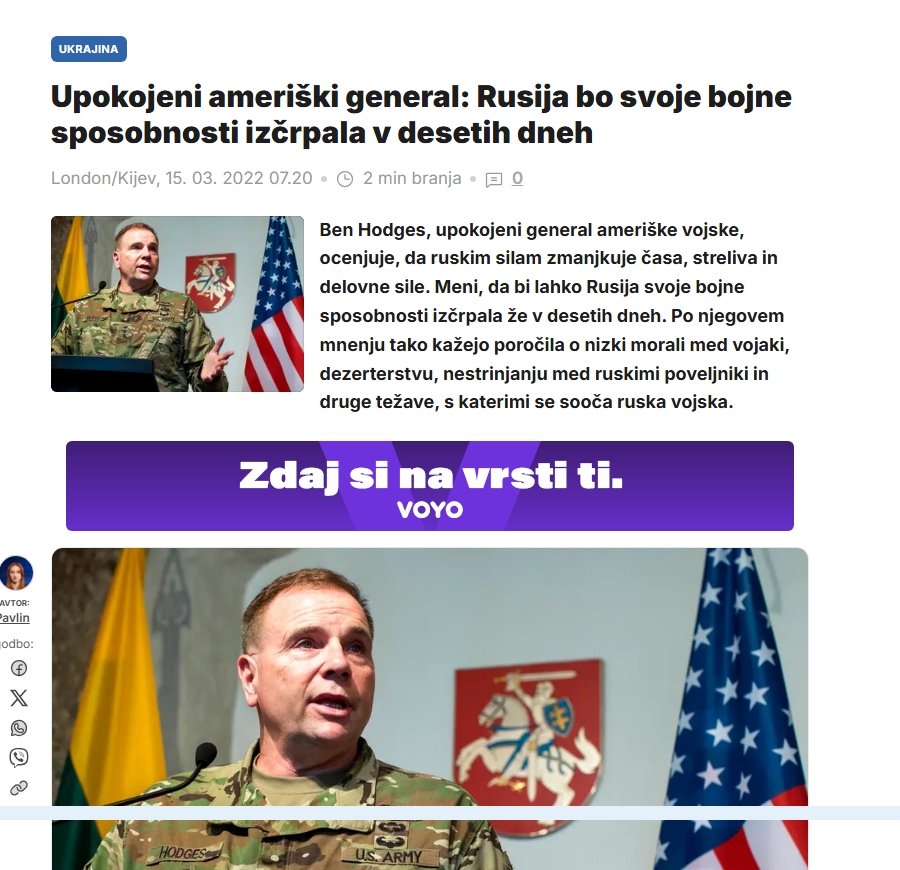
Perhaps the cleanest example is a 24ur article from March 15, 2022. The headline says:
“Russia will exhaust its combat capabilities in ten days.”
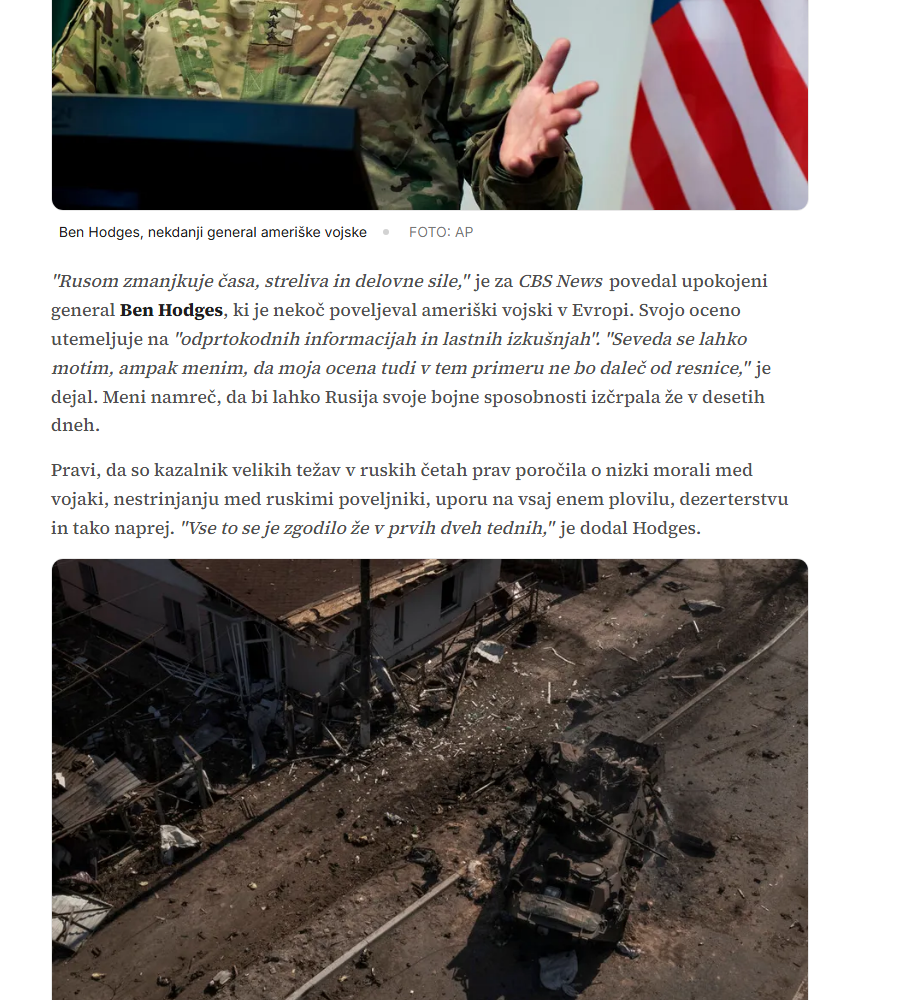
But in the article, retired U.S. general Ben Hodges estimates that Russia could exhaust its combat capabilities in ten days. He also adds that he may be wrong. Between the source and the headline, a small change occurred:
could → will
Grammatically, almost a detail. Semantically, it is not. A possibility became a far more categorical prediction. Ten days later, Russia had not exhausted its combat capabilities in the sense of being unable to continue the war. That does not mean Hodges had failed to identify serious Russian logistical problems at the time. It means something much simpler:
the headline was more certain than the source.
From “some units” to “the Russians”
A similar process can be seen in Siol's headline:
“The Russians are running out of food, fuel, and the will to fight.”
Reports of logistical problems in the Russian military during the first weeks of the conflict had a real basis. But when it came to morale, the publicly presented U.S. assessment was narrower: problems were reportedly being observed in some units. The headline, however, becomes:
“The Russians are running out of the will to fight.”
Some units become “the Russians.” The claim is not necessarily completely invented. But its scope changed.
How do we know what Putin expected?
On February 26, 2022, Siol published:
“Putin expected the war to be over in no more than four days.”
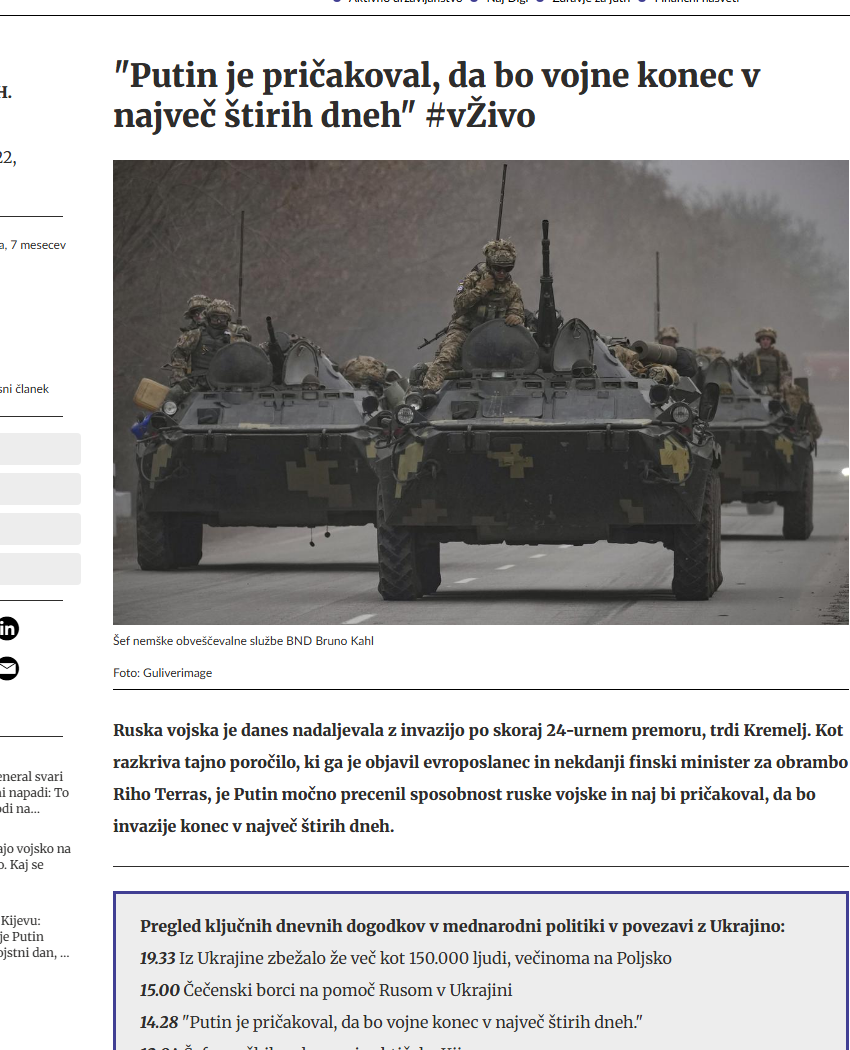
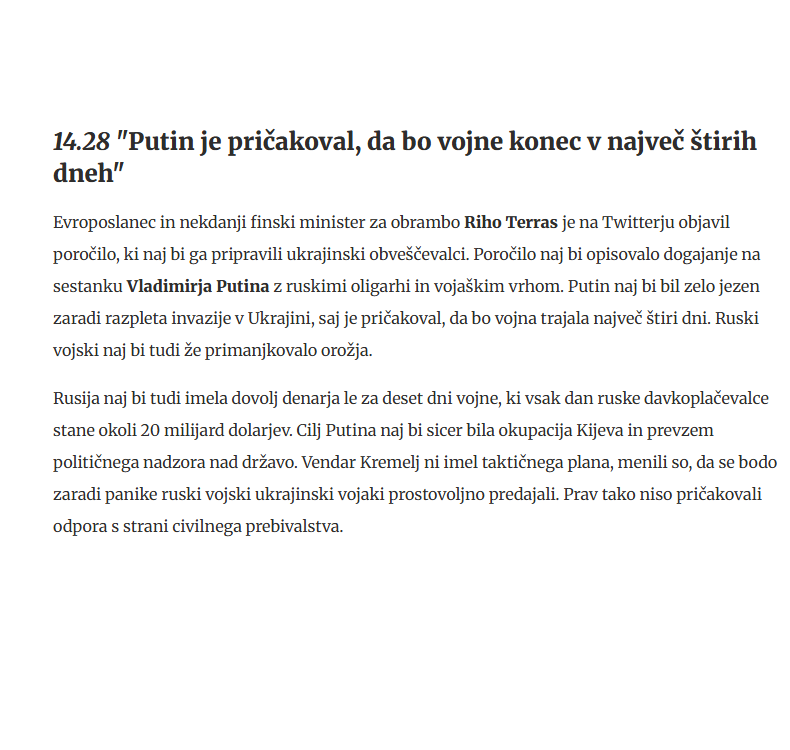
When we open the article, the evidentiary chain becomes far less direct. Riho Terras published a report supposedly prepared by Ukrainian intelligence. According to it, Putin expected the war to be over within no more than four days. The same bundle of claims also included statements about weapons shortages, high daily costs, and a limited period during which Russia would supposedly be able to continue the war.
The chain was roughly:
alleged Ukrainian intelligence information → European politician → social network → Slovenian media outlet → “Putin expected”
The article contains “reportedly.” The headline removes it. We cannot know what Putin privately expected. That is exactly why a journalist should not erase the difference between:
“a source claims that he reportedly...”
and:
“Putin did...”
Siol also incorrectly described Riho Terras as a former Finnish defense minister. Terras is Estonian, a former commander of the Estonian Defence Forces and a Member of the European Parliament. This is a small biographical error, but in an article already based on a multi-stage source chain, it is symptomatic.
Bankruptcy with an exact date
On March 8, 2022, Siol published:
“Russia will most likely go bankrupt on April 15.”
Behind the story was a Morgan Stanley analysis of the possibility of a Russian sovereign default on external debt as certain bonds came due. That is substantially more complex than the everyday meaning of the sentence:
Russia will go bankrupt.
A financial scenario acquired a country, an event, and an exact date. The headline was not without basis and retained the words “most likely,” but it simplified a technical financial problem into a far more dramatic everyday image.
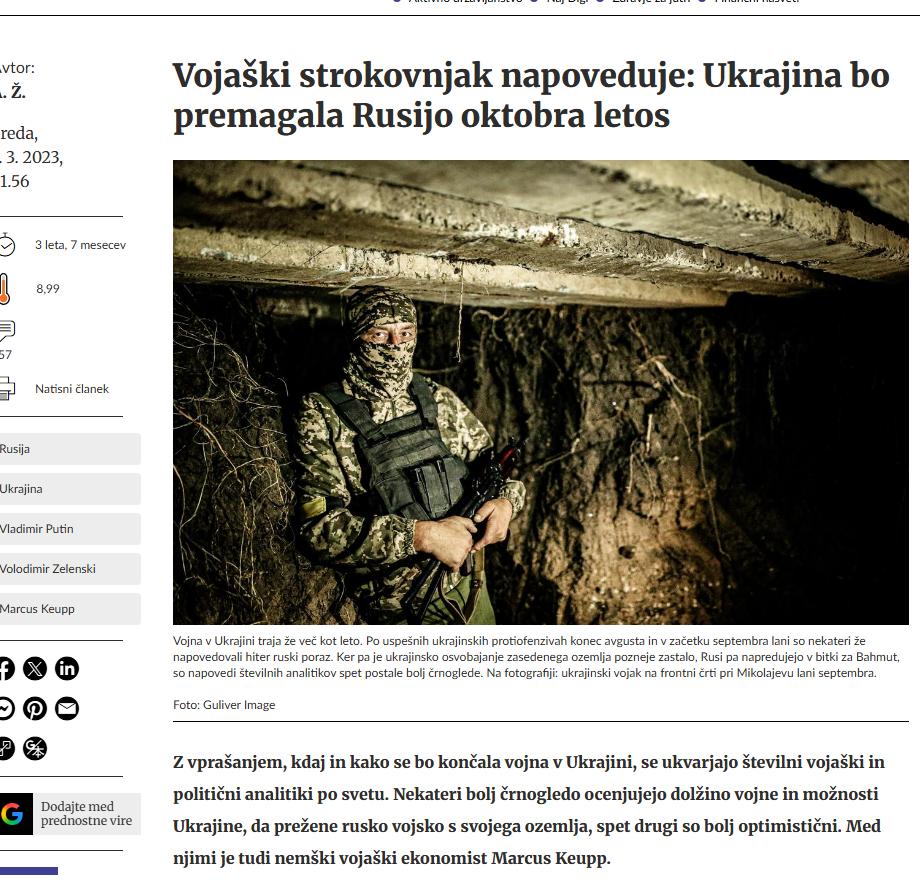
“Ukraine will defeat Russia in October”
In March 2023, Siol published another very specific prediction:
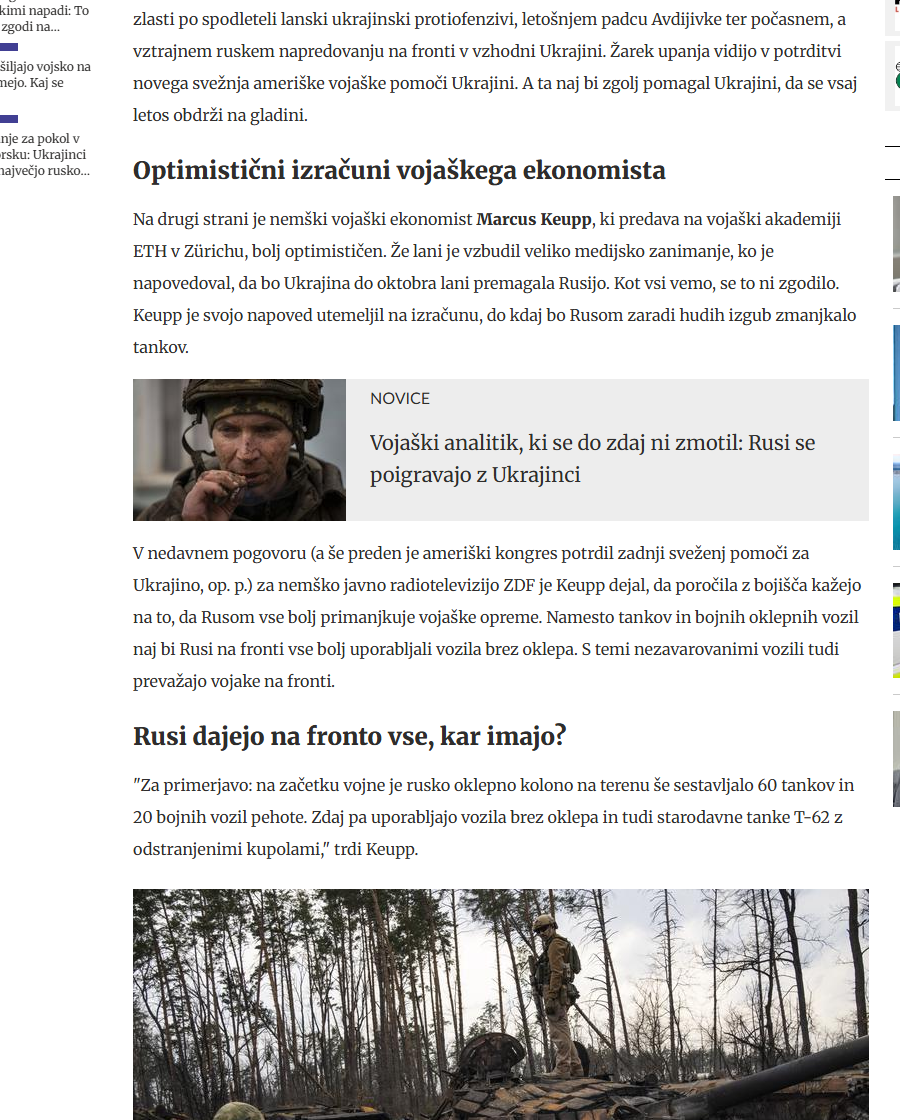
“Military expert predicts: Ukraine will defeat Russia in October this year.”
German military economist Marcus Keupp inferred from Russian losses that it was possible to calculate when Russia would run out of weapons and predicted a Ukrainian victory in October 2023. The prediction did not come true. In this case, the Slovenian outlet did not distort Keupp's basic claim. The expert really did say it. But that is precisely why the example raises a different question:
why are highly categorical and dramatic predictions so attractive as headlines, while their later failure usually receives far less attention?
In 2024, when reporting a new Keupp analysis, Siol itself noted that the earlier prediction had not come true. That was appropriate. But the original headline and the later correction do not necessarily have the same reach or memory effect.
What happens when the information comes from Russia?
Russian official sources must be checked. Russia is a belligerent party and uses propaganda, selective reporting, and information operations. But it does not follow that:
Russian source = falsehood.
Just as it is not true that:
Ukrainian source = truth
or:
Western intelligence service = independently confirmed fact.
Several examples make this very clear.
Azov, Bandera, and “denazification”: what is fact and what is political expansion?
One of Russia's central arguments is the presence of far-right and neo-Nazi elements in Ukraine. Across much of the Western public sphere, after February 2022 this subject was often treated primarily through the frame of Russian propaganda. The difficulty is that two things can be true at the same time:
Russia can instrumentalize the problem and greatly exaggerate its scale.
And:
that does not make the problem imaginary.

Azov is not a Russian invention
The original Azov Battalion was formed in 2014. Reuters and research institutions describe its origins as having far-right or ultranationalist roots. The unit was later reorganized and incorporated into Ukraine's National Guard. In a 2026 analysis, Poland's Centre for Eastern Studies, OSW, states that the core of the original Azov consisted of personnel from far-right circles and football ultras. The movement used symbols also associated with the European far right, while later leadership rejected the interpretation that the symbols indicated allegiance to the Third Reich.
Its institutional trajectory also matters. Structures that emerged from the Azov environment now hold an important place in Ukraine's defense system; some commanders have advanced to senior positions. This does not mean:
“the Ukrainian military is neo-Nazi.”
It does mean:
the claim that far-right structures from the Azov milieu acquired an institutional place in Ukraine's security system is not a Russian invention.
Who are the “Banderites”?
Historically, the term refers primarily to members or supporters of the OUN-B faction associated with Stepan Bandera. OUN-B was a radical nationalist movement. Before Germany's attack on the Soviet Union, part of the movement cooperated with the Germans in the expectation that the war would enable the creation of an independent Ukrainian state. The United States Holocaust Memorial Museum documents the participation of OUN activists in anti-Jewish violence in Lviv in 1941.
But the history is not one-dimensional. Germany did not recognize Ukrainian statehood; Bandera was later arrested and spent most of the 1941–1944 period in German detention. That does not erase the documented antisemitism of part of the movement, nor the mass violence committed by OUN-UPA against the Polish population in Volhynia and Eastern Galicia. Modern veneration of Bandera in parts of Ukraine is therefore historically and politically controversial.
Does this mean Ukraine is a “Nazi state”?
No. That is an important boundary. The existence of Azov, the history of OUN-B, the rehabilitation of some nationalist figures, and the institutional presence of people from far-right environments do not prove that the Ukrainian state as a whole is controlled by Nazis. Election results do not support such a simplification either: Ukraine's far right has remained marginal in national elections.
The following conclusions can therefore all be true at once:
Ukraine is not a state that can simply be described as Nazi.
Far-right and neo-Nazi groups in Ukraine have genuinely existed and continue to exist.
Some acquired a place in official security structures after 2014.
The Bandera historical legacy is publicly venerated in parts of Ukraine even though it contains deeply problematic chapters.
Russia uses these facts and expands them into a much broader political narrative about “denazifying” the entire country.
The last step is the propagandistic expansion. But if that expansion causes us to reject all the facts preceding it as well, we have made the opposite propaganda error.
Snake Island
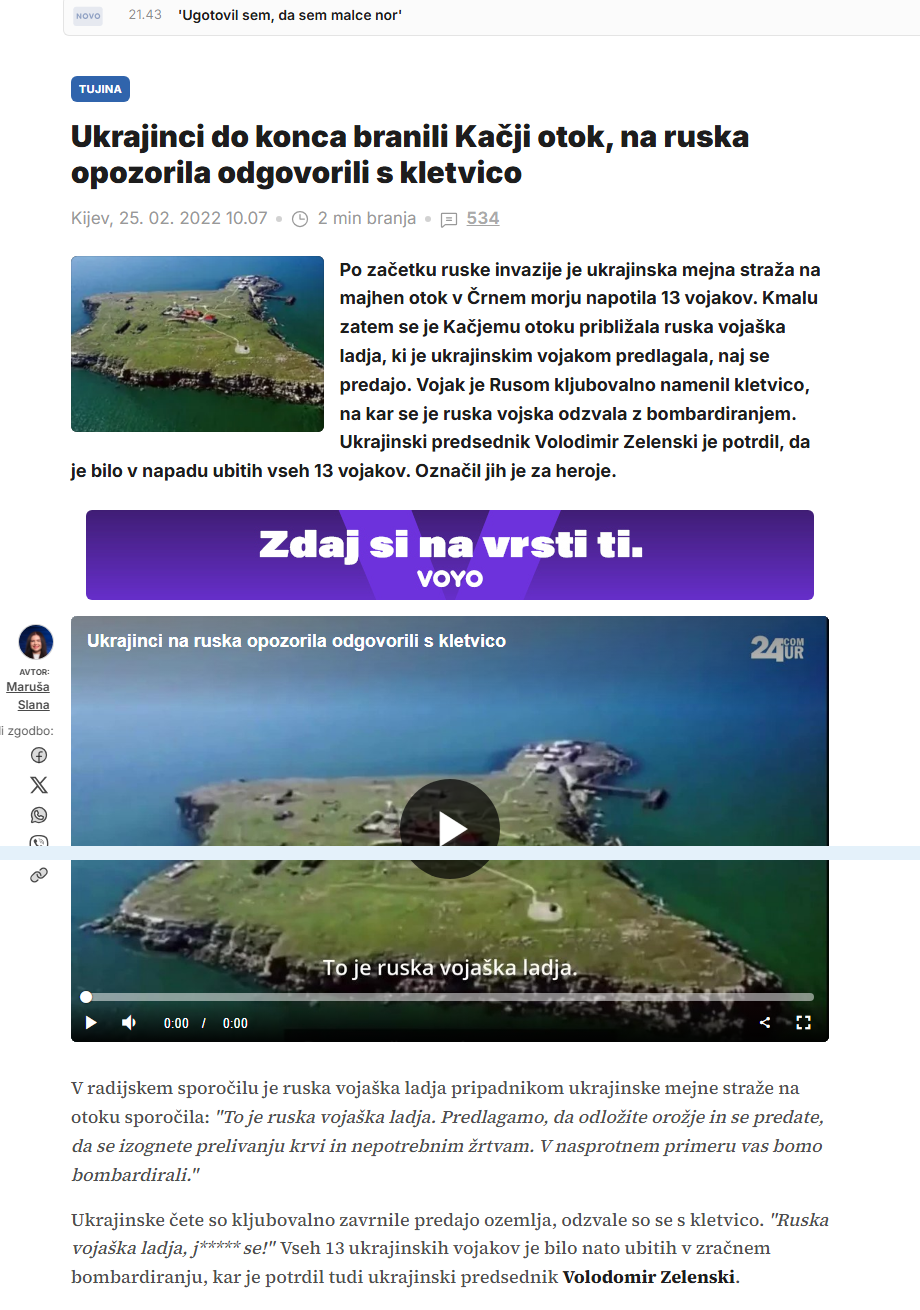
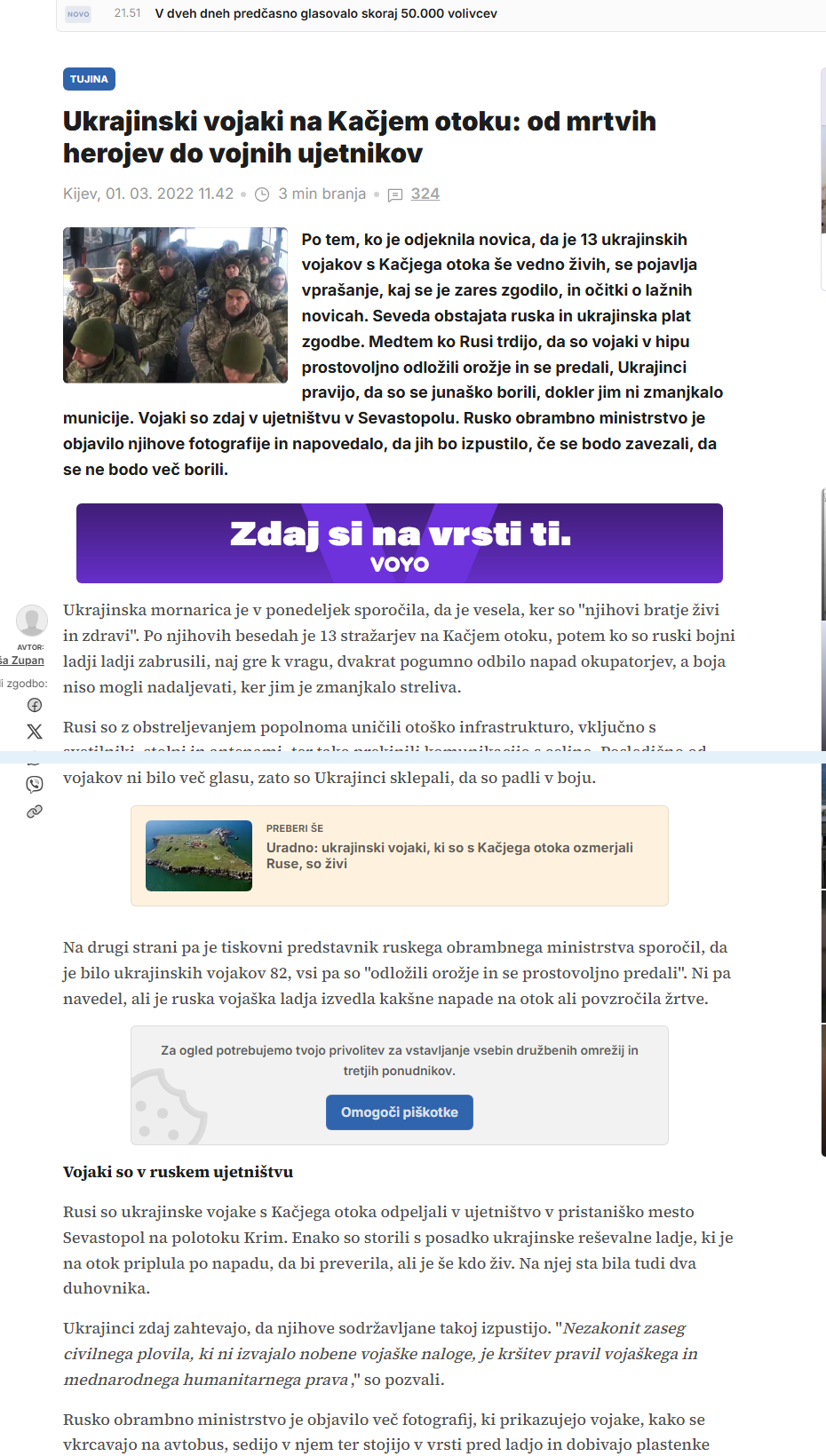
In February 2022, the story of thirteen Ukrainian defenders of Snake Island who were said to have died defending the island spread around the world. Russia claimed the soldiers were alive and had been captured. A few days later, the Ukrainian navy confirmed that the defenders were indeed alive. 24ur then published a correction describing the story as a transition “from dead heroes to prisoners of war.”
This does not mean every Russian detail about the event was correct. It does mean that on the basic question — dead or alive — the initial Russian information was more accurate than the initial Ukrainian information.
.jpg&width=1200)
Soledar and “cheap propaganda”
In January 2023, Wagner claimed it had captured Soledar. The Ukrainian side rejected the claim. 24ur correctly reported that Ukrainian military observers described the Russian claims as “cheap propaganda,” while also noting that the situation could not be independently confirmed and that the British Ministry of Defence allowed for the possibility that Russia had captured the town. On January 25, Ukraine officially confirmed its withdrawal from Soledar.
The example is therefore not proof of incorrect reporting by 24ur. It is, however, a very good illustration of something else:
the word “propaganda” by itself does not tell us whether a specific claim is true or false.
Darya Dugina
After the killing of Darya Dugina in August 2022, Russia's FSB blamed the Ukrainian side for the operation. Kyiv denied involvement, while presidential adviser Mykhailo Podolyak described the Russian claims as propaganda. In October 2023, The Washington Post, citing interviews with Ukrainian and Western security officials, reported that the operation had been carried out by Ukraine's SBU. That does not confirm every detail of the original Russian version.
But it confirms the essential part of the attribution:
Ukrainian intelligence involvement was not merely a Russian invention.
Crimean Bridge
After the explosion on the Crimean Bridge in October 2022, Russia attributed responsibility to Ukraine. The Ukrainian side was initially reserved. In August 2023, 24ur reported that Ukraine had publicly acknowledged responsibility for the attack on the Crimean Bridge, and SBU chief Vasyl Maliuk also took responsibility for the October 2022 operation. Here too, political or legal characterization of the attack must be separated from the question of who carried it out.
The basic Russian attribution of Ukrainian involvement was later confirmed.
Forced mobilization: “busification”
Russian media long published videos of men allegedly being stopped and forcibly taken away by Ukrainian mobilization officials. For every individual video, the correct approach is to verify authenticity, place, time, and full context. But the existence of serious abuses in mobilization is no longer merely a Russian claim. In February 2026, Ukrainian Human Rights Commissioner Dmytro Lubinets said his office had received 6,127 complaints in 2025 regarding the conduct of representatives of mobilization centers, compared with 18 in 2022.
That does not mean every video published by a Russian channel is genuine. But it does mean the phenomenon cannot be dismissed merely with the label:
“Russian propaganda.”
Whose casualty numbers?
Military losses are among the hardest things to verify in any war. Both sides have an obvious interest in minimizing their own losses and maximizing the opponent's. So with casualty figures it must always be clear:
who published them and how they were verified.
Exchanges of human remains are especially interesting. In June 2025, Ukraine confirmed receiving 6,057 sets of remains, while Russia received the remains of 78 of its soldiers. In April 2026, the ratio in another exchange was:
1,000 to 41.
The difference is large. But we must not turn this into another form of propaganda arithmetic.
6,057 to 78 does not mean that 78 times more Ukrainian soldiers died.
The quantity of remains returned is affected by control of the battlefield, access to the dead, identification, and many other factors. The figures nevertheless represent a real data point that warns us how careful we must be with categorical claims about the ratio of military losses. A claim by the Ukrainian General Staff is not the same as an independently established number of dead. The same applies to the Russian Ministry of Defence.

How do Slovenian politicians know what Putin thinks?
Another special category of public speech consists of claims about Vladimir Putin's internal intentions. Then-prime minister Janez Janša said in February 2022 that he was “one hundred percent” convinced that if Kyiv fell, Moldova and Georgia would follow, then the Western Balkans and the Baltic states. Then-foreign minister Anže Logar stated:
“He will not stop even before a Finland or a Sweden.”
Asked whether other countries would follow Ukraine, he answered:
“If Putin prevails, then other countries will follow as well. Definitely.”
By October 2026, Russia had not attacked Finland or Sweden. Both countries had meanwhile joined NATO. That does not prove what would happen in some different future. It does show the difference between:
a fact
and:
a political-security prediction.
No one has direct access to another statesman's thoughts. We can analyze his speeches, troop movements, documents, and past actions. But the proper formulation is:
“we assess that...”
and not:
“Putin wants...”
if we lack direct evidence for such a categorical claim.
What about Putin's own words?
In September 2026, Putin stated that Russia was not preparing for military conflict with Europe and had no such plans. Does this prove that Russia will never attack Europe?
No. Before February 2022, Russia also denied plans for a large-scale attack on Ukraine and then carried one out. Putin's statement therefore establishes his publicly declared position, not the future. But the same principle must apply on the other side. A statement by a European politician or general that Putin wants to attack Europe is likewise not by itself proof of Putin's internal intent.
Is Russia preparing an attack on NATO?
This is one of the central questions of 2026. European politicians, generals, and intelligence services warn about Russian military capabilities, hybrid operations, and the possibility of a future direct conflict. These are legitimate security questions. But the time horizon is essential. On September 30, 2026, NATO Secretary General Mark Rutte explicitly said there was no imminent threat to NATO territory. At the same time, NATO treats Russia as a long-term security danger and urges member states to increase defense capabilities. This means the following claims can all be true simultaneously:
Russia represents a long-term security risk.
Russia could, under certain future circumstances, attack NATO.
There is currently no identified imminent large-scale Russian invasion of NATO.
The Russian leadership publicly denies intending such an attack.
These are not the same pieces of information. From:
“Russia could develop the capability for an attack by 2029”
we cannot, without additional evidence, turn it into:
“Putin wants to attack Europe.”
Possibility is not a decision. Capability is not intent. Long-term risk is not an imminent attack.
When does doubt become justified?
After all the incorrect or overly categorical predictions of recent years, it is entirely legitimate to ask:
Who is saying today that Russia will attack Europe?
A politician?
A general?
An intelligence service?
Is it a probability?
A possible scenario?
An assessment of capability?
Is there evidence of an actual decision to attack?
If the assessment is:
“Russia could develop the capability to attack by 2029”
the headline must preserve that distinction. Possibility is not a decision. Capability is not intent. Long-term risk is not an imminent attack.
A Russian media outlet is not automatically truth — nor automatically falsehood
RT, RIA, TASS, Sputnik, and other Russian media are not neutral observers of the conflict. They operate within a Russian information environment that also uses propaganda, selection, and political narratives. But it does not follow that:
Russian source = falsehood.
The cases of Azov and OUN-B, Snake Island, Soledar, Ukrainian involvement in the Dugina assassination, the Crimean Bridge, and mobilization abuses show that the specific claim must be verified, not merely the label of the source. The same applies in the opposite direction. The solution is therefore not:
believe Russia instead of the West.
The solution is:
check both.
How a false impression can emerge without a single big lie
A misleading media picture does not require a completely fabricated story. It may be enough to:
select the most dramatic source,
select the most dramatic part of the statement,
remove some of the uncertainty,
publish a strong headline,
repeat similar predictions,
and give the correction far less attention.
Every individual article can formally defend itself:
“They really did say that.” “We did cite the source.” “The article does say the information cannot be confirmed.” But the person who saw only the headline may never have read any of that. They saw:
The Russians are running out.
Russia will be exhausted in ten days.
Russia will go bankrupt.
Ukraine will win in October.
Putin's days are numbered.
And today they may see:
Russia will attack Europe.
How much can we then trust a Slovenian media outlet?
A past error does not mean the next story from the same outlet is false. But trust does not mean uncritical acceptance either. If a media outlet repeatedly publishes failed predictions, headlines more categorical than its own sources, or anonymous claims the reader cannot verify, it is entirely reasonable to check the next extraordinary claim elsewhere as well. Especially when we are talking about war.
With the claim:
“Russia wants to attack Europe”
the reader should receive answers to at least four questions:
Who is making the claim?
What is the assessment based on?
How certain is it?
What time horizon is it talking about?
Without those details, a scenario can become a fact in the headline.
Who speaks and whom do we believe?
When a Slovenian reader opens a story about Ukraine, they may be reading something:
said by an anonymous intelligence officer,
summarized by a foreign media outlet,
carried by a news agency,
translated by a Slovenian portal,
and compressed by an editor into a headline.
After several intermediaries, the most important information may disappear:
who originally made the claim and how much of it could actually be verified.
The simplest rule of war journalism should therefore also be the strictest:
a claim by one side must remain a claim by one side until it is supported by independent evidence.
That must apply to Moscow. To Kyiv. To Washington. To London. To NATO. And to Ljubljana. Because a false impression does not always require a great lie. Sometimes it is enough to remove just two words:
could have.
Spodaj so ključni viri, uporabljeni za faktografski audit članka.
Sources and further reading
- Slovenski mediji. 24ur, Ben Hodges, 15. 3. 2022 Source
- Siol, Putin / štirje dnevi, 26. 2. 2022 Source
- Siol, bankrot 15. aprila, 8. 3. 2022 Source
- Siol, Marcus Keupp, 1. 3. 2023 Source
- Siol, poznejša preverba Keuppa, 2024 Source
- 24ur, Kačji otok, prvotna zgodba Source
- 24ur, Kačji otok, popravek Source
- 24ur, Krimski most Source
- Siol, Anže Logar Source
- Primarni / uradni / raziskovalni viri. Evropski parlament — Riho Terras Source
- Estonske obrambne sile — Riho Terras kot poveljnik Source
- Ukrajinski varuh človekovih pravic — pritožbe glede mobilizacijskih centrov Source
- Reuters — repatriacija posmrtnih ostankov, junij 2025 Source
- Reuters — repatriacija posmrtnih ostankov, april 2026 Source
- GOV.SI — Janez Janša, 28. 2. 2022 Source
- NATO — Mark Rutte, 30. 9. 2026 Source
- OSW — Azov Movement, 11. 2. 2026 Source
- USHMM — Lwów pogrom 1941 / OUN context Source
- Washington Post — ukrajinske obveščevalne operacije / Dugina Source
- Arhivske slike / licence. Kačji otok — State Border Guard Service of Ukraine, CC BY 4.0 — ,2022-07-07(01).jpg Source
- Azov v Mariupolu — MVS/Azov Regiment, CC BY 4.0 Source
- Stepan Bandera — javna domena Source
- Izmenjave posmrtnih ostankov — Nikolai Twin, CC BY 4.0 Source