Slovenian Media During the Epidemic: How the Reality of COVID Was Created
What Slovenian media emphasized during the epidemic, how claims changed, and when reporting moved from informing toward moralizing and behavioural pressure.

What we knew, what we were told, and what happened when knowledge changed
On March 4, 2020, Slovenia confirmed its first case of infection with the new coronavirus. In the weeks that followed, something that had until then been a distant story from China and Italy became the central subject of Slovenian public life. Infected. Hospitalized. Intensive care. Ventilators. Deaths. Masks. Quarantines. School closures. Curfew. Vaccines. PCT — recovered, vaccinated, or tested. Daily press conferences. Daily counters. Daily warnings. But alongside the health crisis, another system emerged: a system for producing the public interpretation of the crisis.
Laboratories, hospitals, and the National Institute of Public Health, NIJZ, produced the data. The government turned them into measures and public messages. Experts gave them authority. And the media decided: what would become the headline, who would be the guest, which number would be repeated, what would be presented as certain, what as dangerous, who as responsible, and who as the problem. So the question of this article is not: Did COVID exist? It did. Nor: Did vaccines have an effect? They did. The question is more demanding:
During the crisis, did Slovenian media and institutions present the degree of certainty, danger, and moral responsibility to the public in proportion to the evidence actually available at each point in time?
And: What happened when it became clear that some confident claims required important corrections?
First, one boundary
Criticism of the pandemic system does not require invention. There is no need to claim: that COVID did not cause deaths, that vaccines did not prevent severe outcomes, that every hospital statistic was false, that every adverse event after vaccination was caused by the vaccine, or that every journalist received secret instructions from Brussels. Such claims would only weaken more serious criticism. Because there is enough documented material. It is documented: that there were predictions that did not come true; that health data were sometimes translated into far more categorical slogans;
that unvaccinated people were publicly described as a social problem, as limiting other people's freedom, and even as people whose behavior caused additional victims; that the state created the PCT system, which had not only an epidemiological but also a clear behavioral function of encouraging vaccination; that an administrative rule was introduced for the Janssen vaccine that the expert group had not recommended;
that the European Commission directly linked the fight against “vaccine disinformation” with achieving vaccination targets and expected platforms to promote authoritative content while limiting opposing content; and that some politicians and officials responsible for measures themselves behaved differently from the rules they demanded the public follow. That is a serious enough story.
A crisis of data quickly became a crisis of interpretation
At the beginning of 2020, caution was understandable. A new virus. Little data. No vaccine. No specific treatment. Uncertain mortality. An uncertain proportion of undetected infections. An uncertain long-term trajectory. Under such conditions, it is rational to react more cautiously than to a well-known disease. But the problem of crisis communication lies elsewhere. Caution can quickly become certainty. A possible scenario becomes a prediction. A statistical category becomes a causal claim. A regulatory benefit-risk assessment becomes the slogan: safe. A relative reduction in risk becomes: 95 percent effective. A public-health recommendation becomes: a decision for life.
And an individual's health decision becomes: a measure of their responsibility to society.
“Record”
During the autumn wave of 2020, the word record became an almost permanent part of the media vocabulary. On September 11, 24UR published: “A record 108 infections on Thursday.” Two weeks later: “A record 192 coronavirus infections on Thursday.” It is important to tell the full story. The articles did not contain only an alarming headline. The text also included: the number of tests, the share of positive tests, hospitalizations, and other information. In the story about 192 cases, the record number of tests was also explicitly mentioned. So the problem is not:
the media outlet published a lie. The problem is the editorial relationship between: the headline and the context. The word record was at the top. The explanation of what that record meant was not. This is exactly the sensationalist mechanism from the previous article.
Death every evening
In the autumn and winter of 2020, it became normal for the daily news to include: the number of new cases, and the number of deaths. “Another 41 people died.” “Another 45 died.” “Another ...” In a severe epidemic, mortality data are of course important. But so is the question: what exactly are we counting?
“Died with confirmed infection” is not the same as “died from COVID”
For rapid epidemiological monitoring, NIJZ used an operational definition under which a person who died within a specified period after a positive test was included among deaths with confirmed infection. Such a system allows rapid daily monitoring. But it does not yet require a final determination of the underlying cause of death. Later statistics were different.
In final coding, NIJZ took the underlying cause of death into account and explained, among other things, that a clear alternative cause such as trauma meant that COVID was not the underlying cause. Therefore: death after a positive test is not automatically the same as: death from COVID. That does not mean COVID did not cause substantial mortality. NIJZ later determined that COVID was the underlying cause of death for 3,390 residents in 2020 and 3,062 in 2021. But it does mean:
the daily media counter and the final causal mortality statistics were not the same thing. If the media do not explain the distinction, readers may understand an epidemiological category as already established causality.
A time-based review: what was said and what happened later
The following table matters because it does not force different problems into one category. Something may be: correct but sensationalized; later outdated; too categorical even when stated; an unfulfilled prediction; a moral slogan; or a materially misleading formulation. None of this is yet the same as proof that the speaker knowingly lied.
| Date | Headline or claim | What comparison shows | Assessment |
|---|---|---|---|
| 11 Sep 2020 | 24UR: “A record 108 infections on Thursday” | The figure was correct; the article contained additional epidemiological context. | True, alarmingly framed. |
| 22 Sep 2020 | 24UR: “Minister warns about measures but does not follow them herself” | At the event, the minister and other senior guests were without masks or proper distancing; Bojana Beović called it a poor example, and Kustec apologized. | Documented double standard and an example of good watchdog journalism. |
| 25 Oct 2020 | 24UR: “Krek without a mask at a petrol station” | The NIJZ director, one of the most visible public faces urging compliance with measures, was documented without a mask. 24UR itself framed the story around the question of “double standards.” | Documented inconsistency between the public message and the behavior of the messenger. |
| 16 Dec 2020 | Siol: “Projection: another 750 people will die by New Year” | The article contained several scenarios and intervals; the headline highlighted the highest central scenario. | A model was presented much more categorically in the headline than in the body of the article. |
| 1 Feb 2021 | 24UR commentary: “You are responsible for there being even more victims” | The author directly linked people spreading doubts about vaccination and testing with additional illness and deaths and wrote that on the vaccination side there was “nothing,” while on the other there were more than two million victims. | Strong moral accusation; “nothing on one side” was an overly absolute formulation. |
| spring 2021 | Janša: 70% vaccination by summer; later, a level that would “successfully stop the epidemic” by mid-June | On June 8, Dnevnik found that the targets had been missed by at least 400,000 vaccinated people. | Unfulfilled and overly confident prediction. |
| July 2021 | Public formulation: “Vaccination is the only tool that offers us a way out of the epidemic” | Vaccination was an important tool, particularly against severe outcomes, but it was never literally the only epidemiological tool. | Materially overbroad formulation. |
| 22 Jul 2021 | Delo: “The debate for and against vaccination has gone off the rails” | The author warned against paternalistic and authoritarian messaging and explicitly rejected dividing people into “allies” and “enemies.” | Important evidence that the problem of polarization was not invisible to all media at the time. |
| 26 Aug 2021 | Slovenian Medical Ethics Commission: insufficient vaccination “maintains the epidemic,” “limits the freedom of society”; treatment of unvaccinated patients was said to restrict treatment for others | The commission linked the health consequences of non-vaccination with broader social and moral responsibility and even called on media not to encourage opposition to vaccination. | Shift from health assessment to moral-political categorization. |
| 4 Sep 2021 | N1: “What can we do in the fight against anti-vaccine sentiment?” | The introduction describes ideas said to pose a “serious threat to public health” and asks what citizens, intellectuals, media, and politicians can do. The article also proposes debate among different forms of advocacy for vaccination rather than debate “for or against.” | Clear normative editorial frame, not a neutral description of a dispute. |
| 12–13 Sep 2021 | Milan Krek: “We are becoming hostages of unvaccinated people.” | Krek directly linked the unvaccinated with lockdowns and hospital burden and called on “anti-vaxxers” to accept responsibility for the consequences. | Strong moral and collective attribution of blame. |
| 15 Sep 2021 | Jelko Kacin: vaccinated people become “part of the solution and not part of the problem for society” | The statement came as queues formed at vaccination centers because of the expanded PCT requirement. | Public division of people into problem and solution. |
| 15 Sep 2021 | Expanded PCT requirement | Expansion of the condition directly increased interest in vaccination; with Janssen, PCT status could be obtained immediately after the dose. | In addition to being a health filter, PCT was a strong behavioral pressure. |
| 29–30 Sep 2021 | The case of Katja Jagodic and immediate PCT status after Janssen | N1 established that the expert group had not recommended immediate PCT status; Beović said that from a professional standpoint there should have been a 14-day wait. 24UR published an assessment that the decision was political rather than science-based. | Documented difference between the political rule and expert recommendation. |
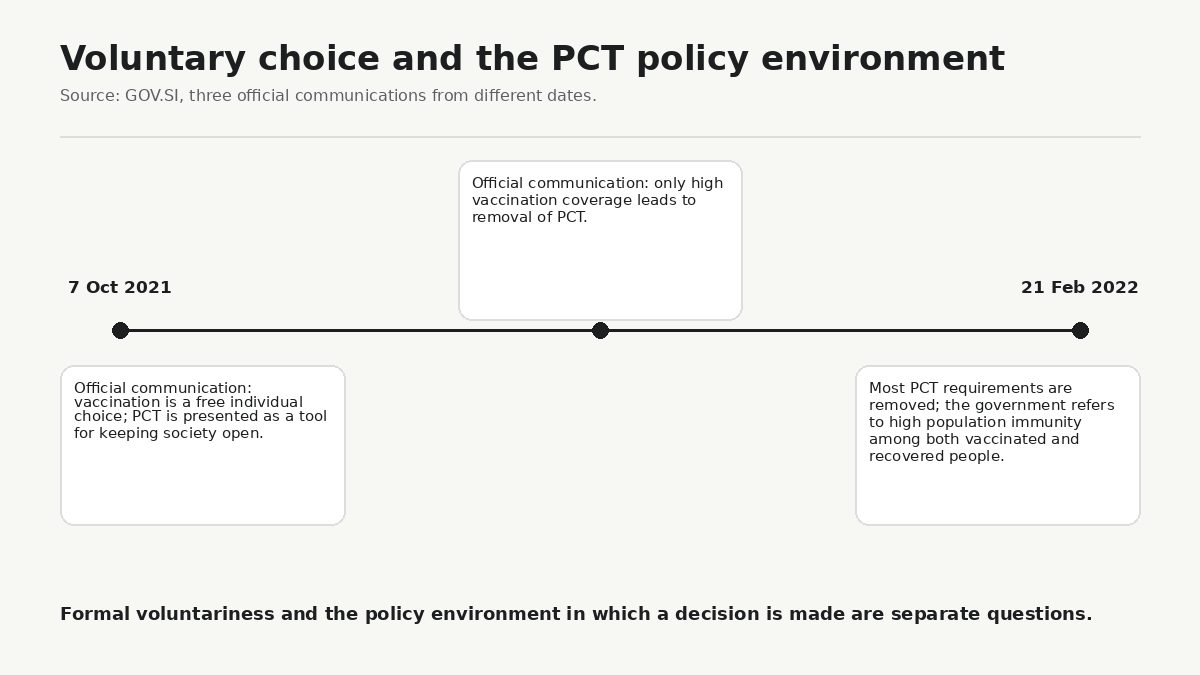
| 7 Oct 2021 | Poklukar: “The decision to be vaccinated is a free decision for each of us.” | The same appearance presented PCT as a tool for preventing the closure of society; vaccination exempted individuals from many burdens of repeated testing. | Formally true, but incomplete regarding the actual environment of pressure. |
| 11 Oct 2021 | Poklukar: only more than 70% vaccination coverage would allow measures to be lifted and society to be fully open | In February 2022, the government lifted most PCT requirements because of the changed epidemiological situation and a “high level of population immunity,” explicitly referring to both vaccinated and recovered people. | Later developments disproved 70% vaccination as the necessary sole condition for lifting PCT. |
| 2 Nov 2021 | Milan Krek: “Vaccination is currently the best protection against infection and severe disease.” | A Qatar study published almost a month earlier showed rapid waning of Pfizer protection against infection itself to about 20% in months 5–7, while protection against severe outcomes remained much better preserved. | Combining two very different effects into one slogan was too imprecise. |
| 3 Nov 2021 | Bojana Beović: “The decision to be vaccinated is a decision for life.” | The explanation in the same appearance was more differentiated, but the headline was morally and emotionally much stronger than the scientific claim about reduced risk. | Behavioral slogan, not a neutral medical formulation. |
| 30 Nov 2021 | Commission confirms causality in Katja's death | The commission unanimously found vaccine-induced immune thrombotic thrombocytopenia and a connection with Janssen. | Suspicion changed into an expert-established causal link. |
| 30 Dec 2021 | Janez Janša: around 6,000 dead, “almost all unvaccinated” | In 2020 alone, 3,390 deaths were recorded with COVID as the underlying cause; the first vaccine arrived in Slovenia only on December 26, 2020. | Could be literally true regarding vaccination status, but causally misleading as an argument about the consequences of refusing vaccination. |
This is no longer only a story about “changing science”
The table shows something important. Some claims changed because new data arrived. That is normal. But not everything can be explained with that sentence. Some predictions were too categorical. Some slogans ignored limitations that were already known. Some formulations turned a health risk into moral classification of people. And for some claims, sufficiently broad context was already available at the time to make a more cautious formulation professionally more appropriate. That is a different problem.
When a health decision becomes a moral identity
In August and September 2021, a pronounced shift took place in official and media language. Unvaccinated people were no longer merely: people with a statistically higher risk of severe disease. They were becoming: people who “maintain the epidemic”; people who “limit the freedom of society”; people because of whom others have more difficulty accessing treatment; people whose behavior creates additional victims; a “problem for society”; people whose hostages others were supposedly becoming. That is something fundamentally different. On August 26, the Medical Ethics Commission of the Republic of Slovenia explicitly wrote that insufficient vaccination:
“maintains the epidemic, endangers people's health, and limits the freedom of society and every individual.” It added that hospital treatment of unvaccinated patients limited other patients' access to treatment and that media reporting should not encourage opposition to vaccination. This is no longer only an epidemiological description. It is also: a moral instruction for how society should be understood.
From “higher risk” to “you are the reason others are not free”
It is important to distinguish two claims. The first:
In a certain age or risk group, an unvaccinated person has a higher risk of hospitalization from COVID.
That is an empirical claim that can be tested. The second:
The unvaccinated limit society's freedom.
That is already: political, ethical, and moral judgment. It also contains another assumption: the restrictions are not a decision by the authorities, but a consequence of the behavior of the unvaccinated. Responsibility for the measure is thereby shifted. Not:
the government introduced a restriction.
But:
because of you, we have to have it.
That is a powerful technique of social pressure.
“We are becoming hostages of the unvaccinated”
In September 2021, Milan Krek said: “We are becoming hostages of unvaccinated people.” He added that people because of whom others had not been vaccinated should accept responsibility for their hospitalizations and mechanical ventilation. The health argument is understandable: at that time, unvaccinated people faced a higher risk of severe disease. But the word hostage does something else. A hostage implies: a perpetrator, and a victim. That is not a medical term. It is a moral metaphor. With it, a group of residents was placed in the role of people depriving others of freedom.
“Part of the solution and not part of the problem”
Three days later, Jelko Kacin described on N1 the people waiting in vaccination lines because of the new PCT requirement: “People have realized that by being vaccinated they will become part of the solution and not part of the problem for society.” This is an almost perfect binary division: vaccinated = solution; unvaccinated = problem. Such language has a behavioral purpose. It does not merely tell a person: the vaccine reduces your risk. It tells them: your decision shows what kind of citizen you are.
The media were not merely the postman
At this point it is not enough to say:
The media outlet merely published a politician's or doctor's statement.
A newsroom decides: whether such wording becomes the headline, whether it is highlighted, whether it is problematized, whether another perspective is presented alongside it, whether health statistics are separated from moral judgment. Sometimes Slovenian media did this. Sometimes they did not. But the idea that a media outlet bears no responsibility because it is quoting someone else is too convenient. Selecting the quote is an editorial decision.
N1 and the “fight against anti-vaccine sentiment”
On September 4, 2021, N1 published an article: “What can we do in the fight against anti-vaccine sentiment?” The introduction itself describes the ideas of the anti-vaccine movement as: “a serious threat to public health” and asks what: citizens, intellectuals, the media, and politicians can do to fight the spread of such ideas. An interviewee in the article goes further and proposes that the debate should no longer be conducted at the level of: for or against vaccination, but: among different forms of advocacy for vaccination. He explicitly mentions: a soft approach, mandatory vaccination,
and even forced vaccination as possible positions within the debate. This is an important document of the information environment of the time. Not because N1 itself thereby introduced coercion. But because it shows how the boundary of a legitimate public question could already be narrowed in advance.
But Delo warned about the same danger
We therefore should not claim that all media outlets were alike. In July 2021, Delo published a pronounced criticism of paternalistic pro-vaccination communication. The author highlighted as a caricature: “Get vaccinated, you idiots, individualists, anti-vaxxers!” and wrote that social media contained paternalistic and authoritarian ways of addressing unvaccinated people. He specifically rejected the division into: allies — the vaccinated and enemies — the unvaccinated. This is important evidence. Polarization did not become visible only in retrospect. Some people warned about it at the time.
PCT: voluntary, but under conditions
On October 7, 2021, Health Minister Janez Poklukar said: “The decision to be vaccinated is a free decision for each of us.” In the same appearance, he described PCT as a tool through which the government avoided a complete closure of society. The two statements are formally compatible. No one physically grabbed a person and vaccinated them against their will. But the word: free does not necessarily mean: neutral. The decision was being made in an environment where PCT affected: work, study, hospitality, events, services, travel, testing, the everyday organization of life.
A more precise formulation is therefore: vaccination was formally voluntary, while the PCT system created strong indirect pressure in its favor.

PCT was not only an epidemiological measure
Its behavioral function is visible from its effects alone. After PCT was expanded, N1 reported queues outside vaccination centers and Kacin's satisfaction that the new situation was prompting people to seek vaccination. This means: PCT did not merely check epidemiological status. It changed behavior. That alone does not mean the measure was unjustified. But it does mean it is misleading to describe it as merely a neutral technical rule.
Janssen reveals the system in a single case
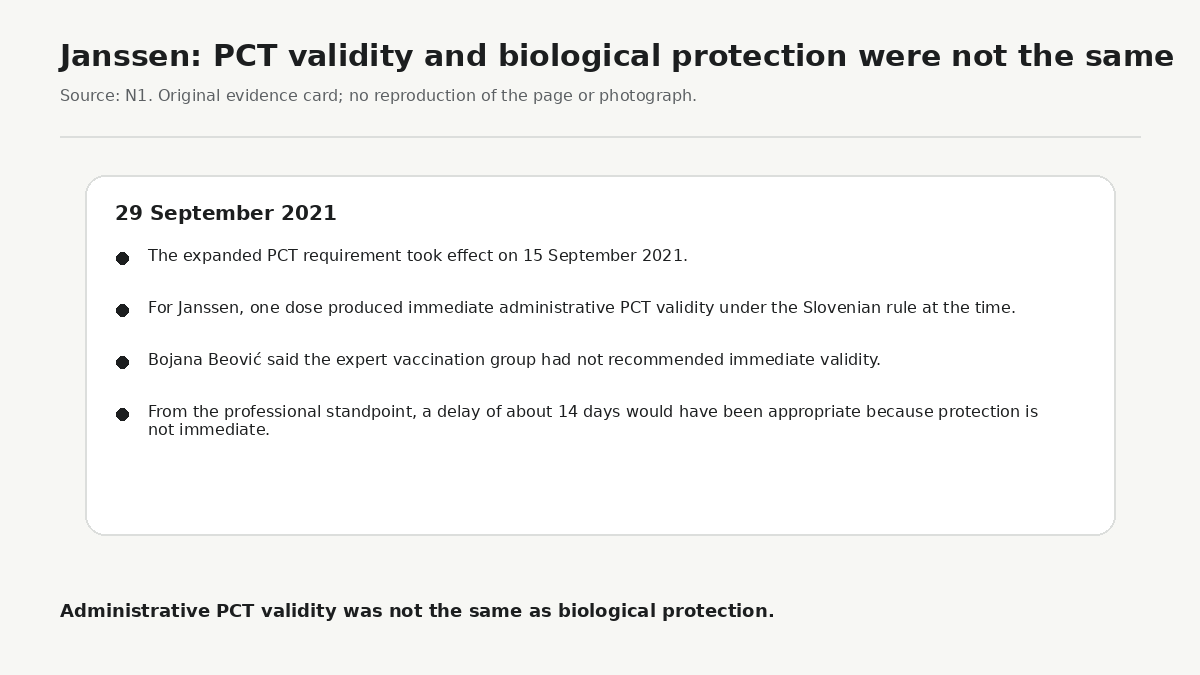
After the PCT expansion, interest in the Janssen vaccine increased. Why? Because only one dose was required. And because under the Slovenian PCT rule, the status became valid: immediately after vaccination. After Katja Jagodic's death, N1 directly asked Bojana Beović: Did the expert group recommend such a rule? The answer: no.
Beović said the expert group had not recommended immediate validity and that, professionally, there should have been a wait of roughly 14 days after Janssen, when the person was actually adequately protected. This is one of the most important findings of the entire Slovenian COVID period. The official administrative status of a vaccinated person was not the same as their biological status of protection.
_J.jpg&width=1200)
A political rule, not an expert recommendation
A day later, 24UR highlighted the same dilemma even more directly. Bojana Beović again said the expert group had not recommended immediate PCT status. Mario Fafangel emphasized that the experts had not encouraged people to use the vaccine in that way. Zarja Muršič described the decision as something that: “was not based on science, but was merely a political decision” and assessed it as wrong. This is an important example of good journalism. The media outlet broke the official system into: expert advice and political decision.
Katja Jagodic
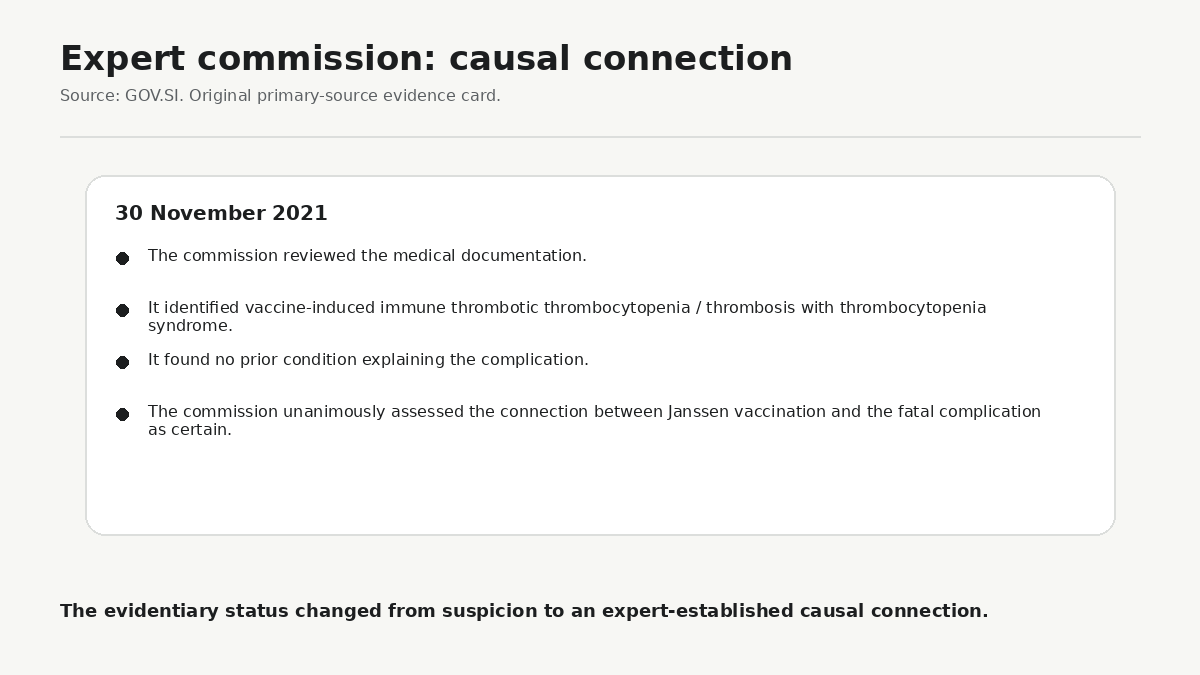
Katja was 20 years old. She received the Janssen vaccine on September 16, 2021. After her death, her father said she had wanted vaccination in order to: “buy her freedom” and avoid PCT restrictions. When she died, the causal link had not yet been professionally confirmed. It was therefore correct to speak of: suspicion. Not: a proven death caused by the vaccine. But on November 30, the evidentiary status of the story changed. The expert commission unanimously found: vaccine-induced immune thrombotic thrombocytopenia, and a reliable connection between Janssen and the fatal complication.
No prior health condition was found in Katja that would have explained the development of the complication. This means: in this specific case, causality was not a theory, suspicion, or merely temporal association. It was professionally established.
The risk was rare. It was not unknown.
Something else is important. As early as April 20, 2021, EMA decided that unusual blood clots with low platelet counts associated with Janssen should be listed as a very rare adverse effect. Among the cases reviewed at the time was also a fatal outcome. So in September 2021 we were not in a situation where: no one could have known about such a risk. The risk was: known to be very rare. That does not mean the vaccine was therefore necessarily inappropriate at the population level.
But it does mean that an administrative decision that made precisely this vaccine particularly attractive to young people because of immediate PCT status deserved very strict scrutiny.
“Safe” does not mean “without danger”
This reveals the problem with the entire slogan: safe and effective. When a regulator uses the word safe, it does not mean: it is impossible for the vaccine to cause a severe complication. It means roughly: for approved use, the balance between benefits and known risks is sufficiently favorable. Those are very different meanings. If a public slogan erases that distinction, the average person receives a simpler message than the regulator is actually giving.
Effectiveness also split into several different things
In October 2021, a large study from Qatar was published. For the Pfizer vaccine, it estimated protection against any infection at approximately: 77.5% in the first month after the second dose and approximately: 20% in months five through seven. At the same time, protection against severe, critical, or fatal COVID remained substantially higher during the first six months. This is probably one of the clearest illustrations of the pandemic communication problem. A vaccine can simultaneously be: increasingly poor at preventing infection itself and still very useful in reducing severe outcomes.
If we compress all of this into: effective, we have lost the key information.
Yet in November the headline still spoke of the “best protection against infection”
On November 2, GOV.SI published a page: “Vaccination is the best protection against infection.” Milan Krek said vaccination was: “currently the best protection against infection and severe disease.” The problem is not the part: protection against severe disease. That was well supported. The problem is combining that effect with protection against infection in one undifferentiated formulation at a time when data were already available showing substantial waning over time of protection against infection. This is a point where the explanation: “science changed later” is not entirely sufficient.
Some relevant knowledge was available already at the time.
One day later: “a decision for life”
On November 3, the title of a government release became: “The decision to be vaccinated is a decision for life.” Bojana Beović said we were choosing between: a mild course after vaccination, and the risk of severe disease, mechanical ventilation, or death. On average, the risk of severe disease really was lower among vaccinated people. But the slogan: a decision for life is not the same as: vaccination statistically reduces the probability of a severe outcome. The first is a moral and emotional behavioral message. The second is a medical claim.
“Almost all unvaccinated”
On December 30, 2021, Janez Janša said: “we had 6,000 dead, almost all unvaccinated.” The sentence has an interesting property. Literally, a large proportion of those who died may indeed have been unvaccinated. But if it is used as evidence that: people died because they chose not to be vaccinated, an obvious problem appears. NIJZ later estimated that in 2020 alone, there were 3,390 deaths in which COVID was the underlying cause. The first vaccine arrived in Slovenia only on: December 26, 2020.
More than half of the roughly six-thousand cumulative total therefore came from a period when the population had practically no opportunity to be vaccinated. This is a very good example of a claim that can be: literally correct and at the same time causally misleading.
“Freedom” was used in both directions
This is one of the strangest elements of the PCT period. Katja's father said she had wanted to: buy her freedom. The Medical Ethics Commission wrote that non-vaccination: limits the freedom of society. The minister insisted vaccination was: a free decision. PCT, meanwhile, was presented as a condition necessary for society to remain: open. The same word — freedom — was thus used as: a motivation for vaccination, an argument for restrictions, a defense of voluntariness, and a basis for blaming the unvaccinated. This is not merely medical discourse. It is political language.
The European framework: a documented informational goal
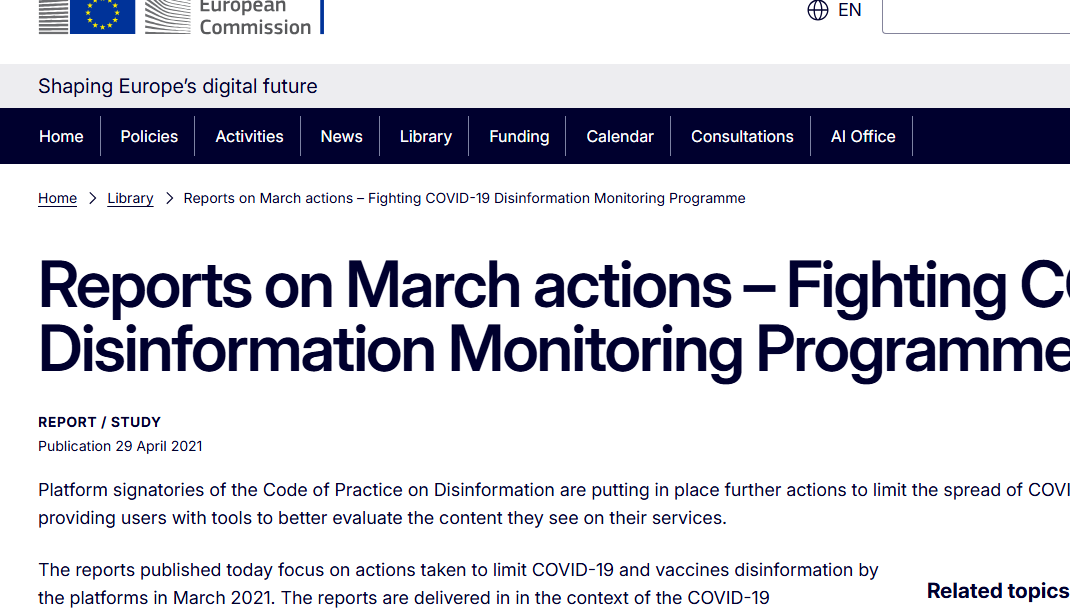
Here we must be very precise. I found no evidence that the European Commission sent a Slovenian journalist an instruction saying: write this headline. So we will not claim that. Something else, however, is documented. The European Commission operated a formal COVID-19 Disinformation Monitoring Programme. It required platforms to report on: measures against disinformation, promotion of authoritative content, labeling, removal of content, and other interventions. On April 29, 2021, European Commissioner Thierry Breton publicly said: the fight against vaccine disinformation was a common struggle toward achieving the goal of: 70% of Europeans vaccinated by July.
It was also stated that platforms had a role in: increasing the availability of authoritative content on the importance of vaccination and limiting disinformation that could hinder collective efforts. This is a very important document.
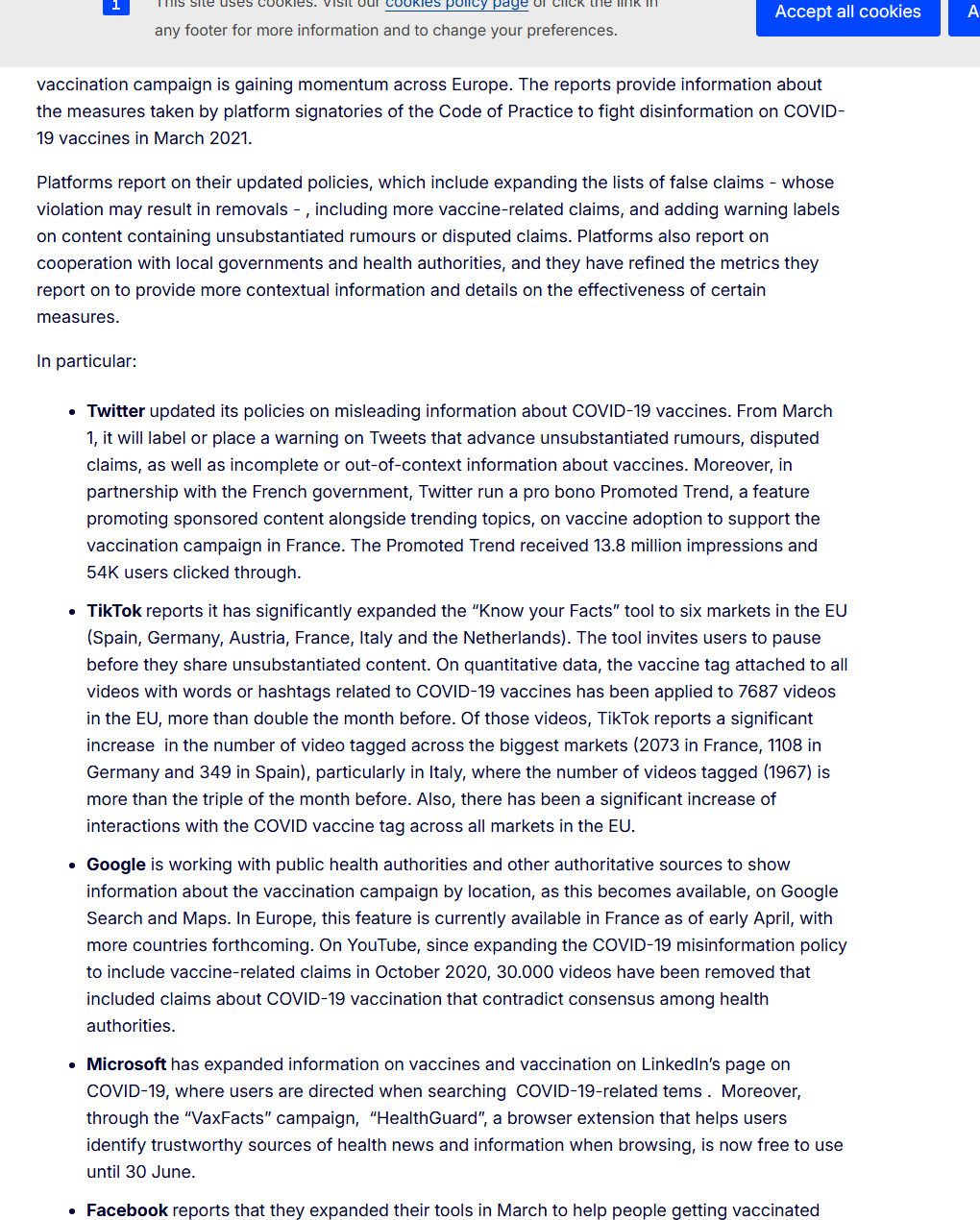
What this European document proves — and what it does not
It proves: that the fight against disinformation was not designed only as an abstract exercise in checking truth; it was also directly connected to the behavioral public-health goal of increasing vaccination coverage. It proves: that the European Commission expected major platforms to intervene in the information environment. It does not prove: that every skeptical post removed contained truth; that all rules were wrong; that the EU dictated Slovenian television reports; or that every Slovenian journalist wrote under political instruction. The precision of this distinction is essential. Because the documented phenomenon is important enough by itself:
regulatory, platform, and public-health goals began to overlap.
Promotion of “authoritative” voices had a consequence
If a platform increases the visibility of: WHO, EMA, national health authorities, ministries, and other official sources, that can be very useful against: fake cures, false information, fake profiles. But if the reach of a legitimate expert question is simultaneously reduced, a problem appears. Because an authoritative source is not: an infallible source. The pandemic demonstrated that repeatedly.
Was it deliberate manipulation?
Here the word deliberate must be used correctly. From a statement later shown to be wrong, we cannot simply conclude about a particular doctor or politician: they knew it was untrue and deliberately lied. That conclusion would require evidence: internal documentation, email, an admission, proof that the person knew contradictory data and knowingly concealed them. For most statements, we do not have that. But there is another form of intent that is documented: the intention to change population behavior. The state wanted: more vaccination; more compliance with measures; more PCT-compatible behavior. The European Commission wanted:
higher vaccination coverage; greater visibility for authoritative content; less reach for content defined as disinformation. So: the intention to influence behavior is not a hypothesis. It was part of the publicly described system.
When influence meets overly categorical information
This is precisely where the problem becomes serious. Behavioral guidance is not necessarily unethical in itself. If you warn people: the fire is approaching, evacuate, that is an attempt to influence behavior. But if you want to achieve a particular health goal and therefore use claims with more certainty than the data support, communication can move from: persuasion into manipulative simplification. Especially when accompanied by: fear, restrictions, moral blame, and social pressure.
The media bear their own responsibility
It is not enough to say: politicians spoke that way. The media are not recording devices. When a politician says: hostages of the unvaccinated, a journalist can: put it in a large headline, analyze the expression, test its assumptions, ask whether restrictions are ultimately a government decision, show the statistical differences in risk. When an institution says: the unvaccinated limit society's freedom, a media outlet can transmit that as a moral fact, or treat it as a normative position of a particular institution. That is an editorial choice.
But Slovenian media were not a monolith
That is precisely why it is important to show good work too. 24UR documented ministers and the NIJZ director when they violated, or appeared to violate, rules the public was required to follow. Delo warned about the authoritarian tone of pro-vaccination messaging. In the Janssen case, N1 directly checked whether the expert group had recommended the rule adopted by the government. It had not. 24UR later likewise made clear that this had been a political decision, not an expert recommendation. These are important examples.
Criticism of the media is stronger when it acknowledges when they did their job.
Double standards by authorities were not merely a feeling
In September 2020, 24UR published footage from an event at which Minister Simona Kustec and other senior guests did not follow rules on masks or distancing. Bojana Beović said it was: “an extremely poor example.” In October, the same outlet published: “Krek without a mask at a petrol station” and framed the report with the question: “Double standards in the measures?” So there is no need to claim: they all wore masks only for the cameras. We cannot prove that. But we can prove:
there were publicly documented cases in which the most visible proponents of the rules themselves failed to model the behavior they demanded of others.
That is a serious enough finding.
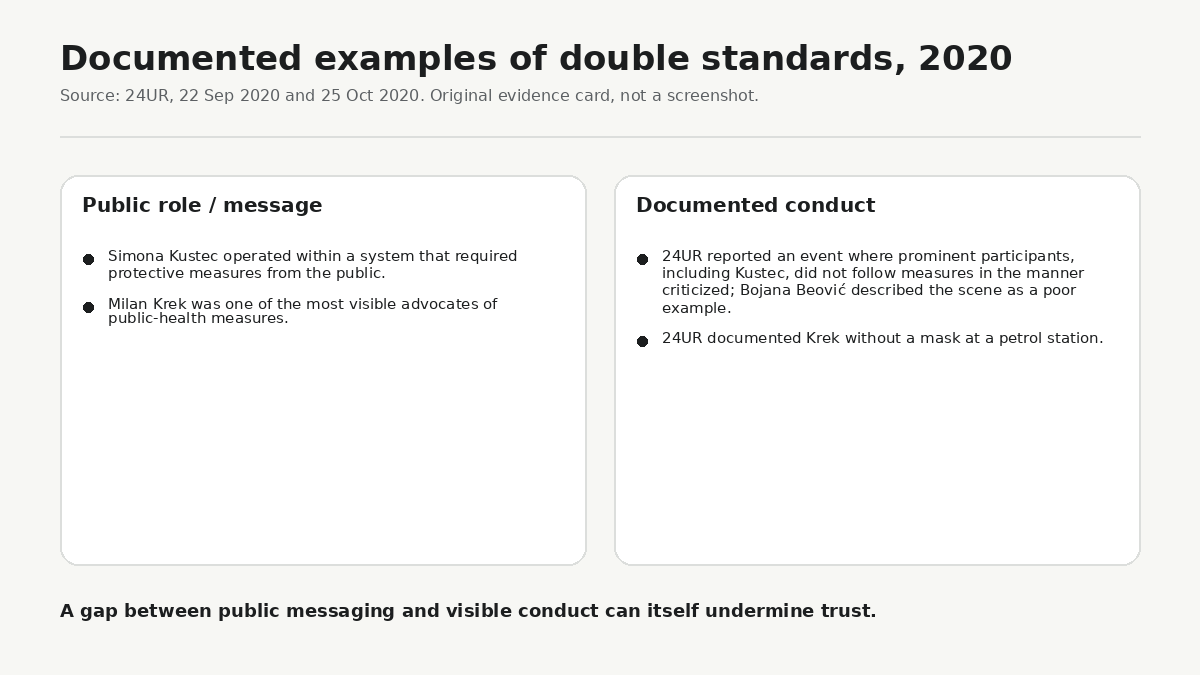
What do such double standards do to trust?
If authorities say: the measure is necessary to protect others, while people see those same authorities failing to follow it consistently, one of two interpretations emerges: either: the rule is not as important as they say, or: the rule applies to us, not to them. Both are destructive to trust. And then a paradox appears. Institutions explain lack of trust primarily through: disinformation, anti-vaccination, conspiracy theories, while part of the distrust may also have arisen from: their own contradictions.
How many statements were actually “false”?
In the timeline, I deliberately selected a limited sample of concrete public claims. We must not turn it into a statistical portrait of all Slovenian doctors, politicians, or media. But we can distinguish at least four categories. First: predictions that did not come true. Example: vaccination targets and the prediction of a rapid level that would supposedly stop the epidemic. Second: claims that were too categorical or materially incomplete. Example:
that “only” 70% vaccination would permit a completely open society, even though PCT was later abolished on the basis of recovery and broader population immunity as well. Third: slogans and moral judgments. “Hostages of the unvaccinated.” “Part of the problem.” “A decision for life.” These cannot be called false in the same way as an incorrect measurement. They are: behavioral and moral frames. Fourth: claims that may be literally correct but create a false causal impression. Example: “6,000 dead, almost all unvaccinated,” when more than half of the deaths occurred before mass vaccination actually began.
This fourth category is particularly important. Because manipulation is often more effective when it does not require a pure falsehood.
The hardest problem is not false information
The hardest problem may be: correct information arranged in such a way that the audience draws a broader conclusion from it that the information itself does not prove. For example: more hospitalized unvaccinated people → the unvaccinated are the reason you are not free. Or: most people who died across the whole pandemic were unvaccinated → they died because they refused the vaccine. Or: the vaccine has a favorable benefit-risk balance → there is practically no serious risk. Or: vaccination reduces infections → vaccinated people do not represent epidemiologically relevant transmission. These are different conclusions.
Why did skeptics lose trust?
Because they often observed a sequence: first: a very certain claim, then: a new qualification, then: another qualification, and in the end the explanation: science changes. Science really does change. But a problem arises when communication in the first phase fails to show the uncertainty that already existed at the time. A person does not necessarily lose trust because a new study appears. They may lose it because they remember that the previous temporary finding was presented to them as: final.
Skepticism was not always correctly directed
This should not be romanticized either. The internet carried: fabricated stories, false claims about deaths after vaccination, false claims about pregnant women, magnets, microchips, genetic modification. 24UR, for example, checked specific viral stories about alleged complications and found some to be false or partly untrue. Therefore: a skeptic was not automatically right merely because they opposed the authorities. But likewise: the authorities were not automatically right merely because they spoke in the name of expertise.
The same standard in both directions
This is the basic rule. If someone dies after vaccination: temporal sequence is not enough. A causal assessment is needed. In Katja's case, that assessment was performed and the connection confirmed. If someone dies after a positive test: the positive test by itself is likewise not enough to determine the final underlying cause of death. A causal assessment is needed. If a critic publishes a claim: we check it. If a ministry publishes it: we check it. If a television doctor says it: we check it. If an alternative portal publishes it: we check it.
Authority is not a substitute for evidence.
What was most problematic about Slovenian reporting?
Not one single large, proven lie. Rather, a systemic combination of: an alarm-driven rhythm; daily counters; moral slogans; a narrow set of highly visible expert voices; PCT as behavioral pressure; categorical headlines; and the translation of political messages into health language. When this was joined by statements about: hostages, a problem for society, limiting freedom, and responsibility for additional victims, a health distinction also became: social labeling.
Was this incitement to hatred?
The word hatred must be used carefully. From every harsh statement, we cannot prove an intention that: people should hate the unvaccinated. But we can document rhetoric that created: blame, moral inferiority, a division into responsible and irresponsible, solution and problem, hostages and their alleged captors. Such rhetoric can increase: stigmatization, social hostility, and the legitimacy of discriminatory treatment. It is therefore more precise to write: part of official and media communication created or reinforced a stigmatizing frame toward the unvaccinated. That is evidentially stronger than claiming every speaker consciously intended to produce hatred.
A journalist must not become the state's behavioral operator
The state may have a legitimate public-health campaign. Its task may be: to increase vaccination. A journalist's task is not the same. If the state says: we need more vaccinated people, the journalist should not automatically become part of the campaign. They should ask: Why? What are the data? For which age? Against which outcome? What is the risk? What has changed? What is a political decision? What is expert advice? Who bears the consequences? That is the difference between: journalism and government crisis communication.
The greatest mistake: confusing trust with obedience
An implicit logic in many pandemic messages was: trust the experts → follow the instruction. But genuine trust is not the same as obedience. Trust allows questions. It allows: uncertainty, a change of mind, criticism, another expert assessment. If every doubt is quickly understood as: anti-vaccination, disinformation, irresponsibility, or a threat to public health, then we are no longer asking for trust. We are asking for: conformity.
The pandemic as a litmus test for journalism
The crisis revealed what happens when journalists are under maximum pressure. The official source is fast. There is a press conference every day. The data are prepared. The expert is available. The headline has to be published immediately. In such an environment, it is very easy to become: a distributor of the system. Much harder to become: its independent verifier. At different moments, Slovenian media played both roles. That is an important conclusion.
This article is therefore not an acquittal
It is not enough to say: we were all learning as we went. Of course we were. But public power brings greater responsibility. A politician demanding restrictions from millions of people bears more responsibility for their wording than a private person on Facebook.
A doctor appearing as a central national authority bears more responsibility for the degree of certainty in their claims than a person in a pub. A media outlet with hundreds of thousands of users bears more responsibility for a headline than an anonymous commenter. And when they make mistakes, it is not enough for the correction to exist somewhere in an archive.
A real correction must be visible
If the original claim was: a large headline, multiple television appearances, a push notification, a government campaign, then an important change should receive comparable prominence. Otherwise the public is left with: the original certainty as memory and the later correction as a footnote. That is not good information.
What can we take away from the COVID period?
Not: never trust a doctor. Not: never trust the media. Not: the state always lies. But: when someone says: safe, ask: what does that mean medically? When they say: effective, ask: against what? When they say: almost all unvaccinated, ask: did they even have the opportunity to be vaccinated? When they say: a free decision, ask: under what conditions? When they say: the experts decided, ask: did they really? With Janssen, they did not. When they say: disinformation, ask: is the claim demonstrably false, merely contested, or still unverified?
When a politician demands a certain behavior from you: also look at whether they behave the same way themselves.
The reality of COVID was not only the virus
It was also: a statistical definition, a graph, a headline, a press conference, expert authority, a PCT code, an app, a television studio, an algorithm, a political decision, social pressure. That does not mean the disease was a media construction. It means: the way we understood it was necessarily mediated by media and politics. And serious mistakes were made in that mediation. Some because of uncertainty. Some because of poor predictions. Some because of excessive confidence. Some because of political objectives. Some because of sensationalism. And some because the boundary between: informing and directing behavior
became blurred.
The most important question after the crisis
It is not: Who was always right? Such a person hardly exists. The question is: Who was willing to show when they did not know? Who corrected their claim? Who separated politics from expertise? Who explained the difference between infection and severe disease? Who acknowledged an adverse effect? Who scrutinized their own government?
Who stopped speaking about “hostages” and “the problem” and began treating people as citizens again? That is the real test of trust.
The next empirical test: Ukraine
With COVID, many disputes could eventually be compared with: registries, studies, hospitalizations, pharmacovigilance, underlying causes of death. War is more difficult. States conduct information operations. Armies conceal data. Intelligence services become media sources. Videos arrive without context. Civilian casualties become political numbers. And journalists often have to report on an event to which they have no direct access. That is why the next Slovenian empirical article will examine: how our media selected sources, language, and levels of certainty in the war in Ukraine.
Sources and further reading
- NIJZ, data on COVID-19 as the underlying cause of death in Slovenia in 2020 and 2021.
- 24UR, reporting on the maskless event involving Minister Simona Kustec, September 22, 2020.
- 24UR, Krek without a mask at a petrol station, October 25, 2020.
- Siol, Projection: another 750 people will die by New Year, December 16, 2020.
- 24UR, Goran Novković, You are responsible for there being even more victims, February 1, 2021.
- Dnevnik, Predictions dissolve: Janša and Kacin miss the target, June 8, 2021.
- Delo, The debate for and against vaccination has gone off the rails, July 2021.
- Medical Ethics Commission of the Republic of Slovenia, position dated August 26, 2021.
- N1, What can we do in the fight against anti-vaccine sentiment?, September 4, 2021.
- Milan Krek, interview and reporting on the statement “We are becoming hostages of unvaccinated people,” September 2021.
- N1, interview with Jelko Kacin, September 15, 2021.
- N1, Father of deceased 20-year-old: She wanted to buy her freedom, September 29, 2021.
- 24UR, reporting on the political decision regarding Janssen/PCT, September 2021.
- GOV.SI, The decision to be vaccinated is a free decision for each of us, October 7, 2021.
- GOV.SI, Only high vaccination coverage leads to the lifting of the PCT condition, October 11, 2021.
- GOV.SI, lifting of most PCT requirements on February 21, 2022 due to the changed epidemiological situation and high immunity among vaccinated and recovered people.
- GOV.SI, Vaccination is the best protection against infection, November 2, 2021.
- GOV.SI, The decision to be vaccinated is a decision for life, November 3, 2021.
- NEJM, Waning of BNT162b2 Vaccine Protection against SARS-CoV-2 Infection in Qatar, October 2021.
- EMA, Janssen and very rare thrombotic complications, April 20, 2021.
- GOV.SI, expert commission on the direct connection between Janssen and the death of the 20-year-old woman, November 30, 2021.
- GOV.SI, interview with Janez Janša for TV Slovenija, December 30, 2021.
- GOV.SI, the first vaccine arrived in Slovenia on December 26, 2020.
- European Commission, COVID-19 disinformation monitoring programme and platform reports, 2020–2022.
- European Commission, April 29, 2021: combating vaccine disinformation and the target of 70% vaccination coverage by July.