Fear Sells
Why negativity, records, shocking images, and relative risk attract attention, and how journalism can become an industry of anxiety.

When shock, danger, and anxiety become a media business model
The phone vibrates.
NEW DANGER.
You open the story.
The next one:
EXPERTS WARN.
Another:
RECORD NUMBER.
Then:
CHAOS.
THREAT.
DEATH.
CATASTROPHE.
WHAT AWAITS US?
Perhaps none of these stories is false. Perhaps every individual piece of information is technically correct. But after twenty minutes, the world starts to look different. More dangerous. More unstable. More violent. More hopeless. This is not merely a side effect of journalism. In the contemporary digital media environment, that emotional response can itself become part of the business model. Because fear attracts attention. Shock stops the thumb on the screen. Anger triggers a comment. Uncertainty produces another click. And in a system where attention is measured, sold, and monetized, human anxiety can become a very good product.
The brain does not ignore danger
People often respond faster and more strongly to negative information than to positive information. There is an understandable evolutionary background to this. A person who notices something beautiful a little later usually survives. A person who notices danger too late may not. Research on the so-called negativity bias shows that negative news triggers stronger physiological responses than positive news in many people. That is not a moral flaw in the audience. It is part of human psychology. But when journalism systematically exploits this trait, something changes. Negativity is no longer merely a consequence of the fact that the world contains misfortune.
It becomes an editorial strategy for capturing attention.
Today a newsroom can see which word scares people better
In the age of print newspapers, an editor had a rough sense of which headline sold. Today, that can be measured almost in real time. Headline A: this many clicks. Headline B: this many. Photograph A: this much time on page. Photograph B: this much more. A push notification with the word “warning”: this response. A push notification with the word “danger”: a different response. Robertson and colleagues analyzed more than 105,000 variants of online stories, about 5.7 million clicks, and more than 370 million impressions.
Because different formulations of the headline for the same story were randomly shown to different visitors, it was possible to measure the effect of the words themselves with considerable confidence.
The result was clear:
negative words increase click-through rates.
For a headline of average length, each additional negative word increased click-through rate by approximately 2.3 percent. Positive words had the opposite effect.
This is an experimentally supported lesson a newsroom can understand very quickly:
sounds worse — gets more clicks.
But the research does not excuse the journalist
There is an important distinction here. We often speak as if the problem were caused by: algorithms, Facebook, Google, the attention economy, or “the system.” All of these play an important role.
But an algorithm does not sit down at an editorial meeting and write:
SHOCKING.
An algorithm does not choose the most disturbing photograph. It does not remove the denominator from a statistic. It does not turn a possibility into a prediction. It does not choose the word “chaos” instead of “disruption.” It does not write “we are threatened” instead of “researchers are examining the possibility.” It does not put one death on the front page and another in the third paragraph. People do that.
Journalists.
Editors.
Producers.
Publishers.
The algorithm may reward them. The business model may create pressure. But professional responsibility does not disappear because of that. If it did, every journalistic ethical decision could be justified with the sentence:
the audience clicked.
That is not journalism. That is traffic optimization.
The media teach us fear — and we teach them that fear works
The audience is not entirely passive either. We click. Share. Comment. Send the article to a friend. Get angry. Return five minutes later to check for updates. Negative news often spreads better on social networks as well. But that does not mean a professional media outlet must uncritically follow the strongest human impulse. Sugar sells too. That does not mean a doctor's job is to prescribe as much of it as possible.
Journalism has a professional function precisely because it is supposed to be more than a machine for producing whatever causes the strongest reaction.
The media's job is not only to ask:
What will people open?
But also:
What do they need to know to understand the event at the correct scale?

Sensationalism is not merely bad style
The word sensationalism can sound almost harmless. Like a slightly shouty headline. A lurid photograph. Overdone television graphics. But its effect can be much deeper. Sensationalism changes the relative importance of an event. If it presents a small risk as enormous, it changes our perception of the world. If it shows a rare event every day, it makes it psychologically common. If it repeats the worst possible scenario without its probability, it turns possibility into expectation. If it publishes bad news ten times and improvement once, it changes the direction of the story.
If it translates a cautious study into a categorical headline, it changes the level of certainty. This is no longer a question of tone. It is a question of the accuracy of the overall impression. A media outlet can publish only true sentences and still create a misleading picture of reality.
“If it bleeds, it leads”
An old journalism saying goes:
“If it bleeds, it leads.”
A murder is news. Millions of days without a murder generally are not. A plane crash is news. Millions of safely completed flights are not. A fire is news. A house that did not burn down is not. That is partly understandable. News is often something unusual. But when every day we construct our “picture of the world” from the most unusual, dangerous, and horrifying events, a systemic distortion emerges.
The unusual becomes normal.
The rare becomes frequent.
The exception begins to feel like the rule.
Media reality is not statistical reality
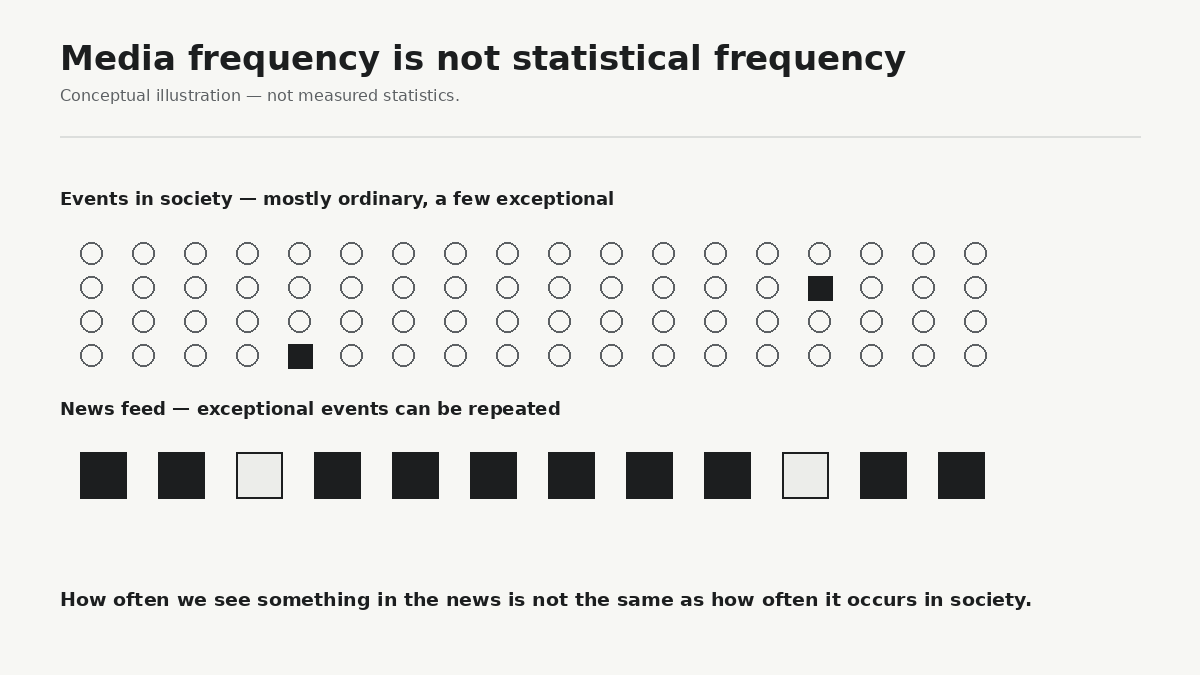
Crime shows this clearly. A person who several times a day sees: murder, assault, robbery, rape, violence, begins building their picture of the environment from events selected precisely because they are extreme. This does not mean the crime is unreal. It means that the frequency of its presence in the news is not necessarily the same as the frequency of its occurrence in society.
That is a fundamental distinction:
media frequency is not statistical frequency.
When the media blur that distinction, they begin creating reality rather than merely reporting it.
Shock has a photograph
Sensationalism is not only a word. It is also an image. A person on a ventilator. A burning house. A bloodied face. A wrecked car. A tank among ruins. A giant red virus. A black graph with a red line rising. A photograph of a frightened child. Within seconds, a television studio can transform a relatively complex statistical fact into an exceptionally clear visual message:
DANGER.
The text beneath the image may be cautious. The headline may use the conditional. But many people see: the photograph, the headline, the first five words. If those three elements scream, caution in the seventh paragraph does not necessarily correct the first impression. A journalist and editor therefore cannot limit their responsibility to the sentence:
It was explained correctly in the article.
If the headline creates a different impression from the article, the headline is also part of the journalistic product.
COVID was almost a perfect laboratory for sensational coverage
In 2020, most of the world followed the same danger at the same time. Every day. For months. A news website had a dedicated section. Television had permanent graphics. The phone had push alerts. Social networks carried an endless flow of new alarms. Infected. Hospitalized. Intensive care. Dead. New variants. New hotspots. New records. The danger was real. People were dying. Health systems were under extraordinary pressure during some periods. But precisely because the crisis was serious, the journalistic standard should have been higher. Not lower. If the public is afraid, it is even more important to: explain the denominator, explain the definition, show uncertainty,
distinguish a model from a forecast, distinguish correlation from causation, and correct an old claim when new data appear. Fear is not permission for carelessness.
Negative news even when the situation is improving
Sacerdote, Sehgal, and Cook analyzed a large sample of COVID coverage. Under their classification, approximately 91 percent of stories in major U.S. national media were negative, while the share was lower among major non-U.S. media and scientific publications. The choice of trends was even more interesting. Stories about rising infections were substantially more common than stories about falling case numbers, even during periods when cases were actually declining. That is the essence of negative selection. A media outlet can report the truth.
But when it has two true stories available:
the situation has improved
and
the danger still exists,
it can always choose the second. If it does so for long enough, the audience has almost no chance to perceive the improvement.
“Record” is the perfect journalistic drug
The word:
RECORD
is extraordinarily effective. Record number of infections. Record heat. Record inflation. Record debt. Record number of migrants. Record price. But a record without context often tells us very little.
A record compared with:
what period?
how many measurements?
how many tests?
what population?
what methodology?
how long has the series existed?
If we increase the number of tests, the number of detected cases can increase. If we increase the number of monitoring stations, we detect more extremes. If we do not adjust nominal monetary amounts for inflation, almost any long enough period will eventually produce a “record.” The word can be technically correct. And still misleading. A journalist who knows that the word “record” will attract attention therefore has a particular responsibility to add context.
A counter that can only rise
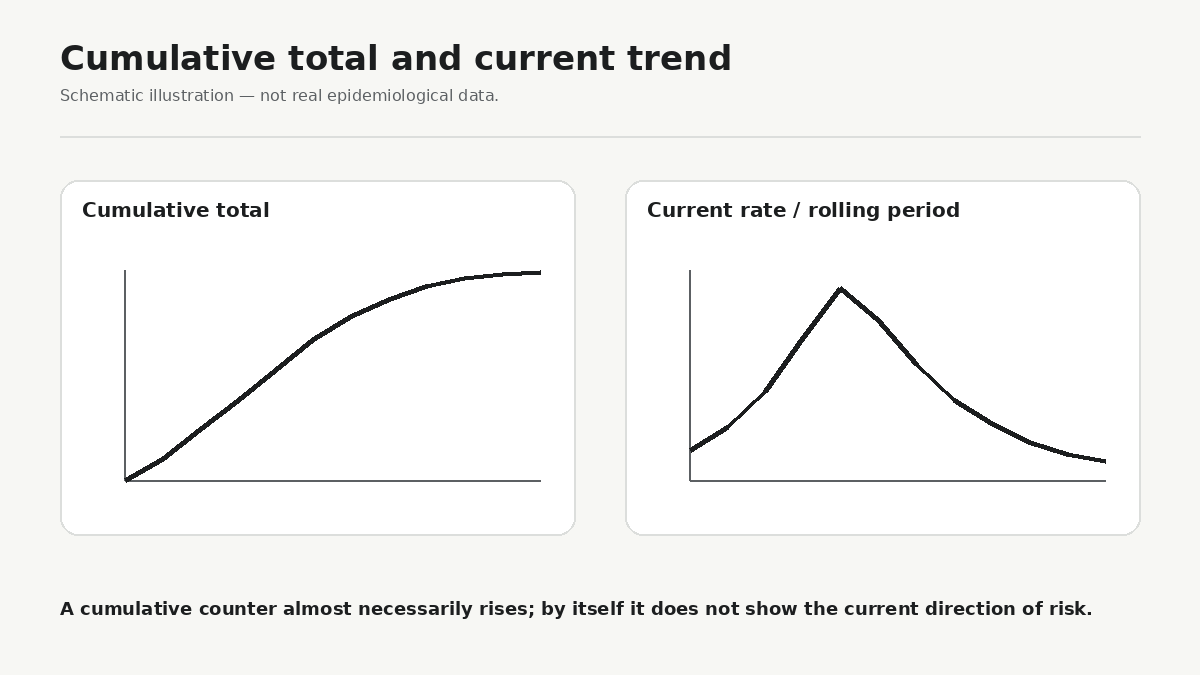
A cumulative counter is especially effective. Total deaths. Total infections. Total damage. If a counter shows a cumulative number, almost by definition it will be: higher tomorrow than today. That is a mathematical property of the indicator.
Visually, however, it looks like:
continuous deterioration.
If we want to understand current danger, it is often more important to know: the direction of the trend, the weekly change, the rate per capita, the age structure, or the current burden on the system. But a red number that rises every evening is much more powerful television. And that is exactly why a responsible media outlet should use it carefully.
“Another 30 COVID patients died”
A number by itself is not enough. We need its definition. As we showed in the previous article, Slovenia's rapid epidemiological system counted people who died after confirmed infection differently from the later determination of the underlying cause of death. That does not mean COVID did not cause a large number of deaths.
It does mean that:
“died after confirmed infection”
and
“died from COVID”
are not automatically the same statistical claim. If a journalist knows the difference but chooses a headline formulation that presents causality more categorically because it is stronger, this is no longer merely simplification. It can be a distortion of the meaning of the data. In our Slovenian analysis, we will examine specific headlines and how often this actually happened.
Fear in more than one hundred thousand headlines
A large analysis of 141,208 English-language coronavirus headlines from the first half of 2020 found a pronounced dominance of negative tone. That in itself is not surprising. A pandemic is negative news. But something else matters: the audience did not merely live through an epidemic. It lived through an epidemic and its continuous emotional interpretation by the media. Every new piece of data could be packaged as: a warning, a danger, a reversal, a new record, a threat, or a reason for further concern. At that point the media are no longer merely a window into the crisis.
They become part of the crisis's psychological environment.
“We are only reporting” is not an adequate answer
Journalists often respond, correctly:
We did not create the disease.
Of course not.
We did not start the war.
Of course not.
We did not cause the murder.
True. But it does not follow that the way they report has no effect. A media outlet chooses: how many times it will repeat the story, how large a headline it will receive, which photograph accompanies it, what comparison it will use, whether it will include the probability, whether it will mention improvement, whether it will present an alternative explanation, and whether it will correct the impression the next day. “We are only reporting” is therefore too comfortable an answer.
Reporting is always selection.
Journalism can become an anxiety industry
Here we have to be uncomfortably direct. If the business model rewards time on page, clicks, repeat visits, reactions, and shares, then a media outlet has a financial interest in a person not becoming completely calm. A calm person closes the app. An anxious person checks again. What happened? Is there anything new? Is the danger closer? Is the situation worse? Do I need to do something? The system can thus create a form of permanent readiness for the next piece of bad news. The media publish a danger. The person becomes uncertain. The media then offer new information supposedly to reduce the uncertainty.
But the new information opens a new danger. And the cycle continues. That is a highly profitable dynamic. It is not necessarily good for the public.
Doomscrolling did not emerge in a vacuum
The term doomscrolling describes behavior in which a person continues consuming negative information even though they feel it is harming them. That can look irrational.
But from the perspective of a survival mechanism, it has a logic:
perhaps the next piece of information is the one I need for my safety.
Digital media and social networks therefore possess an almost perfect combination: an endless stream, negative information, personalization, push notifications, live counters, and the ability to refresh. News is no longer something you watch at seven in the evening. It can become a state you inhabit all day.
.jpg&width=1200)
The media cannot ignore psychological consequences
Studies during the pandemic found associations between intensive consumption of COVID news and greater anxiety, fear, hopelessness, and other psychological difficulties. This does not mean the direction of causality is simple in every study. Frightened people may also seek news more often themselves. But that is precisely why the media must understand that their reporting is not psychologically neutral. If every day they use: the most disturbing image, the most emotional word, the worst statistic, and the worst-case scenario, they cannot later behave as if they have nothing to do with a feeling of permanent catastrophe.
The algorithm is not the editor-in-chief
This is one of the crucial distinctions we must preserve. Facebook may reward a shocking headline. Google may rank it highly. X may spread it.
But a newsroom can still say:
No.
We will not turn a study with a small absolute effect into a “SHOCKING DANGER.” We will not call one possible projection a forecast. We will not deliberately choose a photograph that creates a more dramatic impression than the event itself. We will not publish relative risk without absolute risk. We will not publish a record without comparison. We will not publish growth every day and almost never decline. These are editorial decisions. If journalism hands them over to the algorithm, it has voluntarily surrendered its professional function.
A photograph can be clickbait too
Clickbait is not only text. An article about a relatively ordinary seasonal wave of illness can be illustrated with: an intubated patient, a doctor in full protective equipment, or a computer-enhanced red image of a virus. An article about a local incident can receive a photograph of flashing police lights framed as if the city were in a state of emergency. An article about an economic decline can be illustrated with: a red arrow, darkness, an expression of despair. An editor knows very well that the photograph establishes the first feeling.
If the image is more dramatic than the substance of the article, that is also a form of sensationalism.
The headline and the article can tell two different stories
This is one of the most common practices.
Headline:
SCIENTISTS DISCOVER NEW DEADLY DANGER
Article:
Researchers emphasize that the absolute risk is very small and that more research is needed.
Headline:
NEW WAVE COULD BE THE WORST YET
Article:
This is one of several modeled scenarios.
Headline:
DRUG DOUBLES RISK
Article:
The risk increased from 0.01 to 0.02 percent.
A journalist cannot say:
But it is all explained below.
Many people see only the headline. The newsroom knows this. A headline is therefore a substantive claim, not an advertisement for the article.
Relative risk is a gold mine for sensationalism
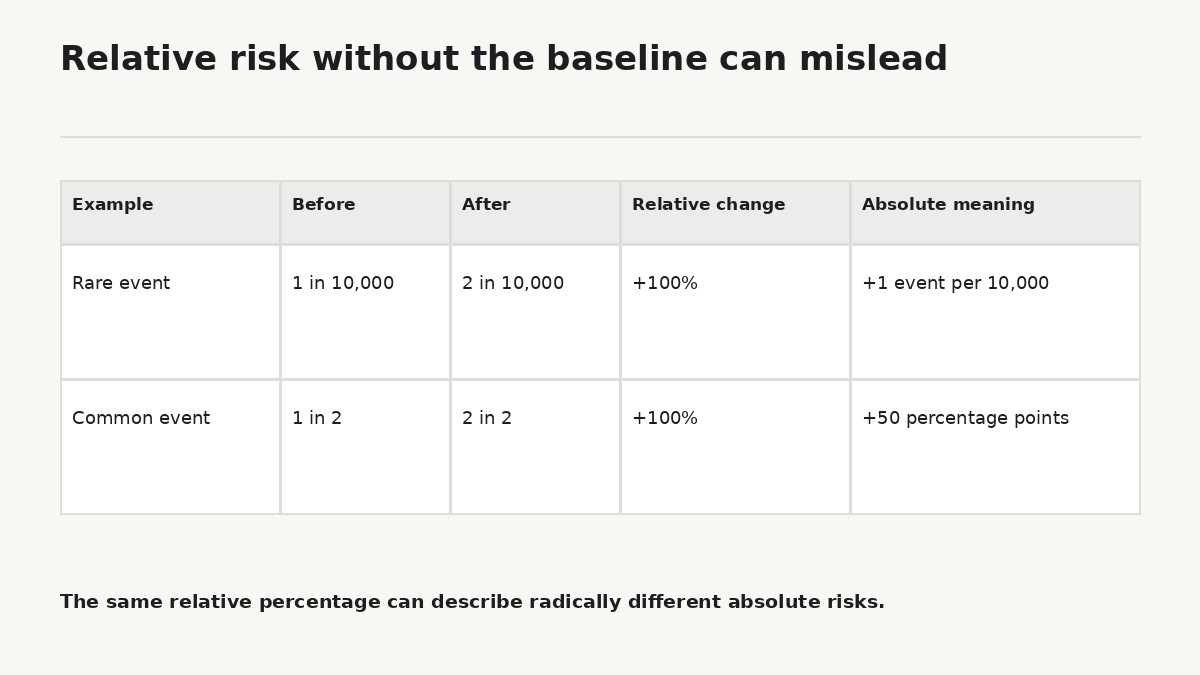
RISK INCREASED BY 100%
sounds important. But: 1 in 10,000 → 2 in 10,000 is just as much a 100-percent increase as: 1 in 2 → 2 in 2. A relative percentage without the baseline risk can create a completely false intuition about the size of the danger.
The same applies in the opposite direction:
50-percent reduction in risk
can sound extraordinary.
But the person also needs the question:
from what to what?
Anyone reporting on health, risk, or science should know this. If they know it but still choose only the larger percentage because it is more clickable, the problem is not ignorance. It is an editorial decision.
The worst-case scenario is almost always a better headline
Models usually contain multiple scenarios. But the media instinctively search for the edge. What could be the worst? How many people could die? How high could it rise? What if the worst variant arrives? The worst-case scenario is a legitimate part of the information.
The problem begins when:
possibility loses its probability.
A model may say:
in an extreme scenario, X is possible.
The headline becomes:
X IS COMING.
At that point the media have not merely shortened a scientific document. They have changed the epistemological status of the claim. Possibility has become prediction.
Shock works in politics, war, and crime too
COVID is simply a particularly clean example. The same mechanism applies elsewhere.
MIGRANT CHAOS.
EUROPE ON THE BRINK OF WAR.
ECONOMIC COLLAPSE.
CRIME EXPLODES.
DEMOCRACY ON THE BRINK OF FAILURE.
Every topic may have genuinely serious substance behind it.
But the journalistic task is to determine:
how serious?
The sensationalist task is different:
how serious can it sound?
Those two goals are not the same.
Fear can become political capital
Media-amplified perceptions of danger do not affect only clicks. They can affect what the public is willing to accept. When people feel threatened, they may be more willing to support: emergency measures, harsher penalties, greater surveillance, military intervention, restrictions on movement, new security measures, or other interventions. This does not mean such measures are automatically wrong. It does mean that the way danger is presented has political consequences. That is why journalistic responsibility in the use of fear is greater, not smaller.
A short-term click can destroy the audience in the long term
Sensationalism also carries its own punishment. People get tired of it. The Digital News Report 2026 finds that 42 percent of respondents sometimes or often actively avoid the news; in 2017, the figure was 29 percent. For several years, the Reuters Institute has found that people cite feelings of overload, a depressing or negative tone, and helplessness as important reasons for withdrawing from news. The irony is almost perfect.
The media discover:
fear increases clicks.
So they use more fear.
Over time, the audience replies:
I do not want to watch this anymore.
Short-term optimization can destroy long-term trust and people's relationship with news.
If everything is urgent, nothing is urgent anymore
Every week: breaking. Every month: historic. Every study: shocking. Every warning: alarming. Every change: dramatic. Words lose their weight. We get alarm inflation. And then a genuinely extraordinary danger appears. But part of the public no longer reacts. Not because the danger is not real.
But because they have already heard a hundred times:
this time it really is serious.
Sensationalism therefore does not only destroy trust in journalism. It can also reduce the effectiveness of legitimate warnings.
A journalist must not be an adrenaline salesperson
This is the point at which journalism has to redefine its own function. A journalist is not paid merely to capture attention. If that were the sole task, the best journalist would be the person who could write the most manipulative headline.
The professional value of journalism must be different:
put the event at the correct scale.
Sometimes that means frightening people. Sometimes reassuring them. Sometimes saying: this is very serious. At other times: this is real, but rare. Or: the number looks large, but the denominator changes its meaning. Or: this is the worst-case scenario, not the most likely one. Or: the trend has reversed. Journalism that can only increase intensity is no longer a good measuring instrument.
Five questions for every shocking headline
-
What is the absolute risk? Not only the relative percentage.
-
Compared with what? Last week, last year, normal conditions, or only a selectively chosen starting point?
-
Is this a trend or one dramatic data point? A single day can say something entirely different from a multi-week average.
-
Is this the most likely result or the worst possible scenario? Possibility is not prediction.
-
Would the media emphasize the opposite change equally? If an increase is front-page news while a decline is a footnote, we have reason to suspect negative selection.
The solution is not to hide bad news
Criticizing sensationalism does not mean: do not report on war. Do not show hospitals. Do not talk about the dead. Do not warn about an epidemic. Do not publish dangers. That kind of journalism would be equally irresponsible.
The difference is simple:
are we measuring the danger or marketing it?
If the danger is catastrophic, the headline can be catastrophic too. But if it is small, uncertain, or merely possible, that should be visible. And when the situation improves, the improvement should be newsworthy.
You do not have to lie to frighten a million people
That is the essence. Sensationalism can be made entirely of true elements. A real death. A real graph. A real study. A real possibility. A real photograph. But: choose the most frightening example, remove the denominator, enlarge the photograph, use red graphics, select the worst scenario, add the word “record,” repeat the story all day, and put the improvement at the bottom of the page. Every part can be technically true. The overall impression can still be severely distorted. That is the responsibility of the media. Not the algorithm. Not the audience. Not only “the system.”
The media.
Because journalism always emphasizes something
An editor has limited space. Television has limited time. A website has a limited front page. Something must be selected. So perfect neutrality does not exist. But there is a difference between: selection that tries to represent importance, and selection that tries to maximize emotional response. The first is editorial work. The second can be manipulation of attention. And that is why sensationalism must be a serious issue of journalistic ethics, not merely something to mock in the tabloid press.
The next problem: when everyone sounds the same
Sensationalism alone does not explain why the same headline frame often appears simultaneously across many different media outlets. Why do they all use on the same day: the same statement, the same expert, the same photograph, the same term, the same political frame? Sometimes because they use the same news agency. Sometimes because they receive the same press release. Sometimes because they all watch the same metrics. Sometimes because media ownership is far more concentrated than the audience realizes. And there are documented cases in which numerous local television anchors literally read almost identical corporate-prepared scripts.
So the next question is no longer merely:
Why does the news frighten us?
It is:
Why do so many different media outlets sometimes speak with one voice?
Sources and further reading
- Robertson, C. E., Pröllochs, N., Schwarzenegger, K., Pärnamets, P., Van Bavel, J. J., & Feuerriegel, S. Negativity drives online news consumption. Nature Human Behaviour 7, 812–822 (2023). DOI 10.1038/s41562-023-01538-4.
- Soroka, S., Fournier, P., & Nir, L. Cross-national evidence of a negativity bias in psychophysiological reactions to news. PNAS 116(38), 18888–18892 (2019).
- Watson, J., van der Linden, S., Watson, M., & Stillwell, D. Negative online news articles are shared more to social media. Scientific Reports 14, 21592 (2024).
- Brady, W. J., McLoughlin, K., Doan, T. N., & Crockett, M. J. How social learning amplifies moral outrage expression in online social networks. Science Advances 7, eabe5641 (2021).
- Romer, D., Jamieson, K. H., & Aday, S. Television News and the Cultivation of Fear of Crime. Journal of Communication 53(1), 88–104.
- Sacerdote, B., Sehgal, R., & Cook, M. Why Is All COVID-19 News Bad News? NBER Working Paper 28110 (2020).
- Aslam, F. et al. Sentiments and emotions evoked by news headlines of coronavirus disease (COVID-19) outbreak. Humanities and Social Sciences Communications 7 (2020).
- Bendau, A. et al. Associations between COVID-19 related media consumption and symptoms of anxiety, depression and COVID-19 related fear in the general population in Germany. European Archives of Psychiatry and Clinical Neuroscience.
- Price, M. et al. The Mental Health Impact of Daily News Exposure During the COVID-19 Pandemic. JMIR Mental Health (2022).
- Reuters Institute for the Study of Journalism. Digital News Report 2025. Reasons for selective news avoidance, overload, and the negative effect of news.
- Reuters Institute for the Study of Journalism. Digital News Report 2026. 42% of respondents sometimes or often actively avoid the news; in 2017 the share was 29%.