When Many Media Outlets Speak with One Voice
A hundred logos do not mean a hundred independent newsrooms: agencies, ownership, costs, and centralized distribution can create an appearance of plurality.

A hundred logos do not necessarily mean a hundred independent editorial perspectives
You switch television channels. A different logo. A different studio. A different presenter. You open the next news portal. A different color. A different name. A different domain owner. But the story is almost the same. The same event. The same quote. The same expert. The same order of information. Sometimes even almost the same words. That can look suspicious. And sometimes it is. But similarity between media outlets has several entirely different possible causes. Media may speak similarly because: they are reporting on the same event, they use the same news agency, they received the same press release, they watched the same press conference,
they do not have enough journalists for their own reporting, they belong to the same owner, they use a shared central newsroom, or they were actually sent a specific text with instructions to publish it. These are not the same things. If we mix them together, we get a conspiracy theory.
If we separate them, we get something much more interesting:
a map of the ways in which an apparently plural media environment can become considerably less diverse in content than the number of its logos suggests.
Similarity by itself does not prove centralized control
If a magnitude 7.5 earthquake occurs, many media outlets will report: where it happened, how strong it was, how many people were affected, what the seismological service says. Similarity is expected in such a case. The facts are the same. The same applies to an election result. A sports result. An official court decision. A statistical-office release. It makes no sense to demand that every media outlet invent a different fact simply to prove its independence.
But similarity becomes more interesting when what matches is not only:
what happened,
but also:
how the event is explained,
which quotes are selected,
who is presented as an authority,
what is omitted,
which political language is used
and
which conclusion is offered to the reader as self-evident.
Then we need to look more deeply into how the news was produced.
First layer: everyone gets the same raw material
Imagine a major international story. An event takes place in a country where a Slovenian media outlet has no correspondent. What does it do? It does not put a journalist on a plane for every story. It uses: Reuters, Associated Press, AFP, STA, other national or international agencies, partner media or official sources. This is a normal part of modern journalism. News agencies are a kind of wholesale infrastructure for news. One reporter at the scene prepares information that is then used by a large number of newsrooms. This allows a small local outlet to report within minutes on: an earthquake in Asia,
an election in South America, a war in the Middle East, or a decision by the U.S. Supreme Court. Without agencies, much international reporting would be practically impossible for smaller newsrooms. But there is a price.
If twenty media outlets draw from the same initial source, twenty logos may simply be twenty versions of one basic story.
A news agency can become the invisible first editor
The agency decides: what is most important, which quote goes in the first paragraph, which background is included, which term is used, and how much space each side receives. A local portal may: shorten the text, translate it, change the headline, add a photograph, and publish it. On screen, it looks like an article from the local outlet. But much of its informational skeleton was built elsewhere.
A 2025 systematic review of research on so-called churnalism found that news agencies play a very important role in this chain and that many news stories closely follow agency copy or other already-prepared journalistic sources. The review also points to a “multi-stage” chain in which an agency itself may draw from a press release, after which its text is picked up by other media.
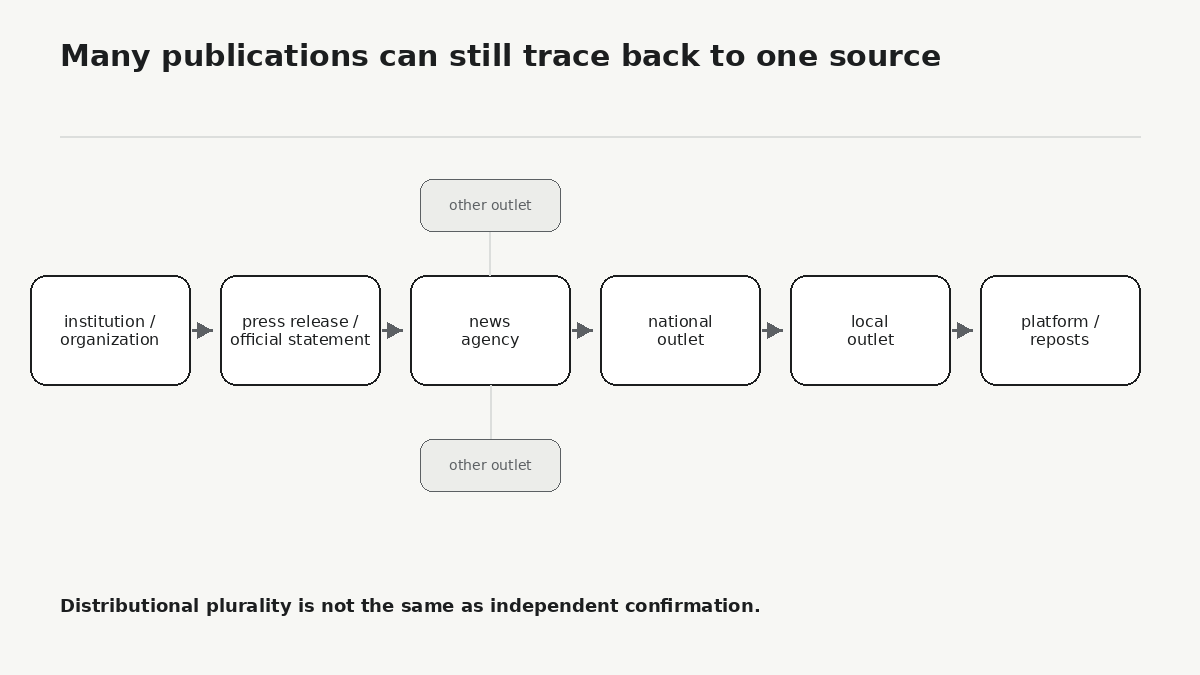
Information can therefore travel:
ministry → press release → news agency → national portal → local portal → social media.
At the end, it looks as if five different media outlets reached the same conclusion. In reality, they may all share the same original source.
Five articles are not always five independent confirmations
This is extremely important when verifying information. Suppose we find a claim on five websites.
At first glance:
five sources.
But if all five are summarizing Reuters, then in evidentiary terms it may be:
one source, five publications.
If Reuters is summarizing the police, the original source may be:
one police statement.
That does not mean the claim is false. It does mean that the number of search results is not the same as the number of independent confirmations.
Serious verification therefore requires us to follow the chain back:
Who actually established this first?
Not:
How many websites published it?
Second layer: the press release
A large part of the information environment does not originate in a newsroom at all. It originates in: a ministry, a company, a university, the police, a non-governmental organization, a political party, a pharmaceutical company, a military institution, a PR agency. The organization prepares: a headline, a summary, quotes, key figures, photographs, video, contact details for statements. The journalist receives an almost finished package. If they have time and resources, they verify it. Call the other side. Find the document. Read the study. Check the methodology. If they do not have time, they may simply rework the package.
A Dutch study covering a ten-year period found that approximately one in ten analyzed newspaper stories had been triggered by a press release, with a somewhat higher share at the news agency. The research did not find simple mass verbatim copying of all press releases, which is an important limitation: PR influence is not the same as complete copying. But a more recent study of scientific reporting on ocean-plastic research found press-release wording in more than half of the analyzed newspaper articles, while the core of the stories often closely followed the original PR material even when paraphrased. This matters.
A journalist does not have to press:
copy → paste
for an organization's message to determine the story.
It is enough for the organization to determine:
what the story will be about in the first place.


Whoever prepares the package already shapes the questions
Imagine a pharmaceutical company publishing the results of a study.
Press-release headline:
New drug reduces risk by 50%.
The media write:
New drug cuts risk in half.
Both statements may be mathematically correct. But if the original study shows a fall in risk: from 2 percent to 1 percent,
then the absolute reduction is:
one percentage point.
If the journalist does not open the study and remains with the prepared summary, the PR department has already defined the strongest frame. That does not necessarily mean the company lied. It means it chose the formulation that best serves its interest. The journalist's job is to know that.
Time is one of the greatest enemies of plurality
Why would a journalist simply summarize prepared material? Because they have to publish. Now. The competitor has already published. The push notification has to go out. The website needs content. The journalist is writing their third article of the shift. The newsroom is smaller than it was ten years ago. The media business model is under pressure. Centralized content is cheap. Original reporting is expensive. A journalist who spends three days investigating a document costs more than a journalist who rewrites ten agency stories in one day. Media economics can therefore produce homogeneity by itself. Not because an owner called and said:
Everyone write the same thing.
But because the system rewards:
speed, cheap production, and reuse of already-prepared content.
Third layer: a common owner
Now we reach a stronger mechanism. Two media outlets may have: different names, different local histories, different frequencies, different presenters, and still have the same owner. That creates the possibility of sharing: journalists, footage, editors, technology, national reports, commentary, graphics, legal services, and entire content packages. This makes business sense. If one national segment can be used on a hundred local stations, it is much cheaper than having a hundred local newsrooms produce a hundred different segments.
But something democratically very important may be reduced in the process:
editorial diversity.
When an acquisition changes the news
Gregory Martin and Joshua McCrain analyzed more than 7.4 million segments of local television news on 743 U.S. stations. They paid particular attention to stations acquired by Sinclair Broadcast Group in 2017. After the acquisition, those stations increased their coverage of national politics by roughly a quarter relative to the baseline, mainly at the expense of local politics. At the same time, their political language shifted to the right relative to other stations in the same market. Especially important: the change did not produce a clear increase in viewership.
That suggests the shift cannot simply be explained by:
“the audience demanded this kind of content.”
The authors found that ownership has a measurable effect on content and that conglomerates gain substantial cost advantages from centrally produced national material. That is the essential finding.
Ownership is not merely a financial detail at the bottom of a website.
It can change what counts as news.
But concentration does not always produce worse journalism
Here too, we should not turn one study into a universal law. A more recent study of more than two million articles from 108 Swedish newspapers between 2014 and 2022 found a more complicated result. Consolidation was associated with greater homogenization of content — outlets used more shared material and somewhat less local news. But the researchers also found slight improvement in some indicators of journalistic quality. Why? Because a larger system can share more efficiently: technology, specialists, knowledge, administration, and costs.
Therefore:
a larger owner does not automatically mean a worse media outlet.
But a larger owner can mean:
fewer independent editorial decisions.
Those are two different questions.
A hundred local stations, one corporate infrastructure
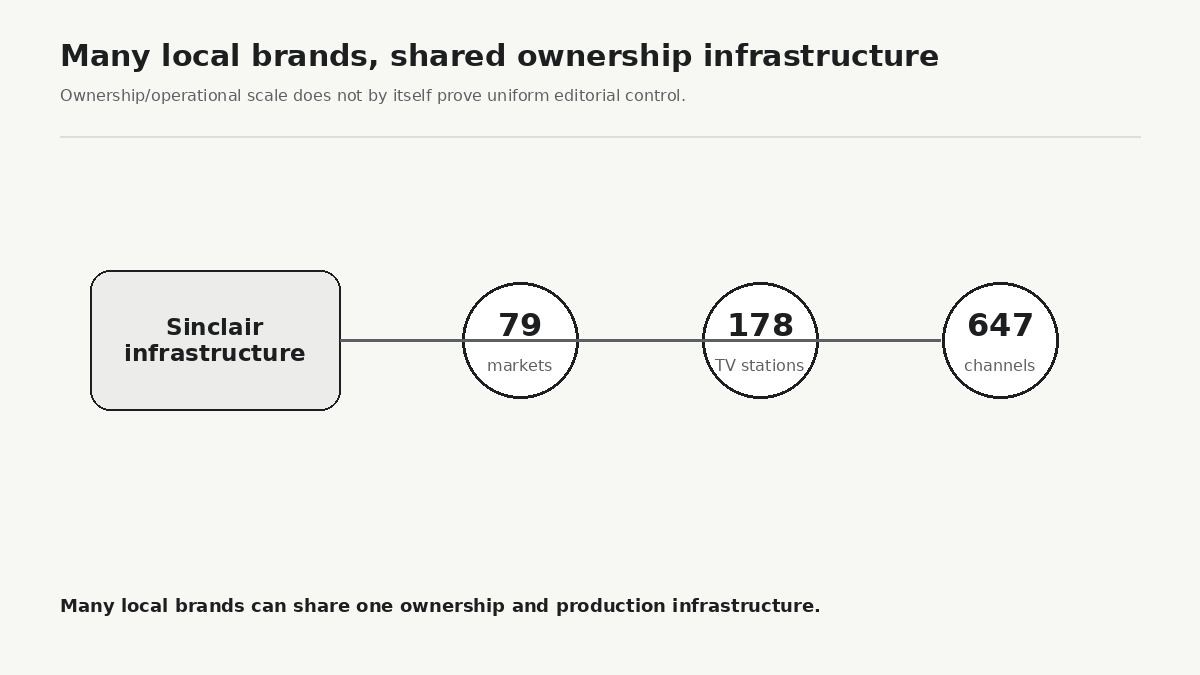
Sinclair remains an especially useful example because its size makes the relationship between local branding and central infrastructure very clear. According to its own reporting, in June 2026 Sinclair owned, operated, or provided certain programming or operational services to 178 television stations in 79 markets, broadcasting 647 channels. A viewer may see: a local station, a local presenter, a local weather forecast, a local name. But part of the infrastructure is shared. That alone does not mean political control. It does mean there is a technical capacity for centralized distribution of content on a very large scale.
And in Sinclair's case, we know that this capacity did not remain merely hypothetical.
When there is no longer any doubt: the same script really was sent to everyone
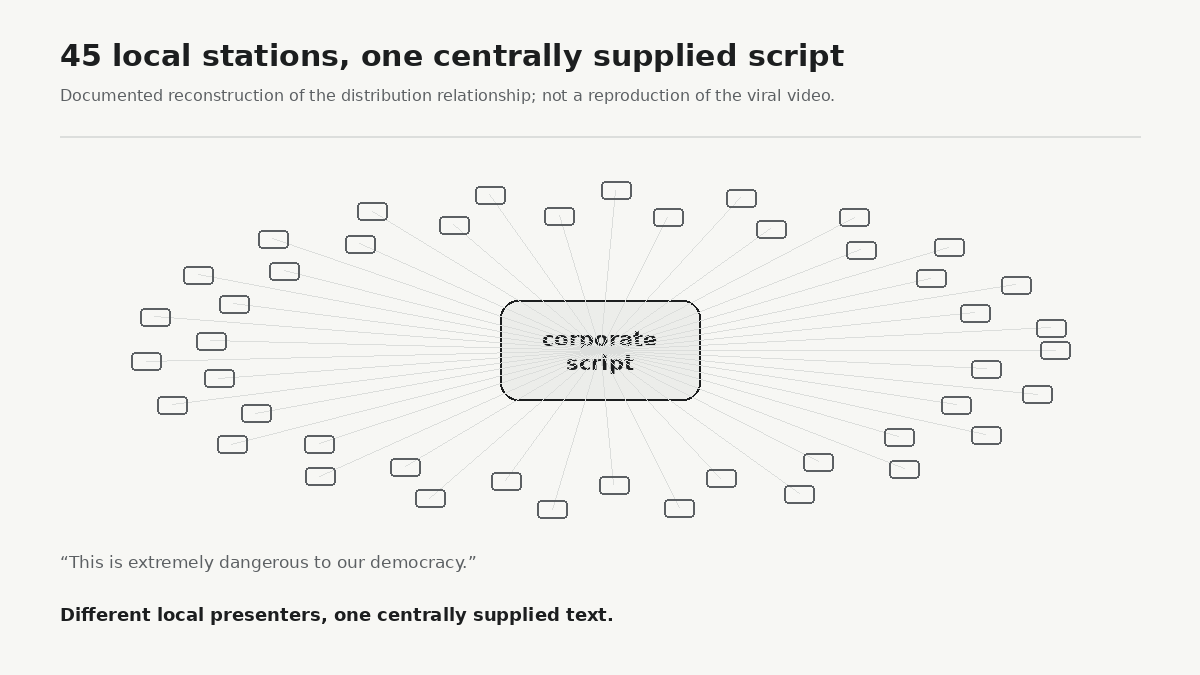
In 2018, an unusual video spread across the internet. It cut between anchors at numerous local U.S. television stations. Men. Women. Different cities. Different studios. Different logos. But they were saying almost exactly the same sentences. The montage combined footage of anchors from 45 Sinclair stations reading language about “biased and false news” and warning that some media outlets use their platforms to push their own agendas. The closing sentence became famous:
“This is extremely dangerous to our democracy.”
This time, it was not a theory that the anchors had simply happened to use similar wording. Sinclair had in fact sent the local stations one standardized corporate-prepared script, and their anchors were required to record and air it. This is a documented example of a centralized message. When a corporation distributes one standardized editorial message to local stations and audiences receive it under dozens of local brands, that is not plurality. It is centrally coordinated editorial distribution.
The paradox of the message
The strangest part of the Sinclair case is the content of the statement itself. The anchors warned viewers about the danger of: one-sided reporting, agendas, manipulation, and media that want to control what people think.
But the warning was:
read by dozens of local anchors from the same script prepared by their corporate headquarters.
That is why the montage became so effective. It needed no commentary.
It simply showed:
an apparent multitude of independent local voices simultaneously reciting the same centrally written sentence about the danger of controlled media.
“Must-run”
Sinclair's system also included so-called must-run segments. These were centrally produced pieces that certain local stations were required to include in their broadcasts. They included political commentary.
This matters because of the difference between:
a local newsroom voluntarily deciding to use a centrally produced report,
and
a corporation requiring that report to be aired.
The first situation is content cooperation. The second is editorial hierarchy. Academic research on Sinclair acquisitions identified must-run content as one important mechanism through which national and more politically oriented material spread across local stations.
Sinclair is not only about a video that became a meme
The easiest way to end the article would be with the viral montage and say:
See, all media are controlled.
That would be wrong. The systemic research is more important. Analysis of local stations before and after Sinclair acquisitions shows that their content actually moved closer to the pattern of Sinclair's existing stations after the ownership change.
So we do not merely have:
one strange corporate promotional message.
We also have empirical evidence that:
a change of owner can change the editorial product.
Ownership does not require a phone call to every journalist
When people think about owner influence, they often imagine a caricature. A billionaire calls the editor:
Write this today.
Sometimes direct orders do exist. But the system can be much subtler. The owner selects: the editor-in-chief, management, the budget, staffing levels, the organizational structure, central content services, performance metrics, which programs will be cancelled, which content will be shared between outlets. The editor then selects journalists. The journalist learns what kind of story gets space. Over time, a direct order may no longer be necessary at all. The organization develops a culture. That does not mean every journalist automatically adopts the owner's political preferences. It does mean that the ownership structure creates the environment within which the journalist works.
Cost may be even more important than ownership
The owner does not have to be ideologically motivated. That is one of the more important findings from the research. A centralized national story is cheap. A local story is expensive. For a local story you need: a local reporter, time, contacts, fieldwork, a camera, verification. A central segment is produced once. Then it is distributed to a hundred stations. Homogenization can therefore arise entirely from economies of scale. That may be less dramatic than a theory of political control.
But the effect can still be:
fewer different eyes on the same world.
Co-owned media begin to resemble one another
This phenomenon is not limited to Sinclair. A large international study analyzed 591,532 articles published in 2,505 newspapers in 116 countries about U.S. or multinational military operations in Iraq, Afghanistan, Libya, and Kosovo. The result: newspapers in the same ownership chain were more similar to one another in terms of: the volume of coverage, topic selection, and content diversity than newspapers with different owners. That does not mean they all publish the same political commentary. It does mean that common ownership statistically reduces some content heterogeneity. And that matters for democracy.
Plurality of logos versus plurality of origin
Imagine a city with six news portals.
It looks like:
six media outlets.
But if: two belong to the same company, three rely primarily on the same agency, four are summarizing the same press conference, and all six have too little time for independent verification, actual plurality is less than six.
Media pluralism should therefore be measured on several levels:
How many brands do we have?
How many owners?
How many independent newsrooms?
How many reporters in the field?
How many original information sources?
Those are very different numbers.
Multiple outlets can create a false sense of confirmation
This problem is especially important for the audience. We see the same information: on television, in a newspaper, on portal A, on portal B, on radio.
We conclude:
everyone is confirming it.
But perhaps everyone is summarizing: one agency. Or one police statement. Or the same study. Or one government press conference. Media plurality can therefore be partly an optical illusion. Different distributors are not necessarily different investigators.
The state as a wholesale supplier of information
In crises and politics, one source is especially important: the state. A government prepares: a press conference, statistics, an official statement, video, photographs, an expert, questions and answers. Within minutes, all media outlets have the same raw material. If they lack time or access for independent verification, much of the coverage will inevitably look similar. We have seen this with: wars, pandemics, terrorist attacks, natural disasters, police incidents. This does not require the state to control the media.
It is enough for it to be:
the fastest, best organized, and most easily accessible source.
Institutional power thereby becomes an informational advantage.
Convergence without conspiracy
This is one of the most important lessons of the entire series. If twenty media outlets report very similarly, there are two overly easy explanations. The first:
If they all say the same thing, it must be true.
The second:
If they all say the same thing, they must all be centrally controlled.
Both can be wrong. Similarity can arise from: the same source, the same agencies, the same deadlines, the same economic pressures, the same owner, the same professional routines, the same algorithms, the same PR material. This is structural convergence. It does not require a secret room. But that does not mean central control never exists. The Sinclair case proves that it can also exist very directly.
So we must always ask:
which mechanism can we document?
Four levels of similarity
| Level | What we see | What we can conclude |
|---|---|---|
| 1. Same facts | Media report the same basic information about the same event | Completely normal; by itself it tells us nothing about coordination |
| 2. Same source | Identical quotes, same structure, same agency or PR material | There is a common informational origin; this does not mean common editorial control |
| 3. Common ownership or centralization | Several outlets share content, staff, or a central newsroom | The independence of individual brands is lower than their number suggests |
| 4. Centrally mandated message | Different stations receive the same script or mandatory segment | Documented direct editorial coordination |
This distinction is essential.
Without it, we can use the real Sinclair example to make the unsupported claim:
all media always receive the same script.
The evidence does not show that.
It does show something serious enough without exaggeration:
the media system contains multiple mechanisms that can reduce the actual diversity of information.
What about the journalist?
Professional responsibility does not disappear here either. A journalist often cannot control: ownership, staffing levels, the agency subscription, the corporate structure.
But they can ask:
Who is the original source?
Can I get independent confirmation?
Did I merely translate agency copy?
Did I read the document?
Did I call the other side?
Do all my “sources” actually trace back to the same institution?
Did I add anything that was not in the original PR package?
That is the difference between:
information distribution
and
journalism.
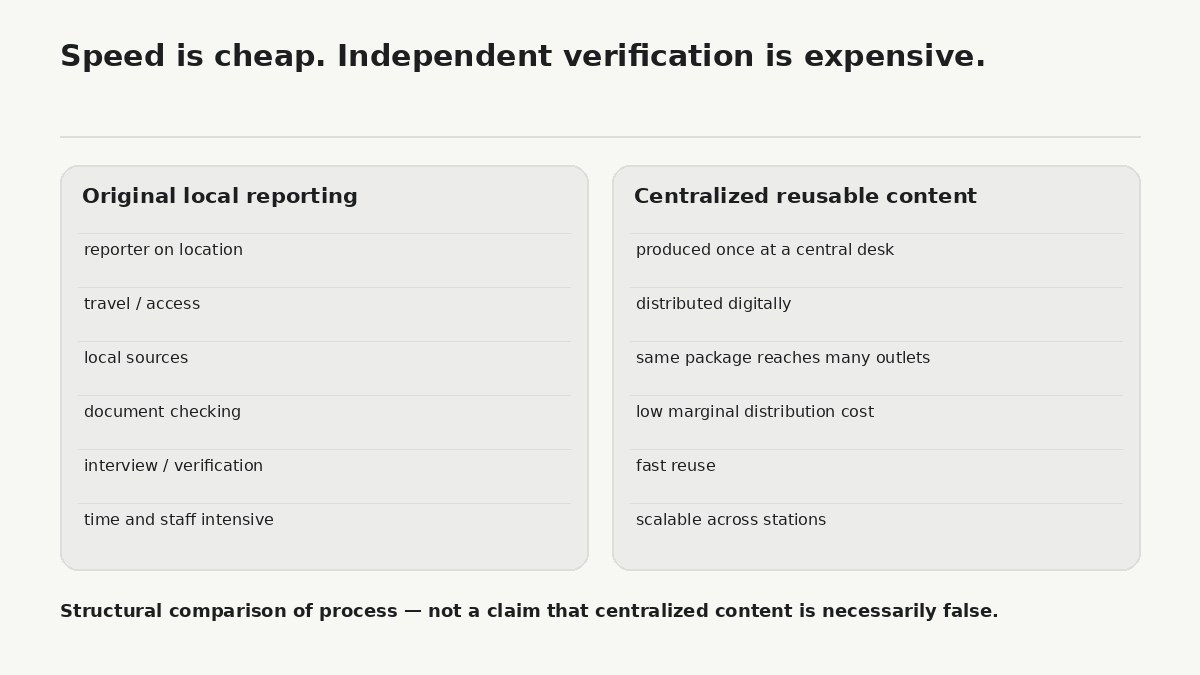
Speed is cheap. Independence is expensive.
Truly independent reporting requires: time, people, money, access, knowledge. That is why media economics are directly connected to media pluralism. If newsrooms cut local reporters while increasing the amount of content, what follows is almost inevitable: more agency material, more PR material, more centralized content, more summaries of other media. This is not necessarily an ideological project.
But the democratic result can be similar:
fewer people are actually checking reality first-hand.
Investigation is more expensive than summarizing
Suppose a ministry announces:
the new measure is effective.
First model of journalism: the journalist publishes the statement. Ten minutes. Second model: reads the study, checks the methodology, calls an independent expert, looks for contradictory data, asks the ministry for an additional document. Several hours or days. Which model is cheaper? The answer is obvious. If a media business model rewards volume and speed, independence does not necessarily disappear because of censorship. It can simply be crowded out by economics.
When the local disappears
Centralization has another consequence. National politics is cheap to distribute to hundreds of stations. A local municipal meeting is not. But democracy does not happen only in the capital. It happens at: the municipal council, the local health institution, the school board, a local construction project, a public utility. If a centralized owner concludes that a national political segment is cheaper and more shareable than a local investigation, the viewer can receive more politics while knowing less about the government closest to home. The Sinclair study found exactly such a shift from local toward national politics after acquisition.
Owners are not invisible
The Digital News Report 2026 asked people in 26 countries which groups they believed influence the news. The groups included: politicians, experts, advertisers, activists, and media-company owners. Owners were perceived as an important source of influence; in some countries, including the United States and Australia, respondents rated their influence even higher than that of other listed groups. This is public perception, not proof of a specific editorial intervention.
But it shows that the question:
who owns the media outlet?
is not a marginal issue.
How do we recognize an apparent multitude of voices?
When several media outlets publish the same story, check:
Do they cite the same source?
If all of them cite Reuters, we do not have five independent confirmations.
Is the wording similar?
Unusually identical sentences may indicate agency copy or a press release.
Do they have the same owner?
Different brands may belong to the same group.
Do they use the same footage or expert?
There may be only one original information package.
Is anyone doing original reporting?
Is there a reporter in the field? Did the outlet obtain a document? Conduct an interview? Check the number?
Those are better questions than:
How many media outlets published the same thing?
The problem is not that media use agencies
Without news agencies, the information world would be poorer. The problem is not that a company issues a press release. The problem is not that a media group shares certain content. The problem begins when the audience can no longer see the difference between original reporting and redistribution. If one underlying source begins to look like several independent confirmations merely because it appears under several logos, the result is a misleading appearance of plurality. If ten websites publish the same agency story, that may be an excellent distribution system. It is not ten independent investigations.
If a local television station airs a centrally produced national report, that is not necessarily bad. But it is not a completely local editorial decision. Transparency here is not a minor detail. It is how the audience understands the actual structure of information.
The greatest power is not always in what you are required to publish
It can also lie in what you can no longer afford to investigate. If you have fewer local reporters: fewer people attend meetings. Fewer people examine documents. Fewer people speak with local sources. If at the same time you receive large amounts of cheap central content, the daily space still fills up. The audience still sees news. Perhaps it even sees more of it.
But:
more content does not necessarily mean more independent journalism.
That is one of the great paradoxes of modern media.
A hundred channels can mean only a few sources
Never in history have we had so many: portals, channels, podcasts, posts, videos, commentators. It seems that this must mean the greatest informational plurality ever. To some extent, it does. But beneath the surface, many streams can flow from a much smaller number of sources: agencies, state institutions, large media groups, platforms, the PR industry. So we should not measure informational plurality only by the number of windows.
We should ask:
how many different people are actually looking through them?
When everyone says the same thing, do not jump to conclusions
When many media outlets sound alike, both reflexive reactions are dangerous.
“They all say the same thing, so it must be true.”
and
“They all say the same thing, so someone controls them all.”
The correct answer is slower. Trace the origin. Look at ownership. Find the agency. Check the press release. Compare the texts. See who actually did the original reporting. Only then can we determine what we are looking at: normal journalistic convergence, economic centralization, a PR chain, ownership-driven homogenization, or an actually centrally mandated message. Sometimes we will find the first. Sometimes the last. Sinclair proves that the last possibility is not imaginary. But the seriousness of that case lies precisely in the fact that we can prove it.
The next question: who decides which voice is dangerous?
Once a system already uses: shared sources, central communication points, agencies, platforms, and rapid-distribution networks, the next question appears.
What happens when a particular piece of information is judged not merely wrong, but:
disinformation?
Who makes that decision? The government? A health organization? An intelligence service? A fact-checker? A technology platform? A media outlet? And what happens when a claim labeled dangerous misinformation today turns out tomorrow to have been a legitimate question?
Then we are no longer talking only about:
who gets the microphone.
We are talking about:
who has the power to turn the microphone off.
That will be the subject of the next article.
Sources and further reading
- Martin, G. J., & McCrain, J. Local News and National Politics. American Political Science Review. Analysis of more than 7.4 million segments on 743 local television stations and changes following Sinclair acquisitions.
- Stanford Graduate School of Business. Media Consolidation Means Less Local News, More Right Wing Slant. Summary of the findings by Martin and McCrain.
- Washington Post. Paul Farhi. As Sinclair’s sound-alike anchors draw criticism for ‘fake news’ promos, Trump praises broadcaster, April 2, 2018. Documentation of the standardized corporate script for local anchors.
- Washington Post. Sinclair faces fallout from viewers and Democratic candidates over ‘fake news’ promos, April 5, 2018.
- Sinclair, Inc. / SEC. Second-quarter 2026 report: 178 television stations in 79 markets and 647 channels as of June 30, 2026.
- Martin, G. J., & McCrain, J. Research on local-television consolidation and the effects of group ownership on local reporting.
- Baum, M. A., & Zhukov, Y. M. Media Ownership and News Coverage of International Conflict. Political Communication. Analysis of 591,532 articles from 2,505 newspapers in 116 countries.
- Media consolidation and news content quality. Journal of Communication, 2025. Analysis of more than two million articles from 108 Swedish newspapers; content homogenization was found alongside some simultaneous improvements in quality.
- Copy, paste, and publish: a systematic review of churnalism as a journalistic practice. Annals of the International Communication Association, 2025.
- Boumans et al. Subsidizing The News? Journalism Studies. Ten-year analysis of the influence of 4,455 press releases on Dutch media and a news agency.
- Journalism Versus Churnalism: How News Factors in Press Releases Affect Journalistic Processing of Ocean Plastic Research in Newspapers Globally. Journalism Studies, 2024.
- Reuters Institute for the Study of Journalism. Digital News Report 2026. Data on perceived influence of politicians, owners, advertisers, and other actors on news.