Who Decides What Is Disinformation?
How error, disinformation, and open questions differ, and what happens when expert labels are combined with the distribution power of platforms.

When protection from falsehood becomes the power to decide which questions may be asked at all
A warning appears on the screen.
False information.
A post loses reach. A video disappears from recommendations. An account receives a warning. An article is labeled unreliable. Perhaps the measure is entirely justified. Perhaps someone really is spreading a fabricated cure, a manipulated video, a fake quote, or state propaganda disguised as independent media. But the word disinformation has a particular power.
Once something receives that label, the discussion often changes. The question is no longer:
Is the claim correct?
It becomes:
Why is this person spreading lies?
And this is exactly where the problem begins. What if the claim has not yet been proven, but has not been disproven either? What if science does not yet have an answer? What if the information is true but presented without context? What if a prediction is wrong, but was reasonable when published? What if an authority labels a claim disinformation and two years later it turns out to have been at least a legitimate hypothesis?
Then the question is no longer only:
How do we stop falsehoods?
It becomes:
Who gets the power to decide when the debate is over?
First, we have to use the words correctly
The World Health Organization distinguishes fairly clearly between misinformation and disinformation. Misinformation is false information that a person shares without an intention to deceive. They may sincerely believe it is true. Disinformation, by contrast, is false information that someone knowingly creates or spreads while knowing it is false and with the intention of deceiving or causing harm.
The key distinction therefore is not only:
whether the information is false,
but also:
what its author knew and what they intended to achieve.
This matters more than it may seem. If a person makes a claim in 2020 that they believe to be correct and it turns out in 2022 to be wrong, that alone does not make it disinformation. It may be: a mistake, a poor judgment, a premature conclusion, bad research, or an honest hypothesis that later failed. To use the word disinformation, we should show something more: that the person knew the claim was untrue, or consciously manipulated information. That is a much higher evidentiary threshold.
Then there is “malinformation”
The U.S. Cybersecurity and Infrastructure Security Agency, CISA, has also used a third term in its materials: malinformation. It defined this as factual or true information taken out of context and presented in a way intended to cause harm. In the same framework, CISA described misinformation as false information regardless of intent, and disinformation as intentionally created false information designed to deceive. Here the boundary becomes even more complicated.
With disinformation, in principle at least, we can ask:
Is the claim false?
With “malinformation,” the information itself may not be false at all. The problem is supposed to be: context, intent, timing, or the harm it may cause.
This shifts information control away from the question:
What is true?
toward a much broader question:
What are people allowed to do with true information?
That does not mean true information can never be abused. Publishing someone's private medical record, the precise location of a victim of violence, or military positions can cause very concrete harm. But that is no longer primarily a problem of truth. It is a problem of: privacy, security, context, ethics, or law. If all of these are collapsed into a broad category of “information disorder,” we can quickly lose the crucial distinction between:
a falsehood
and
an unwanted truth.
Disinformation is a real problem
Criticism of systems for combating disinformation must not become denial of the phenomenon itself. Organized information operations do exist. In September 2024, the U.S. Department of Justice announced a court action seeking the seizure of 32 domains as part of an operation called Doppelganger. According to court documents, Russian organizations acting under the direction of the Russian presidential administration used websites designed to imitate legitimate media outlets, including U.S. media brands.
They allegedly used fake web addresses, fake profiles, paid advertisements, influencers, and AI-generated content to present state propaganda as authentic local journalism. According to U.S. authorities, the objectives included reducing support for Ukraine and influencing voters. That is a very different situation from a scientist who has an incorrect hypothesis. Here we allegedly have: concealment of origin, imitation of legitimate media, false identities, organized distribution, and a deliberate intention to influence.
Similarly, in the Internet Research Agency case, the U.S. Department of Justice documented a system for creating false American identities and profiles in order to influence political debate. So the problem is not the word disinformation itself. The problem begins when the same label is applied to phenomena that are not evidentially comparable.
A fake account is not the same as an incorrect scientific conclusion
If someone creates a fake website pretending to be The Washington Post, the problem is fairly clear. If someone alters a video so that a person appears to say something they never said, likewise. If someone knowingly publishes a forged document, its authenticity can be checked. But what do we do with the statement:
This virus may have escaped from a laboratory.
In 2020, such a claim was often placed in a very different informational category than it is today. And this is exactly why the time dimension is essential in fact-checking.
A case we can no longer ignore: the origin of SARS-CoV-2
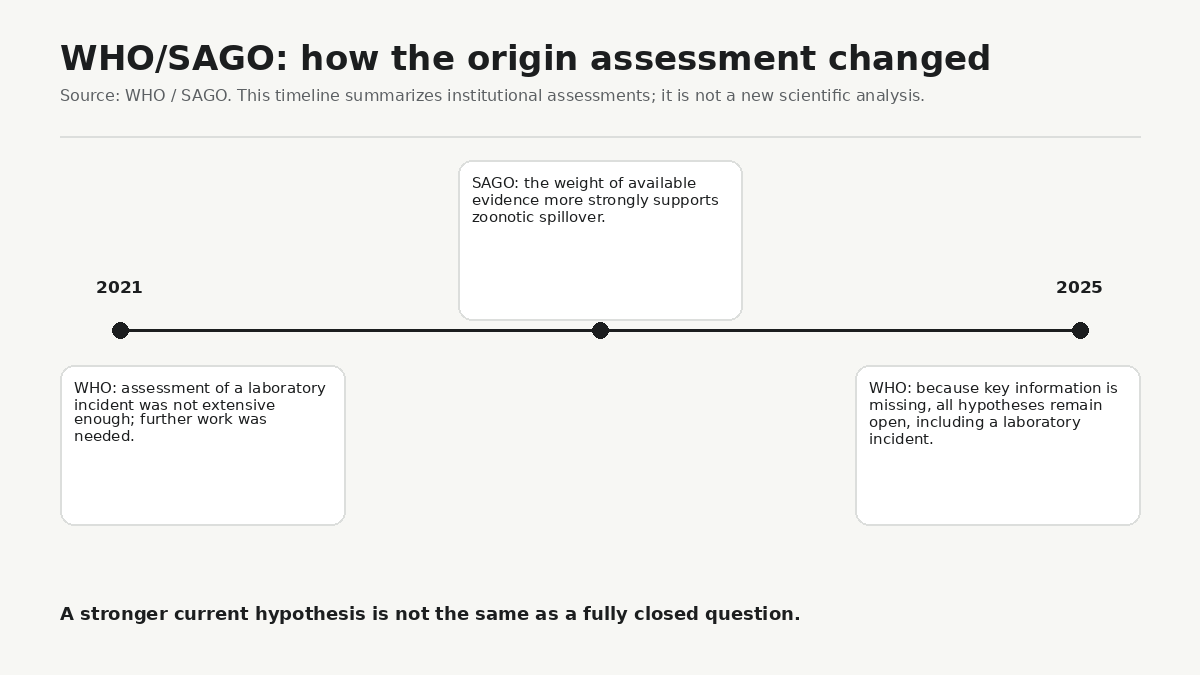
On February 19, 2020, The Lancet published a letter signed by 27 scientists who wrote that they “strongly condemn conspiracy theories” suggesting that COVID-19 did not have a natural origin. They added that, in their view, scientific analyses overwhelmingly supported an origin in wildlife. The context matters. At the time, completely unsupported claims were also circulating publicly: that the virus was a deliberately engineered biological weapon, that it had been intentionally released, that there was proof the virus had been artificially constructed. Much of that had no evidence behind it. But the wording in The Lancet was broader.
“COVID-19 does not have a natural origin” also encompassed the possibility that a naturally occurring virus, or its ancestor, could have come into contact with humans as the result of a laboratory incident. Those are not the same scenarios.
A laboratory incident does not necessarily mean a genetically engineered virus.
And it means an intentional biological attack even less.
What was labeled a conspiracy theory later remained an open question
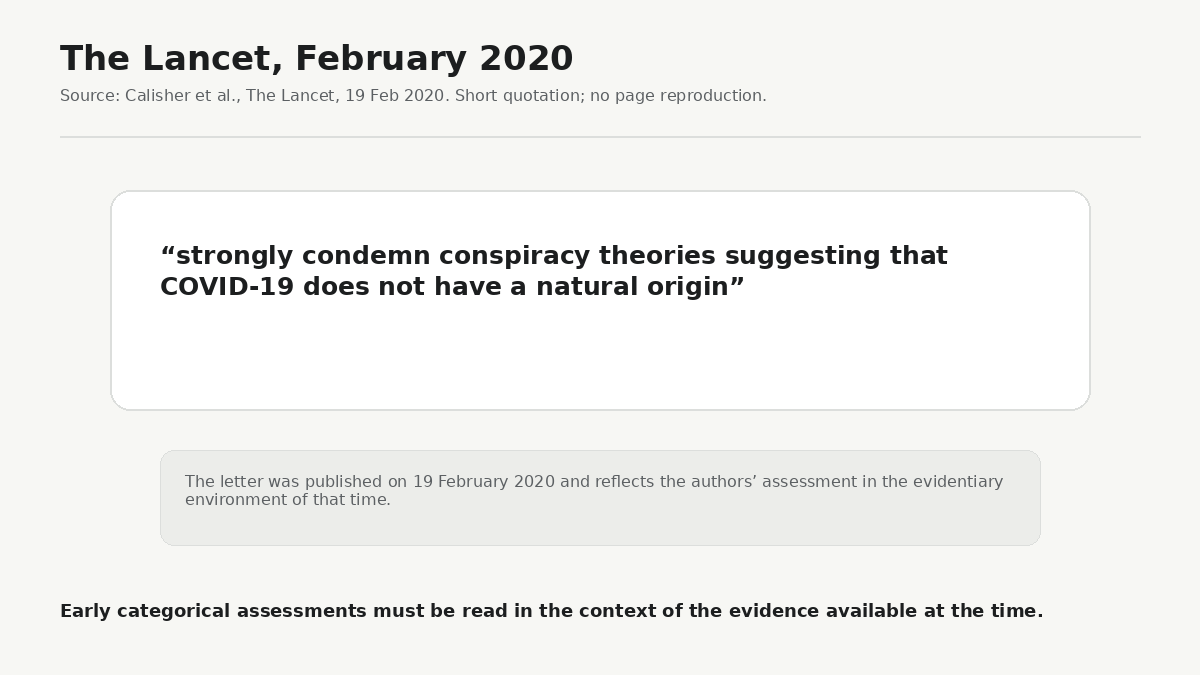
As early as March 2021, after the publication of the joint WHO-China report, WHO Director-General Tedros Adhanom Ghebreyesus explicitly said that the assessment of a laboratory incident had not been extensive enough and that further data and studies were needed.
His formulation was clear:
all hypotheses remain on the table.
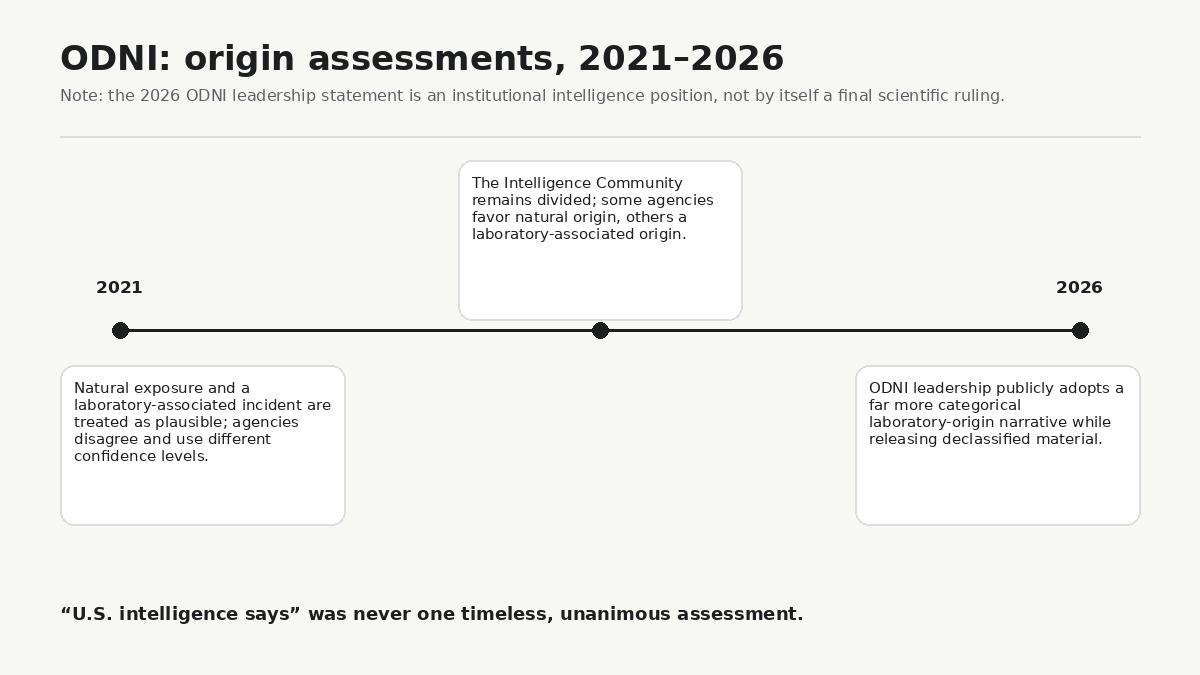
The U.S. intelligence community likewise assessed in 2021 that two main possibilities remained plausible in the sense of serious hypotheses: natural animal-to-human transmission, and a laboratory-associated incident. Agencies disagreed over which was more likely. By 2023, the split was even more obvious. The FBI and the U.S. Department of Energy assessed a laboratory-associated incident as more likely, several other intelligence elements favored a natural origin, while the CIA and one other agency had not at that time selected one explanation. Nearly all agencies simultaneously assessed that SARS-CoV-2 was not genetically engineered, and all assessed that it had not been developed as a biological weapon.
This separation is essential.
Laboratory incident ≠ genetic engineering ≠ biological weapon.
What does WHO say today?
In June 2025, after years of work, WHO's expert group SAGO published a new assessment.
Its conclusion was:
the weight of currently available evidence supports zoonotic spillover.
That matters and should not be omitted. But WHO simultaneously said something else: much of the data needed for a complete assessment had not been provided, and China had not supplied several requested early viral sequences, animal data, and details about research and biosafety in Wuhan laboratories.
Tedros therefore again said:
all hypotheses must remain on the table, including zoonotic transmission and a laboratory incident.
This means something very concrete for our subject.
Today it would not be scientifically correct to say:
a laboratory origin has been proven.
But it is likewise difficult to defend the idea that in February 2020 the entire possibility of a laboratory incident should have been filed under the label:
conspiracy theory.
By 2026 the picture had become even more political
In June 2026, the U.S. Office of the Director of National Intelligence under Tulsi Gabbard released a large collection of declassified material together with a much more categorical message: the office claimed that research in Wuhan, including research supported with U.S. funding, was connected to a laboratory incident that started the pandemic, and that competing assessments had been suppressed. But this too should not be transformed into a new absolute truth.
It is the current claim of the executive leadership of the U.S. intelligence community, not by itself a final scientific judgment. Public analysis of the released documents has already argued that the materials do not establish all of the categorical claims the ODNI leadership attributed to them. That makes the case an almost perfect illustration of the problem.
In 2020:
conspiracy.
In 2021:
a hypothesis requiring further investigation.
In 2023:
U.S. institutions are divided.
In 2025:
WHO gives greater weight to zoonosis but does not exclude a laboratory incident.
In 2026:
U.S. political-intelligence leadership categorically supports a laboratory origin, but that does not automatically end the scientific dispute.
If an information-moderation system has only two categories:
truth
and
disinformation,
it will almost inevitably make mistakes on questions like this.
Sometimes the correct answer is: we do not know yet
That is a category the digital environment handles poorly. A platform wants a decision. A fact-check wants a label. A politician wants a clear answer. Television wants a headline.
But science often needs a third option:
uncertain.
Or:
there is not enough evidence.
Or:
one hypothesis currently has more support, but the other cannot be excluded.
These are not weak answers. They may be the most precise answers available at that moment.
Hunter Biden: another form of the same problem
On October 14, 2020, the New York Post published stories based on data said to have come from Hunter Biden's laptop. The provenance of the material was unusual. It came through Rudy Giuliani. The election was less than three weeks away. After the Russian operation in 2016, there was a reasonable fear of another hack-and-leak operation. Caution was therefore not irrational.
But what happened next matters for the question:
who decides what is suspicious enough to justify restricting distribution?
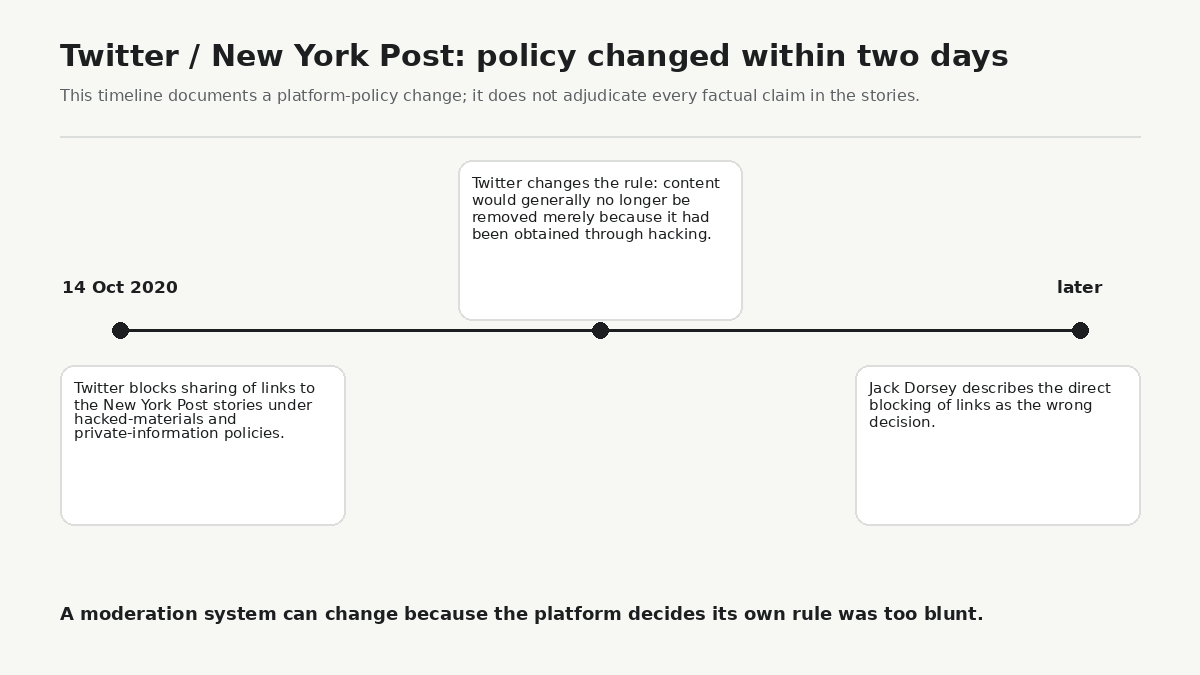
Twitter blocked the link
On October 14, Twitter prevented users from sharing links to the New York Post articles. In documents submitted to the U.S. Federal Election Commission, former Twitter security chief Yoel Roth explained that the team believed the material might have originated from a hack and applied the platform's “hacked materials” policy and private-information policy. But only two days later Twitter changed the policy. Under the revised approach, content would no longer be removed merely because it had been obtained through hacking, except where it was directly published by hackers or their collaborators. Instead of blocking, Twitter would use labels and context. Then-CEO Jack Dorsey described the direct blocking of links as the wrong decision.
This is an important example. The platform did not merely learn a new fact later. It also concluded that its decision-making mechanism itself had been too blunt.
The FBI had more information than the public did
Later congressional testimony revealed another unusual layer. In one published transcript, former FBI official Laura Dehmlow described a meeting with Twitter representatives in which someone from Twitter asked whether the laptop was real. According to her testimony, an FBI representative confirmed that it was, before another participant cut off the discussion by saying there would be no further comment. Congressional documentation summarizing additional testimony also states that the FBI had seized and verified the hard drive attributed to Hunter Biden by late 2019.
This still does not mean:
every political claim made by the New York Post was correct.
Authenticity of the device or part of the data is not the same as the correctness of every interpretation of those data.
But it means the question:
“Was all of this merely a Russian fabrication?”
was different from the question:
“What do these data prove politically?”
Those two questions were frequently conflated in public debate.
Fifty former intelligence officials and a headline that went further than their letter
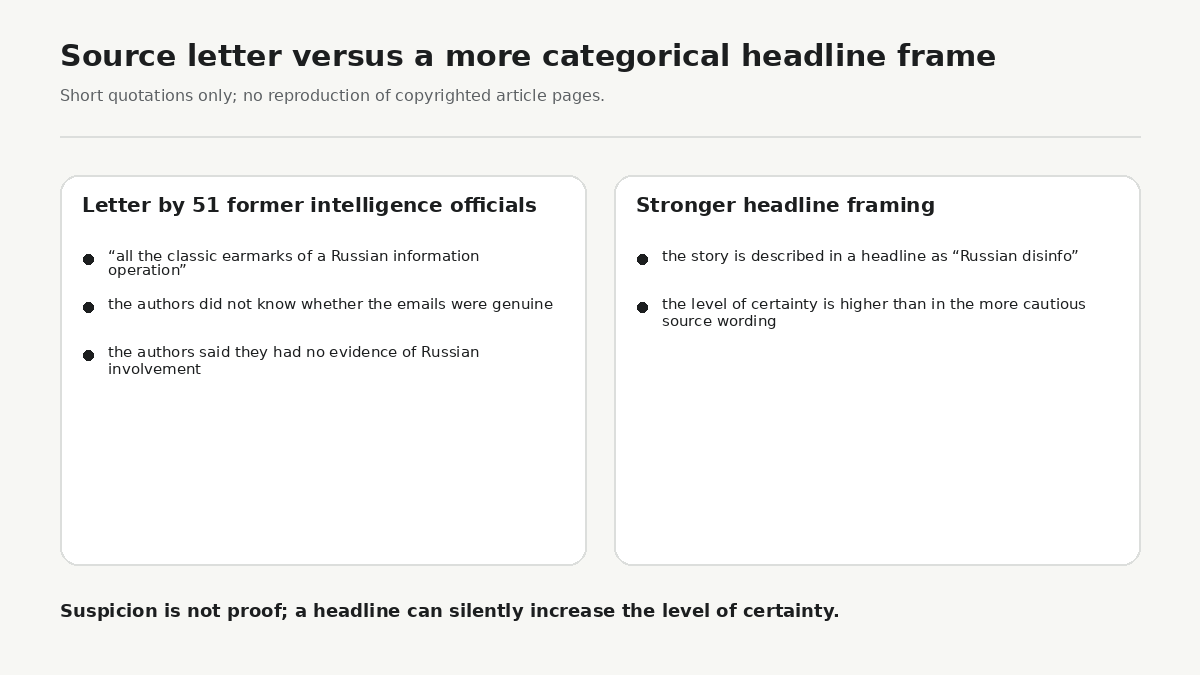
On October 19, 2020, 51 former U.S. intelligence officials signed a public letter. They wrote that the appearance of the emails had “all the classic earmarks of a Russian information operation.” But the same document included two crucial qualifications: they did not know whether the emails were genuine, and
they had no evidence of Russian involvement.
Politico published the story under the headline:
“Hunter Biden story is Russian disinfo, dozens of former intel officials say.”
But The Washington Post later pointed out that the letter did not actually make the claim stated in the headline. This is a clean example of a problem we already encountered with sensationalism: an institutionally cautious formulation becomes a categorical claim on the way to the public.
“Has the earmarks”
becomes
“is Russian disinformation.”
An expert can offer an assessment. A media outlet can turn it into a verdict.
This is an important lesson. The former intelligence officials were entitled to say:
Based on our experience, this looks suspicious to us.
That is analysis.
But their status cannot turn:
suspicion
into
proof.
When a media outlet turns the headline into a categorical finding, it creates a new claim — one the experts themselves may never have made. This matters for fact-checking too.
The question is not only:
Whom did we ask?
It is:
What does their answer actually prove?
A government warning can be useful
Here too, we must avoid the opposite extreme. Before elections, security agencies have a legitimate role in warning platforms about: foreign hacking operations, fake accounts, state bot networks, forged documents, identity theft. Operations such as Doppelganger show that the danger is not imaginary. If the FBI knows that a foreign intelligence service has stolen documents and is preparing a manipulative release, it is entirely reasonable to warn companies.
The problem begins at the boundary between:
a warning
and
pressure to remove lawful speech.
Murthy v. Missouri: what did the Court actually decide?
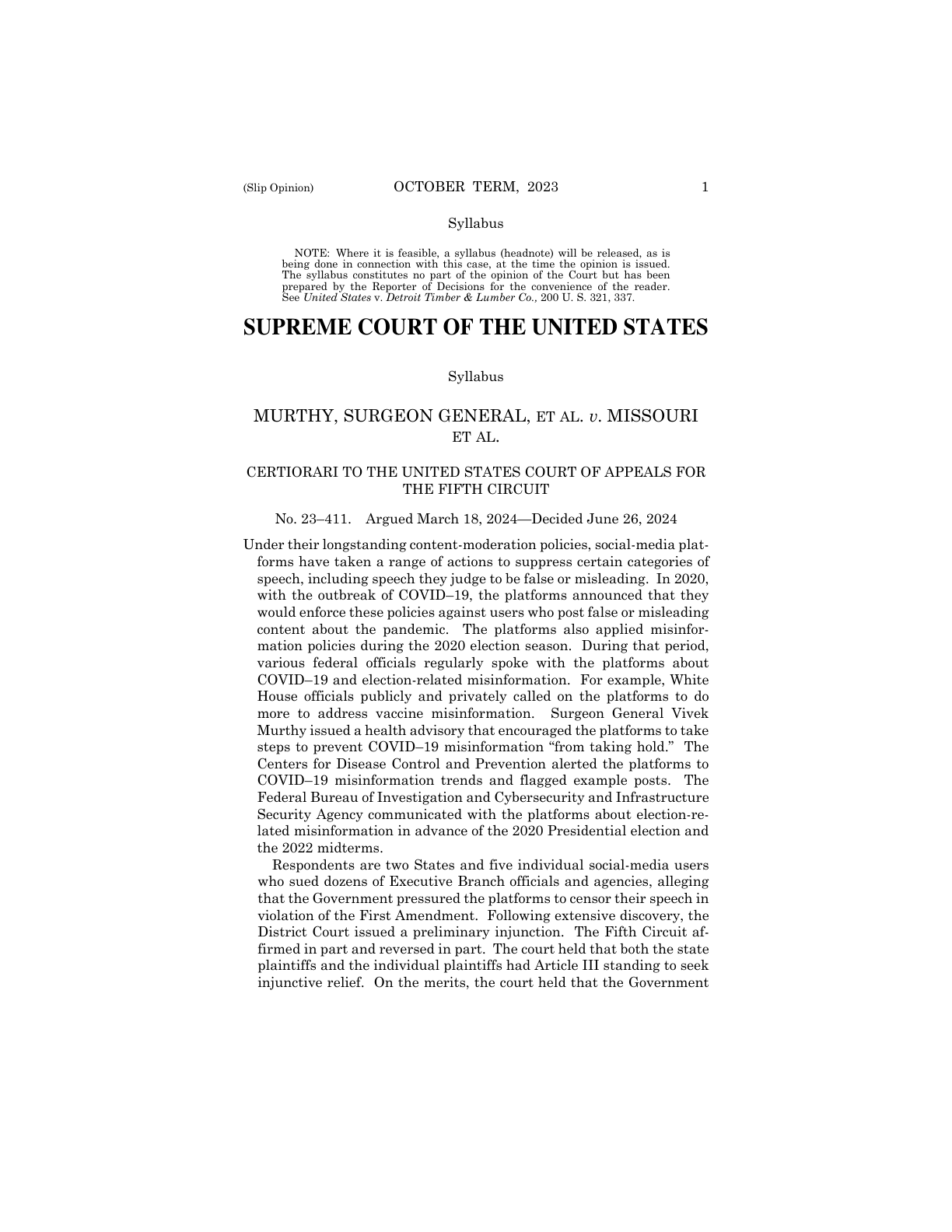
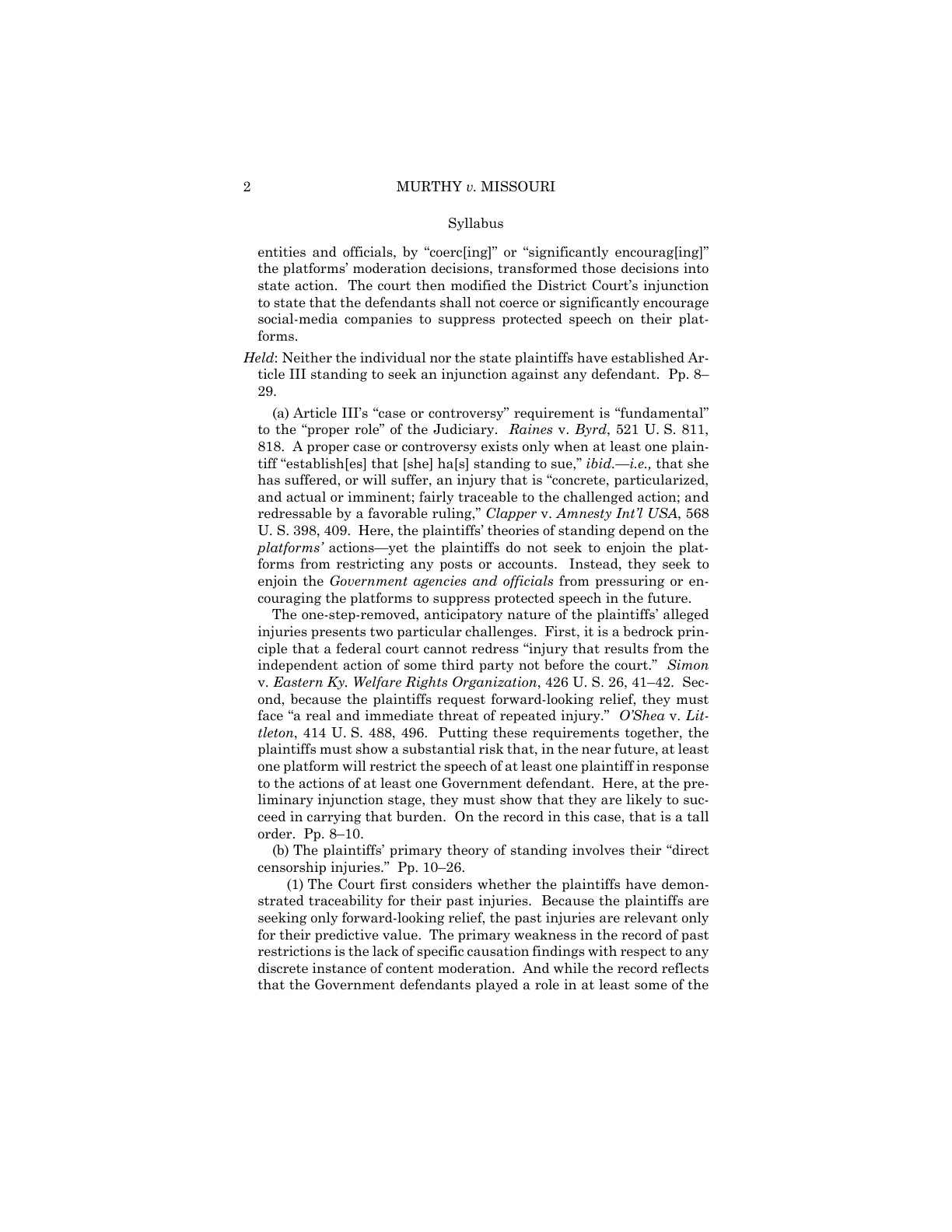
That boundary reached the U.S. Supreme Court. In Murthy v. Missouri, the plaintiffs alleged that federal officials had pressured social-media platforms to restrict content about COVID-19 and other political subjects. In June 2024, the Supreme Court, by a 6–3 majority, reversed the lower-court decision.
But an important detail is:
the Court did not rule that the government's conduct was constitutional.
The majority primarily concluded that the plaintiffs had not sufficiently established standing for the injunction they sought — they had not adequately linked a specific government official, a specific platform action, and a likely future injury to a specific plaintiff. The majority also emphasized that platforms had their own reasons for moderation and that some COVID-related content had been restricted even before the disputed government communications.
The three dissenting justices read the same evidentiary record very differently and wrote that the lower courts had documented extensive federal pressure on the platforms.
So both of these headlines would be wrong:
“The Supreme Court proved government censorship.”
and
“The Supreme Court proved there was no pressure.”
It did neither.
Zuckerberg: pressure existed, but the final decision was Meta's
In August 2024, Mark Zuckerberg wrote to the U.S. Congress that senior officials in the Biden administration had for months in 2021 pressured Meta's teams over the removal of certain COVID content, including humor and satire.
But Zuckerberg also added:
the final decision to remove content was Meta's.
That is a very important formulation.
It does not support the simple slogan:
the government ran Facebook.
But neither does it support the claim:
the government did not try to influence moderation.
Reality is more inconveniently complex: government officials applied pressure, the platform had its own policies, and the platform formally made the final decision.
So who is the censor?
With digital speech we need to distinguish at least three kinds of power. The first is editorial or platform power. A private platform decides what it will recommend, demonetize, or remove under its own rules. The second is state power. A state can prohibit or punish certain speech, or influence platforms through regulatory means. The legal limits differ between countries. The third is informational authority.
A fact-checker, expert institution, media outlet, or researcher may not directly remove anything, but their label can cause a platform to reduce a piece of content's reach. For the user, the result may be the same: fewer people see the information. But the mechanisms are not the same.
And for democratic accountability it matters to know:
who actually made the decision.
Fact-checking can be extremely useful
There are claims for which fact-checking is ideal. Is the photograph ten years old? Did the politician really say the quote? Is the document forged? Is the number 42 or 420? Was the video artificially altered? Is the account presenting itself as a ministry actually official? These are largely verifiable claims. A good fact-check can show: the origin, the evidence, the method, and the correction. The problem begins when the same model is applied to questions that are not binary.
Not every question is suitable for a “true / false” stamp
What will the economy do in six months? Which measure is best? Do the benefits of a policy outweigh its harms? How likely is a laboratory accident? What will a new virus variant do to a population? Is a particular military strike strategically justified? These are not necessarily questions with one simple verifiable answer at the time of publication. They may contain facts. But they also contain: models, assumptions, values, predictions, incomplete data, and expert judgment.
If we label such a claim false merely because it does not match the currently dominant assessment, we have turned fact-checking into something else:
judging which expert opinions are permissible.
Platforms themselves concluded that they had a problem
Meta began using independent external fact-checking organizations in 2016. In January 2025, it announced the end of that system in the United States and a shift to the Community Notes model. Meta's own explanation was highly critical: the company said fact-checking had expanded into legitimate political speech and debate, and that labels combined with reduced reach had become too similar to censorship. That is Meta's explanation of its own previous system, not independent proof that fact-checkers were systematically politically biased. But the change itself matters.
The platform acknowledged that a mechanism designed to correct falsehoods can also produce enough mistaken or overly aggressive interventions to justify changing the model.
The European Union is moving in the other direction
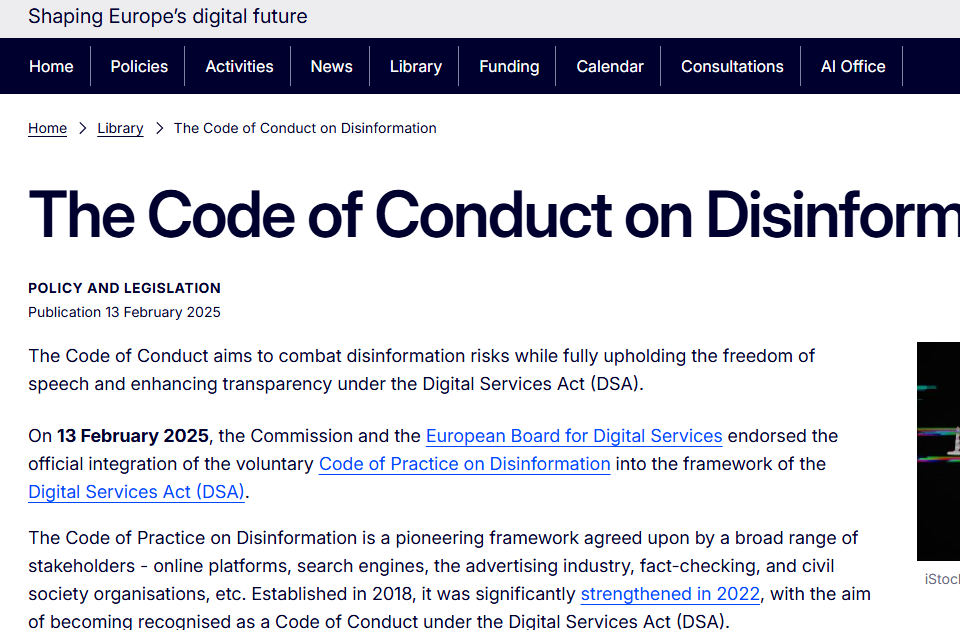
Europe is developing a different model. In February 2025, the European Commission and the European Board for Digital Services integrated the Code of Practice on Disinformation into the framework of the Digital Services Act. From July 1, 2025, the code became an important benchmark for assessing compliance by major platforms that committed to it; it covers areas such as demonetization of disinformation, political advertising, fact-checking, transparency, and user empowerment. But the DSA formally recognizes the other side of the problem as well.
Among the systemic risks that large platforms must address are threats to:
freedom of expression,
media freedom,
and
pluralism.
The European Commission also emphasizes that the DSA prohibits a general obligation to monitor all user content. This is the fundamental tension of modern regulation: the state wants platforms to limit systemic risks, while at the same time it must prevent the restrictions themselves from becoming a systemic risk to freedom of expression.
The greatest problem is a category error
Good moderation must know what type of claim it is looking at. If someone posts a fake photograph, that is one thing. If someone speculates about the still-unresolved origin of a virus, another. If someone publishes a genuine document without context, a third. If someone incites violence, a fourth. If someone performs an incorrect statistical analysis, a fifth. If a state runs a covert propaganda operation under false identities, a sixth.
If we call all of this:
disinformation,
we lose the ability to distinguish between different problems.
We need more precise labels
Instead of one large label, it would be fairer to distinguish:
| Label | What it actually means |
|---|---|
| Demonstrably false | The claim directly contradicts reliable evidence |
| Forged / manipulated | A document, photograph, identity, or recording has been artificially altered or falsely represented |
| Unverified | There is currently insufficient evidence for the claim, but it has not necessarily been disproven |
| Contested | Important evidence or expert arguments exist in more than one direction |
| Hypothesis | A reasonable possibility that has not yet been confirmed |
| Outdated | The claim may have matched older knowledge, but newer data have changed the picture |
| Missing context | The underlying fact may be correct, but the presentation omits essential information |
| Opinion / prediction | The statement cannot be treated as a simple verifiable fact |
| Disinformation | False information for which there are reasons to conclude that it was knowingly created or spread with the intention to deceive |
This does not give us less verification.
It gives us:
more precise verification.
Time must be part of a fact-check
One of the greatest errors in retrospective fact-checking is judging a statement from 2020 using what we know in 2026.
The correct question is:
What could reasonably have been known at the time?
If someone in March 2020 confidently claimed something the data did not support then, that matters — even if the claim later happened to turn out to be correct. And the reverse. If someone reached a reasonable conclusion based on the best available data at the time, and a new study disproved it two years later, we cannot retroactively turn that person into a liar.
Science does not have a function called:
edit the old post and pretend we always knew this.
It has a history of revisions. Fact-checking should show that history.
The most dangerous moment is when expert authority combines with distributional power
A scientific institution can make a mistake. A media outlet can make one. A fact-checker can make one. A government can make one. A platform can make one. That alone is not a catastrophe. The catastrophe comes if the same mistaken assessment simultaneously has the power to: define official truth, reduce the visibility of competing claims, label critics dangerous, and prevent evidence needed for correction from reaching the public. Then the system loses its own correction mechanism.
That is the paradox of information control:
the more efficiently a system removes deviation, the harder it becomes for the system to detect its own mistake.
Freedom of speech is not a promise that all claims are equally good
Criticism of censorship does not mean we must treat all information equally. A fraudulent study is not equivalent to a high-quality study. An anonymous Telegram channel is not the same as an original document. A manipulated video is not “another opinion.” A documented Russian operation using fake American websites is not merely an alternative view of geopolitics. A free information environment requires: verification, criticism, corrections, context, transparency of origin.
But there is an important difference between:
adding information
and
preventing access to information.
The first helps the user judge. The second judges for them. In some cases removal is necessary — for example with illegal content, concrete danger, fraud, or certain forms of abuse. But the threshold should be higher when we are dealing with: political speech, scientific uncertainty, and matters of public interest.
A real fact-check must allow for the possibility that the fact-checker is wrong
This should be a basic rule.
If a fact-checker writes:
FALSE,
they should be able to show: the exact claim, the evidence, the method, the date, the level of certainty, and the conditions under which they would change their assessment. A good fact-check is not a verdict of eternal truth.
It is:
the documented state of the evidence on a specific date.
That is how science works. That is how information verification should work too.
So who decides?
In practice, no single person decides. Decisions are made by: editors, fact-checkers, algorithms, platforms, health institutions, government agencies, regulators, courts, intelligence services, and users.
So the problem is not simply:
who is the minister of truth?
Such a figure mostly does not exist.
The more interesting question is:
How do the decisions of all these institutions combine into a system that determines which information receives reach and which does not?
That is a much more complex mechanism. And therefore much harder to oversee.
The best defense against disinformation is not one infallible authority
No such authority exists. A safer system has multiple safeguards: clear information provenance, open primary documents, plurality of experts, transparent platform rules, a right of appeal, visible corrections, a clear distinction between fact and opinion,
and the ability to say:
we do not know this yet.
Disinformation is a real problem. But a system that fights it by closing legitimate debate too quickly can create a new problem:
institutionalized certainty without sufficient evidence.
And now we have to examine what this looked like at home
So far, we have mostly discussed international examples. But the next article will be different. It will no longer be mainly an explanation of a mechanism. We will examine: what Slovenian media actually wrote, which experts were given space, how doubts were presented, how deaths were counted, what “safe and effective” meant, how transmission was discussed, what happened when effectiveness changed, how media reported adverse effects, how the PCT system changed the meaning of a “voluntary” decision,
and how the same media reacted when a young Slovenian woman died after receiving the Janssen vaccine and an expert commission later found a direct causal connection.
Then we will no longer ask:
What could the media have done?
We will ask:
What did they actually do?
Sources and further reading
- World Health Organization. Disinformation and public health, February 6, 2024 — definitions of misinformation and disinformation.
- CISA. Tools of Disinformation — distinction between misinformation, disinformation, and malinformation.
- U.S. Department of Justice. Doppelganger — seizure of 32 domains in connection with an alleged covert Russian state influence operation, September 2024.
- U.S. Department of Justice. Internet Research Agency indictment and the archive of Special Counsel Robert Mueller.
- Calisher et al. Statement in support of the scientists, public health professionals, and medical professionals of China combatting COVID-19. The Lancet, February 2020.
- WHO. Statements by the Director-General on the origin of SARS-CoV-2, March 2021 and June 2025; SAGO report, 2025.
- Office of the Director of National Intelligence. Updated Assessment on COVID-19 Origins and the June 2023 report on differing assessments among U.S. intelligence agencies.
- Office of the Director of National Intelligence. Release of declassified documents on COVID-19 origins, June 18, 2026.
- Federal Election Commission. Yoel Roth's declaration on Twitter's handling of the New York Post article and its hacked-materials policy.
- Congressional transcripts on FBI communications with platforms and the status of Hunter Biden's laptop.
- Public Statement on the Hunter Biden Emails, October 19, 2020.
- The Washington Post. Retrospective analysis of the difference between the text of the former intelligence officials' letter and the headline published by Politico.
- Supreme Court of the United States. Murthy v. Missouri, 603 U.S. 43 (2024), majority and dissenting opinions.
- Reuters / Mark Zuckerberg's letter to Congress, August 2024 — pressure from the Biden administration regarding COVID content and Meta's final responsibility for decisions.
- Meta. More Speech and Fewer Mistakes and the introduction of Community Notes in the United States, 2025.
- European Commission. Code of Conduct on Disinformation and the Digital Services Act framework, 2025–2026.