How to Recognize Propaganda Without Calling Everything Propaganda
Seven questions for distinguishing propaganda patterns from ordinary bias, persuasion, error, or legitimate political communication.

Seven Questions That Distinguish Organized Influence from Ordinary Bias, Persuasion, and Error
The word propaganda has almost lost its diagnostic value today. Every side uses it against the other. Russia speaks of Western propaganda, the West of Russian propaganda. Political parties accuse the media of it, the media accuse politicians, activists accuse institutions, and institutions accuse online networks. If we use the word broadly enough, almost any political speech, any headline, and any campaign can be declared propaganda.
Then something paradoxical happens: if everything is propaganda, nothing is propaganda. Propaganda is not simply information we disagree with. It is not necessarily a lie. It is not every biased article. It is not every government statement. It is not every emotional message, and it is not every attempt at persuasion. If we want to use the concept seriously, we have to move from the label to the method.
The question, then, is not: “Do I like this message?” The question is: who is speaking, to whom, with what objective, which information is being selected, which information is being omitted, how is the message trying to influence judgment, and what response is it trying to produce?
Propaganda Is a Form of Organized Influence
Garth Jowett and Victoria O’Donnell define propaganda as a deliberate and systematic attempt to shape perceptions, manipulate cognitions, and direct behavior in order to achieve a response that furthers the desired intent of the propagandist. This definition is useful precisely because it does not require propaganda to be false. What matters are intentionality, systematicity, and the desired effect.
Philosopher Randal Marlin places the emphasis somewhat differently. For him, propaganda is an organized communicative attempt to influence beliefs, attitudes, or actions in a way that bypasses or weakens a sufficiently informed, rational, and reflective judgment by the individual. The two definitions do not overlap completely, but together they reveal the essence of the problem: propaganda is not merely a question of content. It is a question of the relationship between the sender, the message, the audience, and the desired behavior.
Propaganda, therefore, is not only a sentence. It can be a system.

Propaganda Is Not Necessarily a Lie
One of the greatest misconceptions is the belief that we have disproved propaganda once we have shown that the fact it uses is true. A true fact can be used propagandistically.
A real photograph can be presented without essential context. A real statistic can be selected in a way that hides the opposite trend. A real crime committed by one side can be systematically repeated while comparable crimes by the other side are ignored. A genuine quotation can be cut out of a longer answer. A real victim can be used to mobilize support for a policy that does not itself follow from the event.
Propaganda therefore often does not need fabricated information. It is enough to arrange reality. The strongest propaganda may be precisely the kind in which individual sentences survive a fact-check while the whole nevertheless systematically leads the audience toward one preselected conclusion.

Lies, Disinformation, Bias, and Propaganda Are Not the Same Thing
For good analysis, we need more precise language. Misinformation is false information that may also be shared without an intention to deceive. When distinguishing between misinformation and disinformation, UNESCO generally treats intent as the key dividing line: with disinformation, the deception is deliberate.
Propaganda is a broader category. It can include disinformation, but it does not require it. It can use truth, half-truth, selective truth, omission, emotional framing, or identity-based mobilization. Bias is not the same thing as propaganda either. A journalist can be politically biased without participating in an organized propaganda campaign. An editor can choose a poor headline. A commentator can see the world through an ideological lens. All of this is open to criticism, but bias alone is not enough to prove propaganda.
If we use the term without these distinctions, “propaganda” becomes only a more sophisticated version of the word “lie” or “something I dislike.”
Persuasion Is Not Automatically Propaganda
A democratic society cannot function without persuasion. A candidate wants to persuade a voter. A trade union wants to persuade the public. A doctor wants to persuade a patient to give up a harmful habit. An activist wants to change the law. A journalist wants to show that one interpretation of an event is better supported by evidence.
If every intentional attempt to influence someone is propaganda, the concept no longer tells us anything. A more useful boundary is between communication that invites us to exercise judgment and communication that tries to bypass, narrow, or instrumentalize our judgment. Research on manipulation often distinguishes between transparent persuasion, in which the arguments and intent are sufficiently visible, and manipulative influence, which conceals intent, exploits vulnerabilities, or uses information asymmetry.
The boundary is not always clear. But it is more useful than asking whether the message has a political objective.
Propaganda Can Hide in What Is Missing
Most people look for propaganda in words. Sometimes we have to look for it in silence. Tom Huckin uses the expression propaganda by omission for cases in which the systematic omission of relevant information distorts understanding of a subject. This distinction matters: every article has to omit something because it is impossible to say everything. Omission becomes diagnostically important when the missing context is essential, when the pattern repeats, and when its absence systematically pushes the audience toward the same political or ideological conclusion.
Imagine a media outlet that presents every attack by side A together with the history of the conflict, motives, prior provocations, and legal arguments, while presenting every attack by side B only as an isolated act of aggression. The individual articles may contain entirely true facts. The propaganda effect arises through asymmetry of context. When analyzing propaganda, then, we do not only check what is present. We also check what is systematically absent.
Emotion Is a Signal, Not Proof
Propaganda often uses fear, anger, disgust, pride, shame, humiliation, and a sense of threat. But emotion alone is not proof of propaganda. If a tornado is approaching, an alarmist tone may be entirely justified. If a mass atrocity has occurred, an emotional reaction is normal. If we are talking about the death of a child, sterile neutrality is not necessarily more truthful.
The real question is: is the emotional intensity proportional to the evidence, and does it help us understand the event or replace understanding?
When a message primarily demands that the audience feel the correct fear, the correct anger, the correct pride, or the correct hatred, while the argument becomes secondary, we have a stronger propaganda signal. It becomes even stronger when emotion is tied to identity.
“If You Are One of Us, You Must Believe This”
Propaganda does not only shape opinions about events. It can also shape the idea of what it means to belong to a group. Research on so-called identity propaganda shows how political actors use communication to define norms of group membership: what a “real” member of the group must support, whom they must be loyal to, and whom they must understand as the out-group.
The argument then takes on a new form. We no longer ask: “Is this policy good?” The message becomes: “If you are a true patriot, you support it.” Or: “If you are a true democrat, you must not doubt.” Or: “If you are one of us, you know who the enemy is.” This is effective because the cost of disagreement is no longer merely the possibility that we are mistaken. The cost becomes belonging. When a political claim begins functioning as a test of moral or group loyalty, we should be especially careful.
Seven Questions for Recognizing a Propaganda Pattern
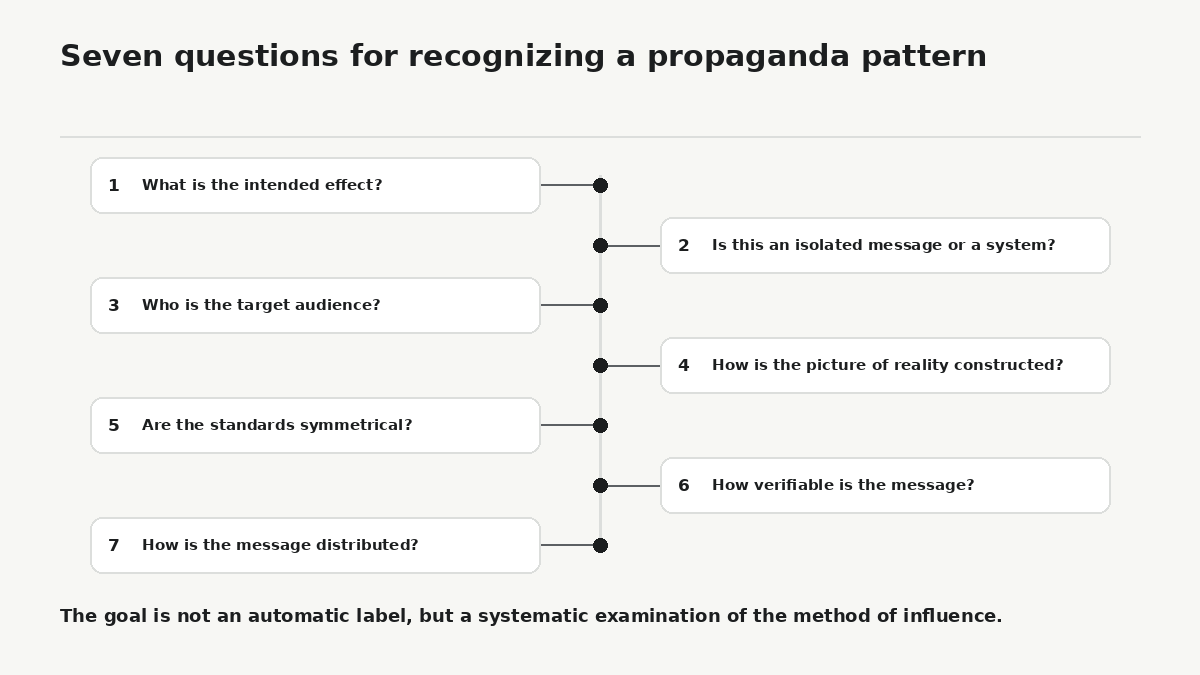
For THY-REALITY, we can derive a simple diagnostic framework from academic approaches. It is not a scientific index and it has no magical numerical threshold. Its purpose is to force us to examine the structure of a message before attaching a label to it. First question: what is the desired effect? Is the purpose mainly to inform and argue, or can we identify a behavioral objective: mobilize, frighten, delegitimize, gain support, induce passivity, or reinforce loyalty?
Second question: is this an isolated message or a system? One bad post may be a mistake. Propaganda is generally more systematic: the same frame repeats over time, across channels, speakers, and slogans. Third question: who is the target audience? Is the message tailored to a specific group, its fears, identity, political preferences, or vulnerabilities?
Fourth question: how is the picture of reality constructed? Does it use selective facts, important omissions, false dilemmas, demonization, excessive simplification, repetition, moral absolutism, or authority without evidence?
Fifth question: are the standards symmetrical? Does our own side always receive context and explanation, while the opponent receives only condemnation? Is doubt applied only to some sources and certainty to others?
Sixth question: how verifiable is the message? Can we see primary sources, uncertainty, corrections, and counterarguments? Or is the audience mainly expected to trust the status of the speaker?
Seventh question: how does the message spread? Does the same frame appear in a coordinated way across several apparently independent channels? Do we know the original source? Are there proxy channels, coordinated amplification, or centrally prepared messages?
A single “yes” does not prove propaganda. Several independent indicators, especially together with demonstrable intent and systematicity, provide a much stronger basis for the label.
Describe First, Label Later
This leads to an important editorial rule. If we cannot prove organized intent, we do not have to immediately write “propaganda.” We can be more precise. We can write:
- selective framing;
- emotional mobilization;
- propaganda technique;
- communication with characteristics of propaganda;
- propaganda pattern;
- coordinated influence campaign.
Only when we have sufficient evidence of intent, structure, and systematicity is the stronger label “propaganda campaign” appropriate. This does not limit criticism. It protects criticism from superficiality.
An Institution Does Not Become Neutral Merely Because It Uses Technical Language
Modern institutions rarely describe their communication with the word propaganda. They speak of strategic communication, public diplomacy, the information environment, resilience, engagement, influence, countering disinformation, or the cognitive domain. These terms do not in themselves prove manipulation. Nor do they rule it out. So we analyze function, not self-description.
In its official approach from October 2024, NATO wrote that it was developing the capacity to understand and assess the information environment and that such analyses help explain how actors influence attitudes and behavior. In describing the Information Environment Assessment program in 2023, Allied Command Transformation wrote that contemporary communication makes it possible to inform, persuade, confuse, coerce, deter, and deceive, and that NATO needs an understanding of the environment in order to develop strategic messages. Other current descriptions of the program refer to analysis of social groups, behavioral patterns, narratives, sentiment, networks, and modeling the spread of information.
This is an important and documented infrastructure of influence. But it still does not follow that every NATO article or every press conference is propaganda. If we want to label a particular piece of communication that way, we still have to show intent, selectivity, manipulative techniques, a target audience, and a broader pattern. The same rule must apply to everyone.
The Russian “Firehose of Falsehood” Is a Model, Not a Universal Definition
In 2016, RAND described a contemporary Russian propaganda model with the expression firehose of falsehood. It emphasized a high volume of messages, multiple channels, speed, repetition, and a willingness to use partial truths or outright fabrications. The model is useful because it shows that the aim of propaganda is not always to persuade the audience to accept one stable story. Sometimes the aim can also be to saturate the information environment, blur judgment, or make truth exhausting to reach.
But here too, we have to be precise. The “firehose” is not a definition of all propaganda, and the fact that a media outlet is Russian is not proof that every one of its articles is false or propagandistic. If we determined the label solely by the flag of the source, we would ourselves be using a propaganda shortcut.
Swap the Flags
This may be the best practical test in the entire article. When assessing a message, imagine that the same technique is being used by the side we support politically. If the Russian side shows only its own civilian victims and omits the others, do we call that propaganda?
If the Ukrainian, American, Israeli, Palestinian, or Slovenian side does the same thing, do we apply the same standard?
If an opponent uses an emotional image of a child to support military policy, we become suspicious. What do we do when “our” side uses the same image?
If an opponent links political disagreement with betrayal, we recognize propaganda. What about when this is done by a government or media outlet we otherwise agree with?
This mental exercise removes the most comfortable form of propaganda analysis: the one in which propaganda is always something they do.
If a technique is propaganda when the opponent uses it, it must remain a candidate for the same label when our side uses it too.
Propaganda May Be Most Effective When It Feels Like Common Sense
The most obvious propaganda is often the least interesting. A poster demonizing the enemy is easy to recognize. It is harder to recognize an environment in which a particular interpretation is no longer presented as an argument but as a self-evident description of the world.
When one term is always used for one side and another term for the other. When one side always has motives while the other has only pathology. When one set of actions is understood in historical context and the other outside it. When one death receives a name and a face while another becomes a number. When one question is treated as legitimate and another as morally suspect.
At that point, propaganda does not necessarily need a central command. It can stabilize as an institutional routine, a recurring frame, or a culture of selection. But here we must be especially careful with the word intent. A similar propaganda effect can arise even without a demonstrable central campaign. That is why it is often more precise to speak of a propaganda pattern or propaganda effect rather than automatically of organized propaganda.
What to Do When We Are Exposed to a Powerful Message
The best defense is not the belief that we ourselves are immune to propaganda. People generally recognize propaganda that supports an enemy ideology more easily than propaganda that supports their own. A short discipline is more useful. First, separate the event from the interpretation. What physically happened? Which parts can be directly verified?
Then find the primary source. The full speech, document, original video, database, or court record. Look at what came before the quotation and what followed it. Ask what essential information is missing. Check whether the headline uses the same degree of certainty as the evidence. Notice which emotion the message is trying to trigger. Then ask the most uncomfortable question: what am I supposed to do after receiving this message?
Am I supposed to support a war? Oppose negotiations? Hate a group? Trust an institution? Accept a restriction? Vote? Stay silent? Treat doubt as betrayal?
Once we identify the desired behavioral result, the structure of the message begins to become more visible. And when possible, wait. Propaganda is often most powerful in the first hours of a crisis, when emotions are strongest and verifiable information is scarcest.
We Do Not Need a World Without Influence
It is impossible to create a public sphere without influence. Every speech selects words. Every newsroom selects topics. Every political campaign seeks to change behavior. Every social system has symbols, stories, and frames. The goal therefore cannot be a world without persuasion. The goal is a society in which we can distinguish argument from manipulation, explanation from mobilization, and error from systematic propaganda. For that, we need more precise language.
Something can be biased without being propaganda. Something can be false without being propaganda. Something can be true and still be used propagandistically. And something can contain propaganda techniques without us having enough evidence for the existence of a centrally organized campaign. The worst way to fight propaganda, then, is to turn the word propaganda into our own propaganda label for everything that comes from the other side. A better test is simple:
Do not look at the flag first. Look at the method of influence.
Sources and further reading
- Jowett, G. S., O’Donnell, V., & Snow, N. Propaganda & Persuasion. SAGE.
- Jowett, G. S. “Propaganda, Visual Communication of.” Wiley International Encyclopedia of Communication. Source
- Marlin, R. Propaganda and the Ethics of Persuasion. Broadview Press.
- “Criminology and Propaganda Studies: Charting New Horizons in Criminological Thought.” British Journal of Criminology, 64(3). Source
- UNESCO. “Disinformation.” Source
- UNESCO. “Misinformation.” Source
- Bakir, V., Herring, E., Miller, D., & Robinson, P. “Organized Persuasive Communication: A new conceptual framework for research on public relations, propaganda and promotional culture.” Source
- Marková, I. “Persuasion and Propaganda.” Diogenes, 55(1). Source
- Huckin, T. “Propaganda by Omission: The Case of Topical Silence.” In Qualitative Studies of Silence. Cambridge University Press. Source
- Horz, C. M. “Identity Propaganda.” British Journal of Political Science, 54(2), 313–338. Source
- NATO. “NATO’s approach to counter information threats.” 18 October 2024. Source
- NATO Allied Command Transformation. “Information Environment Assessment Capability Programme Plan Initiated.” 3 April 2023. Source
- NATO Allied Command Transformation. “Harnessing Artificial Intelligence: Allied Command Transformation at the Forefront of NATO Innovation.” Source
- NATO Allied Command Transformation. “Decoding the Information Environment: NATO’s Strategic Communications Centre of Excellence.” 18 September 2024. Source
- Paul, C., & Matthews, M. The Russian “Firehose of Falsehood” Propaganda Model. RAND Corporation. Source
- Godber, A., & Origgi, G. “Telling Propaganda from Legitimate Political Persuasion.” Episteme. Source