When Audiences Leave the Mainstream
When Audiences Leave the Mainstream

Podcasts, Alternative Media and the New Economy of Trust
When people lose trust in a newspaper, a television channel or a public broadcaster, information does not disappear. It moves somewhere else. To YouTube. Into a three-hour podcast. Onto TikTok. Into a newsletter. To a creator who speaks directly to the camera and does not sound as if they are reading from an editorial rulebook. To a host who openly says they have a point of view. To someone who makes mistakes out loud, laughs, interrupts a guest, tells a personal story and does not sit in a studio full of anonymous editors.
That shift is understandable. For decades, institutional media demanded trust even when they undermined it with their own mistakes: headlines that went too far, overly rapid repetition of official sources, concealed uncertainty, ideological blind spots, or corrections that were far less visible than the original error. But legitimate distrust does not mean that the new media system has no gatekeepers. They are simply different.
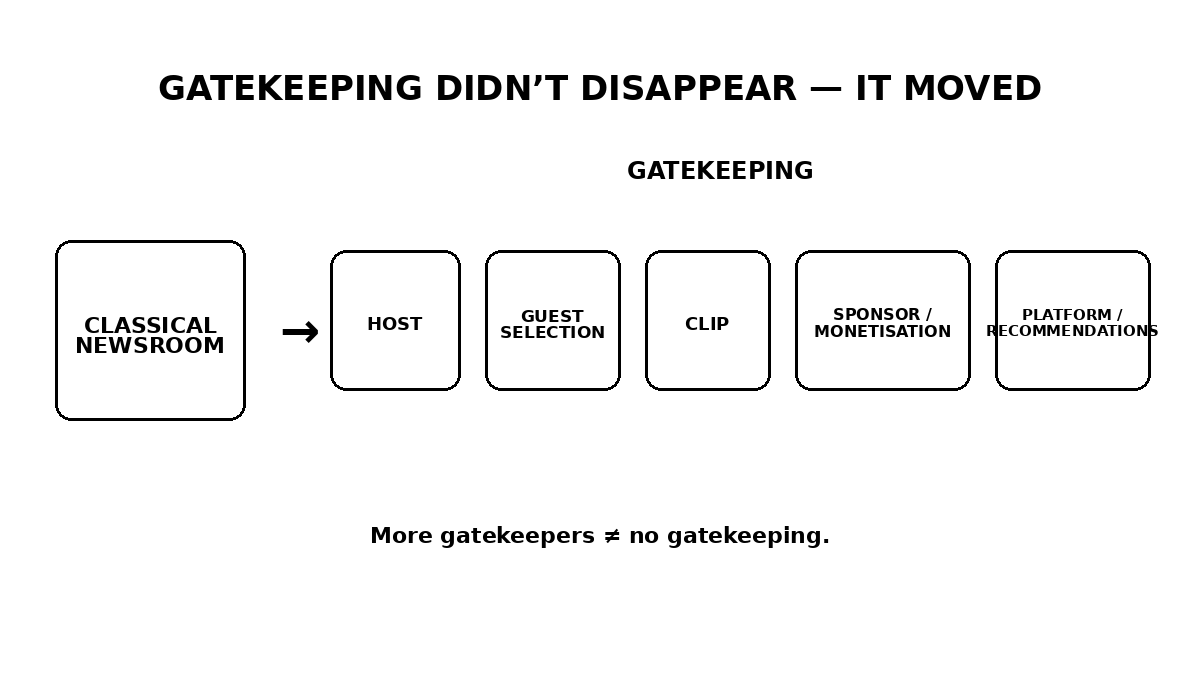
Instead of a newsroom, decisions may be shaped by the host, guest selection, the thumbnail, the sponsor, the subscription model, the viral clip and the platform algorithm.
The collapse of trust in one gatekeeper does not abolish gatekeeping. It relocates it.
Audiences Have Not Simply Abandoned the Mainstream
The story about the “death of mainstream media” is attractive. It is also too simple. In the Digital News Report 2026, the Reuters Institute found that 27 percent of respondents across 48 markets get at least some news each week from creators focused on news, or news creators. That is a large share and a clear sign that individual creators, podcasters and platform-born media brands are no longer marginal. But the same data show something less spectacular.
Around 13 percent of respondents say that news-focused creators meet most or all of their news needs. Around 3 percent say that such creators meet all of their news needs, and the Reuters Institute explicitly notes that these respondents may still consume news from other sources.
Data · Reuters Institute · 2026
Do news creators replace traditional news sources?
| 27% | Get at least some news weekly from news-focused creators. |
|---|---|
| 13% | Say creators meet most or all of their news needs. |
| 3% | Say creators meet all their news needs. |
Important: the last figure does not mean respondents use creators exclusively. They may still consume other news sources. These measures are not additive.
The dominant model is therefore not:
old media out, new media in.
A more accurate description is:
old and new media live inside the same information system, borrowing topics, sources, footage, stories and audiences from one another.
A creator often comments on an article first published by a traditional outlet. Television summarises a podcast excerpt. A podcast dissects a television segment. A TikTok account turns both into a 45-second video. A newspaper then writes an article about the viral video. Information no longer travels through a single pipe. It circulates.
Why a Person Can Feel More Real Than an Institution
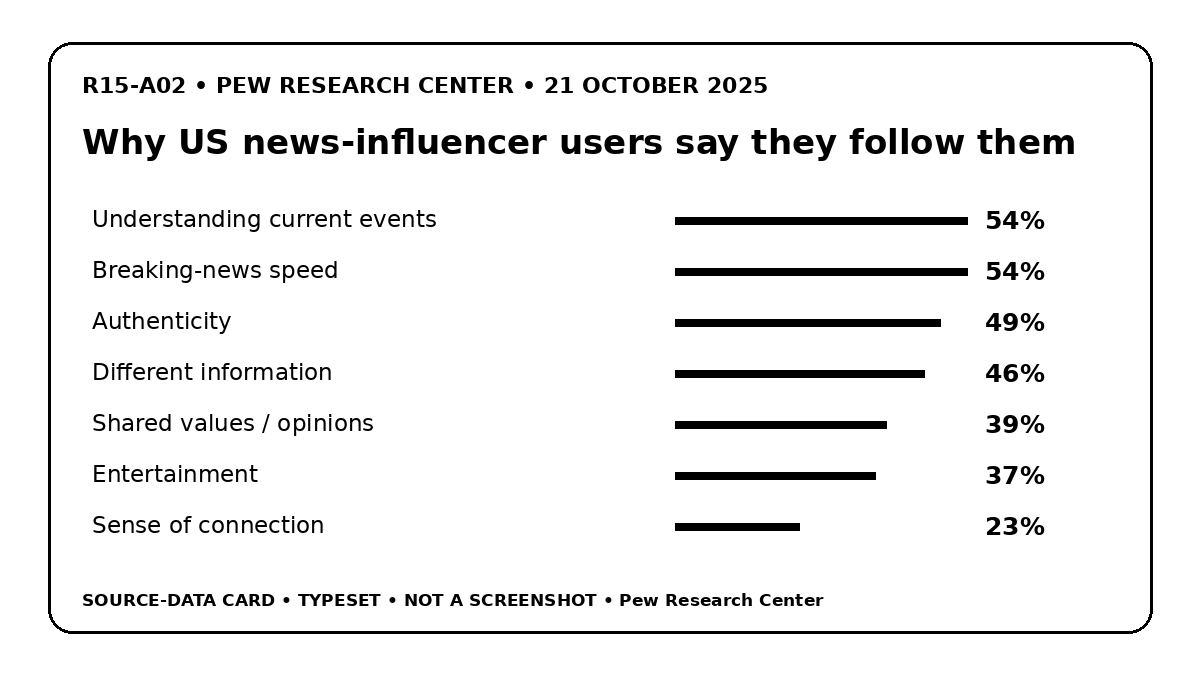
An institution speaks with the voice of an organisation. A creator speaks with a face. That difference is not trivial. In 2025, the Pew Research Center asked US adults who regularly get news from news influencers why they do so. Among the most common major reasons were help understanding current events and fast access to breaking news — 54 percent named each as a major reason.
Almost half, 49 percent, also named a sense of authenticity as a major reason: the impression that the influencer really is what they present themselves to be. Forty-six percent cited information that is different from what they get elsewhere. Thirty-nine percent cited shared opinions or values. Thirty-seven percent cited entertainment. Twenty-three percent cited a sense of connection with the creator. Those are not trivial figures. They show that people do not want only a correct sentence from an information source. They also want a form of relationship.
Someone they understand. Someone whose way of thinking they feel they know. Someone whose point of view is visible rather than hidden behind institutional language. But this is also where the problem begins.
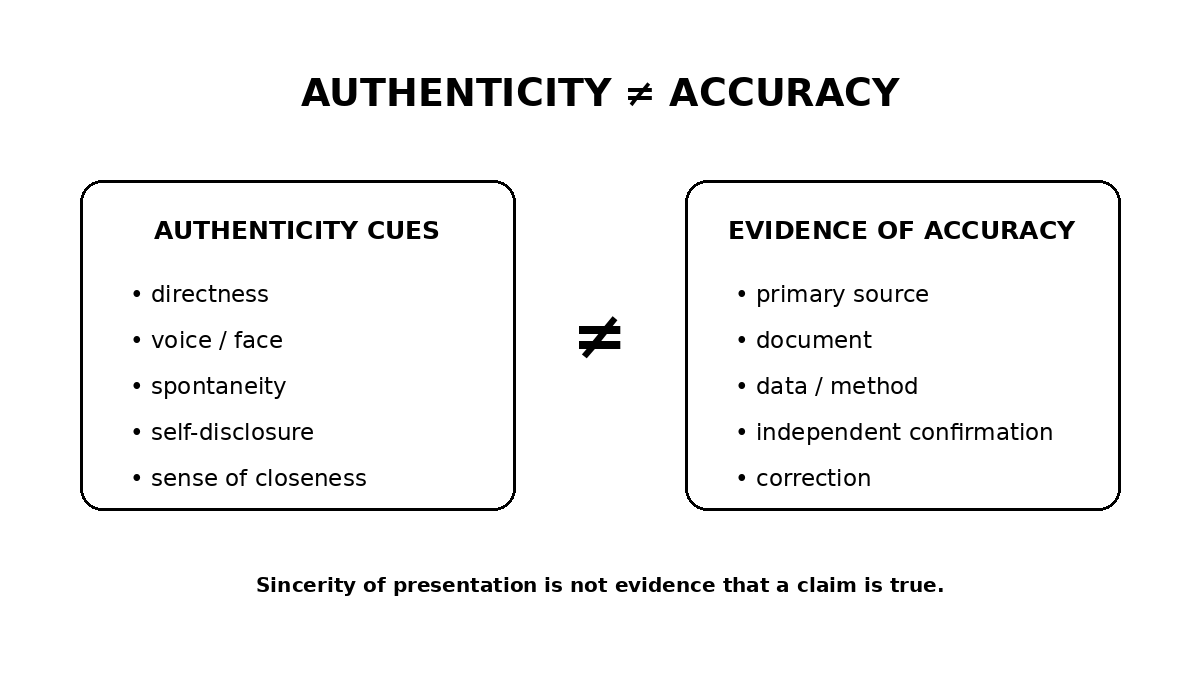
A sense of sincerity can be genuine. It is not a measure of factual accuracy.
Authenticity Is a Media Currency
The word authentic has become an almost universal compliment for creator media. It is not hard to see why. A podcast allows silence. An unfinished sentence. A correction in the middle of a thought. Laughter. A personal story. Informal language. A host can speak to the same audience every week for three years. The listener knows the host’s voice, jokes, political preferences, the way they react when surprised, and the subjects that make them angry. That creates a different kind of credibility from a television logo.
Academic literature also describes this through parasocial relationships — one-sided feelings of closeness between an audience and a media personality. A 2026 review of empirical research on science podcasts identified recurring mechanisms: cues of expertise, narrative proximity, self-disclosure, continuity of voice and a sense of relationship with the host. These elements are associated with trust, engagement and deeper processing of information.
But the review also stresses an important limitation:
most of the research is correlational. We cannot turn that into the story:
“If you listen to a host for long enough, you start believing them uncritically.” That would go too far. A more accurate formulation is:
a personal relationship changes the way we evaluate a source.
Sometimes it can increase credibility. Sometimes it can increase interest. And sometimes closeness means that a listener also knows the host’s weaknesses better.
Three Hours of Conversation Are Not Three Hours of Fact-Checking
Long-form conversation has real advantages. A guest can explain an argument without a television countdown clock. A host can ask a follow-up question. A listener can hear uncertainty. They can see whether a person changes their answer. They can understand the broader context of a position. Some claims that can be compressed into a single sentence in an article reveal all of their assumptions when discussed at length. That has value.
But three hours are not a verification method.
A guest can confidently say something false for three hours. A host may not know the field well enough to notice the problem. A number can go unchecked. A document can be mentioned without anyone opening it. A charismatic person can sound authoritative even outside their actual field of expertise. And because the conversation is long, the sheer volume of words can create an impression of thoroughness. That is not a criticism of podcasts. It is a basic epistemic boundary.
Context is not the same thing as verification.
Parasocial Trust Does Not Necessarily Mean Blindness
Here we need to avoid another cheap criticism. Podcasts are not dangerous because people are “sheep” who become emotionally attached to a host. The research is not that simple. In research on podcast advertising, Brinson and Lemon showed that trust, credibility, authenticity and the parasocial relationship with a host can affect attitudes toward advertised brands.
That confirms that the relationship between host and audience has commercial value. Experimental evidence also does not support the automatic equation “more parasocial closeness = less critical thinking.” In a laboratory experiment with 129 participants who listened to a corporate podcast, stronger parasocial interaction with the host led to more negative thoughts about the message and, through that mechanism, to a weaker intended persuasive effect. The authors themselves caution that this was a specific corporate and laboratory context, so the result should not be generalised to political or news podcasts.
Broader research on political authenticity provides another useful brake. Influencers were not always perceived as more authentic or more effective than traditional celebrity figures; effects varied across groups. So:
parasocial trust exists. Its effect is not automatic.
“Independent” From Whom?
In a sample of 500 US news influencers who regularly posted about current events and civic affairs and had at least 100,000 followers on one of the platforms studied, Pew found that 77 percent had no current or past affiliation with a news organisation. That is an important shift. Information influence can now be built without a television network, newspaper or newsroom. But the same study found that 59 percent of the influencers analysed monetised their online presence in at least one of the ways measured.
Some use subscriptions. Donations. Merchandise. Sponsorships. Advertising. Paid communities. Thirty-four percent were also present through podcasts and 22 percent through newsletters. There is nothing automatically suspicious about this. Journalists also need to be paid. Studios cost money. Production costs money. Travel costs money. Time costs money. But the word “independent” often does something it should not. It turns the descriptive claim:
“this creator is not employed by a large media organisation” into the value claim:
“this creator has no interests.” That does not follow.
Independence from a newsroom is not independence from economics.
A Sponsor Is Not a Conspiracy
The creator economy is full of advertising. That is not hidden proof of manipulation. A revenue model by itself does not tell us whether a claim is true or false. But a financial relationship is information the audience needs. In its commercial endorsement guidance, the US Federal Trade Commission requires clear disclosure of a material connection between a creator and an advertiser when that connection is not already obvious from context and could affect the weight or credibility of the endorsement. Disclosure does not mean:
“this person is lying.” It means:
“the audience has a right to know that this relationship exists.” In 2026, the UK Advertising Standards Authority published research showing that people often find influencer advertising harder to distinguish from ordinary posts than they expect and that they want clear labels. That makes sense. A traditional advertising break was obvious. A creator can move from a personal story into an advertisement in the same sentence. Transparency is therefore not a moralistic formality. It is part of the information context.
The Political Influencer and the Problem of the Invisible Client
Political speech is even more complicated. A commercial endorsement and political promotion are not necessarily governed by the same rules.
A 2026 US study of paid political influencers starts from precisely this problem. Its authors note that in the United States, political influencers — unlike influencers promoting commercial brands — are not generally required to disclose whether they were paid to promote a political organisation, party or campaign. In a survey of 906 US social-media users, transparency around paid political influencing was a strong concern on both sides of the political spectrum, although greater conservatism was associated with lower support for disclosure. Users who placed greater value on authenticity also expressed greater support for disclosure.
That reveals a paradox in creator culture. Audiences want a direct, personal, authentic person. That makes information about who pays that person even more important.
The Platform Is a Distribution Gatekeeper, Not a Classical Editor
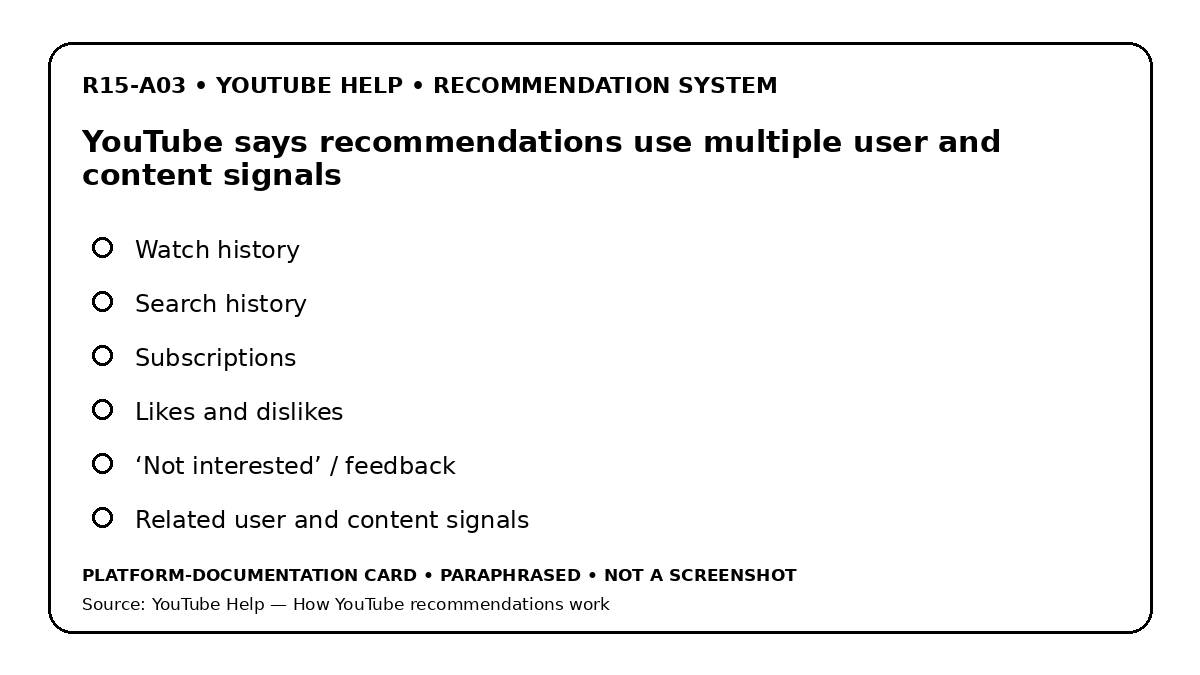
“No one tells me what I am allowed to publish.” That may be true. And you can still have a gatekeeper. If your main channel is YouTube, the platform’s recommendation system plays an important role in shaping the distribution architecture. In its own documentation, YouTube describes a recommendation system that uses signals such as watch history, search history, subscriptions, likes, dislikes and other forms of feedback. That does not mean the algorithm writes the content. It does mean that it helps determine which content is shown to which users. That distinction matters.
A traditional editor may assemble a common front page or programme for a broad audience. A recommendation system dynamically assembles different sets of suggested content for different users. That is not the same function as editorial decision-making, but it has a gatekeeping effect on visibility and discovery. A creator can be editorially independent of a media company and at the same time highly dependent on a platform for:
- content discovery;
- recommendations;
- monetisation;
- video hosting;
- search;
- subscriptions;
- moderation rules.
Independence has several dimensions. If we talk about only one, we can miss the others.
A Podcast Is No Longer Just a Podcast
A podcast was once almost synonymous with audio. That is no longer true. In 2026, Edison Research reported that 80 percent of Americans aged 12 or older had ever listened to or watched a podcast, 58 percent had used one in the past month and 45 percent in the past week. Among weekly podcast users, video and audio had moved very close to one another: in The Podcast Consumer 2026, Edison reported 82 percent as active viewers of video podcasts and 78 percent as listeners to audio-only versions.
In February 2025, YouTube itself reported that podcast content on the platform had more than one billion monthly active viewers. That is more than a format curiosity. It means that the podcast is becoming part of a wider system:
- thumbnails;
- recommendations;
- comments;
- Shorts;
- television screens;
- viral clips;
- cross-platform distribution.
A “podcast” is therefore no longer simply a long audio conversation. It is increasingly a media brand with a long-form core and short-form distribution derivatives.
The New Gatekeeper: Guest Selection
If a podcast has no newsroom, someone still chooses. Who gets into the studio?
Who does not?
Who gets one hour?
Who gets three?
Whom does the host challenge?
Whom do they trust?
Whom do they ask for a source?
Whom do they allow to speak for ten uninterrupted minutes?
Those are editorial decisions even if no one calls them that. In traditional media, gatekeeping can hide behind an organisation. In creator media, it can hide behind a personality. In both cases, the audience sees the final selection. It does not see all the candidates who never made it through the door.
The New Gatekeeper: The Clip
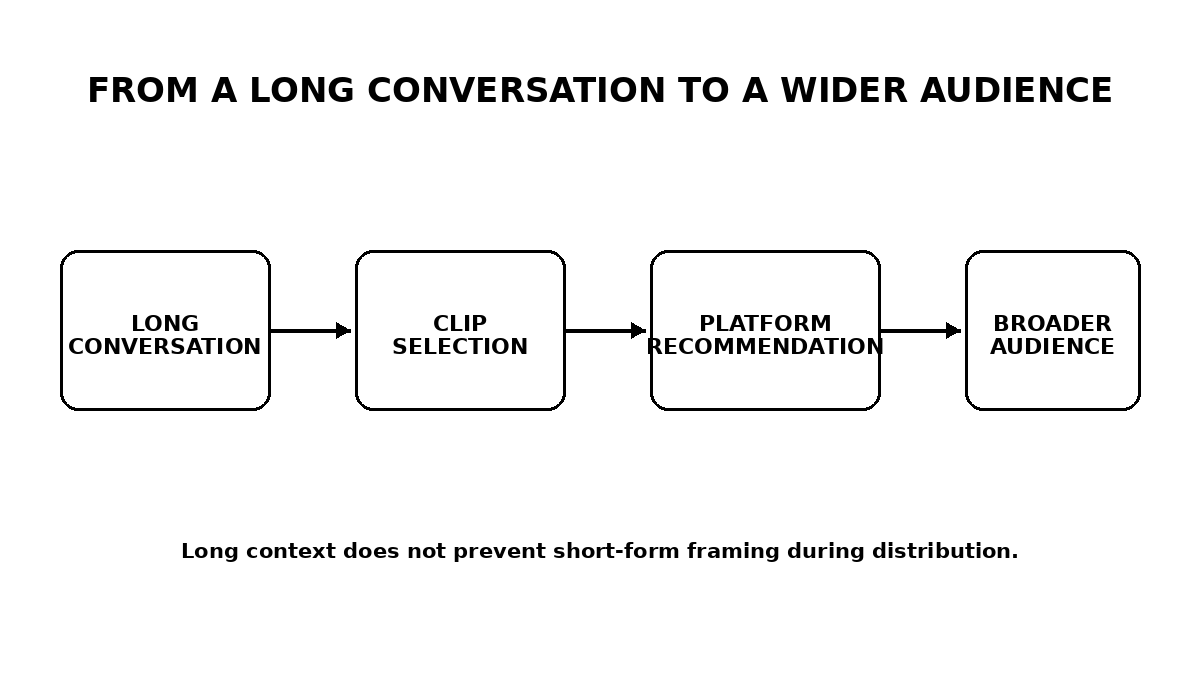
This is where the story becomes even more ironic. A major reason for the popularity of podcasts is resistance to clipped quotations and short television segments. “Watch the whole conversation.” That is good advice. But how do most people discover the whole conversation?
Often through a clip. Thirty seconds. Sixty seconds. A thumbnail. A headline. A YouTube Short. TikTok. An X video. A reaction clip from another creator. The long-form format therefore lives inside a short-form economy. That means the framing problem does not disappear. It simply moves to another point in the production chain. A three-hour conversation can be fair. Its most viral 25-second clip can create an entirely different impression.
Long context is not protection against short distribution.
How Do You Correct an Error Without a Newsroom?
This is one of the hardest differences to compare fairly. Traditional newsrooms can have formal corrections policies. Editors. Legal departments. Archives. Codes. Public standards pages. But we all know that the existence of a policy does not guarantee a good correction. An error can be corrected too late. Quietly. At the bottom of the article. Without a new headline. Without the reach of the original false statement. Creator media can have the opposite problem. There may be no formal process. But a host can say in the next episode:
“I got that wrong.” And a million people may hear the correction. That is why the categorical claim:
“mainstream media have accountability, alternative media do not” does not hold up. A better measure is concrete:
Does a correction exist?
Is it linked to the original?
Does the same audience see it?
Is it clear what was wrong?
Did the original remain unchanged?
Is the error still spreading through clips?
A 2026 experiment in science journalism found a more complicated picture: the correction itself reduced the perceived expertise of the author, while a short explanation of why checking and correcting are part of responsible journalism improved trust in the article and the author and mitigated part of the correction’s negative effect on general trust in journalism. The study involved a specific experiment with 178 participants and two science-and-technology articles, so it should not be turned into a universal law of corrections.
For a direct universal comparison between creators and newsrooms, we do not have enough data. So the answer has to remain open.
When the Mainstream Makes a Mistake, the Creator Gains Capital
Traditional media have more responsibility here than they sometimes admit. When a large outlet reports something incorrectly, it does not damage only one story. It can damage future stories too. A creator who has been saying for years:
“you cannot trust these people” gets a concrete example. A recording. A headline. A screenshot. A correction. And can then use it for years. One real error becomes evidentiary material for a much broader claim:
“they lie about everything.” That broader inference may be false. But the outlet supplied the fuel. That is why it is not enough to say:
“everyone makes mistakes.” In a low-trust information environment, the price of an error is higher. The reverse is also true. When a creator makes an error, the response:
“at least they are not mainstream” is not a standard. It is a tribal exemption. If we demand sources, context, corrections and separation of fact from opinion from institutional media, we have to demand the same from a podcast, newsletter and YouTuber. Otherwise we have not replaced a bad standard with a better one. We have only changed tribes.
Whom Do You Trust — or What Can You Prove?
In the previous media world, a common question was:
“Which outlet do you read?” Today it is increasingly:
“Whom do you follow?” Both questions can be a problem. Because they transfer trust too quickly from one verified claim to an entire institution or person. If someone correctly explains ten subjects, that is not a guarantee for the eleventh.
If a newspaper gets one story wrong, that does not mean its entire archive is wrong. If a podcaster identifies a real CNN error, that does not mean all of the podcaster’s health, military or economic claims are correct. If a journalist exposes a creator’s false claim, that does not rehabilitate every error made by the journalist’s own institution. Trust is useful.
Transferred trust is dangerous.
Authenticity Is Not Reality
This is the central boundary of R15. A person can be sincere and wrong. They can genuinely believe something that is not true. They can be highly transparent about their political position and very poor at checking data. An institution can be cold, bureaucratic and factually accurate. It can also be confident, professional and wrong. No style of speech is an evidentiary standard. Not a studio.
Not a tie. Not a three-hour podcast. Not a direct look into the camera. Not the sentence:
“I am just telling you the truth.” Evidence is something else. A source. A document. A data point. A method. Context. The possibility of verification. A correction when it turns out you were wrong.
The Same Standard for Both Worlds
If you want to know whether a media source deserves trust, do not begin by asking whether it is mainstream or alternative. Ask:
What is the source of the claim?
Can I open the primary document?
Does the speaker separate fact from interpretation?
Do they say what they do not know?
Is the guest’s expertise relevant to the subject?
Is the financial relationship disclosed?
Is the same political standard applied to friends and opponents?
Is the clip representative of the full conversation?
Are errors corrected?
Is the correction visible?
Does platform ranking create the impression that an opinion is more widespread than it would be without the recommendation system?
Do I trust the claim because I have evidence — or because I feel as if I know the person?
That is a harder standard. That is why it is better.
The New Economy of Trust
Traditional media sold a package. A brand. If you trusted a newspaper, you often trusted it on politics, economics, health and foreign affairs. The creator economy breaks that package into people. Someone follows one person for geopolitics, another for finance, a third for health and a fourth for daily news. At first glance, that is decentralisation. In one sense, it is. But at another level, a new concentration appears.
Millions of people can develop a very strong relationship with one personality. That person selects the guests. Selects the topics. Selects the sponsors. Selects what will be cut into a clip. The platform then selects whom to recommend the content to. So the future of media may not be a battle of:
mainstream versus alternative media.
It may be a competition between different models of gatekeeping. Institutional. Personal. Algorithmic. Commercial. Political. And if we want to get something better out of that system, the answer is not to declare one side pure and the other corrupt. The answer is far less comfortable.
Demand evidence from everyone.
Sources and further reading
- Reuters Institute for the Study of Journalism. Digital News Report 2026 — Executive Summary. 16 June 2026. Source
- Newman, N. How news creators are impacting politics and media around the world. Reuters Institute, 16 June 2026. Source
- Pew Research Center. America’s News Influencers: The creators and consumers in the world of news and information on social media. 18 November 2024. Source
- Pew Research Center. News Influencers Fact Sheet. 21 October 2025. Source
- Pew Research Center. Why people get news from news influencers. 21 October 2025. Source
- Edison Research at SSRS. The Infinite Dial 2026. 12 March 2026. Source
- Edison Research at SSRS. The Podcast Consumer 2026. 4 June 2026. Source
- YouTube. Celebrating 1 billion monthly podcast users on YouTube. 26 February 2025. Source
- YouTube Help. How YouTube recommendations work. Source
- Federal Trade Commission. Advertisement Endorsements / Endorsement Guides. Source
- Parasocial interactions and relationships in science podcasts: A configurative mapping review on digital trust, engagement, and cognitive elaboration. Computers in Human Behavior Reports 22 (2026), 101072. Source
- Brinson, N. H., & Lemon, L. L. Investigating the effects of host trust, credibility, and authenticity in podcast advertising. Journal of Marketing Communications 29(6). Source
- “One of Us”: Examining the Authenticity and Parasocial Relationships of Stand-Up Comedian Podcast Hosts. Journal of Radio & Audio Media, 2024. Source
- Harff, D., & Schmuck, D. Is authenticity key? Mobilization by social media influencers versus celebrities and young people's political participation. Psychology & Marketing 41(11), 2024. Source
- Riedl, M. J., et al. Antecedents of Disclosure: What Transparency Measures Social Media Users in the United States Want From Paid Political Influencers. Social Media + Society, 2026. Source
- Advertising Standards Authority / CAP. Public want influencer ads to be clearly labelled, new research shows. 12 February 2026. Source
- Newman, N. The Changing Shape and New Economics of News Podcasting: From listening to watching, from podcasts to shows. Reuters Institute for the Study of Journalism, 7 May 2026. Source
- Explain Yourself: How Corrections and Epistemic Explanations Impact the Public’s Trust in Science Reporting. Journalism Practice, 2026. Source
- Mayer, F., Auschel, E., Baumbach, M., & Schindler, K. Corporate Communication Through Podcasts: The Impact of Voice-Fit and Attention During Listening on Parasocial Interaction with the Host and Persuasive Effects. Journal of Radio & Audio Media, published online 13 September 2024. Source