
AI, Bots and Synthetic Media: What Happens When We Can Fake Not Only the Story, but the Voice, Face and Author?
For decades, a simple rule more or less held: a photograph could be cropped, a video edited, a statement taken out of context, and a headline written in a way that changed the impression. But somewhere behind the manipulation, there was almost always an original event. Someone had said something. A camera had recorded something. A photograph had been taken through a lens. The abuse happened in selection, editing, the headline, the context, or the distribution.
Generative artificial intelligence has moved that boundary. Today we can create the voice of a person who never uttered the sentence. We can create a photograph of an event that never happened. We can create the face of a person who does not exist and give that person a biography, a profile, and an apparent history of posts. We can automate thousands of comments, replies, and variations of the same message.
But the most dangerous conclusion would be the one that presents itself first:
that this means we can no longer believe anything.
That would be capitulation. The real problem with synthetic media is not that reality has disappeared. The problem is that verification has become more expensive, the production of a convincing fake cheaper, distribution faster, and doubt itself has become a weapon even against authentic evidence.
Deepfakes Are Only the Most Visible Part of the Problem
When we talk about artificial intelligence and media, we almost automatically think of deepfake video. A politician's face on another person's body. Lips moving convincingly enough. A voice that sounds almost right. But synthetic media are a broader category.
In its report on the risks posed by synthetic content, NIST addresses images, audio, video, and text that are substantially generated or altered by algorithms, including generative AI. The problem is therefore no longer simply whether someone swapped a face in a video. It can be an artificially generated voice, a fabricated photograph, a fictional person, an automated article, a crowd of apparent commenters, or a combination of all of these.
That changes the basic economics of manipulation. In the past, a convincing fake often required an actor, a studio, an editor, a graphic designer, or at least someone with sufficient technical skill. Today, much of that can be done faster, more cheaply, and in multiple languages. But this is where the first important brake has to be applied.
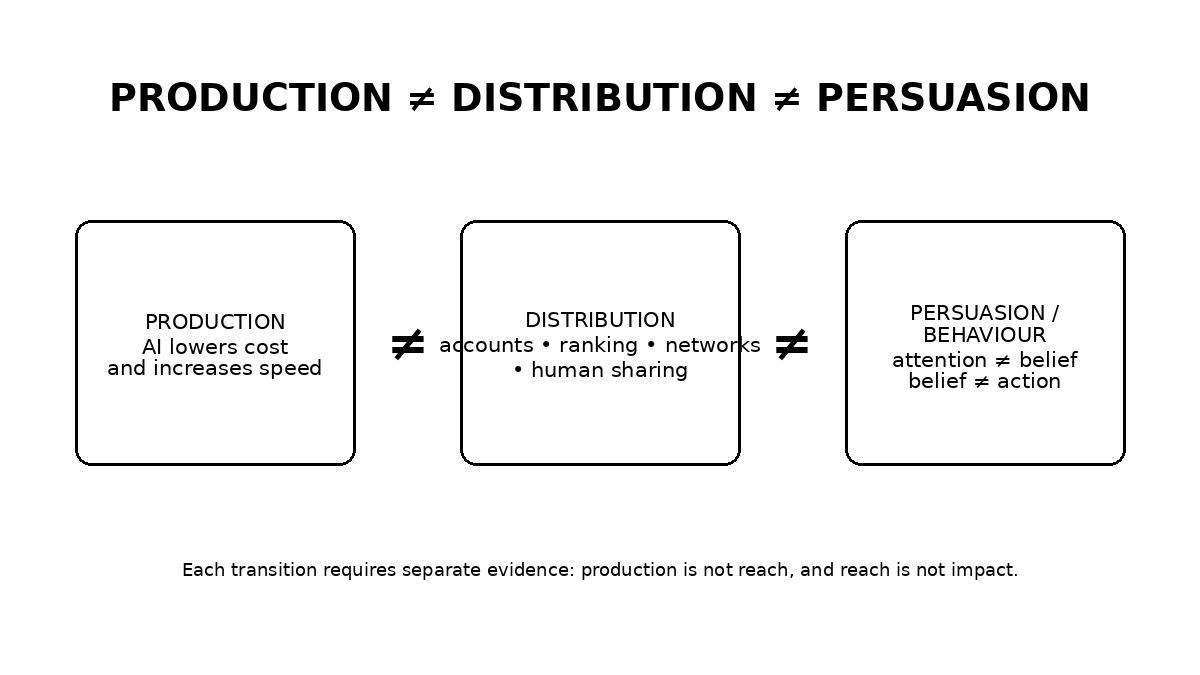
Cheaper production is not the same thing as successful propaganda.
The content still has to reach an audience. Someone has to publish it. Someone has to share it. An algorithm has to surface it. People have to notice it. And if a campaign wants to change behaviour or opinion, people still have to accept it. AI can make the message factory cheaper. It does not guarantee customers.
A Bot Is Not an Opinion — but It Can Help Create the Appearance of a Crowd
The word bot has almost lost its meaning in political internet discourse. Today, users often use it for anyone who posts too much, repeats a particular position, or simply disagrees with them. “They're all bots” has become a convenient explanation for an inconvenient crowd. But real social bots exist.
They are automated or partly automated accounts that can post, share, like, reply, mention other users, or attempt to imitate ordinary human activity. Their effect does not necessarily lie in each individual bot personally persuading someone. Something else may matter more. On social networks, we often judge the importance of information partly by its social environment. How many people are sharing it? How many replies does it have? Is the topic everywhere? Is everyone talking about it?
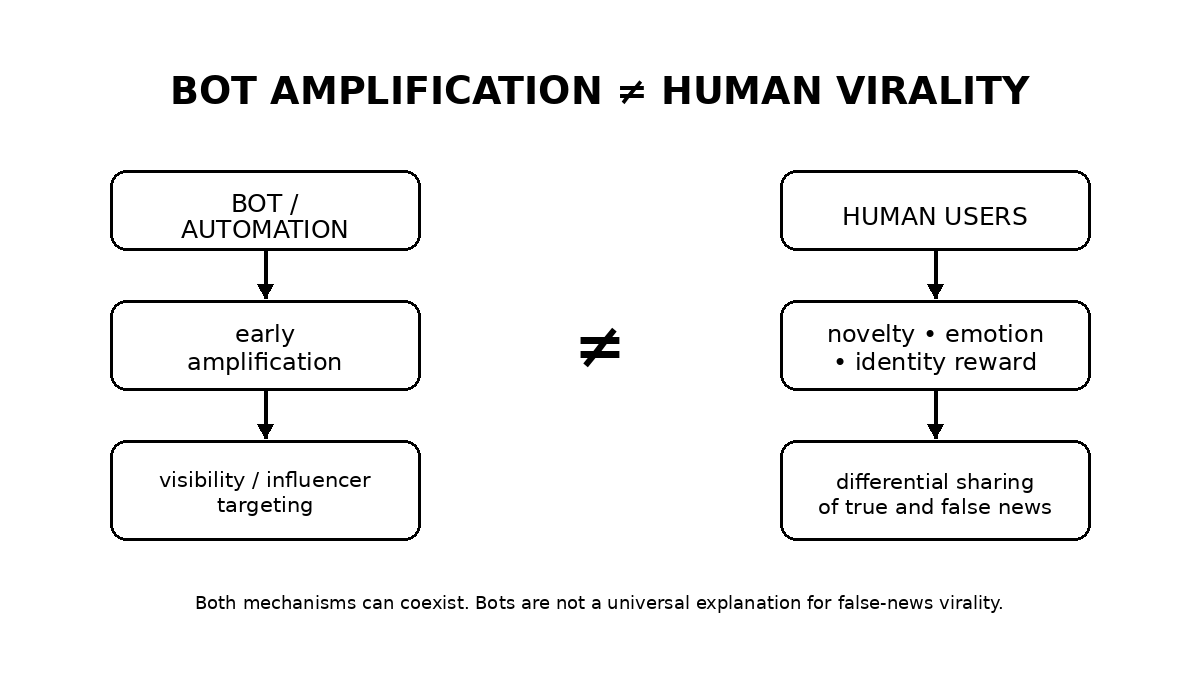
If part of that signal is artificially produced, automation can change the impression of what is popular, urgent, or broadly accepted. A large study published in Nature Communications analysed millions of tweets linking to low-credibility sources. The authors found that accounts with bot-like characteristics were disproportionately active in the early stages of spreading such content and often targeted users with large followings through mentions and replies.
If an automated network can place a claim in front of influential users, media outlets, or real communities quickly enough, it does not need to create the whole audience itself. It may be enough to trigger people. But none of this means that bots are the main reason false information succeeds.
Bots Are Not a Magical Explanation for Virality
Another large study, published in Science, found something that at first glance appears almost to conflict with the previous study. False news travelled farther, faster, deeper, and more broadly than true news. But when the researchers examined automated accounts, they found that bots accelerated the spread of true and false news at roughly the same rate. The difference between true and false was explained more by people. This is not evidence that bots do not matter.
It means we need to be precise about what we are measuring. One study analysed a broad stream of content from low-credibility sources and found substantial bot amplification. The other analysed verified true and false stories and showed that automation alone did not explain why falsehood travelled farther than truth. Both findings can be true at the same time. A bot can push content into the stream. It can repeat it. It can create initial visibility. It can target influential accounts.
But once real people start sharing a story because it is novel, shocking, enraging, politically useful, or compatible with what they already believe, automation is no longer the only engine. This matters for propaganda as well.
If we explain everything with bots, we may miss a more uncomfortable fact: people often voluntarily spread content that gives them an emotional or identity reward.
 Original source
“They're Bots” Can Also Become Propaganda
There is another trap. If bots genuinely exist, every inconvenient crowd can be declared artificial. Research on perceptions of bots suggests that people often overestimate their presence. Experimental work published in Scientific Reports found that participants frequently overestimated bot prevalence even before exposure, and exposure to bot profiles further increased some of those perceptions. That means the very idea of bots can become part of an information conflict.
If a political group comes to believe that almost every opposing comment is automated, it starts treating real people as inauthentic. It stops testing arguments. It starts testing allegiance. The evidentiary rule is therefore simple:
do not call an account a bot merely because it behaves strangely or because you dislike what it says.
A serious claim of coordinated automation requires technical, behavioural, network, or platform evidence.
When an Artificial Person Becomes a “Journalist”
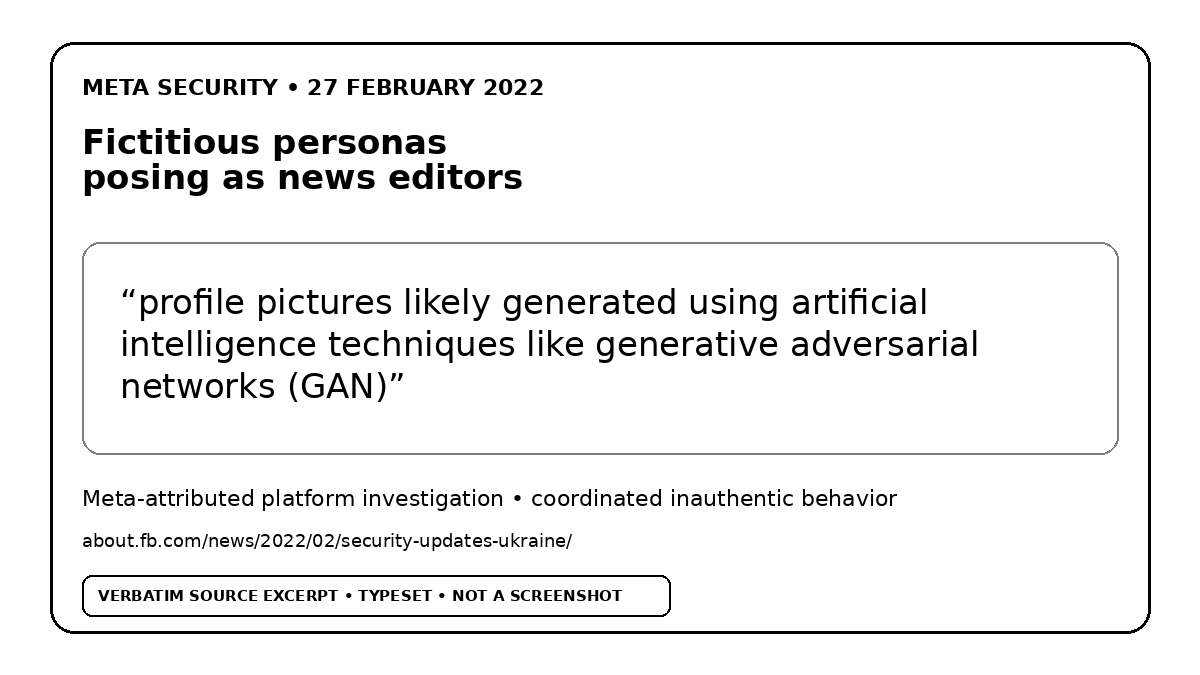
AI cannot only create a news item. It can also help create the apparent person publishing it. In February 2022, Meta described a network of accounts and websites targeting audiences in Ukraine. Part of the operation posed as independent news entities, used fictitious personas, and employed profile pictures that Meta assessed were likely created with generative adversarial networks (GANs). Some of the fake personas presented themselves as editors, experts, or authors.
This is a different kind of fake from a deepfake video. It does not fabricate the event. It fabricates the social context of the information. The reader does not see only an article. The reader sees an alleged author. A profile picture. A workplace. A description. Perhaps even a network of other accounts interacting with that person. In this way, artificial intelligence can help create something that is often more valuable to propaganda than a single image: an apparently independent source.
Caution is still necessary. We know this case primarily from Meta's own platform investigation. It is documented evidence about a specific network, not a neutral statistic about the entire information environment.
 Original sourceLicense / legal basis
The President's Voice That Was Not His
In January 2024, two days before the New Hampshire presidential primary, prospective voters received automated telephone calls. The voice sounded like Joe Biden. The message advised them not to vote in the primary and to “save” their vote for November. The voice was not Biden's.
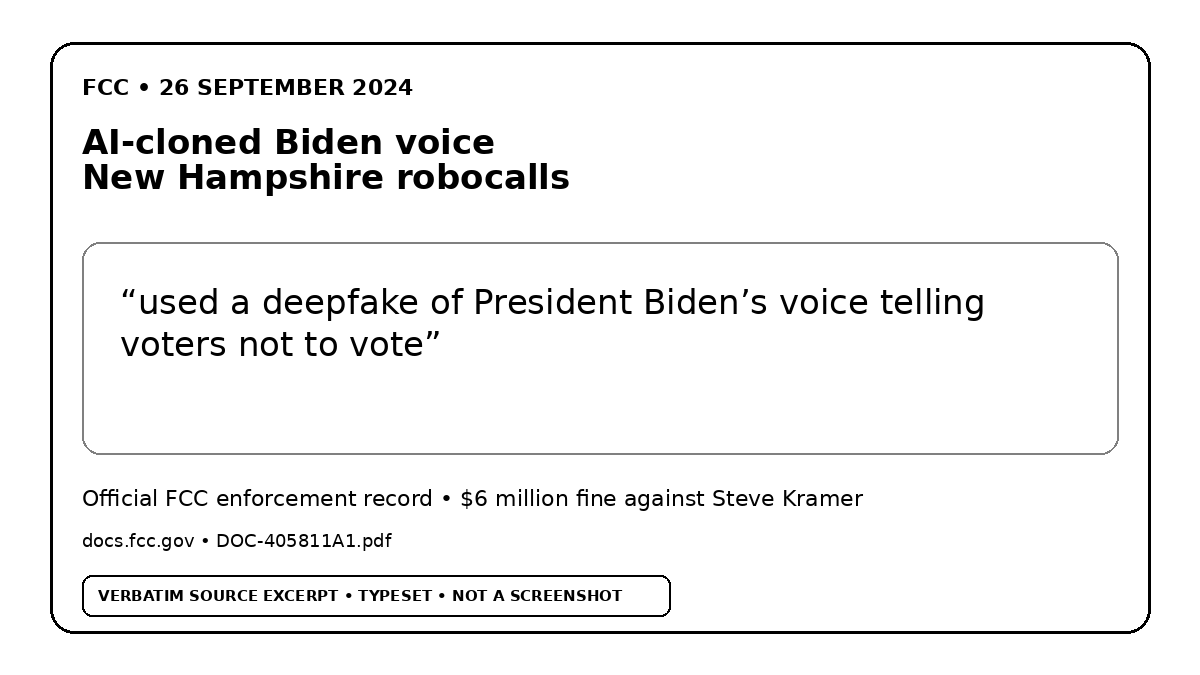
It was artificially generated. The case is especially useful because it does not rest only on media speculation about whether the recording was authentic. The U.S. Federal Communications Commission formally investigated the incident. In February 2024, the FCC also clarified that U.S. legal restrictions on an “artificial or prerecorded voice” apply to modern AI technologies used to generate human voices.
In September of the same year, the FCC imposed a six-million-dollar forfeiture on political consultant Steve Kramer over illegal robocalls using an AI-generated cloned voice and falsified caller identification information. This is concrete evidence that synthetic political media are not a hypothetical future. But even this case must not be turned into a spectacle larger than the evidence. The case proves that an artificially cloned voice was used for election-related disinformation.
It does not prove that the call changed the outcome of an election. Serious journalism has to preserve that distinction.
 Original sourceLicense / legal basis
The Deepest Problem with a Deepfake May Be an Authentic Recording
When Bobby Chesney and Danielle Citron analysed the development of deepfake technology at the end of the previous decade, they warned about a problem that is even more important today. If convincing fakes become widely known to exist, power does not accrue only to liars who create fakes. It also accrues to people who were genuinely recorded. Why?
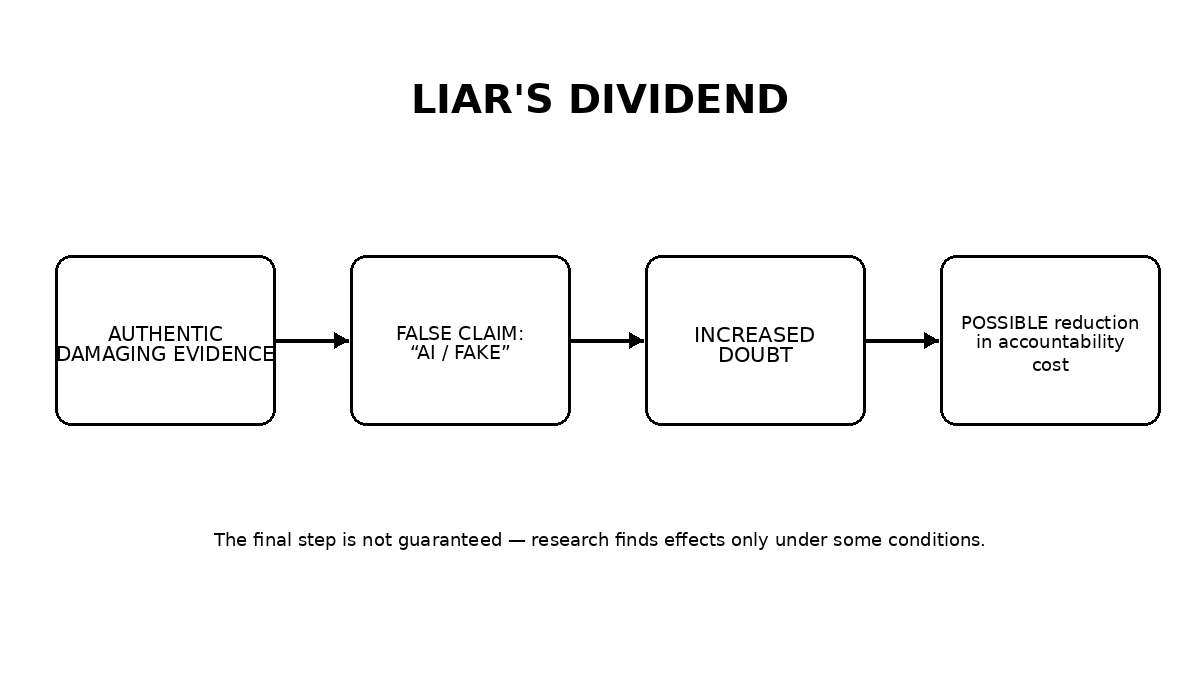
Because they can dismiss an authentic but damaging recording as fake. The authors called this the liar's dividend. In a world where anyone can say “that's AI,” authentic evidence does not necessarily lose its technical authenticity. It loses part of its automatic political force. More recent experimental research suggests that this effect is not merely theoretical. A study published in the American Political Science Review tested what happens when a politician dismisses a real scandal as “misinformation” or a “deepfake.”
Such false rebuttals could, under some conditions, increase support for the politician. But here too the boundary matters: the effect was stronger for text-based stories and substantially weaker for video evidence. The liar's dividend therefore does not mean that anyone can erase any evidence simply by saying “AI.” It does mean that the environment created by synthetic media has produced a new defensive argument for people who want to undermine inconvenient information.
A Detector Is Not a Judge of Truth
When a suspicious recording appears, the natural reaction is:
“Run it through an AI detector.” That can be a useful step. It must not be the final one. In its current technical review of synthetic content, NIST discusses several approaches: detection, watermarking, metadata and provenance, cryptographic signatures, and combinations of these methods.
None is presented as a universally perfect solution. Detectors are statistical systems. They can be wrong. They may work better on one type of generator than another. An image can be recompressed, cropped, photographed from a screen, or otherwise transformed. Generative techniques change, while the detector is always chasing a moving target. An authentic photograph can also carry a false context. A recording can be completely genuine and still be presented as footage from a different place, date, or event.
So the answer to “is this file AI?” is not the same as the answer to “is this story true?”
Content Credentials: A Trail of Origin, Not a Certificate of Truth
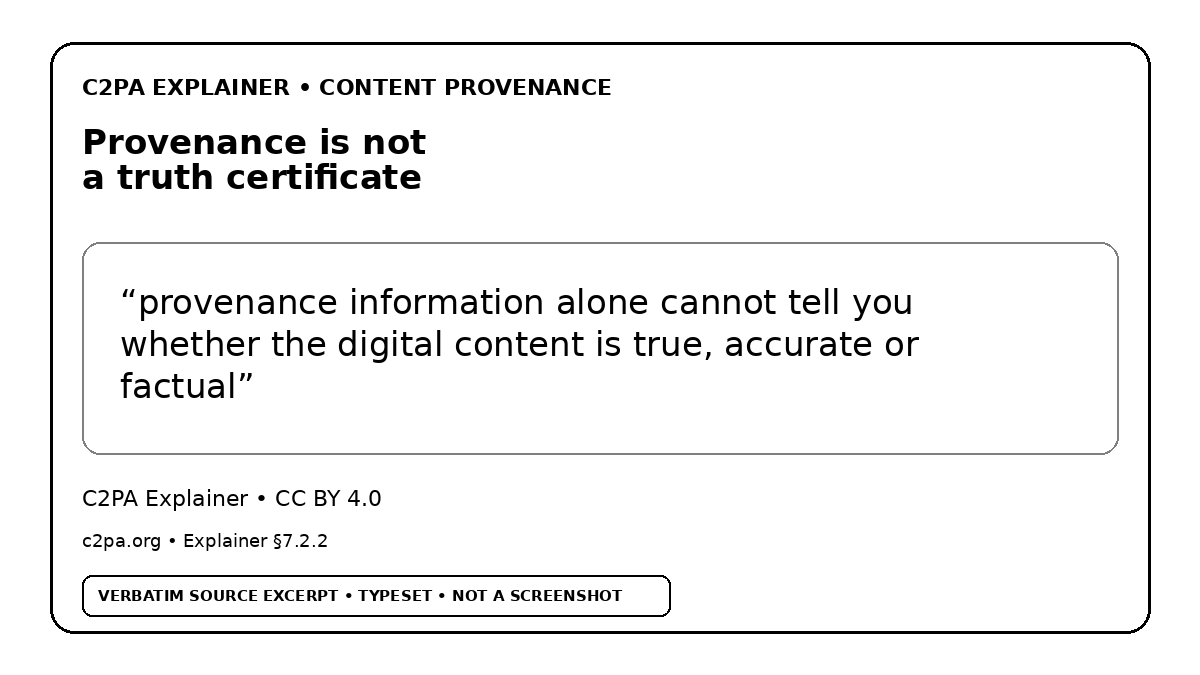
Another path is provenance. The Coalition for Content Provenance and Authenticity, or C2PA, develops the open Content Credentials standard. Digital media can carry cryptographically verifiable data about origin, signer, creation, and recorded modifications. If a photograph is created in a device that generates the relevant signature, if its changes are recorded, and if that chain is preserved through publication, the audience gains an additional layer of evidence. But C2PA itself stresses a limit that public discussion often skips:
provenance does not tell you whether the content is true.
Valid Content Credentials can help verify a signer, the relationship between the manifest and the file, and recorded information about creation and modification. They cannot by themselves tell us whether the photographed event was staged, whether a witness lied, whether the frame deliberately omitted the essential context, or whether an authentic recording was published under a false description.
Likewise, the absence of Content Credentials does not mean the content is false. An old archival recording, a photograph from an inexpensive phone, or a document from a system that does not support the standard may have no such credential and still be entirely authentic. If society began to equate “no credential” with “suspicious,” the solution could create a new kind of epistemic monopoly.
 Original sourceLicense / legal basis
Artificial Intelligence and Propaganda: Revolution or Merely Cheaper Production?
The most tempting headline would be:
“AI has revolutionised propaganda.” That is partly true. Generative systems can produce text, translations, images, comments, biographies, and variations of the same message at a speed that would have been unreachable for a human team. But real-world data on detected influence operations require a less dramatic formulation.
In its report on the 2024 election year, Meta wrote that in the covert influence networks it detected on its platforms, generative AI mainly produced incremental gains in productivity and content generation. In several investigations in 2024, OpenAI described the use of generative models for comments, articles, translation, research, fake personas, and apparent engagement. In the five operations it described at the time, the company said the use of its services did not produce a meaningful increase in audience reach or engagement.
Later reports from OpenAI and Google Threat Intelligence Group show a similar pattern: AI is increasingly being added to older operational methods, increasing scale and speed and enabling new forms of content. In September 2026, Google reported that in information operations it was still seeing mainly productivity gains and experimentation; among the tactics it was observing at the time, it had not identified a breakthrough capability that by itself changed the nature of the influence operation.
That is the key counterweight in the entire article.
AI lowers the cost of production. It does not eliminate the problems of distribution, credibility, human error, and actual influence.
Propaganda needs more than a generator. It needs a channel. It needs an audience. It needs a context in which the content will work. And it often still needs people who will spread it voluntarily.
Europe's Response: Label the Synthetic
The European Union has also responded to the problem through law. Article 50 of the AI Act introduces several transparency requirements. For certain generative systems, providers must ensure machine-readable marking that makes it possible to detect artificially generated or manipulated content. Users, or deployers, of certain systems must disclose when deepfake images, audio, or video have been artificially generated or manipulated.
A special regime also applies to AI-generated or manipulated text published for the purpose of informing the public on matters of public interest. The law includes an important exception: that disclosure obligation does not apply where the content has undergone a process of human review or editorial control and a natural or legal person holds editorial responsibility for publication.
Article 50 applies from 2 August 2026. For systems placed on the market before that date, there is a limited transition concerning the technical marking obligation in Article 50(2): their providers must comply with that requirement by 2 December 2026. Importantly, the law does not treat every use of AI as deception. There are exceptions and special rules for artistic, creative, satirical, and other contexts, as well as a distinction between technical machine-readable marking and disclosure that an audience can understand.
That is the right direction of thought. The problem is not the existence of synthetic content. The problem is when synthetic content, in a context where authenticity matters, presents itself as real without appropriate disclosure.
When Everyone Has the Evidence That Suits Them
The worst possible outcome of the synthetic revolution is not a world in which everyone believes deepfakes. It may be a world in which everyone believes only the recording that benefits their own side and says of every other one:
“AI.” That would be the perfect culmination of the development we have followed throughout this series. First, the media select reality. Then they frame it. Then the story is repeated through apparently independent channels. Then the platform decides what will be visible. And now artificial intelligence can help manufacture the raw material from which the story itself is built. But the answer cannot be a new automatic rule.
We cannot replace the old rule “I saw it on video, so it must be true” with a new rule: “I saw an AI artefact, so nothing is true.” We need a stricter culture of evidence. Who is the original source?
Does an original file exist?
When did it first appear?
Do we know the chain of creation and modification?
Does the event match other independent data?
Does provenance support the origin?
Do we have only the output of an AI detector or several different forms of evidence?
Is someone claiming that the recording is fake only after it became politically inconvenient?
And above all:
what can we actually prove?
The New Media Literacy Is Forensic
For years, media literacy mainly meant asking questions such as:
Who owns the outlet?
Who is the author?
What does the headline say?
What was omitted?
Which source is being cited?
In a synthetic information environment, we have to add another layer. Does this person exist?
Is this really their voice?
Did this image come from a camera?
Was the video substantially generated or altered?
Is provenance available?
Is the provenance complete?
Can the synthetic-content label be removed?
Are we looking at one account or a coordinated network?
Does a crowd of reactions represent a crowd of people?
This does not mean that every reader has to become a digital forensic analyst. It does mean that serious media will increasingly have to explain why they trust a particular digital artefact. Not only that they checked it. How they checked it.
The Greatest Danger Is Not the Perfect Fake
The most sophisticated propaganda of the future may not need a perfect deepfake at all. A large volume of good-enough content may be sufficient. A few synthetic images. A few authentic recordings in the wrong context. A few fake profiles. A few automated accounts. A few real people who spread all of it because they want to believe. And when authentic evidence appears, someone will say that it too is synthetic.
That environment is much harder than a world in which there is simply truth on one side and a fake video on the other. The problem becomes the management of uncertainty. At that point, we have to return to the rule that runs through this entire series. Do not trust the label. Do not trust authority alone. Do not trust the image alone. Do not trust the detector alone. Check the chain of evidence.
Because artificial intelligence has not abolished reality. It has simply made it much cheaper to manufacture convincing competition for it.
Sources and further reading
- National Institute of Standards and Technology (NIST). Reducing Risks Posed by Synthetic Content: An Overview of Technical Approaches to Digital Content Transparency (NIST AI 100-4), 2024, updated 2026. Source
- Coalition for Content Provenance and Authenticity (C2PA). Content Credentials / C2PA Technical Specification 2.3. Source
- C2PA. C2PA and Content Credentials Explainer — provenance and truth limitations. Source
- Chesney, B., & Citron, D. Deep Fakes: A Looming Challenge for Privacy, Democracy, and National Security. California Law Review, 2019. Source
- Schiff, K. J., Schiff, D. S., & Bueno, N. S. The Liar’s Dividend: Can Politicians Claim Misinformation to Evade Accountability? American Political Science Review, online 2024 / vol. 119, 2025. Source
- Shao, C., Ciampaglia, G. L., Varol, O., et al. The spread of low-credibility content by social bots. Nature Communications 9, 4787 (2018). Source
- Vosoughi, S., Roy, D., & Aral, S. The spread of true and false news online. Science 359 (2018). Source
- Yan, H. Y., Yang, K.-C., Shanahan, J., et al. Exposure to social bots amplifies perceptual biases and regulation propensity. Scientific Reports 13, 20707 (2023). Source
- Federal Communications Commission. Implications of Artificial Intelligence Technologies on Protecting Consumers from Unwanted Robocalls and Robotexts, Declaratory Ruling FCC 24-17, 2024. Source
- Federal Communications Commission. FCC Fines Man Behind Election Interference Scheme $6 Million for Sending Illegal Robocalls That Used Deepfake Generative AI Technology, 26 September 2024. Source
- Meta. Updates on Our Security Work in Ukraine, 27 February 2022. Source
- Meta. What We Saw on Our Platforms During 2024’s Global Elections, 2024. Source
- OpenAI. Disrupting deceptive uses of AI by covert influence operations, 30 May 2024. Source
- OpenAI. Disrupting malicious uses of AI: October 2025, 7 October 2025. Source
- Google Threat Intelligence Group. GTIG AI Threat Tracker: From Prompting to Autonomy – The Evolution of Adversarial AI, 2026. Source
- European Commission. Transparency obligations under Article 50 of the AI Act, 2026. Source
- European Union. Regulation (EU) 2024/1689 — Artificial Intelligence Act, Article 50, consolidated text. Source