The Anatomy of a Slovenian Headline: How Information Becomes an Impression
How a headline can remove a qualification, turn association into causation, or increase certainty and present a stronger claim than the article supports.

The article can say one thing while the headline says another
How many people actually read the article?
And how many read only the headline?
This question matters more than it may seem. On a news website, the headline is no longer merely the name of a text. It appears on the front page, in a search engine, on social media, in a phone notification, and in conversation with someone who may never have opened the article.
In her overview of the development of Slovenian headline writing, Monika Kalin Golob finds that headlines in printed newspapers were already designed for rapid information and attention capture, and that this function has become even more important with the scanning of online news portals. Digitalization, commercialization, and tabloidization have affected their structure, length, and language choices.
This means that a headline is not merely the doorway to an article. For part of the audience, the headline is practically their entire contact with the news story. And that is where the problem begins. A headline can be grammatically correct. The source can exist. The article underneath can even be cautious and high quality. Yet the headline can still create a stronger impression than the evidence in the article permits.
For this process, we will use the descriptive expression epistemic compression of the headline. This is not an established academic term, but our label for the phenomenon in which complex information containing limitations, uncertainty, sources, and conditions is compressed into a shorter, simpler, and often more certain claim. In the process, precisely what matters most for understanding the information can disappear.
A headline also affects how we read the article
The easiest answer to a bad headline would be:
People should just read the article.
But psychological research shows that the problem is not so simple. Ullrich Ecker, Stephan Lewandowsky, and colleagues experimentally demonstrated that misleading headlines can affect readers' memory, reasoning, and behavioral intentions. A headline guides the interpretation of the text that follows, and people do not always fully correct the initial false frame even after receiving more accurate information.
Therefore:
“But everything is written correctly in the article.”
is not a complete answer. The headline comes first. It establishes the frame. The article is then read through that frame.
Two words can change the level of certainty
In the previous article on reporting about Ukraine, we saw an almost laboratory-clean example. A 24ur headline in 2022 predicted that Russia would exhaust its combat capabilities within ten days. In the text, U.S. general Ben Hodges spoke more cautiously: Russia could exhaust its capabilities, while explicitly allowing for the possibility that he might be wrong. The headline turned:
could
into:
will.
That is not merely shortening. Could expresses possibility. Will expresses a far more categorical prediction. If we remove the conditional, we change the epistemological status of the information. But the same media outlet can preserve uncertainty very well on another occasion. When discussing Omicron, 24ur titled a story:
“Could Omicron mark the end of the coronavirus?”
The question appropriately preserves the possibility and uncertainty of the scenario. That matters. The problem is not that Slovenian media do not know how to write precise headlines. They do. The question is:
when is precision preserved, and when is it replaced by a stronger formulation?
When “a study suggests” becomes “causes cancer”
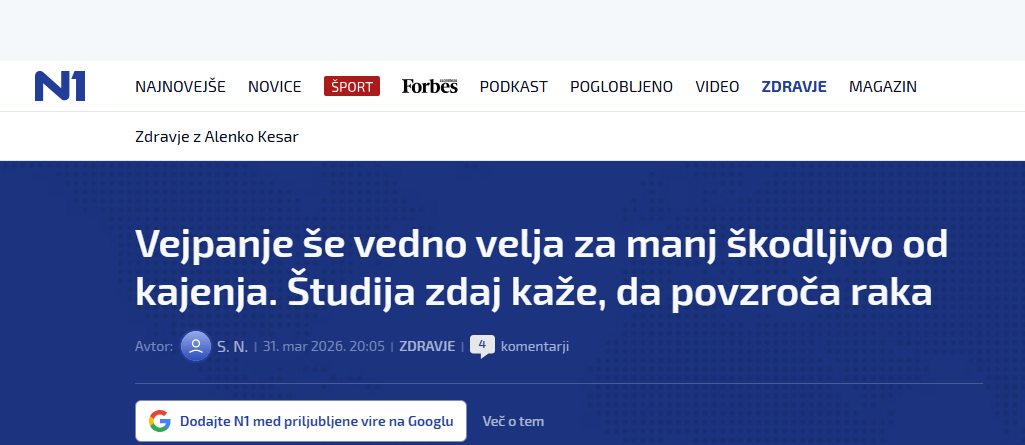
A very good example comes from health reporting. In March 2026, N1 published the headline:
“Vaping is still considered less harmful than smoking. A study now shows that it causes cancer.”
This is a very strong formulation. “Causes cancer” is a claim of causality. But the text immediately reveals a more complicated situation. Electronic cigarettes have been widely used for a relatively short period, so there are not yet enough long-term epidemiological studies. The reviewed research therefore analyzed effects on the body already known to be associated with cancer development, and from that evidence the authors concluded that vaping probably causes some cancers.
That does not mean vaping is safe. Nor does it mean future long-term studies will not confirm a causal relationship. But it does mean the evidentiary situation is more complicated than the bare sentence:
“A study shows that it causes cancer.”
It is important to distinguish:
biological mechanisms associated with cancer
from:
an epidemiologically demonstrated higher incidence of cancer
and from:
a demonstrated causal relationship.
These are different levels of evidence.

Association is not the same as cause
The same caution applies to nutrition research. In 2025, N1 reported on an analysis that found an association between even small amounts of processed meat and sugar-sweetened drinks and a higher risk of certain diseases. The article also states the limitation very clearly: the included studies were observational. They can show an association, but they cannot by themselves prove that the specific diet caused the disease. This is an exemplary illustration of the difference between:
associated with
and:
causes.
In everyday language, the formulations can seem almost identical. In science, they are not.
Sometimes a reassuring headline is too certain as well
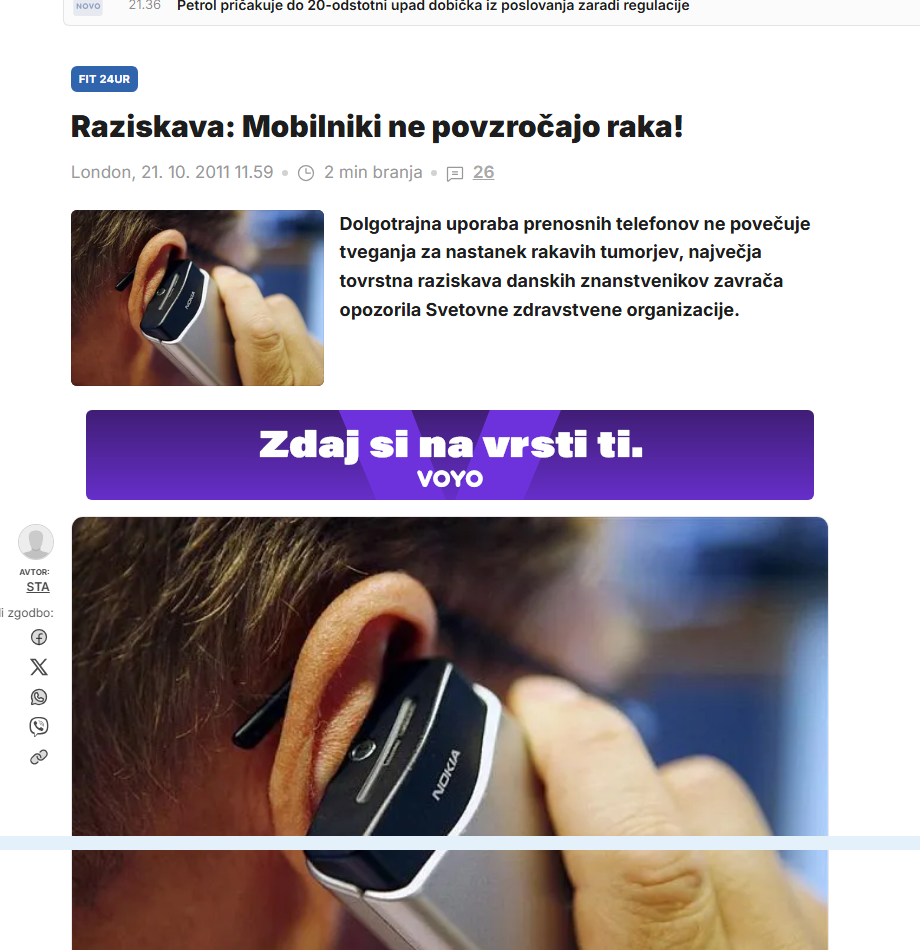
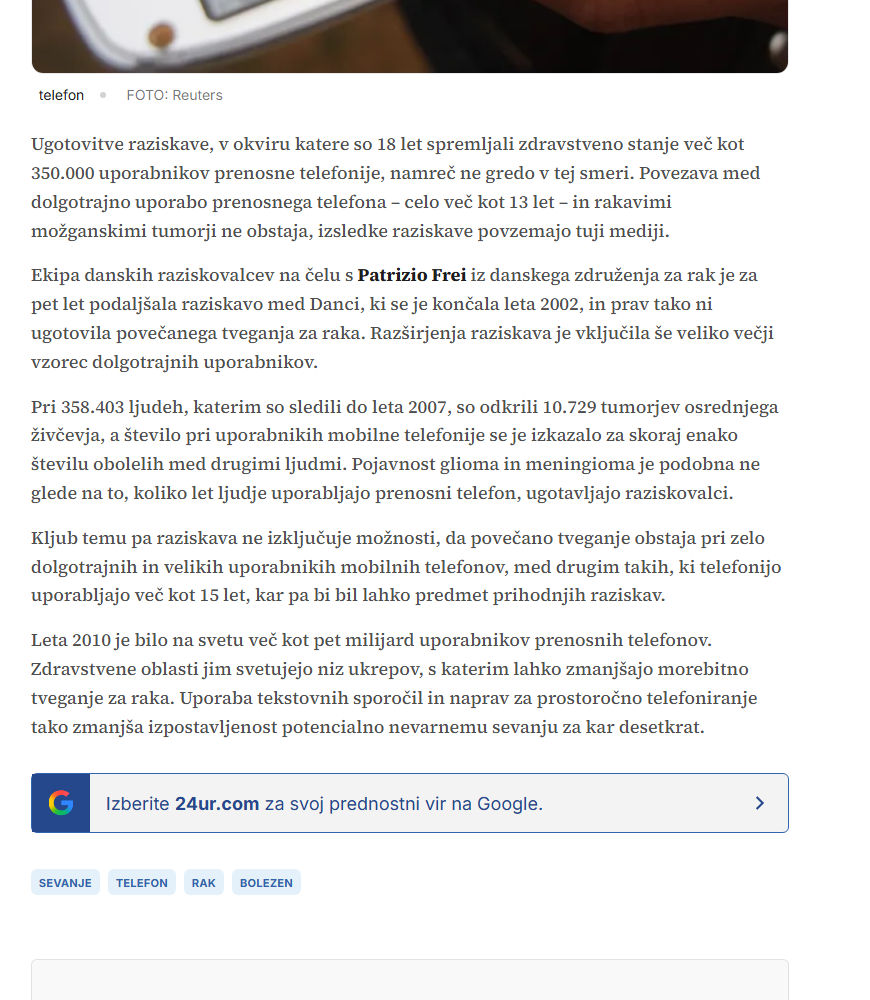
Sensationalism does not necessarily mean only frightening people. In 2011, 24ur published:
“Study: Mobile phones do not cause cancer!”
The article reported on a large Danish study in which no increased risk of certain tumors was found among mobile-phone users in the population followed. But the same article notes that the study could not exclude a possible risk among very long-term and intensive users. It also cites the more cautious assessment of the International Agency for Research on Cancer at the time.
The headline:
“Mobile phones do not cause cancer!”
is broader than the finding:
“A large Danish study found no increased risk of certain tumors in the population followed.”
The first is more attractive. The second more accurately states what was actually found. This example matters because it shows the problem does not have only one ideological or emotional direction. A headline can exaggerate toward danger. It can also exaggerate toward reassurance. The mechanism remains the same:
limited result → general claim.
“Does fruit cause lung cancer?”
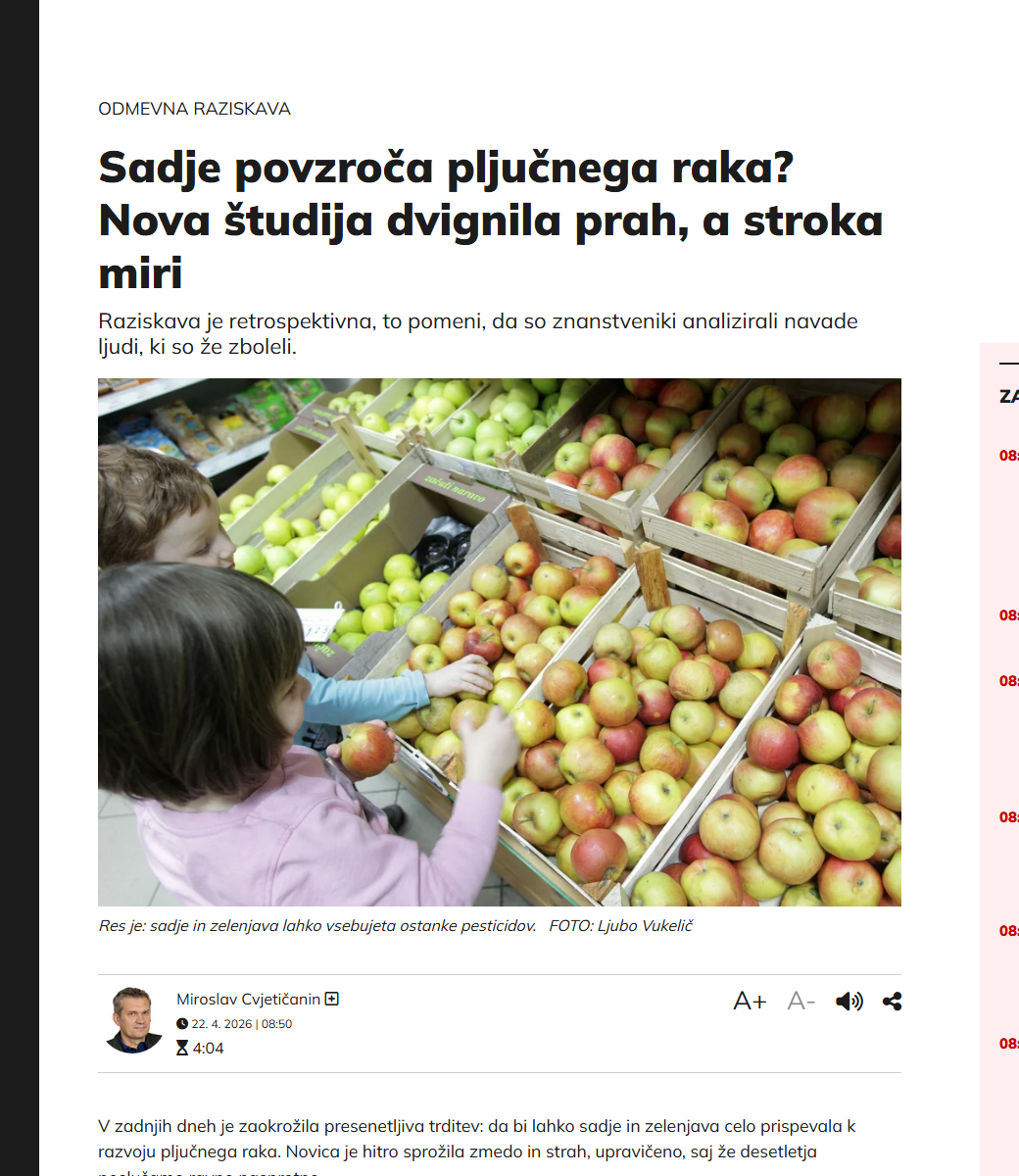
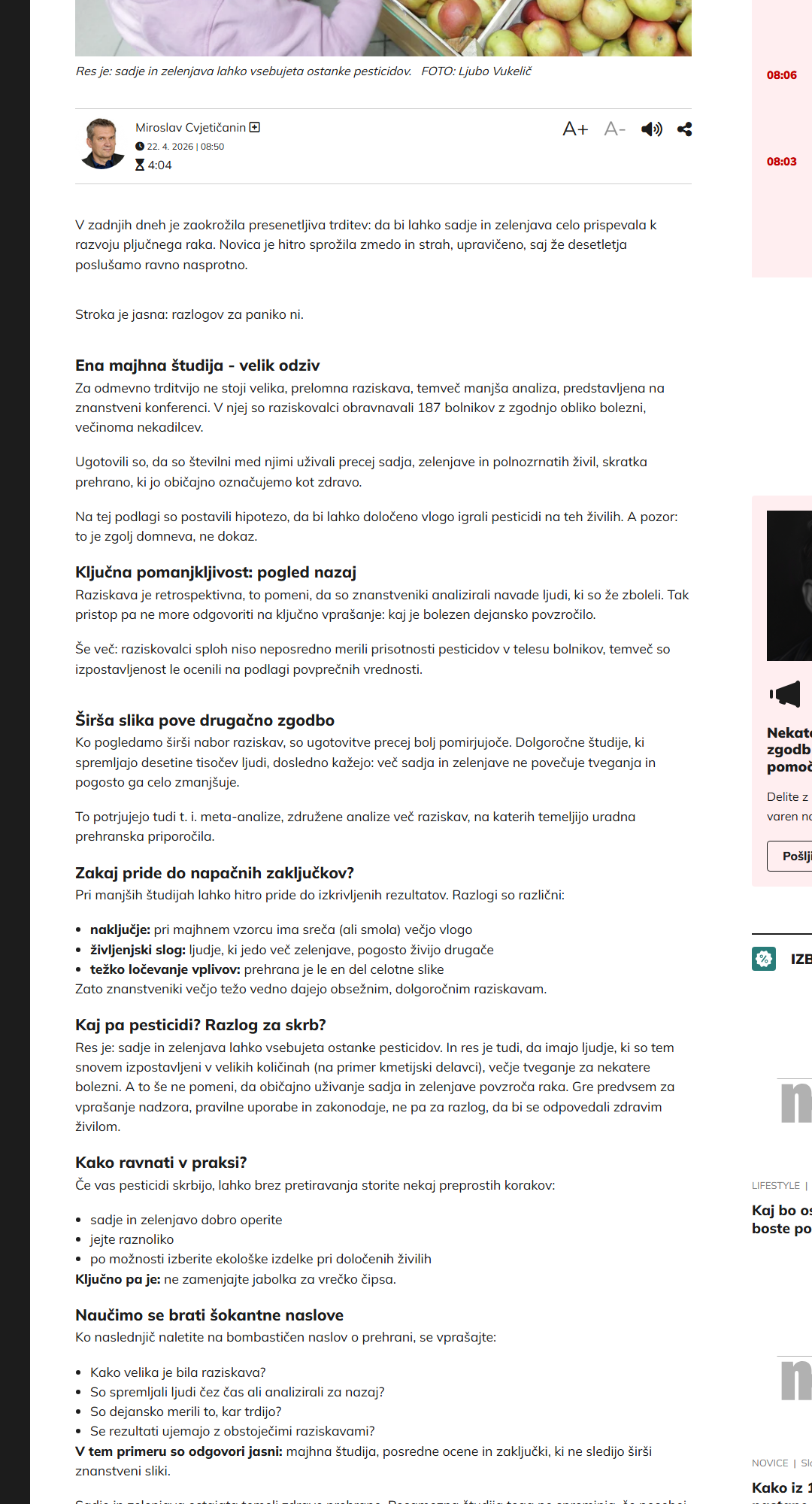
A question mark is one of the most interesting forms of punctuation in journalism. It can sincerely express uncertainty. But it can also permit the publication of a dramatic connection that the media outlet could not responsibly state without the question mark. In April 2026, Slovenske novice published:
“Does fruit cause lung cancer? New study causes a stir, but experts reassure.”
The article itself is actually very cautious. It explicitly explains that this is a small retrospective study of 187 patients, that pesticides were not measured directly, that the finding was a hypothesis rather than proof, and that broader research does not show that ordinary fruit and vegetable consumption causes lung cancer. But the first connection the reader sees is:
fruit → lung cancer.
The question mark formally says:
we are not claiming this.
But it still places the association between the concepts in the foreground.
But not every question headline is manipulation
We should not create a new simple rule:
question mark = manipulation.
That is not true.
“Could Omicron mark the end of the coronavirus?”
is a question headline, but it appropriately expresses uncertainty in an expert debate. A different example is:
“Tragedy: Did he kill out of jealousy?”
In 2012, 24ur reported on a murder suspect. At the time, jealousy had not been established by police as the motive, but was a claim published by the Večer website while the investigation was still ongoing. Formally, the headline asserts nothing. But the question itself already links the suspect with a particular motive. So with a question headline, what matters is not merely whether it ends with a question mark.
We must ask:
where did the assumption embedded in the question come from?
An experimental study by Linda Lai and Audun Farbrot found in computer-mediated communication that question headlines achieved more clicks than corresponding declarative versions. This was not a study of Slovenian journalism and cannot tell us why a specific Slovenian editor uses a question mark. But it shows that interrogative form can be an effective means of attracting attention.
Emotion can come before information
In 2023, Slovenske novice published:
“You will be horrified when you learn what all causes cancer.”
The headline does not merely tell the reader what they will learn. It also tells them how they should feel:
horrified.
But the article is substantially more heterogeneous. For artificial sweeteners, for example, it explains that there is no evidence of increased cancer risk in humans; for dental fillings, it says research has not shown an association; for deodorants, fluoride, and power lines, it likewise states important limitations or the absence of stronger evidence. The headline compresses all of this into:
you will be horrified + what all causes cancer.
That is not merely a summary. It is also an emotional frame. Similar effects come from constructions such as:
Shocking.
Horrifying.
You won't believe it.
This will shake you.
Before we receive the information, we receive a proposed reaction.
A click does not require a lie — it requires missing information
One of the most effective online techniques is creating an information gap. In 2025, N1 published:
“New study: just one hot dog or one sugary drink a day is enough.”
Enough for what?
The headline does not say. To complete the meaning of the sentence, we have to open the article. The content then explains that the study concerns statistical associations with a slightly higher risk of type 2 diabetes, ischemic heart disease, and colorectal cancer, while clearly stating the limitations of observational studies. This is an interesting example because the article itself is not necessarily problematic.
But the headline withholds essential information.
A Slovenian master's thesis by Atena Bošnjak on clickbait identifies emotionally charged language, questions, numbers, sensational claims, promises of exclusive information, and information gaps that the reader fills only by clicking as characteristic techniques. It also analyzed RTV Slovenija, 24ur, and Slovenske novice.
The source can disappear before the first sentence
Another common problem is the answer to the question:
Who is claiming this?
The headline:
“Experts warn...”
can sound authoritative. But which experts?
How many?
From what field?
Is this a consensus or one person's opinion?
The same applies to:
“Research has shown...”
The word research can refer to an experiment on a few dozen people, a cohort study of hundreds of thousands, research on mice, a laboratory experiment, or a systematic review of dozens of earlier studies. But in a headline, all of them receive the same label:
research.
The word can therefore act as a stamp of scientific authority. But the correct question is:
what kind of research?
From relative risk to personal fear
With health headlines, we must also pay attention to the difference between relative and absolute risk. In the N1 article on processed meat, it is stated that daily consumption of one hot dog was associated with an 11 percent greater risk of type 2 diabetes and a seven percent greater risk of colorectal cancer compared with people who did not have such intake.
But:
11 percent greater risk
does not mean:
11 percent of people will become ill.
It is a relative change compared with the baseline risk in the comparison group. If the baseline risk is not explained, a mathematically correct number can create a much stronger intuitive impression than its meaning for an individual warrants. The shorter the format, the greater the responsibility to ensure that the number does not become psychologically larger than its actual meaning.
A headline can be completely true and still selective
So far we have mainly discussed headlines that are stronger than the content. But there is a subtler problem. A headline can be entirely true. The only question is:
why was this particular piece of information selected?
Imagine a study with ten findings. Nine are boring. One is surprising. The surprising one will almost always become the headline. That is understandable. Media compete for attention. But if this selection is repeated every day, selection bias can emerge. Readers do not necessarily receive false information. They receive a disproportionate amount of the most dramatic information.
Their picture of the world can therefore become distorted without a single invented sentence.
What would a more precise headline look like?
Let us rewrite a few headlines.
“A study now shows that vaping causes cancer.”
More precise:
“Review of research warns of carcinogenic effects of vaping; long-term population data are still lacking.”
“Study: Mobile phones do not cause cancer!”
More precise:
“Large Danish study found no increase in brain tumors among mobile-phone users followed.”
“Does fruit cause lung cancer?”
More precise:
“Small retrospective study raises a pesticide hypothesis; causal link has not been demonstrated.”
“You will be horrified when you learn what all causes cancer.”
More informative:
“What we know about common cancer risk factors — and where an association has not been demonstrated.”
“New study: just one hot dog or one sugary drink a day is enough.”
More informative:
“Small daily amounts of processed meat and sugary drinks associated with slightly higher risk of some diseases.”
The alternative headlines are longer. Less dramatic. They might receive fewer clicks. But even without opening the article, the reader would understand considerably more. This is the fundamental conflict of online journalism. A headline has to:
inform
and at the same time:
attract attention.
Those goals are not always aligned.
Clickbait is not necessarily a lie
The term clickbait is often used too broadly. Not every interesting headline is clickbait. Not every dramatic headline is false. Not every question mark is manipulation. It is more useful to ask:
what did the headline do to the information?
Did it remove uncertainty?
Did it generalize a limited finding to everything?
Did it turn association into cause?
Did it remove the source?
Did it hide important information merely so that we would obtain it after clicking?
Did it assume something the evidence had not yet shown?
Did it determine our emotional reaction in advance?
When one or more of these happen, the headline is no longer merely a summary. It begins actively shaping interpretation. If a headline removes a qualification without which the claim sounds substantially more certain, that is no longer innocent compression. The reader has been given a stronger claim than the article itself supports.
Is this intentional manipulation?
From a single headline, we generally cannot know. A strong formulation may arise from editorial policy. Competition for attention. Time pressure. SEO. Translation of a foreign article. Space constraints. Clumsiness. Or a deliberate desire to create a particular impression. From the final headline alone, we usually cannot prove which reason was decisive. So we do not analyze the editor's thoughts. We analyze the product and its communicative effect.
To conclude that a headline is misleading, proof of intent is not required. Intent becomes necessary only if we want to describe the act as deliberate manipulation or a lie. The examples in this article are also not a statistically representative sample of all headlines in Slovenian media. We deliberately chose examples in which a particular mechanism is especially visible.
To claim that one portal is systematically more misleading than another, we would need a much larger and representative corpus. There are Slovenian studies of news framing showing that media outlets differ and that framing can be detected across different portals, but such studies by themselves do not justify declaring every individual headline propaganda.
A good headline can exist
Slovenian media contain many headlines that preserve important distinctions.
Could...?
Associated with...
According to the assessment of...
The study did not find...
Police suspect...
Such a headline may be less forceful. But it does not push the reader toward a conclusion the evidence does not yet permit. The most important defense against misleading headlines is therefore not a ban on dramatic language. It is preserving the distinctions between:
is
and:
is said to be; between:
will
and:
could; between:
causes
and:
is associated with; between:
proven
and:
one study suggests; between:
X is hiding
and:
X declined to disclose the information. These are not trivial linguistic refinements. They are markers of how much we actually know about something.
The headline as the first version of reality
A person who scans fifty headlines every day can absorb several hundred small interpretations of the world in a single week. They may not read a single article. But an impression is formed anyway. Something is dangerous. Someone is hiding something. Something causes cancer. A country will collapse. A politician is guilty. An expert has proven something. Headline after headline. Each one small. Together they create the information environment within which we think. So with the next dramatic headline, it is useful to perform a very simple experiment:
put back the words that may have disappeared.
Who is claiming this?
What did the research actually show?
Is something possible or certain?
Is it an association or a cause?
Is the question supported by evidence or mainly interesting enough to click?
Because sometimes what is missing between information and a false impression is not an entire story. It is just one word.
Could.
Sources and further reading
- Monika Kalin Golob — Razvoj naslovja v slovenskih tiskanih in spletnih medijih Source
- Ecker et al. — The effects of subtle misinformation in news headlines Source
- 24ur — Ben Hodges Source
- 24ur — Omikron Source
- N1 — Vejpanje Source
- N1 — Hot dog / sladka pijača Source
- 24ur — Mobilniki in rak Source
- Slovenske novice — Sadje in pljučni rak Source
- 24ur — Je moril iz ljubosumja? Source
- Lai & Farbrot — What makes you click? Source
- Atena Bošnjak — Analiza klikvab na spletnih platformah Source
- Skaza — Okvirjanje novic v slovenskih medijih Source