Electric Universe: Plasma, Electromagnetism and Alternative Cosmology
Space plasma, Birkeland currents, and magnetic reconnection are real physics. But they do not automatically show that galactic currents power the Sun or that electromagnetism replaces standard cosmology.
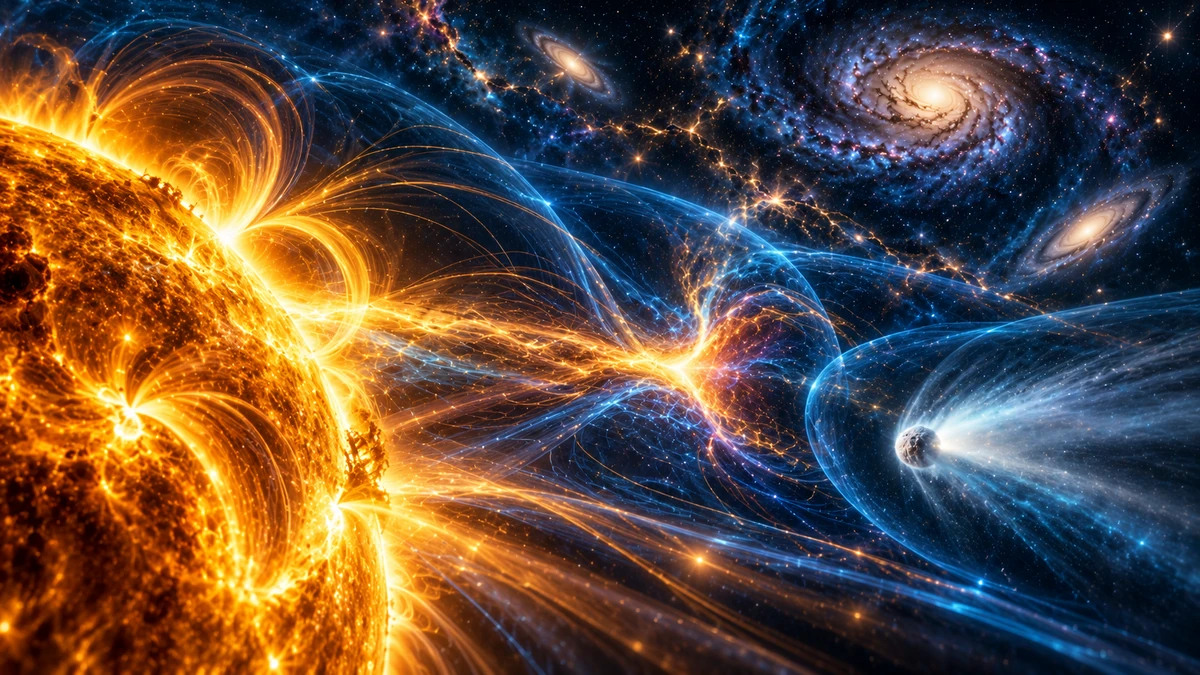
When we look at the Sun, an aurora, a comet tail or the radio jet of an active galaxy, we are looking at a universe in which electromagnetism is not a marginal detail. Space plasmas carry currents, form current sheets and filaments, generate magnetic fields, accelerate particles and release energy through magnetic reconnection. Birkeland currents linking Earth’s magnetosphere and ionosphere are directly measured; the solar wind is a magnetised plasma; modern missions measure electric and magnetic fields at resolutions the pioneers of plasma physics could only imagine. [1][2][3]
That is precisely why the Electric Universe is such an interesting subject. The movement begins with real phenomena and often assigns them a much broader role: electrical currents are proposed as organisers of galaxies, external power sources for stars, drivers of cometary activity and the basis of a cosmology that does not require the Big Bang, dark matter, black holes or other parts of the standard astrophysical framework. [10][11] The central question is therefore not whether electricity matters in space — it unquestionably does — but which phenomena electromagnetism actually explains, on which scales, with which measurements, and where additional claims begin that require evidence of their own.
The Universe Is Full of Plasma — But That Is Not Yet an “Electric Universe” Theory
Plasma is an ionised state of matter in which electrons and ions respond collectively to electric and magnetic fields. Much of the ordinary visible matter in stars and interstellar environments is in a plasma state. In near-Earth space, plasma is measured directly in the solar wind, magnetospheres, ionospheres and the solar atmosphere. [1][3]
None of this implies a single cosmological model. Plasma physics is now a standard part of astrophysics, heliophysics and stellar physics. Magnetohydrodynamics (MHD), kinetic plasma theory, waves, turbulence, current sheets and reconnection are routine tools of modern research. The statement “large electric currents exist in space” is therefore not an alternative to standard physics. It is part of standard physics.
The divergence appears at the next step: do those currents participate in the dynamics of already existing astrophysical systems, or are they the primary external source of stellar energy and the dominant organising mechanism of the cosmos? The latter is a much stronger claim.
Birkeland: Currents from Space Were Predicted and Then Measured
Around the beginning of the twentieth century, Norwegian physicist Kristian Birkeland linked the aurora to electric currents flowing along the geomagnetic field between space and the polar ionosphere. The idea remained controversial for decades. Satellite measurements in the second half of the twentieth century confirmed that such currents do exist. They are now called Birkeland currents, or field-aligned currents. Typical current systems can carry currents of a million amperes or more. [1]
This is an important historical lesson. Space is not electrically “dead,” and plasma does not suppress all macroscopic electric currents. Currents can flow along magnetic fields, while energy and momentum can be transferred between the solar wind, magnetosphere and ionosphere. [1][2]
But Birkeland currents around Earth do not automatically imply that analogous galactic currents power the Sun. Confirming one current system where it is measured confirms the mechanism in that system; it does not by itself confirm every larger circuit that can be imagined.
Hannes Alfvén: Why He Emphasised Currents, Filaments and Double Layers
Hannes Alfvén received half of the 1970 Nobel Prize in Physics “for fundamental work and discoveries in magnetohydrodynamics with fruitful applications in different parts of plasma physics.” [4] His importance to space physics is enormous. Alfvén waves, MHD and his warnings that idealised plasma approximations can obscure current sheets, filaments, double layers and strong local electric fields remain influential. [5]
In his Nobel lecture he stressed the contrast between idealised homogeneous models and the often filamentary, inhomogeneous behaviour of actual plasmas. He also warned that drawing only magnetic field lines can conceal the physical role of current circuits. [5]
It does not follow, however, that his Nobel Prize was awarded for plasma cosmology or for the modern Electric Universe theory. Alfvén did pursue unconventional cosmological ideas, including a matter–antimatter symmetric “ambiplasma” model. That was a separate research direction, not the subject for which he received the Nobel Prize. [4][6]
Plasma Cosmology Is Not Exactly the Same as Today’s Electric Universe
From the 1960s through the 1980s, Alfvén, Anthony Peratt and others investigated models in which cosmic electric currents and magnetised plasmas played a major role in the formation of large-scale structures. Peratt, for example, performed three-dimensional particle-in-cell simulations of interacting large current filaments and compared them with the morphology of radio sources and galaxies. [6][7]
This history deserves accurate treatment: plasma cosmology did not originate merely as an internet movement. It includes technical publications and a serious history of plasma astrophysics. At the same time, these models did not become the dominant cosmology, because a cosmological model must simultaneously explain a much broader body of observations — cosmic expansion, the cosmic microwave background, primordial density fluctuations, structure formation, gravitational lensing and other independent data. [15][16]
The modern Electric Universe movement, as presented by the Thunderbolts Project, goes farther. Its own descriptions argue that electric currents are fundamental to the organisation of galaxies and stars, that stars may be powered by galactic currents, and that the standard cosmological picture need not invoke the Big Bang, dark matter, dark energy, neutron stars or black holes. [10][11] That is a much broader package of claims than the observation that cosmic plasma is electromagnetically active.
Standard Astrophysics Is Not “Gravity Only”
A central rhetorical contrast in Electric Universe material is between a “gravity universe” and an “electric universe.” Modern astrophysics does not use that division. Different systems and scales involve gravity, electromagnetism, nuclear physics, radiation, fluid dynamics and plasma kinetics.
For charged particles moving in the magnetosphere or solar wind, electromagnetic forces are often far more important than gravity. For binding nearly electrically neutral planets, stars, star clusters and large masses of baryonic and dark matter, gravity can dominate on large scales. In accretion disks around compact objects, gravity supplies the energy reservoir while magnetic fields and turbulence enable angular-momentum transport and jet production. In the Sun, nuclear fusion supplies most of the long-term luminosity, while plasma and magnetic processes control the atmosphere, sunspots, flares, coronal mass ejections and solar wind. [3][8][9]
The discovery of an electric field, current or plasma filament is therefore not in itself a failure of standard astrophysics. Such phenomena are frequently exactly what standard plasma models predict and measure.
“The Electric Force Is Far Stronger Than Gravity” — True, but the Conclusion Is Not Simple
Between individual charged particles the electromagnetic interaction is enormously stronger than gravity. Electric Universe literature sometimes uses this fact to argue that electromagnetism must therefore dominate cosmic organisation. [10]
Macroscopic matter, however, is generally extremely close to electrical neutrality. A plasma contains approximately balanced positive and negative charge and responds to local electrostatic disturbances through Debye shielding: charged particles rearrange so as to reduce long-range electrostatic fields. [12] This does not mean that plasmas contain no electric fields or currents. Large current systems can flow along magnetic fields, and magnetic fields can have very long ranges. It means only that the force ratio between two bare charged particles cannot be transferred directly to the net force between two nearly neutral stars or galaxies.
Gravity also has a crucial property: ordinary mass does not come in positive and negative forms that cancel one another. Gravitational contributions therefore add. Electromagnetic effects can dominate locally, but for any macroscopic system we must actually measure or calculate charge distribution, currents, fields and energy.

Magnetic Reconnection: A Real, Directly Observed Plasma-Electric Process
Magnetic reconnection is a process in which magnetic-field topology changes inside a narrow plasma layer and magnetic energy is converted into motion, heating and particle acceleration. NASA’s MMS mission has directly sampled the electron diffusion region at Earth’s magnetopause and measured electric fields, currents and characteristic electron distributions. [2][13]
This is a good illustration of why two extremes are both wrong. It is wrong to say that “official astronomy” does not recognise electric currents and plasma electric fields. But it is also wrong to infer from the existence of reconnection that every high-energy astronomical event is an electrical discharge in the laboratory sense.
Reconnection operates within well-defined plasma physics involving local magnetic geometry, current sheets, density, temperature, flow speed and particle kinetics. The word “electric” by itself is not yet a mechanism.
The Electric Sun: The Strongest Test of the Hypothesis
The Thunderbolts Project explicitly traces the modern Electric Universe model to Ralph Juergens and the electric Sun idea. Its material presents the possibility that the Sun is not powered primarily by nuclear fusion in its interior but by external electrical currents from the galactic environment. [10][11]
This is a strong claim and therefore a highly testable one. If hydrogen fusion in the core is the principal source of solar energy, the nuclear reactions must produce a characteristic neutrino flux. That is exactly what is measured. Borexino directly detected pp neutrinos from the initial reaction of the proton–proton chain and showed that roughly 99 percent of the Sun’s power is associated with the pp chain. [8] In 2020 the same experiment directly detected neutrinos from the CNO cycle, which contributes roughly one percent of solar energy. [9]
Neutrinos are especially important because they escape almost directly from the core and therefore provide a direct measurement of nuclear processes deep inside the Sun. Magnetic activity in the photosphere and corona is real, as are plasma currents and electric fields; those phenomena do not remove the nuclear origin of the Sun’s long-term luminosity.
The claim that the fusion core is merely an unsupported assumption is therefore difficult to reconcile with direct neutrino measurements.
The Corona Is Hotter Than the Photosphere — But That Is Not Evidence of External Solar Power
The solar corona reaches temperatures of millions of kelvin even though the visible photosphere is much cooler. Historically this has been a major puzzle, and the relative importance of different heating mechanisms remains an active research topic. Modern models, however, invoke exactly the kinds of electromagnetic and plasma processes one would expect: magnetic reconnection, waves, turbulence, current sheets and conversion of magnetic energy into heat. [3][13]
In other words, coronal heating is a plasma-physics problem within standard solar physics, not evidence that the entire Sun is powered by an external galactic circuit. An open question about the exact balance of heating mechanisms does not erase independent evidence for core fusion.
This is a general rule that matters beyond this article: an unsolved problem inside one theory is not automatically evidence for a specific alternative theory. The alternative must itself make quantitative predictions and fit the observations better.
Comets Are Electrically Active — But Rosetta Also Measured Something Very Concrete
A comet approaching the Sun enters the solar wind and develops an ionised coma. Plasma waves, an induced magnetosphere, currents and complex electromagnetic interaction can result. Electrical and magnetic phenomena around comets are therefore real. Rosetta measured exactly such interactions at comet 67P/Churyumov–Gerasimenko. [14]
Yet measurements by Rosetta and Philae found no detectable intrinsic magnetic field in the nucleus of 67P; the measured magnetic field was consistent with the external interplanetary solar-wind field. [17] Rosetta also monitored water and ice directly. As the comet approached the Sun, heating increased, water ice sublimated and water-vapour production rose strongly toward perihelion. A daily cycle of surface-ice sublimation and refreezing was also observed. [18][19]
None of this makes plasma physics unimportant for comets. It is crucial to the interaction of the coma and ionised gas with the solar wind. But the measurements do not require an electrical-discharge model as the primary cause of ordinary comet activity. Solar heating and sublimation are directly observed.

Filaments Are Not the Signature of One Unique Mechanism
One of the visually strongest Electric Universe arguments is the filamentary structure of nature. Plasma currents can indeed form filaments and current sheets; Alfvén gave such structures great emphasis, and analogous structures occur in laboratory and space plasmas. [5][7]
But gravitational systems also form filaments. In standard cosmology, initial density fluctuations evolve under gravity into a cosmic web containing nodes, sheets and filaments. The cosmic microwave background measured with high precision by Planck records early density fluctuations from which later structure grew. [15][16]
A similarity of shape — a filament in laboratory plasma, a filament in a molecular cloud, a filament in the cosmic web — is therefore not proof of an identical cause. Mechanism requires measurements of fields, mass, velocity, temperature, ionisation and dynamics, not visual analogy alone.
What Does It Mean to Reject the Big Bang, Dark Matter and Black Holes?
The Thunderbolts Project states in its own synopsis that its view does not require the Big Bang, dark matter, dark energy, neutron stars or black holes. [10] This is not a small adjustment to astrophysics. It requires an alternative explanation for a large network of mutually connected observations.
The Big Bang framework, for example, is not supported only by galaxy recession. The cosmic microwave background has an almost perfect thermal spectrum and a precisely measured pattern of anisotropies; Planck mapped it across the sky, and the standard cosmological model reproduces a large part of its structure with high accuracy. [15][16] The model has open questions and tensions, but an alternative cosmology does not succeed merely by identifying an open problem. It must quantitatively reproduce the same body of data or make better predictions.
The same applies to dark matter and compact objects. Their interpretation can be tested and refined, but replacing the entire framework requires an alternative model with equations, predictions and comparison against independent measurements.
Where Is the Real Boundary?
The Electric Universe touches something completely real: the cosmos is full of plasma, electric currents and magnetic fields, and electromagnetic processes are essential in many astrophysical phenomena. Birkeland currents are real. Magnetic reconnection is real. The solar wind is a magnetised plasma. Current sheets, plasma waves and filamentary structures are real. Alfvén’s warning not to reduce space plasma to a smooth ideal fluid remains historically important. [1][2][3][5]
But those facts do not entail all of the movement’s broader claims. A Birkeland current at Earth ≠ evidence of a galactic power cable feeding the Sun. A plasma filament ≠ proof that a galaxy was electrically created. Coronal heating ≠ evidence of an external source of solar luminosity. Electrical interaction between a cometary coma and the solar wind ≠ evidence that ordinary comet activity is primarily an electrical discharge. [8][9][14][17][18]
The most interesting result of the evidence audit is therefore not that the “Electric Universe” is simply right or wrong. A more precise conclusion is that its first step — emphasising plasma and electromagnetism — is entirely serious modern physics, while several of its most distinctive cosmological and stellar extensions are not supported by evidence of comparable quality and, in some cases, directly conflict with measurements such as solar neutrino observations.
The real question is not “gravity or electricity.” Nature uses both. The question is which force and which mechanism actually carry the energy, momentum and structure in a particular system — and whether a model demonstrates that with measurable predictions.
Sources and further reading
- NASA/Goddard overview of directly measured Birkeland/field-aligned currents and their observational history. Source
- Primary MMS record of measurements inside an electron diffusion region of magnetic reconnection. Source
- NASA heliophysics source on the Sun as a magnetic plasma star and the role of electromagnetic processes. Source
- Official Nobel citation defining the scope of Alfvén’s 1970 prize. Source
- Alfvén’s Nobel lecture on plasma physics, currents, and the limits of idealized MHD descriptions. Source
- Primary historical source for Alfvén’s unconventional ambiplasma cosmology. Source
- Technical historical source for Peratt’s plasma-cosmology simulations of filaments and galactic structures. Source
- Direct Borexino detection of pp neutrinos from the Sun’s dominant proton–proton fusion chain. Source
- Direct Borexino detection of CNO-cycle solar neutrinos. Source
- Primary advocacy source documenting the modern Electric Universe movement’s own central claims. Source
- Primary advocacy FAQ documenting claims concerning an electric Sun and alternative cosmology. Source
- Institutional plasma-physics source on Debye length and shielding. Source
- NASA MMS visualization and description of directly observed magnetic reconnection. Source
- ESA/Rosetta source on plasma waves and electromagnetic interaction between the comet and the solar wind. Source
- ESA/Planck presentation of the measured cosmic microwave background. Source
- ESA/Planck summary of standard-model agreement and remaining large-angle anomalies. Source
- ESA/Rosetta and Philae measurement showing no detectable intrinsic magnetic field in 67P’s nucleus. Source
- ESA/Rosetta observations of changing surface ice and comet heating. Source
- ESA/Rosetta measurements of water production across two years around perihelion. Source