The Holographic Universe: Physical Principle or Metaphor of Consciousness?
The holographic principle is a serious idea in quantum gravity, but that does not mean our universe is literally a projection or that holography proves cosmic consciousness.
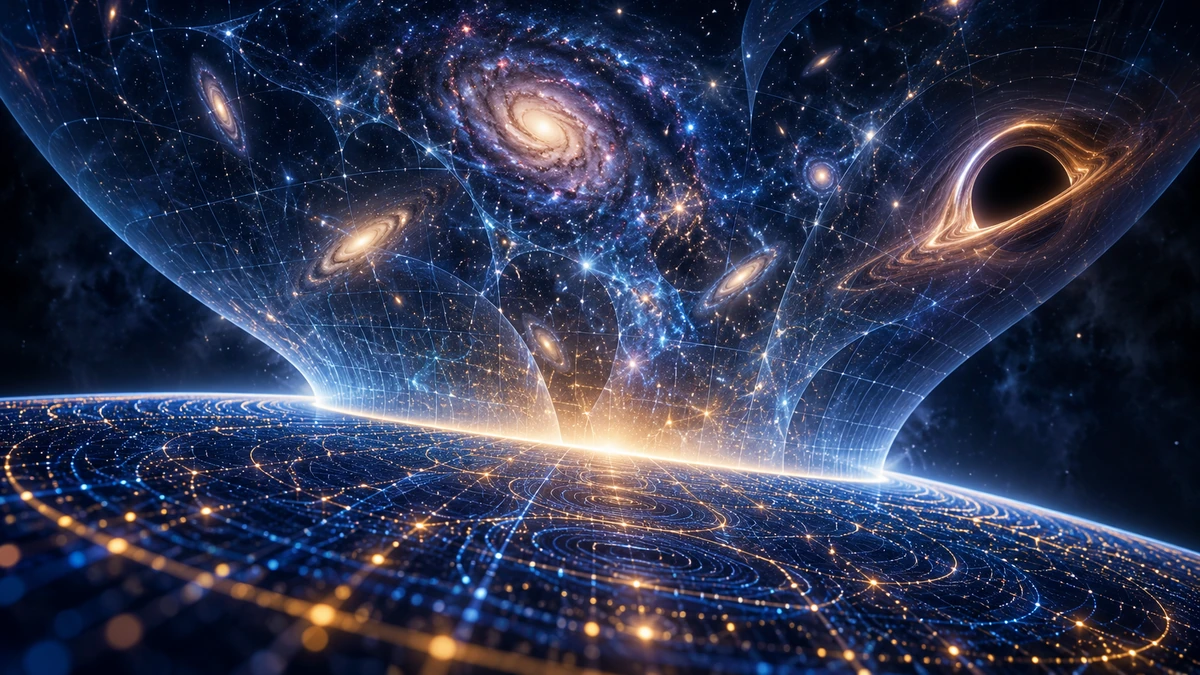
The word holographic now connects several very different ideas. In theoretical physics it can describe the remarkable possibility that gravitational physics in a region of spacetime may be completely represented by a lower-dimensional theory on its boundary. In popular culture, however, a “holographic universe” often means something much broader: that the world is a projection, that every part contains the whole, that consciousness creates reality, or even that the material world is only an apparent image. These claims sound related, but they are not the same theory. [3][4][5][11][13]
That makes the holographic principle an ideal case for separating what modern physics actually claims from the philosophical or spiritual interpretations later built around similar language. The real physics is already strange enough: black-hole entropy scales with area rather than volume, and in some theories of quantum gravity a higher-dimensional gravitational spacetime is mathematically equivalent to a lower-dimensional nongravitational theory. But none of this by itself implies that our universe literally hangs on a cosmic projection screen or that human consciousness produces it. [1][2][5][6]
What Does the Holographic Principle Actually Say?
Ordinary physical intuition suggests that the number of possible states in a system should grow with its volume: more space means more places for particles and information. Gravity changes that intuition. Black-hole research showed that the maximum entropy of a gravitational system is intimately tied to the area of a boundary. From this emerged the idea that the fundamental number of degrees of freedom associated with a spatial region may be governed by its boundary rather than by its volume. [1][2][6]
That is the core of the holographic principle. The word “holographic” is an analogy: just as a two-dimensional holographic record can contain information from which a three-dimensional image is reconstructed, gravitational physics in a volume may admit a lower-dimensional description on a boundary. But the physical claim is more precise than the popular image. The principle does not require a visible screen around the universe, and it does not say that space is an optical illusion. It concerns the organization of information and degrees of freedom in quantum gravity. [4][6]
Black Holes: Why Area Became More Important than Volume
A crucial step came from Jacob Bekenstein. In 1973 he proposed that a black hole must possess entropy and that this entropy is proportional to the area of its event horizon. Stephen Hawking then showed, using quantum field theory in curved spacetime, that black holes emit thermal radiation, placing the relation between temperature, entropy, and horizon area on a firmer physical foundation. Bekenstein-Hawking entropy is proportional to horizon area measured in Planck units. [1][2]
This was surprising because entropy is normally associated with the number of microscopic states inside a system. For a black hole, however, the amount of information attributed to its microstates grows like the horizon area. This result by itself does not prove a universal holographic description of all spacetime, but it provided a powerful clue that gravity changes our ordinary assumptions about how many independent degrees of freedom a region can contain. [1][6]

’t Hooft and Susskind: From Black Holes to the Holographic Principle
Gerard ’t Hooft proposed in 1993 that quantum gravity should permit a description in which observable degrees of freedom are effectively represented on a lower-dimensional structure. Leonard Susskind soon developed the idea in a paper with the memorable title The World as a Hologram. In both cases the starting point was black-hole physics, quantum information, and the preservation of unitary evolution — not human consciousness. [3][4]
Susskind’s holographic comparison is powerful, but it can mislead if taken too literally. The lower-dimensional description need not be a physical sheet onto which our reality is projected. Instead, the proposal is that the same physical system may possess two radically different mathematical descriptions: one with gravity in a higher dimension and one without gravity in a lower dimension. In the early 1990s this was largely a profound principle. Soon afterward it received its first extraordinarily concrete realization. [4][5]
Maldacena and AdS/CFT: When Holography Became a Working Duality
In 1997 Juan Maldacena proposed what is now called the AdS/CFT correspondence. In its best-known form, a theory of gravity or string theory in anti-de Sitter spacetime is equivalent to a conformal quantum field theory on its lower-dimensional boundary. If the duality is correct, this is not merely an approximate model or visual resemblance. The two theories are different languages for the same quantum physics. [5]
This is one of the strongest reasons physicists take the holographic principle seriously. AdS/CFT has made it possible to translate problems in gravity into problems in quantum field theory and vice versa, and it has become one of the central tools in quantum-gravity research. Yet an important boundary remains: Maldacena’s correspondence is best understood in special spacetimes and highly symmetric theories. Its success does not directly establish that our actual universe has been proven to be a hologram. [5][6]

Why a Physical Hologram Is Not an Ordinary Hologram
An optical hologram is produced by the interference of light waves and contains a pattern from which a wavefront, and therefore the three-dimensional appearance of an object, can be reconstructed. Holographic duality in quantum gravity does not operate in this way. There is no photographic plate on the boundary and no beam projecting the interior. The term was chosen because a lower-dimensional description can contain complete information about a higher-dimensional system. [4][6]
Even the phrase “the information is on the surface” must be used carefully. In concrete holographic dualities, encoding is generally highly nonlocal: a small patch of the boundary is not simply one pixel corresponding to one point in the bulk. Modern work suggests that bulk reconstruction is closer in spirit to quantum information encoding than to an ordinary image. The familiar idea of a cosmic screen is therefore useful only as an introductory analogy, not as a literal mechanism. [7][8]
Entanglement, Geometry, and the Emergence of Space
Holography became stranger still when quantum entanglement was found to be tied to geometry. In 2006, Ryu and Takayanagi proposed a formula relating the entanglement entropy of part of the boundary quantum theory to the area of a particular minimal surface in the gravitational bulk. This relationship opened a major research program in which spacetime geometry appears intimately connected to patterns of quantum entanglement. [7]
Later work also uncovered a remarkable relationship between bulk reconstruction in AdS/CFT and quantum error-correcting codes. Information about a bulk region can be distributed or redundantly encoded in the boundary theory, which is another reason the correspondence should not be imagined as a point-by-point projection. This has encouraged the language of emergent spacetime. But “space may emerge from quantum relations” is not the same claim as “space is an illusion created by the mind.” [7][8]
Does the Holographic Principle Describe Our Universe?
This is where the greatest caution is needed. The best-understood example of holography, AdS/CFT, uses anti-de Sitter spacetime with a negative cosmological constant. Our observed universe is undergoing accelerated expansion and, in standard cosmological modeling, this is associated with positive vacuum energy or a positive cosmological constant if dark energy is of that form. AdS is therefore not a direct geometric model of our cosmos. [5][9][10]
There is intense research on holography in de Sitter space, flat spacetime, and cosmology. Important partial results have appeared, but we still do not possess a comparably general and technically controlled holographic duality for a realistic four-dimensional cosmological spacetime of the kind that AdS/CFT provides in its idealized setting. The most accurate statement is therefore not “the universe has been proven to be a hologram,” but rather: holographic description is one of the most serious frameworks for understanding quantum gravity, while its direct form for our universe remains an open research problem. [6][9][10]
Bohm’s Implicate Order: An Older and Different “Holographic” Idea
David Bohm used the hologram as an analogy in his 1980 book Wholeness and the Implicate Order. It helped him illustrate the idea that the whole can in some sense be enfolded within each part and that apparently separate phenomena may express a deeper undivided order. In the same work he also explored the relationship between matter, consciousness, and what he called the holomovement. [11]
Historically, this matters because Bohm’s use of the hologram came nearly a decade and a half before ’t Hooft and Susskind formulated the holographic principle of quantum gravity. Bohm’s framework is therefore not an early version of AdS/CFT. It is a broader physical-philosophical model of order and wholeness that employs a similar metaphor for a different purpose. Later writers often connected the two traditions, but the shared word “hologram” does not establish that they describe the same mechanism. [3][4][11]
Pribram, Talbot, and the Move from Physics to Consciousness
Neuropsychologist Karl Pribram developed a so-called holonomic model of brain processing, using mathematical analogies with wave analysis and holography to think about distributed coding in perception and memory. This is a hypothesis about the organization of neural processing, not a theory that the brain receives information from the boundary of the universe or that human memories are stored on a cosmological horizon. [12]
Michael Talbot’s 1991 book The Holographic Universe combined Bohm’s and Pribram’s ideas into a much broader narrative encompassing paranormal phenomena, out-of-body and near-death experiences, mystical states, and the possibility that the cosmos is a holographic whole. The book appeared before ’t Hooft’s formulation of the holographic principle and before Maldacena’s AdS/CFT correspondence. The later success of holography in string theory therefore cannot by itself serve as retroactive evidence for Talbot’s claims. A bridge between the two would require an additional theory and independent evidence. [3][5][13]
Does Holography Prove Anything About Consciousness?
Consciousness has no special physical role in the equations of Bekenstein-Hawking entropy, holographic entropy bounds, or AdS/CFT. It is not required as an observer that projects space, nor is it identified with the boundary quantum theory. Holography concerns gravity, quantum states, entropy, geometry, and information. It may inspire philosophical questions about what it means for space not to be fundamental, but it does not directly yield a theory of cosmic consciousness. [5][6][7][8]
The reverse boundary matters as well: the holographic principle does not prove that every philosophical proposal about consciousness is false. It simply does not decide them. If consciousness is claimed to be fundamental, nonlocal, or involved in producing physical reality, those claims need arguments and evidence independent of the word “holographic.” A shared metaphor cannot substitute for a missing mechanism. [11][13]
What Does the Holographic Principle Really Change?
The strongest version of the story is already astonishing without extra metaphysics. Black holes revealed that gravity and information are connected in a way that challenges volume-based intuition. ’t Hooft and Susskind turned that clue into a principle, Maldacena supplied an example in which a higher-dimensional gravitational theory is dual to a lower-dimensional quantum theory, and research on entanglement suggests that geometry itself may be deeply tied to the organization of quantum information. [1][3][4][5][7]
Precision makes the idea more interesting, not less. The holographic principle ≠ proof that the world is unreal. AdS/CFT ≠ proof that our universe is an optical projection. Quantum information ≠ consciousness. Bohm’s implicate order ≠ Susskind’s holographic principle. What physics genuinely opens is a deeper question: are space, gravity, and geometry fundamental elements of reality, or are they emergent descriptions of a deeper quantum structure? That remains one of the most fertile questions at the frontier of modern physics. [5][6][7][8][9]
---
Sources and further reading
- Primary foundation for the relation between black-hole entropy and event-horizon area. Source
- Primary thermodynamic source for black-hole temperature, radiation, and entropy. Source
- Primary formulation of dimensional reduction from which the quantum-gravity holographic principle developed. Source
- Primary extension of the holographic principle and the “world as a hologram” framing in quantum gravity. Source
- Primary paper for the AdS/CFT correspondence as a concrete holographic duality. Source
- Authoritative review of the holographic principle, entropy bounds, and its scope in quantum gravity. Source
- Primary source linking CFT entanglement entropy to minimal surfaces in AdS. Source
- Theoretical source connecting bulk reconstruction in AdS/CFT with quantum error correction. Source
- Modern review of de Sitter space and open questions for holography in cosmological settings. Source
- Research example of holography in de Sitter space, supporting the boundary between AdS/CFT and realistic cosmology. Source
- Primary intellectual-history source for Bohm’s implicate order, holomovement, and holographic analogy. Source
- Primary scientific source for Pribram’s holonomic model of brain processing and distributed coding. Source
- Primary popular source for Talbot’s broader synthesis of Bohm, Pribram, paranormal claims, and consciousness. Source