The Matrix: Science Fiction as a Map of Reality, Control, and Awakening
From Plato’s cave, Descartes and brains in vats to Baudrillard, Gnosticism, algorithms and synthetic media: what did The Matrix actually draw from philosophy, and why does its metaphor feel even stronger today?
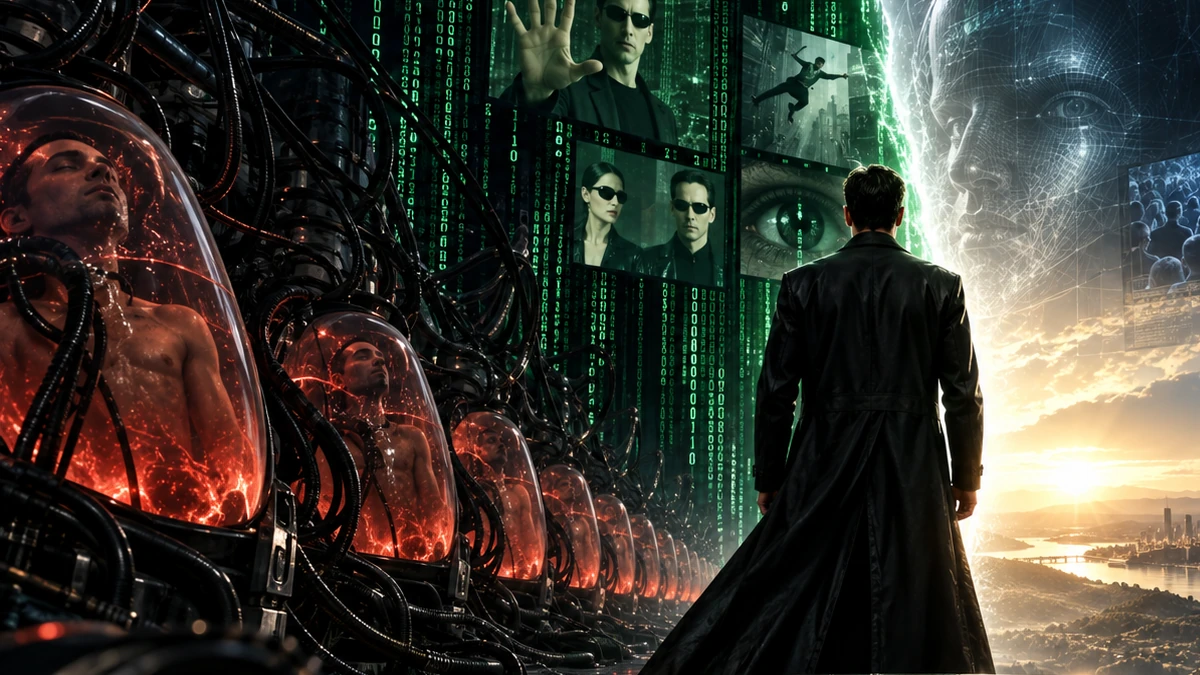
The Matrix (1999) became one of the most powerful modern metaphors for asking whether the world we perceive is the world as it really is. Its strength, however, is not that it proves a literal computer simulation. The film works better as a map of several older problems: Plato’s cave, Cartesian doubt, brains in vats, Gnostic awakening, Buddhist ignorance, cybernetics, artificial intelligence and social control.
Some of these connections have a direct production trail. The Wachowskis had Keanu Reeves read Jean Baudrillard’s *Simulacra and Simulation*, Kevin Kelly’s *Out of Control* and an introduction to evolutionary psychology before filming; Baudrillard’s book also appears in the movie. The BFI documents strong influence from Japanese anime, especially Ghost in the Shell, as well as broader cyberpunk, comics, mythology, the Bible and Eastern religion.
But Baudrillard also marks an important boundary. The film borrows his vocabulary, while the philosopher later argued that The Matrix returns to the classical split between false appearance and a real world outside it. His own theory of simulation was more radical: the problem need not be a hidden reality behind the curtain, but the possibility that the distinction between sign and referent has itself collapsed.
More than two decades later, the film reads differently because mass data profiling, recommendation algorithms, synthetic media, deepfakes and virtual environments have become ordinary parts of life. That still does not prove that we live in a literal Matrix. It does make the film’s question broader than “is the world simulated?”: how much of perceived reality is already assembled by systems that select, measure, predict and generate what we see?
First separate five levels: film, source, parallel, technology and ontological claim
Discussions of The Matrix often mix very different kinds of evidence. The first level is what the film actually depicts. The second is a documented creative source: a book, film, philosopher or tradition for which there is a production or authorial trail. The third is an interpretive parallel that can be supported by philosophy or religious studies without necessarily being confirmed as authorial intent. The fourth is a modern technological analogy. The fifth is the strongest claim: that our world literally operates like the cinematic Matrix.
This article takes the first four levels seriously without assuming the fifth. The resemblance between the film’s world and modern data environments can be striking without implying that human beings are physically plugged into one unified computer simulation. Conversely, the lack of proof for a literal Matrix does not make questions about mediated reality, surveillance and behavioural steering empty.
| Level | What can be checked | What it does not establish by itself |
|---|---|---|
| Film motif | Scene, dialogue, narrative structure and recurring symbolism. | That the depicted world describes our physical reality. |
| Documented source | Production statements, reading lists, visible citations and acknowledged film or philosophical influences. | That the film faithfully reproduces the whole theory of the cited author. |
| Interpretive parallel | Comparison with Plato, Gnosticism, Buddhism, Christianity or existentialism. | That every similarity was intentional or that one tradition explains the whole film. |
| Modern analogy | Surveillance, profiling, recommender systems, synthetic media and virtual environments. | That current technologies form one conscious system or literally simulate the entire world. |
| Ontological claim | Philosophical arguments about the possibility of simulation. | Empirical proof that we in fact live inside one. |
Plato’s cave: the reality taken for granted
The oldest and clearest philosophical parallel is Plato’s allegory of the cave in Book VII of the Republic. Prisoners have faced a wall since childhood and take shadows for the world because they know no other world. Liberation is not pleasant: it requires turning one’s gaze, painful adjustment and gradual discrimination between appearances and what produces them.
The Matrix uses almost the same drama of awakening: a person first doubts the ordinary surface, then experiences shock when a wider framework is revealed, and must learn to see former reality as a mediated display. The parallel is not exact. In Plato, the goal is an intellectual ascent toward truth and the Good; in the film there is an engineered simulation with identifiable operators and a physical outside world.
That difference matters. Plato’s cave is not an early description of a computer but an epistemological allegory. The film gives it technological form and thereby makes the old question vivid: what would have to be true for us to recognize that our ordinary frame is mistaken?
Descartes and brains in vats: can experience rule out total deception?
René Descartes radicalized doubt in the Meditations through the possibility of systematic deception: what if sensory experience is so convincing that it cannot by itself secure certainty about an external world? In the twentieth century this problem acquired the technological form of the brain in a vat: a brain receives electrical stimulation from a supercomputer and therefore experiences a world that is not there.
The Stanford Encyclopedia of Philosophy explicitly uses The Matrix as a modern example of embodied humans whose experience is computer-stimulated. Yet Hilary Putnam, who made the scenario famous in Reason, Truth and History, did not introduce it simply to prove skepticism. His argument about reference attempts to show that the total story “we have always been brains in vats” creates problems for what the words brain and vat could even mean to beings that have never had the relevant causal relations with real brains or vats.
The philosophical genealogy of The Matrix therefore does not point in only one direction toward the conclusion that “nothing can be known.” The film popularizes a skeptical problem; philosophy also contains arguments for why the mere possibility of deception does not by itself destroy all knowledge.

Bostrom’s simulation argument: serious philosophy, not proof of the film’s scenario
In 2003 Nick Bostrom published the famous simulation argument. Its structure is not “we have proved that we live in a simulation” but a trilemma: at least one of three propositions must be true — humanity generally fails to reach a technologically mature posthuman stage; such civilizations almost never run large numbers of ancestor simulations; or simulated observers become so numerous that there is strong reason to consider that we may be among them.
Bostrom used The Matrix as a popular reference, but also stressed that the film’s energy scenario is irrelevant to his argument. His hypothesis requires enormous computational capacity and large populations of simulated minds, not physical humans in pods powering machines.
That boundary matters. The simulation argument is a conditional philosophical argument about probabilities and future civilizations, not an empirical detection of code behind our world. It can be taken seriously without treating The Matrix as a documentary.

Baudrillard: the most famous citation and the most important objection
The connection to Jean Baudrillard is direct. Simulacra and Simulation is visible in Neo’s apartment, and BFI and later production accounts report that the book was part of Reeves’s preparatory reading. The film also borrows the famous phrase about the “desert of the real.”
Yet Baudrillard did not think the film was faithful to his theory. In a later interview he argued that the film treats simulation too Platonically: there is a false digital layer and then, outside it, a clearly separated “real” reality. For him, the more modern problem was precisely that such a clean outside may no longer be available because signs, media and simulations already shape what society counts as real.
That disagreement makes The Matrix more interesting rather than less. The film is not illustrated Baudrillard. It is a dialogue with Baudrillard that translates his idea into a classical liberation story — and changes its meaning in the process.
Cyberpunk, Ghost in the Shell and the ecology of machines
The Matrix did not arise from philosophy alone. The BFI describes it as a fusion of cyberpunk, comics, computer games, Japanese animation and Hong Kong action cinema. The Wachowskis used Ghost in the Shell as an important reference when pitching the project; the influence is visible in the green code, human connection to networks and questions about the boundary between technology, body and identity.
Another direct source is Kevin Kelly’s Out of Control, a book about complex, distributed and self-organizing systems. This matters because the cinematic Matrix is not merely a computer screen but an ecosystem of humans, machines, programs and feedback loops. Agent Smith is a program, the Oracle is a program, the machines have internal hierarchies, and the system adapts to disruption.
The film therefore goes beyond a simple “humans versus robots” story. The question becomes what happens when a system is no longer one tool controlled by one operator but an environment in which different actors follow their own rules. That idea is more contemporary than the image of one giant computer issuing commands from above.
Gnosticism, Buddhism and Christianity: awakening as a syncretic story
Religious readings of The Matrix have serious academic support, but they are not singular. Frances Flannery-Dailey and Rachel Wagner identify strong parallels with Gnostic and Buddhist models: the basic problem is ignorance, an apparent world is mistaken for reality, and awakening requires guidance and transformed perception. Other scholars emphasize Neo as a postmodern messianic figure and the Christian imagery of death, resurrection and salvation.
At the same time, scholarship warns against locking the film inside one religious template. The Journal of Religion & Film describes it as strongly syncretic: Western and Eastern motifs are combined so that any single mapping works only up to a point. This fits the BFI account that the filmmakers poured a very wide range of ideas and cultural influences into the movie.
It is therefore better to speak of an architecture of awakening than a single hidden doctrine. Gnostic language provides a powerful model of false world and knowledge; Buddhist comparisons emphasize ignorance, attachment and transformed perception; Christian motifs shape a messianic narrative. The film uses all three registers without becoming a catechism of any one of them.
Identity and transformation: a layer Lilly Wachowski later explicitly confirmed
One important layer of the film is not merely a later academic projection. In 2020 Lilly Wachowski said that a transgender allegory was part of the original intention, although the corporate and cultural environment of the time was not ready for it. She specifically recalled the idea that Switch would have one sex in the real world and another inside the Matrix, an idea that was not retained in the final film.
This does not mean every line is a code for one experience only. It does mean that motifs of double naming, the feeling that something is fundamentally wrong with one’s assigned everyday identity, choosing transformation and becoming different from the role imposed by a system also have a documented personal-authorial background.
The case is methodologically useful: a later creator statement can confirm one symbolic layer without erasing the philosophical, religious or technological-political layers. The Matrix became such a durable cultural language precisely because it supports several of them at once.
Control without cables: from the electronic panopticon to data profiling
The most useful modern parallel may not be computer simulation at all but an environment of invisible observation and profiling. David Lyon argued as early as 1993 that the metaphor of an electronic panopticon was useful for computerized databases, while warning against stretching it into the claim that all of society is one perfect prison.
Current scholarship on dataveillance describes a far more distributed infrastructure: platforms, mobile devices, data brokers, advertising systems, facial recognition and machine learning collect fragments of behaviour and turn them into profiles and predictions. Some scholars analyze this as surveillance capitalism; others stress distinctions between private data economies and state surveillance, and between risks and benefits under different institutional arrangements.
That looks more like a complex Matrix than a single room with a master computer: different systems see different parts of a person, and their data can be connected. But the analogy has a boundary. The current ecosystem is not proven to be a unified consciousness with one goal and one command structure.
Algorithms as architects of visibility: the system need not lie if it can select
The cinematic Matrix controls nearly all sensory information. Modern recommendation systems have a much narrower but real power: they determine the order and selection of some of the content a user sees. Social-media research shows that changing algorithmic exposure does change a user’s information environment, although effects on beliefs are not always large or simple.
That is an important correction to sensational accounts. An algorithm does not need total hypnosis to influence perceived reality. Selection, repetition, ranking and omission already create different informational horizons. At the same time, empirical studies warn against automatically inferring direct programming of political or personal beliefs.
The Matrix is therefore useful as a metaphor for an architecture of visibility. In the film the system produces an entire world; in real digital environments systems mainly organize access to parts of the world. The difference is enormous, but the question “who decides what reaches our eyes?” remains concrete.
Synthetic media: when image and voice no longer automatically trace an event
A second modern parallel is the rise of synthetic media. Deepfakes, virtual influencers and extended or virtual reality make it possible to create images, voices, persons and environments without a simple physical original. Researchers therefore describe pressure on traditional criteria of reality and the prospect of increasingly personalized perceived worlds.
The philosophical problem is not merely whether someone will believe one fake video. Work on deepfakes identifies a broader epistemic cost: when convincing recordings become cheap to manufacture, video becomes less reliable as a category of evidence. The reverse problem also appears — authentic recordings become easier to dismiss as synthetic.
That is a strongly Matrix-like problem, but in a different sense from the film. An entire city need not be a computer backdrop; it is enough that the boundary among document, simulation and personalized display becomes more expensive to verify. Awakening then becomes not a one-time event but a discipline of verification.
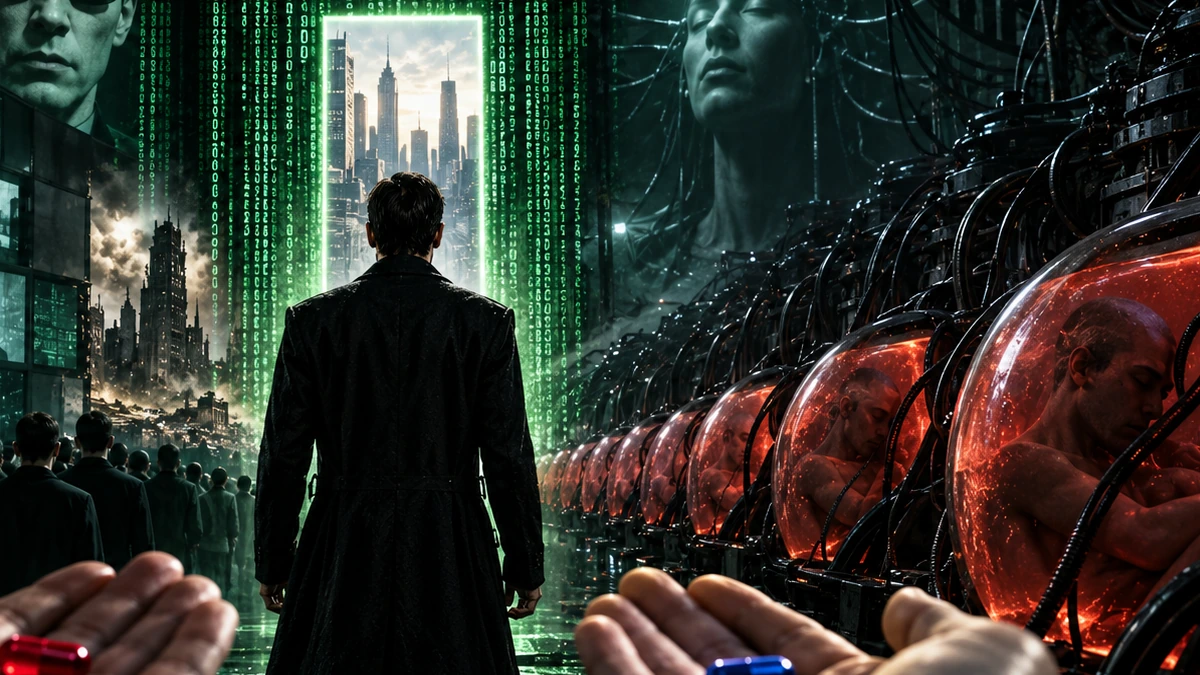
“Awakening” is not evidence: the greatest epistemic trap in the metaphor itself
The Matrix popularized the seductive idea that there are two classes of people: those still asleep and those who have awakened. As cinematic drama this is extremely effective. As a method of knowledge it can be dangerous if the feeling of awakening becomes a substitute for evidence.
Rejecting one explanation of the world and adopting another does not by itself tell us which is true. Neo receives physically checkable consequences of awakening in the film; in real life, competing explanations are often built from the same photographs, numbers and events. The step after doubt therefore has to be verification: provenance, date, independent corroboration, reproducibility where possible, and a clear separation between observation and inference.
The most mature use of The Matrix is therefore not the slogan “I took the correct pill” but a willingness to question even the story that convinced us we were already awake. The film can open the question; it cannot decide the answer for us.
What The Matrix really anticipated — and what it did not
Read literally, the film’s strongest images remain science fiction: there is no evidence that human bodies are mass-stored in pods, that one computer generates the entire sensory world, or that modern platforms are governed by one conscious machine entity. Read as a model of mediated reality, however, The Matrix remains remarkably durable.
The film combined three questions that are even more visible now than in 1999: how we know what is real; who or what selects the information from which we construct the world; and how much freedom remains when systems know patterns in our behaviour that we may not be able to articulate ourselves. None of these questions requires a metaphysical simulation.
| Matrix motif | Documented background or modern parallel | Strongest warranted claim |
|---|---|---|
| False sensory world | Plato, Descartes, brains in vats, synthetic media. | Experience can be mediated or deceptive; it does not follow that the entire world is a computer simulation. |
| A system that watches and adapts | Electronic surveillance, profiling, data brokers and recommender systems. | Digital systems do collect and organize behavioural data; there is no evidence they form one conscious Matrix. |
| Awakening | Plato’s cave, Gnostic and Buddhist parallels, skeptical philosophy. | A changed perspective can be epistemically important; the feeling of awakening does not prove a new interpretation true. |
| Identity transformation | Lilly Wachowski confirmed a transgender allegorical layer. | This layer is authorially documented, but it does not exhaust the film’s other meanings. |
| Machines as environment | Kelly’s complexity, cyberpunk, Ghost in the Shell, artificial intelligence. | The film powerfully dramatizes dependence on complex technological systems; present AI does not prove the film’s enslavement scenario. |
The most unsettling possibility may therefore not be a hidden cable we have failed to find. A more useful question is: if perceived reality can already be significantly reshaped through information selection, profiling, synthetic imagery and incentive systems, how much of a Matrix is needed to reproduce some of its effects?
Sources and further reading
- British Film Institute — Mark Salisbury, “The Matrix: how the Wachowskis changed sci-fi” (2019): production history, cultural sources, Reeves reading Baudrillard/Kelly/Evans, philosophical and religious influences.
- British Film Institute — “Go west: 8 Japanese classics and the western films inspired by them”: Ghost in the Shell as a documented Matrix influence and pitch reference.
- British Film Institute — The Matrix (1999) film record: virtual reality, philosophical unease and Baudrillard reference.
- BFI / Sight and Sound — Kim Newman, “The Matrix and rubber reality” (1999 review, republished 2024): contemporary virtual-reality context.
- WIRED — “How The Matrix Built a Bullet-Proof Legacy” (2019): production recollections and Reeves’s preparatory reading.
- Kevin Kelly — Out of Control, official author site: editions and full-web publication of the 1994 book on complex machine/social systems.
- Perseus Digital Library — Plato, Republic VII 514a–515a: allegory of the cave and prisoners taking shadows for reality.
- Stanford Encyclopedia of Philosophy — “Descartes’ Epistemology”: Cartesian doubt and the rationalist comparison with Plato’s cave.
- Stanford Encyclopedia of Philosophy — “Content Externalism and Skepticism”: brain-in-a-vat scenario, Putnam’s response, and explicit discussion of The Matrix.
- Cambridge University Press — Hilary Putnam, “Brains in a vat,” Reason, Truth and History (1981): primary bibliographic anchor for the vat argument.
- Nick Bostrom — “Are You Living in a Computer Simulation?” Philosophical Quarterly 53 (2003): original simulation argument.
- Nick Bostrom — “The Simulation Argument: Why the Probability that You Are Living in a Matrix is Quite High” (2003): popular explanation distinguishing his argument from the film’s energy scenario.
- Oxford Academic / Screen — Catherine Constable, “Baudrillard reloaded: interrelating philosophy and film via The Matrix Trilogy” (2006).
- University College Cork repository — Randy Laist, “Bullet-time in Simulation City: revisiting Baudrillard and The Matrix” (2011): Baudrillard’s rejection of the film as a faithful rendering of simulation.
- Brill — Sven Lutzka, “Simulacra, Simulation and The Matrix” (2006): critique of treating Baudrillard as a simple interpretive key.
- The Guardian — “From red pills to red, white and blue Brexit: how The Matrix shaped our reality” (2019): Baudrillard’s later criticism and the film’s cultural afterlife.
- Journal of Religion & Film — Frances Flannery-Dailey & Rachel L. Wagner, “Wake up! Gnosticism and Buddhism in The Matrix” (2001).
- Journal of Religion & Film — Julien R. Fielding, “Reassessing The Matrix/Reloaded” (2003): warning against reducing the films to one religious worldview.
- Journal of Religion & Film — Mark D. Stucky, “He is the One: The Matrix Trilogy’s Postmodern Movie Messiah” (2005): messianic/Christian reading.
- Journal of Religion & Film — Jeffery Wittung & Daniel Bramer, “From Superman to Brahman: The Religious Shift of The Matrix Mythology” (2006).
- Google Books / Open Court — William Irwin (ed.), The Matrix and Philosophy: Welcome to the Desert of the Real (2002): philosophical anthology on skepticism, caves, morality, metaphysics and religion.
- Netflix Film Club — “Why The Matrix Is a Trans Story According to Lilly Wachowski” (2020): first-person creator statement on the trans allegory and Switch concept.
- The Guardian — “The Matrix director: I’m glad film recognised as trans metaphor” (2020): report of Lilly Wachowski’s statement on original intention.
- David Lyon, “An Electronic Panopticon? A Sociological Critique of Surveillance Theory,” The Sociological Review 41(4) (1993): electronic surveillance and limits of the panopticon metaphor.
- Kenneth Lipartito, “Surveillance Capitalism: Origins, History, Consequences,” Histories 5(1) (2025): data collection, prediction and asymmetry of surveillance.
- Surveillance capitalism and the surveillance state: a comparative institutional analysis, Constitutional Political Economy (2024): distinctions between private and state data collection.
- Urbano Reviglio, “The untamed and discreet role of data brokers in surveillance capitalism,” Internet Policy Review (2022): pervasive datafication and data-broker infrastructures.
- Nature — “Like-minded sources on Facebook are prevalent but not polarizing” (2023): large field experiment showing algorithmic exposure can be changed without simple one-to-one attitudinal effects.
- Scientific Reports — J. Nathan Matias, “Influencing recommendation algorithms to reduce the spread of unreliable news…” (2023): mutually adapting humans and recommendation algorithms.
- Ignas Kalpokas, “Problematising reality: the promises and perils of synthetic media,” SN Social Sciences (2021): deepfakes, virtual influencers, extended reality and personalized perceived reality.
- Regina Rini, “The Epistemic Threat of Deepfakes,” Philosophy & Technology (2020): deepfakes as a threat to the information carried by video evidence.
- Carl Öhman, “The identification game: deepfakes and the epistemic limits of identity,” Synthese (2022): synthetic likeness and identity problems.