Perception Is Not the Same as Reality
Perception is our first point of contact with reality, but not a perfect copy of it. How can we separate perception, interpretation, and what we can verify?

Perception is our first point of contact with reality, but perception and reality are not the same thing. What we notice and how we interpret what we notice are influenced by attention, context, memory, expectations, and prior experience. If we want to understand the world as accurately as possible, we therefore need to distinguish between what we perceived, what we inferred from it, and what we can independently verify.
Two people can observe the same event and later describe it differently while both are being sincere. One hears anger in someone’s tone; another hears fatigue. Someone may be certain they noticed everything important, only for a recording to reveal a detail they completely missed. Faced with the same visual stimulus, two people can even report seeing different colors.
This does not mean that “nothing is real” or that each person creates an arbitrary reality of their own. It means something more useful: our perception of reality is not a perfect copy of reality itself.
Understanding this distinction is one of the foundations of THY-REALITY. Before judging broader claims about the world, we need to learn where observation ends and interpretation begins.
What Is Perception and How Does It Work?
We often talk about the eyes as if they were cameras and the brain as if it simply played back the images it received. Human perception is a much more active process.
Our senses receive information from the environment, but the nervous system must select, connect, and organize that information into a sufficiently coherent picture for us to function effectively. Context, past experience, and prior knowledge all play a role.
This system is enormously useful. If noise masks one word in a conversation, we can often understand it from the rest of the sentence. We recognize an object more easily in a setting where we expect to find it. An ambiguous stimulus can acquire meaning from information that came just before it.
Research suggests that expectations and prior knowledge can help us deal with incomplete or ambiguous sensory information and can contribute to perceptual inference. At the same time, psychology and the philosophy of perception continue to debate how much such effects directly alter perceptual experience itself and how much they arise through attention, memory, judgment, or decision-making.
For practical purposes, we do not need to settle that debate. It is enough to recognize a basic fact: our conscious impression of the world is not a complete and neutral record of every piece of information that was available at a given moment.
Our perceptual system has to select. And wherever selection is necessary, there is also a possibility that something will be missed.
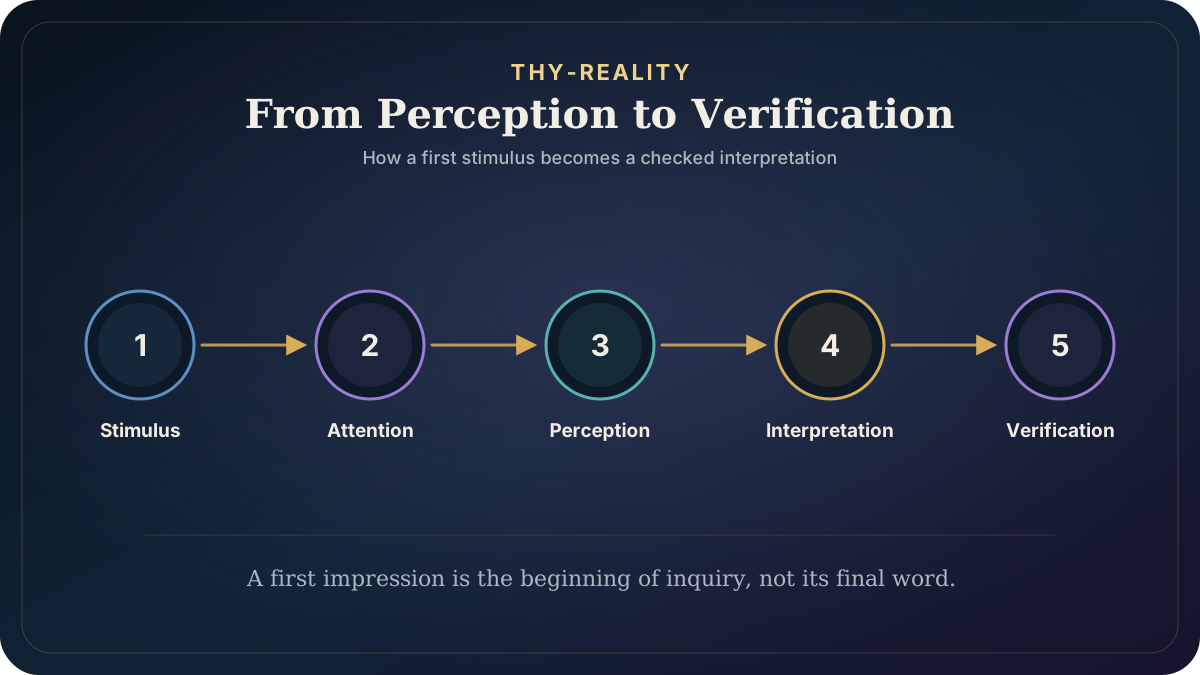
Attention: Looking Is Not the Same as Noticing
One of the best-known demonstrations of this limitation was published in 1999 by psychologists Daniel Simons and Christopher Chabris. Participants watched people passing basketballs to one another. Their task was to follow a particular group of players and count the passes.
During the scene, an unexpected person walked through the display — in the most famous version, someone wearing a gorilla suit. The event was not hidden. Even so, 46 percent of the 192 participants included in the analysis did not notice the unexpected event.
The phenomenon is known as inattentional blindness. The experiment does not prove that we cannot trust our eyes. Nor does it show that reality is an illusion.
It shows something more specific: the fact that something is within our visual field does not guarantee that it will enter conscious attention.
Attention has limits. When we focus intensely on one task, we can miss something else even when it is directly in front of us. This matters outside the laboratory as well. When our attention is heavily occupied, when we are searching for one specific piece of information, or when we direct attention in advance toward one aspect of an event, we cannot assume that we will notice everything else.
“I saw it with my own eyes” can be important evidence, but it does not necessarily mean “I saw everything that mattered.” Those are different claims.
Limited attention raises another question: who or what influences what we attend to in the first place? In an information environment, part of that selection is ours, while part is shaped by editorial choices, ordering of topics, emphasis, repetition, and recommendation systems. These mechanisms are not by themselves proof of manipulation — every act of communication has to select some things and omit others. But they can influence which topics become visible, salient, and worthy of further thought.
Whoever directs attention does not necessarily determine our conclusion — but may influence what we begin thinking about at all.
For important social questions, it is therefore not enough to check only whether an individual presented claim is correct. It is also useful to ask which topics received the most space, which alternatives were omitted, and who shaped the initial frame. We will examine this broader question later through agenda-setting, media framing, and group pressure.
How Can the Same Stimulus Be Perceived Differently?
In 2015, a photograph of a dress became famous around the world because some people saw it as blue and black while others saw it as white and gold. The image displayed on the screen was the same. People’s subjective color experience was not.
Research documented large individual differences in how people perceived the photograph. A key factor is the ambiguous information it provides about the illumination of the scene.
When we look at an object, the visual system must use the light reaching the eye to infer both properties of the object and conditions of illumination. Under ordinary circumstances, it does this so effectively that we rarely notice the process.
In the dress photograph, however, the lighting information is not clear enough to determine a single interpretation. Different implicit assumptions about the lighting conditions can therefore lead to different perceptual outcomes.
The example is especially interesting because it is not merely a disagreement of opinion. People can sincerely report different perceptual experiences of the same visual stimulus.
This does not mean that the object has no physical properties or that every interpretation is equally correct. The original dress was a physical object with definite material properties. The example shows, however, that when sensory information is ambiguous, the perceptual system must infer the most likely explanation of the available input.
What assumptions had to be in place for something to become obvious to me?
That question matters far beyond color perception.
Observation, Interpretation, and Story Are Not the Same
Many errors do not begin with perception itself, but a moment later, when we start assigning meaning to what we observed. Imagine a simple event. You arrive at work in the morning. A colleague walks past and does not greet you.
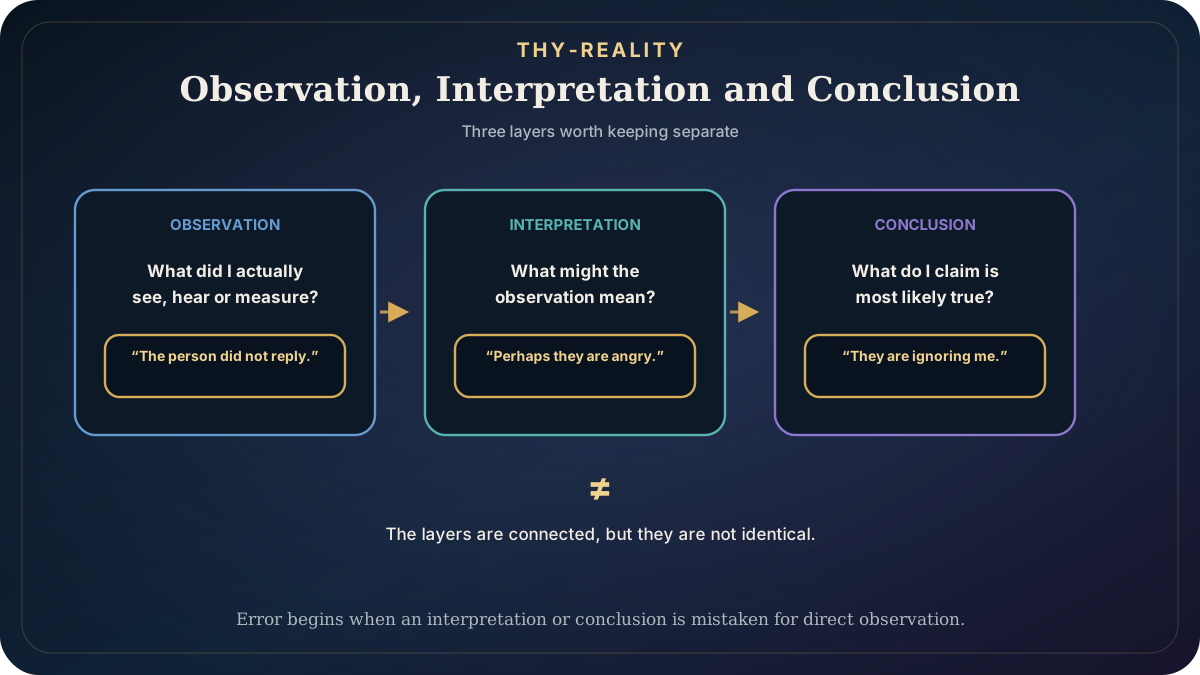
What can you describe relatively directly? They walked past, and you did not perceive a greeting. But the mind can continue almost immediately: “They are ignoring me.” Then: “They are angry with me.” And then: “I must have done something wrong.”
Within seconds, a brief event has become a story. The story may be correct.
But other explanations are possible. Perhaps the colleague did not notice you. Perhaps they were preoccupied. Perhaps they were dealing with a problem you know nothing about. Perhaps they greeted you and you simply did not hear it.
The essential distinction is between observation, interpretation, and a claim about intention. Observation: “They did not answer me.” Interpretation: “I think they are ignoring me.” Claim about intention: “They are deliberately ignoring me because they are angry with me.”
With each step, we add something that the original observation did not establish on its own. This does not mean that we should stop making inferences. Without inference, ordinary life would be impossible.
What matters is knowing when we are observing and when we are inferring.
Subjective Experience and Verifiable Reality
Distinguishing perception from reality does not mean dismissing personal experience. If an event hurt us, the feeling of being hurt is real. If something frightened us, fear is a real experience. If we experience something as beautiful, unpleasant, or important, that experience tells us something about our relationship to what we are encountering.
The reality of a feeling is not automatic proof that the interpretation behind it is correct.
Our inner experience can tell us directly what we are feeling and perceiving. By itself, however, it cannot establish with the same confidence what another person intended, why an event occurred, or what the verifiable state of affairs is outside us.
There is another extreme to avoid. Once we accept that people have different perspectives, it is easy to conclude that “everyone has their own truth” and that no interpretation can be judged against another. But different perspectives do not necessarily imply different external realities.
Imagine a room with three people. One feels cold, another feels comfortable, and the third feels hot. All three can sincerely describe their experience. The question “How do you feel in this room?” can therefore have three legitimate subjective answers.
The question “What is the temperature in the room?” is different. We can measure it.
The same principle applies to more difficult questions. Claims about the external world can be compared with documents, measurements, recordings, independent testimony, primary sources, or findings from replicable research.
These methods are not infallible. A measurement can be wrong, a document forged, a witness unreliable, and a study methodologically weak. But the answer to the possibility of error is not to abandon verification.
The answer is better verification.
How to Check Your Own Perception
The goal is not to become suspicious of our senses or to doubt everything. A more useful approach is a simple process we can apply when a claim matters enough to be worth checking.
- What did I actually observe? Describe the event first without assigning intention, cause, or meaning.
- What did I add to the observation? Separate inference, expectation, memory, emotion, and belief from the observation itself.
- What other explanations are possible? You do not need to reject your first explanation automatically. Check only whether it is really the only plausible one.
- What can I verify independently of my first impression? Additional data, a measurement, a primary document, another perspective, a recording, or a repeated observation may help.
- What would change my mind? If the honest answer is “nothing,” we are probably no longer testing a claim; we are defending a belief.
None of these steps guarantees infallibility. Their value lies elsewhere: they make correction possible.
Being able to say “I was wrong” is not a defeat in the search for reality. It is a sign that verification did its job.
From Perception Toward Reality
Human beings do not have a view of the world that is completely independent of the body, attention, experience, and ways of understanding. But that does not mean reality is unreachable or that all interpretations are equivalent.
Our first impression does not have to be our final conclusion.
Perception is the beginning of inquiry. Then comes the distinction between observation and interpretation. After that come verification, comparison, and correction. And finally, the willingness to revise our picture of the world when better evidence or a better explanation appears.
This is one of the core principles of THY-REALITY. Do not begin with the question: “How can I prove that I am right?” Begin with: “What can I actually show — and what would show me that I am wrong?”
This is where the movement from perception toward reality begins.
Sources and further reading
- de Lange, F. P., Heilbron, M. & Kok, P. (2018). How Do Expectations Shape Perception? Trends in Cognitive Sciences, 22(9), 764–779. DOI: 10.1016/j.tics.2018.06.002. Source
- Firestone, C. & Scholl, B. J. (2016). Cognition does not affect perception: Evaluating the evidence for ‘top-down’ effects. Behavioral and Brain Sciences, 39, e229. DOI: 10.1017/S0140525X15000965. Source
- Simons, D. J. & Chabris, C. F. (1999). Gorillas in Our Midst: Sustained Inattentional Blindness for Dynamic Events. Perception, 28(9), 1059–1074. DOI: 10.1068/p281059. Source
- Lafer-Sousa, R., Hermann, K. L. & Conway, B. R. (2015). Striking individual differences in color perception uncovered by ‘the dress’ photograph. Current Biology, 25(13), R545–R546. DOI: 10.1016/j.cub.2015.04.053. Source
- Lafer-Sousa, R. & Conway, B. R. (2017). #TheDress: Categorical perception of an ambiguous color image. Journal of Vision, 17(12), 25. DOI: 10.1167/17.12.25. Source
- McCombs, M. E. & Shaw, D. L. (1972). The Agenda-Setting Function of Mass Media. Public Opinion Quarterly, 36(2), 176–187. DOI: 10.1086/267990. Source
- Scheufele, D. A. & Tewksbury, D. (2007). Framing, Agenda Setting, and Priming: The Evolution of Three Media Effects Models. Journal of Communication, 57(1), 9–20. DOI: 10.1111/j.0021-9916.2007.00326.x. Source