What We Believe Is Not Necessarily What Is
A belief can be sincere and deeply held and still be wrong. Learn to separate confidence from evidence and keep your model of reality open to correction.

A belief can be sincere, carefully considered, and held with great confidence — and still be wrong. The feeling of certainty tells us something about the state of our mind, not directly about the state of the world. Inquiry therefore requires a fundamental distinction: we must separate what we believe from what we are justified in treating as knowledge.
Every person lives with beliefs. We believe that we know the people around us, that we understand the causes of events, and that we possess a sufficiently good model of the world to make everyday decisions. Without such working models, almost every choice would have to begin from scratch.
Beliefs are therefore not a flaw in the system. In philosophy of mind, belief is commonly used for the attitude we have when we take something to be the case or regard it as true. But the fact that we take something to be true does not guarantee that it actually is true. Epistemology therefore distinguishes between merely believing something and knowing it.
The difficulty begins when we forget what belief can and cannot do. A belief allows us to take a position toward the world, but its correctness is not guaranteed by the fact that it is sincere, long-standing, or emotionally important. The question “What do I believe?” must therefore remain separate from “What is this belief based on?”
That we believe something is a fact about us. Whether what we believe is true is a separate question.
Belief Is a Map, Not the Territory
Imagine a map of a city. A good map is extremely useful. It shows roads, intersections, rivers, stations, and distances. We can use it to reach our destination even when we cannot see the city as a whole. But the map is not the city. It may be simplified, outdated, or designed for only one particular purpose.
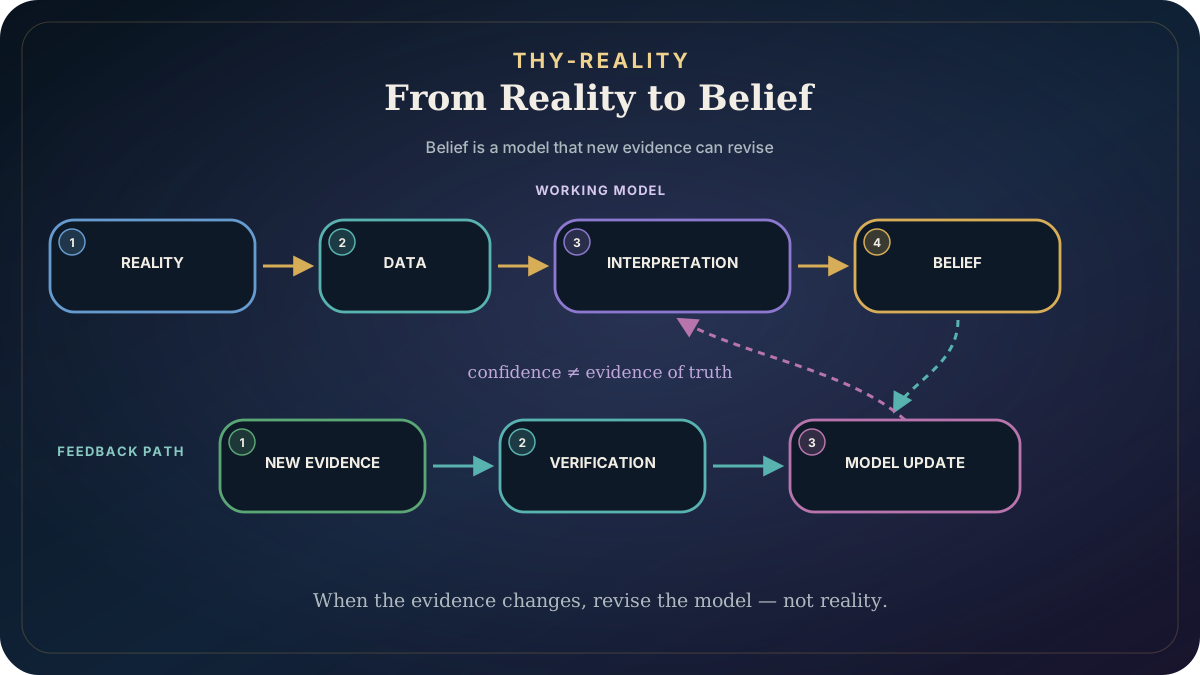
In this article, the map is an editorial metaphor for our beliefs and explanations, not a technical psychological definition of belief. When we say “I know what this person is like,” we have a model constructed from particular events, memories, interpretations, and information supplied by others. When we say “I know why this happened,” our model contains proposed causes and relationships between them.
When we talk about politics, history, or society, the map becomes broader and necessarily more selective. In every case, it is useful to ask which parts come from direct evidence and which parts come from interpretation.
This matters because the map can change without the territory changing. If we discover that a road was drawn incorrectly, we have not damaged the city. We have corrected our representation of it. The same is true of belief. If we discover that we understood something incorrectly, reality has not changed retroactively. Our representation of it has.
Correcting a belief is not a defeat of reality. It is an improvement in our map of reality.
Where Do Our Beliefs Come From?
A large share of what we believe and know did not arise from direct personal observation. We learn about history, distant places, medicine, astronomy, technology, and countless everyday facts through the testimony of other people, books, schools, experts, media, and institutions. The epistemology of testimony therefore treats reliance on others as an indispensable part of human knowledge, not as an error we could simply eliminate.
The same is true of many early beliefs about the world, ourselves, and society. A child does not begin by independently verifying every claim they hear; they learn from people they trust. Research on the development of knowledge shows that testimony is an important source for both ordinary and more abstract beliefs. The fact that a belief came from family, culture, school, or an authority is therefore not evidence that it is false.
The problem appears when we forget the origin of our map. We may have heard something a hundred times, received it from a respected person, or absorbed it so early that it no longer feels like a belief but like a direct fact. Familiarity, tradition, or source status can then acquire more evidential weight than they deserve.
Independent thinking does not mean discovering everything without other people. It means being able to ask whom we trust, why we trust them, and what would justifiably change that trust.
In this sense, moving from belief toward knowledge is less dramatic but more demanding than simply rejecting authorities. We do not need to repeat every scientific experiment or personally inspect every archive. But we should distinguish direct evidence, reliable testimony, expert judgment, tradition, repetition, and our own inference. When we know the reasons for our trust and remain able to revise them, a belief increasingly becomes something for which we can take intellectual responsibility ourselves.
The Feeling of Certainty Is Not a Truth Meter
Some beliefs feel weak: “Maybe that is what happened.” Others feel almost completely certain: “I know this for sure.” That feeling has a practical function. Everyday life would become extremely slow if we had to recheck everything we thought we knew before every ordinary decision.
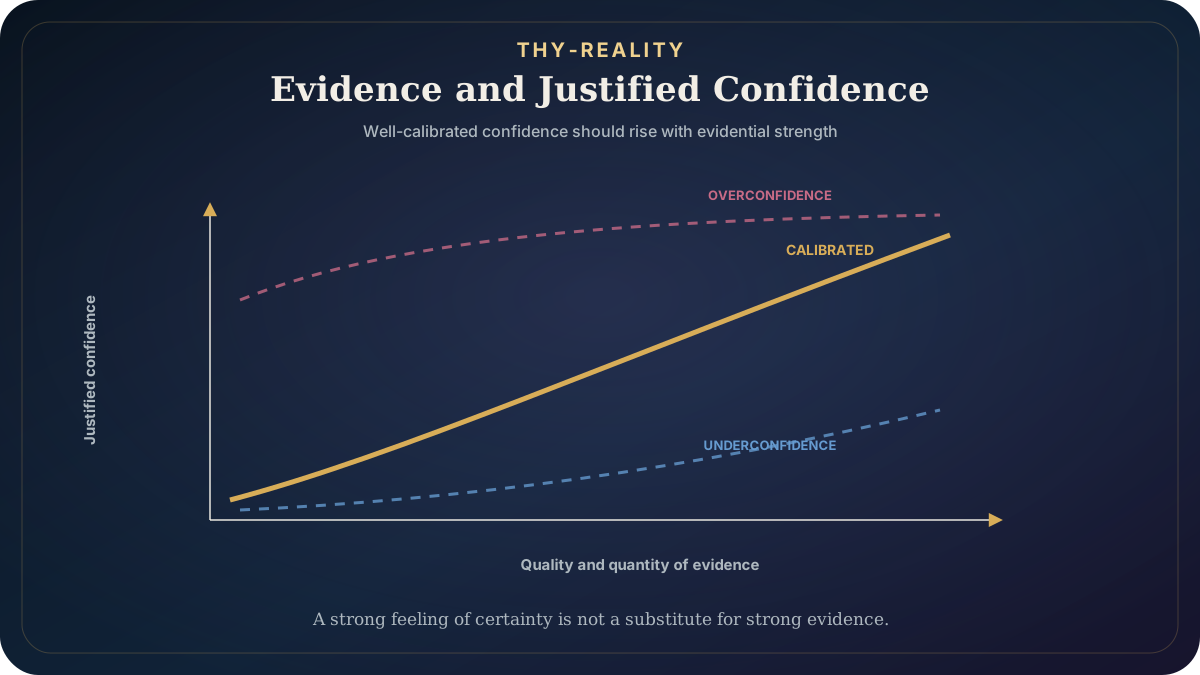
But certainty is not direct access to truth. Stephen Fleming’s review of metacognition treats confidence as an inferential judgment about our own decisions or performance. Such judgments can be informative, but they can also diverge from actual accuracy.
Several combinations are therefore possible. We can be correct and appropriately confident. We can be correct while doubting ourselves. We can be wrong and suspect that we are wrong. Or we can be wrong and highly confident.
The last possibility is especially important. If false beliefs always felt false, correcting them would be much easier. But an incorrect answer does not produce a special internal warning signal. Subjectively, it may feel just as convincing as a correct answer. Metacognition can help us estimate our own performance, but it is not an infallible instrument that directly reads the external world.
The statement “but I am completely certain” describes a level of confidence. By itself, it does not establish correctness. The next question is: “How do I know?”
Sometimes We Think We Understand Until We Try to Explain
There is a difference between the feeling “I understand this” and the ability to explain how something actually works.
Leonid Rozenblit and Frank Keil studied what they called the illusion of explanatory depth. Across a series of studies, people sometimes rated their understanding of complex mechanisms more highly before being asked to produce a detailed explanation. Attempting to explain the mechanism exposed gaps and reduced their own estimate of how well they understood it.
We can observe something similar with ordinary devices and systems. We may feel that we understand how a toilet cistern works, how a refrigerator cools food, or what happens when we enter an address into a web browser. But when we have to explain the mechanism step by step, we may quickly reach the point where “I more or less know” turns into a question.
The same test can be applied to more abstract topics. How exactly does inflation arise? How do the data from a scientific study become the conclusion we later read in a headline? Being able to repeat familiar terms does not necessarily mean that we understand the relationships between them.
This is not a sign of stupidity. No person can carry a complete model of everything, and a great deal of human knowledge is distributed across other people, books, institutions, and technologies. The problem begins only when we mistake familiarity for deep understanding.
A useful test of understanding is not only “Do I recognize this?” but also “Can I clearly explain how it works and where my explanation ends?”
A Belief Can Persist Even After a Correction
Intuitively, we might expect a simple process. We receive information, form a belief from it, later learn that the information was false, and then remove the belief. Under some conditions, however, correction is more difficult.
Craig Anderson, Mark Lepper, and Lee Ross examined the persistence of social theories after participants were told that the original case material had been fabricated. Participants had formed theories about the relationship between risk preference and firefighter performance. Even after the original evidence was discredited, parts of the previously constructed explanation could persist, particularly when participants had generated explanations that connected the initial information into a coherent theory.
A related problem appears in research on misinformation. A major review by Ullrich Ecker and colleagues summarizes evidence concerning the continued influence effect: corrected misinformation can, under some circumstances, continue to influence later reasoning.
This does not mean that corrections do not work. The same literature also examines effective methods of correction and prevention. The more careful conclusion is that removing false information does not always immediately erase all of the effects that information has already had within a person’s mental model of an event.
A good correction may therefore require more than simply saying “That was false.” It can help to explain what was wrong, why it was wrong, and — when the evidence permits — which explanation better fills the gap. Sometimes we accept that the original information was wrong while the explanatory structure built around it continues to shape later judgment.
When one piece of information collapses, the story built around it may remain for a while. Sometimes we must correct not only the information but also the model that connected it to everything else.
A Useful Belief Is Not Necessarily a True Belief
Another common confusion is: “This belief helps me, therefore it must be true.” But usefulness and truth are different properties.
Someone may go into a job interview believing: “I will definitely succeed.” That belief may help them act more confidently. Its psychological benefit does not guarantee that they will get the job.
A ritual may calm someone without thereby proving the explanation they give for how the ritual supposedly works. A shared story may strengthen group belonging without automatically confirming every historical claim contained within it.
The reverse is also true. True information may be unpleasant. It may require change or threaten a comforting story. Its unpleasantness does not make it false. The social effects of a belief are not a measure of its truth either.
We therefore need two different questions: “What does this belief do for me?” and “What reasons indicate that its content is true?” The first is a psychological question. The second is an epistemological one. Both are legitimate, but an answer to one does not replace an answer to the other.
How to Hold a Belief Without Becoming Its Prisoner
The solution is not to live without beliefs. We need working models, conclusions, and enough confidence to make decisions. The more important issue is how we hold our beliefs and how clearly we understand their evidential basis.
- What exactly do I believe? State the claim clearly enough that it can actually be examined.
- What evidence is it based on? Separate direct information from the conclusions drawn from it.
- How much of my confidence comes from evidence, and how much from familiarity or repetition?
- Can I explain what I think I understand? Where does my explanation stop or become unclear?
- What would happen to my belief if its main supporting evidence disappeared?
- What evidence would convince me that the model needs revision? If the answer is “nothing,” the belief has become practically impossible to correct.
- How confident should I be given the quality of the evidence? Confidence should track the evidential basis.
This is not an invitation to doubt everything continuously. It allows a better form of confidence: not “I am certain because that is how it feels,” but “My level of confidence roughly matches the quality of the evidence I have.”
The question of what could change our mind is particularly important. A belief for which every possible observation can be reinterpreted so that the conclusion never changes becomes very difficult to test seriously. That does not prove that the belief is false. It does show that we have greatly reduced our ability to discover our own error.
A good belief is not one that we never change. A well-managed belief is one for which we know why we hold it and what could make us revise it.
Belief as a Revisable Model of Reality
In ordinary language, we often speak as though there were only two possibilities: “I know” or “I do not know.” Real inquiry is more nuanced. Something may be very strongly supported, probable, possible, speculative, or contradicted by the available evidence. This grading is not a weakness of knowledge. It is part of its precision.
The earlier articles showed that perception is not a direct copy of reality, that a claim must pass through verification, that “I don’t know” can be a legitimate response, that a true part can be mistaken for the whole, that we can psychologically defend our own explanations, and that discomfort with uncertainty can push us toward premature closure.
This article brings these threads together into a basic principle: our beliefs can be better or worse models, but reality is not required to match the model simply because we are convinced of it.
This does not lead to complete relativism. Quite the opposite. If models can be compared with evidence, tested, corrected, and held with appropriately calibrated confidence, then some models can describe reality much better than others.
This is also why changing one’s mind is not automatically inconsistency. It would be more inconsistent to preserve the same conclusion regardless of how the evidence changes. When important evidence changes, revising the belief may be exactly what a consistent method requires.
The goal is therefore not to stop believing. The goal is to stop confusing the fact that we believe something with evidence that it is true. Once we preserve that distinction, changing our mind does not have to be a sign of weakness. It may be a sign that our map is more accurate today than it was yesterday.
Our belief is a model. Reality is not required to fit that model simply because we are convinced of it.
Sources and further reading
- Schwitzgebel, E. (2023). Belief. Stanford Encyclopedia of Philosophy. Source
- Ichikawa, J. J. & Steup, M. The Analysis of Knowledge. Stanford Encyclopedia of Philosophy. Source
- Fleming, S. M. (2024). Metacognition and Confidence: A Review and Synthesis. Annual Review of Psychology, 75, 241–268. DOI: 10.1146/annurev-psych-022423-032425. Source
- Rozenblit, L. & Keil, F. (2002). The Misunderstood Limits of Folk Science: An Illusion of Explanatory Depth. Cognitive Science, 26(5), 521–562. DOI: 10.1207/S15516709COG2605_1. Source
- Anderson, C. A., Lepper, M. R. & Ross, L. (1980). Perseverance of Social Theories: The Role of Explanation in the Persistence of Discredited Information. Journal of Personality and Social Psychology, 39(6), 1037–1049. DOI: 10.1037/h0077720. Source
- Ecker, U. K. H., Lewandowsky, S., Cook, J. et al. (2022). The Psychological Drivers of Misinformation Belief and Its Resistance to Correction. Nature Reviews Psychology, 1, 13–29. DOI: 10.1038/s44159-021-00006-y. Source
- Stanford Encyclopedia of Philosophy. Epistemological Problems of Testimony. Source
- Harris, P. L. & Koenig, M. A. (2006). Trust in testimony: How children learn about science and religion. Child Development, 77(3), 505–524. DOI: 10.1111/j.1467-8624.2006.00886.x. Source