Self-Deception: When the Mind Defends the Story Instead of the Truth
Self-deception is not always a conscious lie to ourselves. Learn how motivated reasoning, cognitive dissonance, selective exposure and the bias blind spot can protect a preferred story.

The hardest deceptions are not always the ones other people tell us. Sometimes the problem is that we have such a strong psychological interest in a particular explanation that we begin to judge evidence differently than we otherwise would. Not necessarily because we consciously decide to lie to ourselves, but because a particular story protects our self-image, our sense of security, our belonging, or our past decisions.
In the previous articles, we saw that perception is limited, that belief is not the same as verified knowledge, and that even a true piece of information can be mistaken for the whole picture. But there is an even more difficult problem: what happens when we already have enough information to revise our view — but revision comes at a psychological cost?
If we discover that we were wrong about something unimportant, we may simply say: “I had the wrong information.” It is very different when new evidence threatens something into which we have invested years of our lives, our reputation, relationships, money, or our image of who we are. Then the question is no longer only “Is this claim correct?” Another question may appear underneath it: “What would it mean for me if it were not?”
When an explanation becomes psychologically important, we may begin looking for ways to preserve the story instead of applying the same standards to all of the evidence.
What Is Self-Deception — and What Is It Not?
Self-deception is a philosophically and psychologically difficult concept. When we deliberately deceive another person, we usually distinguish between what we ourselves believe and what we want the other person to believe. With self-deception, the situation is less clear. Does a person have to know the opposing truth somewhere within themselves and intentionally hide it from themselves? This is one of the central disputes in the philosophical literature on self-deception.
For the practical purposes of this article, we use a cautious working definition: self-deception involves cases in which desires, fears, identity, or other motives significantly contribute to forming or maintaining a belief despite serious reasons for doubt. The process does not have to be conscious or intentional.
This distinguishes self-deception from an ordinary mistake. If we receive bad information and sincerely reason from it to an incorrect conclusion, we have made an error. In self-deception, motivation instead helps influence which evidence receives attention, how it is interpreted, or how demanding a standard we apply to information that threatens the preferred conclusion.
It must also be distinguished from deliberately lying to other people. A person may knowingly tell someone something false because they fear the consequences, want to preserve their image, or wish to avoid shame. With self-deception, however, part of the problem is precisely that the person may themselves believe the motivationally shaped explanation.
Self-deception is not simply “knowing the truth and consciously lying to yourself.” An important part of the literature instead treats motivationally biased formation or maintenance of belief in the face of contrary evidence as central to the problem.
When a Fact Threatens the Story We Tell About Ourselves
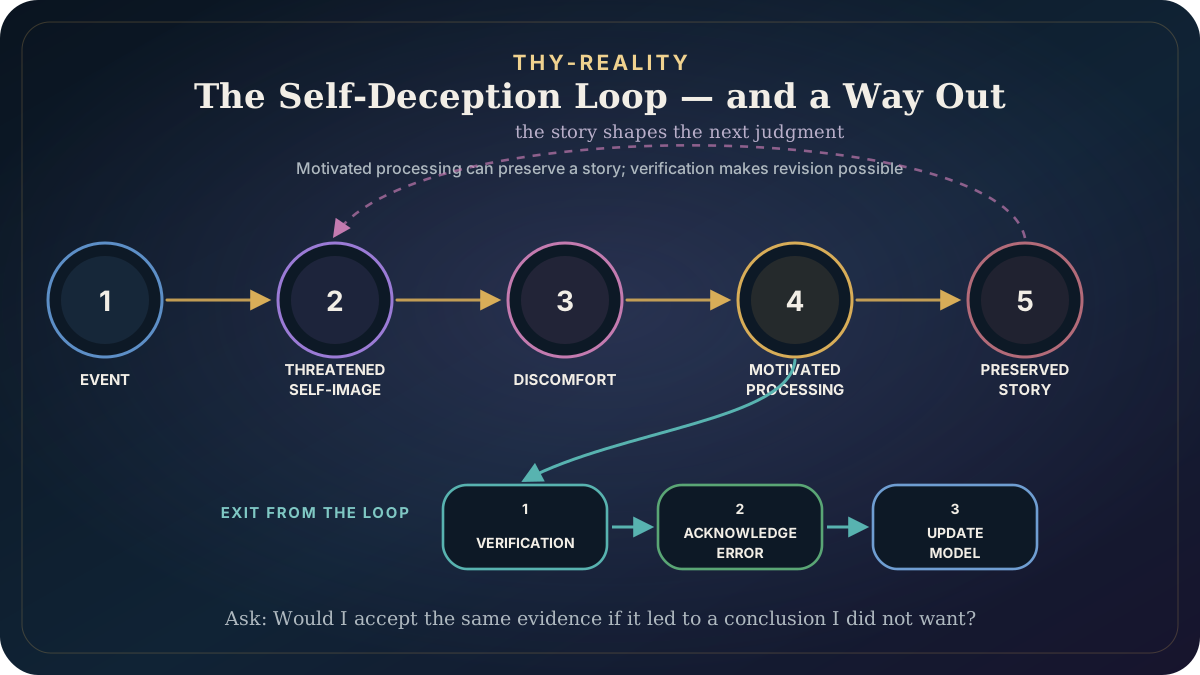
Imagine someone who thinks of themselves as a very honest person. Then they discover that they concealed an important mistake at work. A tension appears between two ideas: “I am an honest person” and “I did something that was not honest.” One possible response is: “I did something wrong, and I need to correct it.” But psychologically easier explanations may also become available: “Anyone would have done the same,” “The system forced me into it,” “Telling them would only have created unnecessary problems,” or “I did not really conceal anything important.”
Some of those explanations may contain elements of truth. The problem is not that circumstances never matter. The problem begins when explanations are judged mainly by how well they protect our self-image rather than by how well they fit the evidence.
This is where the concept of cognitive dissonance becomes useful. Cognitive dissonance theory describes an uncomfortable motivational state that can arise when important cognitions, actions, or commitments conflict with one another. People can reduce that tension in different ways: by changing behavior, changing an attitude, adding new explanations, or reinterpreting existing information.
Reducing dissonance is not automatically self-deception. If a new interpretation is supported by better evidence, revising our belief may be perfectly rational. The warning sign appears when the standard of evidence changes depending on which conclusion protects our self-image or past decision.
A useful question is not only “Can I explain my decision?” but also “Would I accept the same explanation if it did not protect my self-image?”
Motivated Reasoning and the Information We Choose
Human beings cannot simply believe anything they wish to believe. Motivated reasoning is more subtle than that. A preferred conclusion can influence which information we seek, which explanations appear plausible, how strictly we evaluate contrary evidence, and which memories come most easily to mind.
That is why motivated reasoning rarely sounds like: “I know this is false, but I will believe it anyway.” It is far more likely to sound like a completely rational internal monologue: “After considering everything carefully, my explanation still makes the most sense.” Arguments may be present, but the rules may not be symmetrical.
Evidence supporting the preferred conclusion may be accepted quickly. Contrary evidence must survive several additional tests. A favorable interpretation is considered “reasonable.” An unfavorable one becomes “just one possible interpretation.” Another person’s mistake reflects their character. Our own mistake reflects the circumstances. Motivation does not necessarily replace reasoning. It can steer it.
A similar process can occur even earlier, when we decide which information to expose ourselves to. A meta-analysis of 91 studies involving just under 8,000 participants found a moderate overall preference for information consistent with people’s existing attitudes, beliefs, or behavior (d = 0.36). The tendency was not equally strong in every situation: defensive motives and motives for accuracy both mattered, and people sometimes preferred challenging information when it was useful for accomplishing an important goal.
This is especially relevant in digital environments. A large number of links, authors, and posts does not necessarily mean that we are encountering many independent perspectives. If we continually choose sources that support the same story, our information environment may appear rich while remaining epistemically narrow.
The most effective self-deception is not necessarily the absence of arguments. It can be a system of arguments in which evidence is held to different standards depending on where it leads.
Why Is Bias Easier to See in Other People?
Most of us understand the idea of bias quite well. We notice it in political opponents, in our partner, in the media, or in people online. It is much harder to recognize in ourselves. Research refers to this pattern as the bias blind spot.
Part of the explanation lies in how we evaluate ourselves. We have access to our intentions and to our internal stream of thought. Because we usually do not consciously decide “I am going to be biased now,” we may mistake the absence of a subjective feeling of bias for evidence of objectivity. With other people, we do not have the same access to their introspection, so we more readily infer bias from behavior, interests, affiliations, or incentives.
Pronin and Kugler found that people placed greater weight on introspective information when judging their own bias than when judging the bias of others. The problem is that many biased processes are not directly accessible through introspection. Feeling sincerely that nothing influenced us therefore does not prove that nothing did.
This matters for self-deception as well. If self-deception always felt like obvious deception, it would be much easier to detect. Instead, it may feel like nothing more than: “I looked at the facts and reached a reasonable conclusion.”
The fact that we do not feel biased is not evidence that we are unbiased. Introspection tells us something about our experience, not everything about the processes that shaped our judgment.
When the Story Begins to Protect an Identity
Sometimes we are not defending a single claim. We are defending everything attached to it. A person may have spent ten years advocating a decision, invested money in it, persuaded other people to support it, argued about it publicly, and repeatedly said that it was correct. If strong contrary evidence appears, they are no longer facing a single question. They may be facing an entire package of consequences: “Maybe I was wrong,” “Maybe I lost a great deal because of this,” “Maybe I persuaded other people to believe something false,” or “Maybe I will lose credibility.”
The more expensive revising a story becomes for our identity, relationships, or past decisions, the more motives we may have to preserve the old picture. That does not mean self-deception must follow. It means that these are precisely the situations in which stricter self-examination becomes more important.
A particularly interesting case is the identity of being a “truth seeker.” A person may begin to think: “I can see through propaganda,” “I think for myself,” or “I am not like the crowd.” At first, such an attitude may encourage genuine inquiry. But an almost invisible reversal can occur. If the feeling “I am one of the people who can see” becomes more important than verification itself, information threatening that identity may begin to feel like an attack.
Then we can do exactly what we previously accused others of doing: dismiss contrary evidence, attack the source instead of addressing the argument, look mainly for confirmation, or reinterpret every criticism as additional proof that we were right all along. No community is automatically protected from this — not science, politics, religion, skepticism, spirituality, alternative communities, or a project devoted to the search for reality.
THY-REALITY therefore cannot be built around the identity “we are awake.” A safer starting point is: “We can be wrong too, so our method must be stronger than our need to be right.”
How Can We Recognize the Possibility of Self-Deception?
We do not possess a perfect internal detector for self-deception. But we can create conditions that make it harder to maintain. For an important belief, seven questions can help.
- What would it mean for me if this belief were false? In addition to examining the evidence, examine your psychological interest in a particular answer.
- Do I use the same standard for evidence that supports me and evidence that challenges me? If one source is accepted after one study while an opposing source would require ten, the standards are no longer symmetrical.
- What is the strongest evidence against my position? If I do not know it, I may not yet have seriously tested my position.
- What would actually change my mind? If every possible result can be explained in a way that preserves the same conclusion, the belief has become close to unfalsifiable.
- Does my explanation always preserve a favorable image of myself or my group? That does not automatically make it false. It is a reason for additional scrutiny.
- How would I judge the same behavior if it were done by someone I disliked? Reversing the perspective can reveal double standards.
- What action would follow if I took the uncomfortable explanation seriously? Sometimes it is only when we reach the consequences that we discover why we resisted a possibility.
None of these questions guarantees complete objectivity. Their purpose is to create distance between us and the story we want to defend. We stop examining only the conclusion and also examine the process by which we reached it.
A powerful test is symmetry: would I accept the same evidence, the same source, and the same explanation if they led to a conclusion I did not want?
Truth Does Not Require Us to Hate Ourselves
Examining self-deception can quickly become moralistic. When we discover one of our own rationalizations, we may say: “How could I have been so stupid?” But self-condemnation is not the purpose of this method. If defense of self-image is already part of the problem, humiliation can itself become another reason to defend the old story rather than examine it clearly.
A more useful response is more precise: “At the time, I had certain information, motives, and limitations. I now have reasons to revise the model.” That does not remove responsibility. If we harmed someone, acknowledgment matters. If we spread false information, correcting it matters. If we made a poor decision, the new understanding should influence what we do next.
The purpose of self-examination is therefore not to destroy our self-image. It is to reduce the distance between that image and our actual behavior. Integrity does not require the identity “I am a person who is never wrong.” It requires the ability to notice an error, acknowledge it, and change because of it.
The first five THY-REALITY articles developed a method for examining perception, claims, the limits of knowledge, and partial perspectives. This article introduces an uncomfortable but necessary turn: the same method must also be capable of examining us. If everyone else can be biased but we cannot, if everyone else can become trapped inside a story while we always see things exactly as they are, and if everyone else must provide evidence while our own claims are valid simply because they are ours, then we are no longer investigating.
The search for truth becomes serious only when we allow a good method to revise even the story we tell about ourselves.
Sources and further reading
- Stanford Encyclopedia of Philosophy. Self-Deception. Pregled glavnih filozofskih sporov o definiciji, namernosti, prepričanju in motivacijski pristranskosti pri samoprevari. Source
- Kunda, Z. (1990). The Case for Motivated Reasoning. Psychological Bulletin, 108(3), 480–498. DOI: 10.1037/0033-2909.108.3.480. Source
- Epley, N. & Gilovich, T. (2016). The Mechanics of Motivated Reasoning. Journal of Economic Perspectives, 30(3), 133–140. DOI: 10.1257/jep.30.3.133. Source
- Harmon-Jones, E. & Mills, J. (2019). An Introduction to Cognitive Dissonance Theory and an Overview of Current Perspectives on the Theory. In E. Harmon-Jones (ed.), Cognitive Dissonance: Reexamining a Pivotal Theory in Psychology (2nd ed.), pp. 3–24. American Psychological Association. DOI: 10.1037/0000135-001. Source
- Hart, W., Albarracín, D., Eagly, A. H., Brechan, I., Lindberg, M. J. & Merrill, L. (2009). Feeling Validated Versus Being Correct: A Meta-Analysis of Selective Exposure to Information. Psychological Bulletin, 135(4), 555–588. DOI: 10.1037/a0015701. Source
- Pronin, E. (2007). Perception and Misperception of Bias in Human Judgment. Trends in Cognitive Sciences, 11(1), 37–43. DOI: 10.1016/j.tics.2006.11.001. Source
- Pronin, E. & Kugler, M. B. (2007). Valuing Thoughts, Ignoring Behavior: The Introspection Illusion as a Source of the Bias Blind Spot. Journal of Experimental Social Psychology, 43(4), 565–578. DOI: 10.1016/j.jesp.2006.05.011. Source