The Blind Men and the Elephant: Mistaking the Part for the Whole
A true piece of information can still produce a false picture when we mistake one part for the whole. Learn how context and multiple perspectives improve understanding.

A false conclusion does not always begin with false information. Sometimes the information in front of us is entirely real — but we see only one part and mistake it for the whole. That is why the old parable of the blind men and the elephant remains so useful today: each person encounters a different part of the same animal and tries to describe the whole from that limited contact.
One touches a leg, and the elephant seems like a pillar. Another touches the trunk and compares it to a long pole. A third takes hold of the tail and finds something like a rope or broom. Each person is in contact with a real elephant. None of them is inventing the part they encounter.
The problem appears in the next step: “What I have perceived is not merely part of the elephant. This is the elephant.” The part may be accurately described while the conclusion about the whole is not justified.
True information can therefore produce a false picture of reality when we fail to understand which part of the whole it actually describes and how far that information allows us to generalize.
What Does the Parable of the Blind Men and the Elephant Actually Teach?
The parable exists in several forms and became part of different traditions over time. For this article, the main reference is an early surviving Buddhist version in Udāna 6.4, the Tittha Sutta.
In that version, a king gathers people who have been blind from birth and has different individuals encounter different parts of an elephant: the head, ear, tusk, trunk, body, foot, hindquarters, tail, or the tuft at the end of the tail. When asked what the elephant is like, each describes the part they encountered and then defends that partial description as though it described the whole animal.
In its Buddhist context, the story is not simply a lesson that “everyone has their own truth.” It is used to criticize dogmatic attachment to limited views and disputes in which a partial understanding is treated as the whole of reality.
The person touching the leg may be justified in saying, “The part I am touching is like a pillar.” They are not justified in concluding, “The elephant is a pillar.” The mistake is not necessarily in the experience, but in the generalization from part to whole.
A Partial Truth, Context, and the Limits of a Conclusion
A piece of information is always information about something — at a particular time, scale, setting, and within a particular context. When those boundaries disappear, even a correct statement can create a misleading impression.
The statement “sales increased by 20 percent” may be entirely accurate. But without knowing the baseline, time period, whether we mean revenue, volume, or profit, and whether unusual circumstances affected the comparison, we still do not know what conclusion is justified.
The same applies to quotations, historical documents, and research. A sentence can be authentic but misleading when removed from what came before and after it. One genuine document does not automatically represent the entire policy of an era. One well-designed study can report a valid result while still applying only within a particular sample, method, and measurement context, and it must be interpreted within the wider literature.
The question “Is this information true?” is often only the first step. The next question is: “What exactly does this information support — and what does it not support?”
A useful rule is simple: the conclusion should not be broader than the evidence on which it rests.
Perspective, Reality, and Naive Realism
Perspective does not necessarily mean illusion or relativism. Two people can observe the same object from different positions and both perceive something real. If we stand on opposite sides of a house, I may see the front door while you see the garden. The problem begins only if I conclude that what I cannot see does not exist.
In social psychology, naive realism refers to a tendency to experience our own view as a natural and relatively unbiased reflection of objective reality while being more inclined to explain disagreement from others in terms of their ignorance, irrationality, bias, or interests.
This does not mean that two opposing interpretations are automatically equally good. It means that the feeling that our own view is direct or obvious is not proof that it is complete.
Another perspective does not prove that ours is wrong. It may reveal that ours is incomplete or that it contains assumptions we had not noticed.
When a Group Has More Pieces but Fails to Assemble Them
The parable becomes even more interesting when different perspectives are combined. If each person knows only one part of the elephant, we might expect a group to create a better model by pooling its information. That can happen, but groups do not always integrate information effectively.
Garold Stasser and William Titus studied group decision making in situations where members possessed different pieces of relevant information. Collectively, the group had enough information to identify a better option, but individual members initially held incomplete and biased subsets of that information.
Their experiments showed that discussion tended to favor information that members already shared before the discussion and information consistent with members’ existing preferences. Unique information held by only one person had fewer opportunities to enter or influence the discussion. Under some conditions, groups therefore continued toward choices supported by their initial partial information even though combining all of the available evidence would have favored another option.
Later meta-analytic work synthesized 72 independent studies involving 4,795 groups and 17,279 individuals. More effective information sharing was positively associated with team performance, knowledge integration, decision satisfaction, and cohesion, although the strength and form of these relationships varied across conditions.
Having more people does not automatically mean having the whole picture. If ten people repeat the same part of the elephant, we still have one part repeated ten times.
Context and Relationships Between Facts Matter
Sometimes the problem is not simply that we see only one part. The problem is that we remove a fact from the system that gives it meaning.
Consider the statement: “The temperature is 39 degrees.” A body temperature of 39 °C means something very different from an outdoor air temperature of 39 °C. The number is the same; the meaning is not.
The same applies to quotations. A sentence may be authentic, but removing it from its surrounding argument can change how it is understood. In history, a genuine document may reveal something important without representing an entire era, government, or population. In science, one result must be interpreted in relation to method, sample, measurement, uncertainty, replication, and the broader body of evidence.
There is another complication: even collecting every separate part does not guarantee understanding of the whole.
Imagine an engine dismantled on a table. Every component is present, yet someone who does not understand how those components interact may still not understand how the engine works. We can know every word in a sentence and still miss irony or metaphor. We can list every species in an ecosystem and still fail to understand the relationships among predators, prey, plants, climate, disease, and resources.
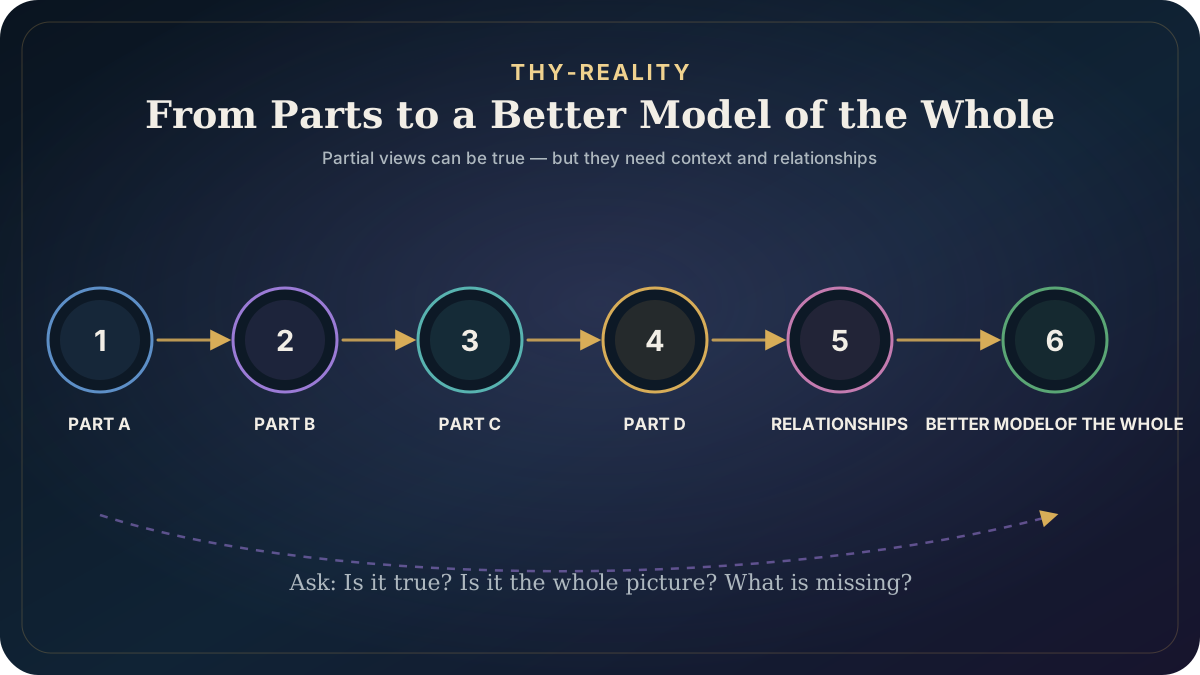
Understanding a whole therefore requires at least two kinds of information: what the parts are and how the parts are related.
To build a better model of reality, it is not enough to collect more pieces. We also need to understand the relationships that make those pieces part of a particular whole.
How to Check Whether We Are Mistaking a Part for the Whole
When evaluating an important claim, a simple process can help.
- What do I actually know? Reduce the claim to what the evidence directly supports rather than immediately expanding it to a person, group, field, or entire story.
- What am I inferring from it? Separate the information from the generalization. Are we moving from one example to a rule, one study to an entire field, or one individual to a whole group?
- Which part of the picture is missing? Ask what information could complete or change the conclusion: another perspective, a longer period, a larger sample, the original document, or counterexamples.
- Are my sources genuinely independent? Five articles that all repeat the same original source are not five independent confirmations.
- Do I understand the relationships between the facts? Check whether we are dealing with causation, correlation, sequence, exception, hierarchy, or another relationship that changes the meaning.
- How broad a conclusion does the evidence support? Keep the conclusion proportional to the scope, quality, and limitations of the evidence.
This process does not require us to know the whole of reality before making any statement. It requires only that we distinguish what the evidence supports directly from the wider model we build around it.
From Multiple Perspectives to a Better Model of the Whole
The limits of perspective do not imply that truth is relative or unreachable. The elephant in the parable exists independently of the descriptions. Its parts have properties, and people can compare, test, expand, and correct their observations.
That is why it is important to distinguish between the claims “everyone has their own truth” and “everyone may have access to a different part of a shared reality.” The second claim allows some perspectives to be more accurate, some to complement one another, and some to be simply wrong.
The first four THY-REALITY articles moved from the limits of perception through verification and responsibility toward recognizing the limits of knowledge. This article adds the next step: even when we know something, we still need to know how much of the whole our knowledge actually covers.
When evaluating an important claim, it is therefore not enough to ask, “Is this true?” Ask also: “Is this the whole picture?” And if it is not: “What is missing?”
Inquiry changes when disagreement no longer produces only the question “Why can’t you see what I see?” but also “What can you see that I cannot?” This is not a surrender of judgment. It is a way of exposing our model of the world to information that may be unavailable from our own position.
Sources and further reading
- Udāna 6.4 — Tittha Sutta (Sectarians 1). Zgodnja budistična različica prispodobe o slepih ljudeh in slonu. Source
- Keown, D. (2013). Buddhism and elephants. In Buddhism: A Very Short Introduction (2nd ed.). Oxford University Press. DOI: 10.1093/actrade/9780199663835.003.0001. Source
- Stasser, G. & Titus, W. (1985). Pooling of Unshared Information in Group Decision Making: Biased Information Sampling During Discussion. Journal of Personality and Social Psychology, 48(6), 1467–1478. DOI: 10.1037/0022-3514.48.6.1467. Source
- Mesmer-Magnus, J. R. & DeChurch, L. A. (2009). Information Sharing and Team Performance: A Meta-Analysis. Journal of Applied Psychology, 94(2), 535–546. DOI: 10.1037/a0013773. Source
- Ross, L. & Ward, A. (1996). Naive Realism in Everyday Life: Implications for Social Conflict and Misunderstanding. In E. S. Reed, E. Turiel & T. Brown (eds.), Values and Knowledge, pp. 103–136. Lawrence Erlbaum Associates. Source
- American Psychological Association. APA Dictionary of Psychology: naive realism. Source