When Too Much Information Leads to Less Understanding
More information does not always produce more understanding. Learn how information overload, working-memory limits, cognitive load and poor synthesis can make judgment harder.

We live in a time when the problem is often no longer a lack of information. For almost any question, we can find articles, videos, comments, studies, expert opinions, user reactions, and links to even more material within seconds. But access to more information does not automatically produce greater understanding. At some point, additional information can begin competing for our attention, increasing the number of open possibilities and making it harder to distinguish what matters from what does not.
Imagine a simple research process. We open one article, then another. The first links to a study. The second presents three opposing views. We add a video, its comments, another study, and a criticism of that study. An hour later, twenty browser tabs are open.
We now possess more individual pieces of information than we did at the beginning. Yet answering the question “What can I actually justify on the basis of all this?” may have become harder.
This is one of the paradoxes of the modern information environment. The problem is not necessarily that information is scarce. It may be that we lack a good way to turn information into structure.
An important methodological boundary is necessary from the beginning: this article does not claim that more information is inherently bad. What matters is the relationship between the volume and complexity of information, the task, the time available, prior knowledge, and our capacity to process what we encounter.
Information is not yet understanding. Understanding emerges when we can select, connect, evaluate, and place information within a coherent model.
What Is Information Overload?
The term information overload is used across several research fields and does not have one perfectly uniform definition. Its common core, however, is relatively clear: information demands can, in a particular situation, exceed the ability of an individual or system to process that information in time and with sufficient quality for the task at hand.
Martin Eppler and Jeanne Mengis showed in their broad review that the problem has been studied in organizational science, marketing, accounting, management information systems, and related fields. What matters is not only the quantity of information. Its quality, complexity, ambiguity, rate of change, mode of presentation, and the amount of time available also matter.
Peter Roetzel’s later review likewise treats information overload as the result of an interaction among characteristics of the information, the individual, the task, and the organizational and technological environment.
This means that there is little sense in searching for one universal number at which information suddenly becomes “too much.” The same quantity may be manageable for an expert and highly demanding for a beginner. The same content may be relatively easy to process when well structured and extremely difficult when presented chaotically.
The problem is not simply that there is “too much information in the world.” The problem arises when the information demands of a particular task exceed our ability to process them meaningfully.
Working Memory and Limited Immediate Capacity
Why can we not simply take all available information and process it simultaneously? One reason is the limited capacity of working memory — the system that helps keep information sufficiently accessible while we perform a current task.
Nelson Cowan’s review discusses evidence that, under particular experimental conditions, a central working-memory store in young adults is limited to roughly three to five meaningful items. This estimate is not a universal limit on all forms of human thought.
Performance depends on the task, repetition, prior knowledge, strategies, and especially our ability to combine information into larger meaningful units. Prior knowledge illustrates why the same amount of information does not impose the same demands on everyone.
A chess expert does not necessarily see a position only as many isolated pieces. They may recognize larger familiar patterns. A programmer may perceive several lines of code as a single known construct. The amount of raw material has not disappeared, but it has been organized into larger meaningful units that are easier to work with.
Understanding is not simply the addition of more data. Much of its power comes from connecting many pieces of information into a smaller number of meaningful structures.
More Content Can Mean More Cognitive Work, Not More Knowledge
Cognitive load theory was developed primarily in research on learning and instruction. Its basic premise is that instructional design must take the limitations of working memory seriously and distinguish between demands created by the material itself and additional demands created by how that material is presented.
John Sweller, Paul Ayres, and Slava Kalyuga describe situations in which poor organization forces learners to perform unnecessary searching, coordinating, or switching of attention. If understanding one relationship requires repeated effort simply to locate and integrate scattered information, some limited cognitive resources are being spent on navigating the presentation rather than on understanding the underlying idea.
Imagine two explanations of the same complex topic. The first immediately presents fifteen definitions, seven graphs, three videos, numerous exceptions, and several competing terminologies. The second begins with the central question, three key concepts, and the relationships among them. It then adds the strongest evidence and only afterwards introduces exceptions and complications.
The second explanation may contain less information at the beginning, yet it may lead to deeper understanding. This does not mean that complex subjects should be simplified until they become inaccurate. The complexity of reality and the complexity of its presentation are not the same thing.
A good explanation does not necessarily remove the complexity of the subject. It removes unnecessary complexity from the path we must follow in order to understand it.
Many Sources Do Not Necessarily Mean Many Independent Lines of Evidence
In a dense information environment, it is easy to mistake quantity for independence. Imagine finding the same claim on ten websites. At first glance, it appears that we have ten confirmations. But after tracing the links backward, we discover that nine sites repeat the same news-agency report, the report refers to one statement, and that statement refers to one study.
We do not have ten independent lines of evidence. We have one information chain appearing in ten places. A large number of search results can therefore create the appearance of widespread confirmation while the actual evidential base is much narrower.
The article “Blind Men and the Elephant” already showed why multiple perspectives are most useful when they genuinely contribute different pieces of information. The article “From Belief to Verification” showed that repetition itself does not improve the evidential quality of a claim. Here we add a practical consequence: when facing large numbers of results, we must examine the origin and dependence of sources, not merely count them.
The number of search results is not the number of independent pieces of evidence. Ten publications derived from the same source remain one information chain.
Can There Also Be Too Much Choice?
A related question concerns the number of available options. A popular story suggests that some choice is good, but too much choice overwhelms us. Individual studies have indeed reported negative effects from large choice sets. But the literature as a whole does not support a simple universal rule.
Benjamin Scheibehenne, Rainer Greifeneder, and Peter Todd conducted a meta-analysis covering 50 published and unpublished experiments, 63 experimental conditions, and 5,036 participants. The average effect of larger choice sets was virtually zero, while there was substantial variation across studies.
Some situations produced evidence consistent with choice overload. Others did not, and in some circumstances additional options could be beneficial. The term choice overload must therefore be used cautiously.
A large number of choices does not by itself guarantee a worse decision. Other factors may matter, including how comparable the options are, whether decision criteria are clear, time pressure, prior preferences, and the difficulty and consequences of the decision.
The problem is not simply “more.” The problem is the relationship between quantity, structure, task demands, and processing capacity.
The Internet: Access to Information Is Not the Same as a Research Process
The digital information environment is an extraordinary achievement. A person can now reach an amount of knowledge within seconds that would once have been practically inaccessible. That is an enormous advantage. But a tool for access does not automatically perform the work of selection, evaluation, and synthesis.
A search engine gives us results. It does not provide a final ranking of reality according to evidential quality. A social network presents content. It does not necessarily show us the information required to balance our model of a subject. A video platform may become very good at predicting what we are likely to watch next. That is not the same as knowing what we need in order to understand a topic.
We can therefore begin to confuse access to information with research. If every new piece of information opens five additional paths, inquiry can become endless expansion without consolidation: one more article, one more video, one more opinion, one more exception, but never the moment when we stop and ask which pieces actually matter and how they fit together.
This article does not claim that the internet inherently reduces understanding. The claim is narrower. In an environment where acquiring another piece of information is extremely easy, explicit methods of selection and synthesis become more important, because continued collection by itself does not guarantee a better model.
Access to more information is a technical capability. Turning that information into well-supported understanding is a research task.
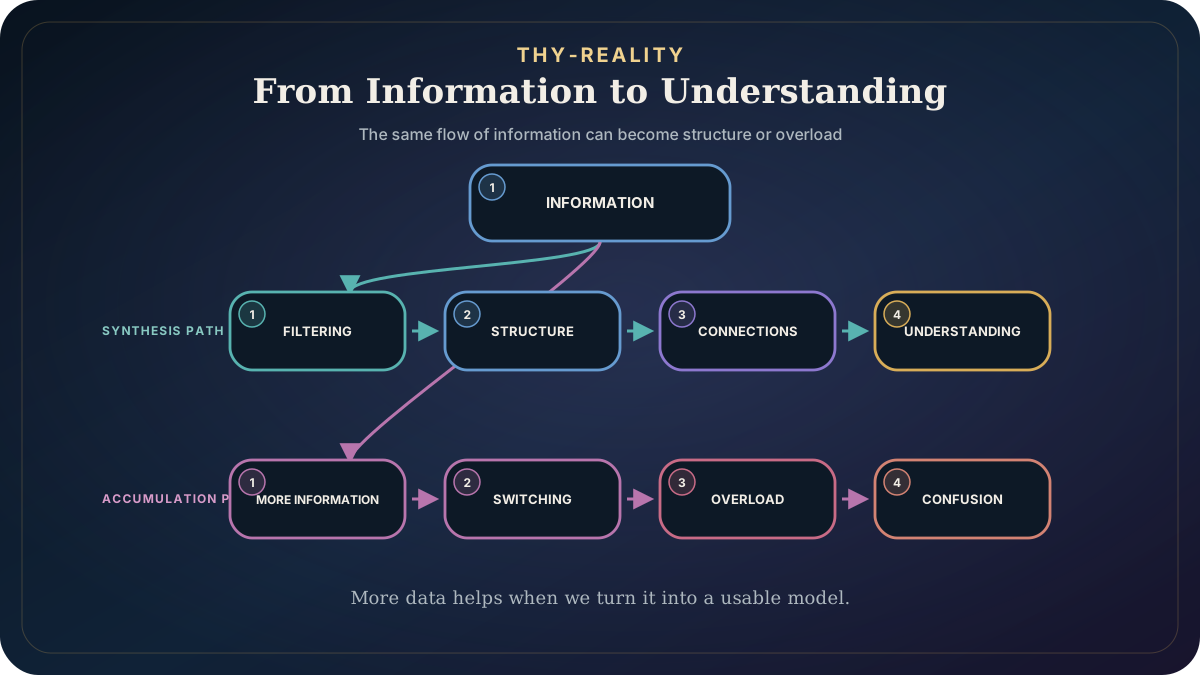
How to Turn Information Into Understanding
The solution is not simply to read less for the sake of reading less. Nor should we automatically remove information merely because it complicates our existing view. We need a process that clearly separates collection from synthesis.
- Define the question first. If we do not know what we are trying to answer, almost every new piece of information can become a new research direction.
- Separate the core from the background. What do we need in order to answer the question, and what is interesting but currently secondary?
- Prefer high-quality primary or review sources when appropriate. A good review or original source may be more useful than many summaries repeating the same information.
- Check whether sources are genuinely independent. Do we have multiple lines of evidence, or mainly multiple repetitions of the same evidence?
- At some point, stop collecting and begin synthesizing. What is repeated across sources? Where do they disagree? What is well supported? What remains unresolved?
- Write down what we still do not know. A clearly marked gap is more useful than additional browser tabs that do not reduce uncertainty.
- Add new information mainly when it can change the model. Does it provide new evidence, an independent perspective, an important counterargument, or a better explanation?
This final step creates a useful stopping criterion. The goal of serious research is not to read everything. For most complex subjects, that is impossible. The goal is to construct a sufficiently good model, understand its evidential basis, and know where its limits remain.
The first eight THY-REALITY articles developed methods for examining perception, belief, sources, uncertainty, partial perspectives, and our own biases. Here we add another skill: managing the flow of information itself.
Even high-quality information does not help if we lack the time and structure required to turn it into understanding. More is not always less, but more is not automatically more either. One hundred disconnected facts may be less useful than five relationships we understand well. Twenty search results drawn from the same information chain may be worth less than two genuinely independent sources.
The information age has given us almost unlimited access to data. Understanding still depends on something limited: our attention, our selection, and our ability to connect what we find.
Sources and further reading
- Eppler, M. J. & Mengis, J. (2004). The Concept of Information Overload: A Review of Literature from Organization Science, Accounting, Marketing, MIS, and Related Disciplines. The Information Society, 20(5), 325–344. DOI: 10.1080/01972240490507974. Source
- Roetzel, P. G. (2019). Information Overload in the Information Age: A Review of the Literature from Business Administration, Business Psychology, and Related Disciplines with a Bibliometric Approach and Framework Development. Business Research, 12, 479–522. DOI: 10.1007/s40685-018-0069-z. Source
- Cowan, N. (2010). The Magical Mystery Four: How Is Working Memory Capacity Limited, and Why? Current Directions in Psychological Science, 19(1), 51–57. DOI: 10.1177/0963721409359277. Source
- Sweller, J., Ayres, P. & Kalyuga, S. (2011). Cognitive Load Theory. Springer. DOI: 10.1007/978-1-4419-8126-4. Source
- Paas, F. & Sweller, J. (2012). An Evolutionary Upgrade of Cognitive Load Theory: Using the Human Motor System and Collaboration to Support the Learning of Complex Cognitive Tasks. Educational Psychology Review, 24, 27–45. DOI: 10.1007/s10648-011-9179-2. Source
- Scheibehenne, B., Greifeneder, R. & Todd, P. M. (2010). Can There Ever Be Too Many Options? A Meta-Analytic Review of Choice Overload. Journal of Consumer Research, 37(3), 409–425. DOI: 10.1086/651235. Source