From Belief to Verification
Strong belief is not the same as good evidence. Learn how to separate claims, sources, evidence, and interpretation — and how to adjust confidence to the evidence.
Belief and knowledge are not the same thing. We can sincerely believe something and still be wrong. We can also doubt something for which there is very strong evidence. When we investigate reality, what matters is therefore not how strongly we believe a claim, but what our belief is based on and how well it has survived verification.
In Perception Is Not the Same as Reality, we saw that perception is not a perfect recording of the world. Attention, memory, context, and interpretation all stand between an event and our understanding of it. But the problem does not end with perception.
Once we accept an explanation, it begins to become part of our view of the world. We compare new information against it, interpret events through it, and often use it as the starting point for further conclusions.
This is unavoidable. No one can re-examine everything they know from the beginning every morning. The difficulty begins when we stop distinguishing between “I believe this” and “I have good reasons to believe this.”
The movement from belief to verification begins with that distinction.
Belief Is Not Evidence
In everyday language, certainty often sounds almost like proof. “I’m certain.” “I know that’s how it is.” “I have no doubt.” Statements like these describe the strength of our internal conviction. They do not necessarily tell us anything about the quality of the evidence on which that conviction is based.
A person can be completely certain and still be wrong. A person can also be uncertain and turn out to be right. It is therefore useful to separate two questions: “How strongly do I believe this claim?” and “How well supported is this claim?”
The first question concerns our psychological state. The second concerns reasons and evidence.
In epistemology — the philosophical study of knowledge — evidence is closely connected with the question of what justifies a belief or makes it reasonable to accept. What matters, however, is not merely whether some evidence can be found in favor of a claim. We also need to consider the wider body of relevant evidence, including evidence that points in the opposite direction.
Imagine that we investigate a question and find three pieces of information that support our preferred explanation. That may feel convincing. But if ten high-quality pieces of evidence point against it, the overall picture changes considerably.
The important question is therefore not simply: “Do I have evidence for my claim?”
A better question is: “What does the overall body of available evidence suggest?”
That question is harder because it requires us to look even where we may not like the answer.
Confirmation Bias: Why We Look for What Supports Our Beliefs
Once we have accepted an explanation, we no longer approach new information from a completely neutral starting point. One of the most extensively studied phenomena in this area is confirmation bias. The term is commonly used for tendencies to seek or interpret evidence in ways that favor existing beliefs, expectations, or hypotheses. Related biases can also affect how we evaluate and select information.
This does not necessarily mean that people consciously falsify information. The process can be far more subtle.
A claim that supports our position may immediately seem plausible, so we demand little additional explanation. But when we encounter evidence that challenges our position, we may suddenly become much more demanding: Who funded the study? How many people participated? Was the methodology really sound? Could there be another explanation?
All of these are legitimate questions. The problem arises when we ask them primarily of evidence we dislike while accepting evidence in our favor with very little scrutiny.
A classic 1979 study by Charles Lord, Lee Ross, and Mark Lepper showed how people with strong prior positions could evaluate the same mixed body of evidence differently depending on whether individual pieces of evidence supported or challenged their initial view.
Later research has documented confirmation bias in many forms and contexts. But the most useful lesson is not: “Other people are biased.”
It is: “If I am human, I should assume that I may be biased too.”
That is why serious verification requires something psychologically difficult: deliberately looking for information that might show us that we are wrong.
The Illusory Truth Effect: Repetition Is Not Evidence
There is another reason a belief may begin to feel stronger even when the evidence has not improved. A claim becomes familiar. We hear it once. Then again. Later we encounter it in an article, a video, a conversation, and a social media post. After a while, it no longer feels new. It feels familiar.
And familiarity can influence judgments of truth. Psychological research describes this as the illusory truth effect. Studies and meta-analyses show that repetition can increase subjective truth ratings of statements.
This does not mean that people will believe anything simply because it is repeated often enough. It does mean that repetition itself can affect how true a claim feels. Research also shows that prior knowledge does not always eliminate this effect.
That distinction matters.
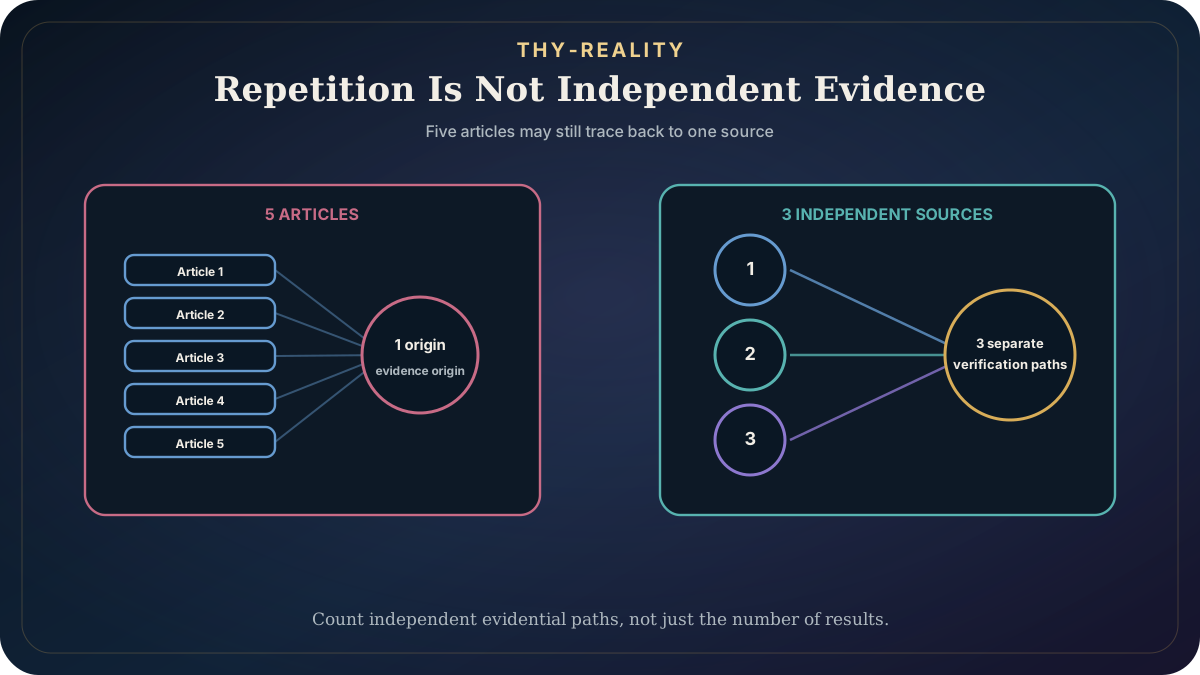
If we encounter the same claim on ten websites, it may appear that we have found ten independent confirmations. In reality, all ten pages may trace back to the same original source. Or perhaps none of them contains evidence at all. They may simply repeat the same assertion.
More repetition is not the same as more evidence.
When checking a claim, we therefore need to ask not only how often we have encountered it, but: Where did the information originate? Do the different sources actually rely on independent evidence? Are they all repeating the same source? Can we trace the claim back to its origin?
Familiarity is a psychological signal. It is not an epistemic guarantee.
How to Verify Information and Claims
We use the word verify very loosely. Sometimes it means: “I searched for it online.” Sometimes: “I found a video that agrees with me.” Or: “I asked someone I trust.” Any of these can be a starting point. But they are not necessarily sufficient on their own.
The right method depends on the type of claim.
If we want to know the temperature of a room, we measure it. If we want to know what a law says, we consult the current legal text. If someone attributes a quotation to a historical figure, we try to find the original speech, book, letter, or another traceable primary source. For a scientific claim, we may examine the original study, its methods, later replications, systematic reviews, or meta-analyses. When checking an event, we may compare independent sources, documents, recordings, and timelines.
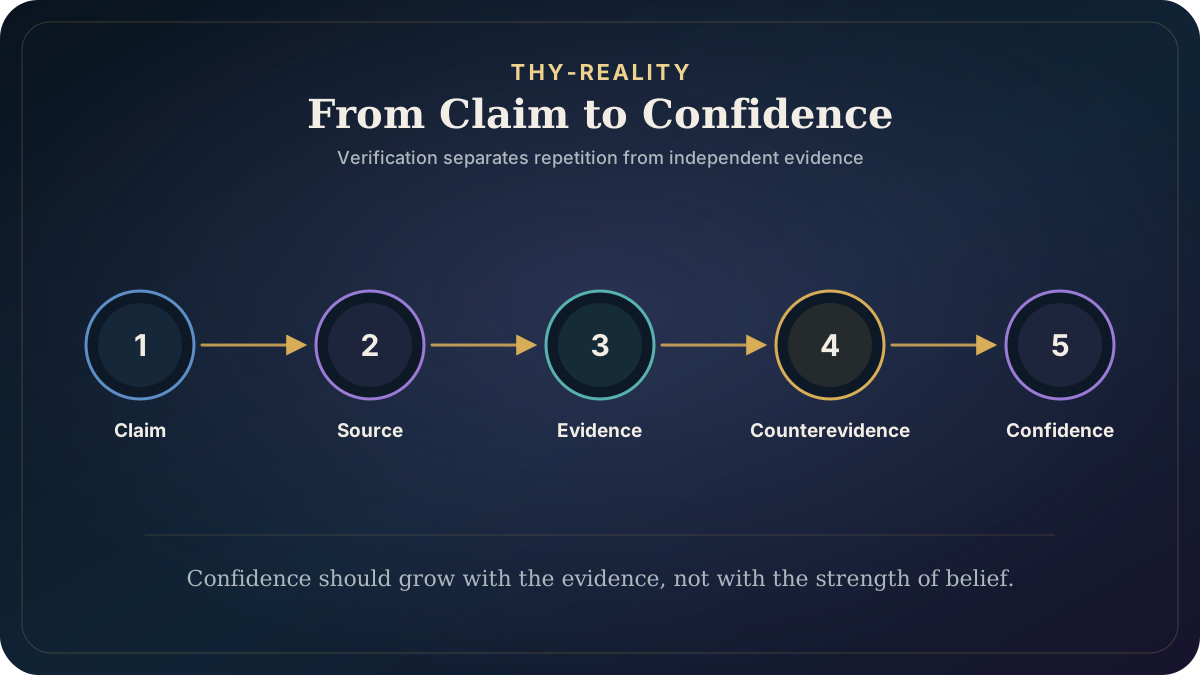
No single method is appropriate for every question. But one distinction is useful almost everywhere: the claim, the source of the claim, the evidence for the claim, and the interpretation of the evidence are not the same thing.
An article, video, or person may be the source from which we first learned about a claim. That does not automatically make the article, video, or person evidence that the claim is correct. And two people can examine the same evidence and interpret it differently.
One of the most useful shifts in inquiry is therefore to move away from asking only “Who says this?” and toward asking:
“What are they basing this claim on?”
The reputation of a source can matter. But a strong source often demonstrates its value precisely by allowing us to follow the path from the claim back to the evidence. Good verification also means more than collecting support. If we genuinely want to test an explanation, we should ask: What would I expect to observe if this explanation were wrong?
This principle has played an important role in the development of scientific reasoning.
With empirical hypotheses, it is especially useful when we can derive observable consequences from them and compare those predictions with what actually happens. A successful prediction can support a hypothesis, but it does not usually transform it into an absolutely proven truth.
The idea of falsification, strongly associated with Karl Popper, emphasized that a scientific theory should risk the possibility of failure: at least in principle, some possible observations should be capable of conflicting with it.
Modern philosophy of science is more complicated than the simple rule that “one exception destroys a theory.” Measurements can be wrong, auxiliary assumptions may fail, and a single anomalous result does not necessarily invalidate an entire model.
But one basic question remains extremely useful in everyday reasoning:
“What would convince me that this explanation is wrong?”
If a claim has a ready-made answer for every possible outcome, genuine testing becomes difficult. If A happens, it is evidence. If B happens, that is also evidence. If nothing happens, that too becomes evidence.
An explanation like this can become resistant to verification because no possible result is allowed to count against it. That does not automatically prove the claim false. It does mean that we should be cautious about how much confidence we place in it.
When a Belief Matters Personally
Verification can become especially difficult when a conclusion matters deeply to us or when we strongly want it to be true. Research on motivated reasoning suggests that motivation can influence which beliefs and strategies people access, construct, and evaluate while reasoning.
This does not mean that every strongly held belief is the result of bias. It means that a desire to reach a particular conclusion can become another factor worth considering when we evaluate our own reasoning.
Some beliefs may also become entangled with our values, sense of belonging, or self-image. In such cases, changing our mind may no longer feel like simply correcting a factual mistake. It may feel as though part of our view of ourselves is being threatened.
A useful alternative is to treat a belief as a current model, rather than as a measure of our personal worth. We can say: “Based on what I currently know, this seems to be the best explanation.” That is very different from saying: “This is true, and anyone who disagrees simply does not understand.”
The first statement allows correction. The second can quickly turn disagreement into a personal conflict.
An investigative mindset does not require us to have no positions. It requires only that no position receive a special exemption from questions such as: Why do I believe this? How do I know this? What would change my mind?
Seven Questions to Ask Before Accepting an Important Claim
For claims that may significantly affect our worldview or decisions, a simple verification process can help.
- What exactly is the claim? — State it clearly enough that you know what is actually being tested.
- Where did the claim originate? — Distinguish the original source from people, websites, or accounts that merely repeat it.
- What is the actual evidence? — Do not ask only who makes the claim. Ask which data, documents, measurements, or observations support it.
- What evidence points against it? — Deliberately look for the strongest counterarguments and conflicting evidence, rather than their weakest versions.
- Are different sources genuinely independent? — Ten websites repeating the same original post do not constitute ten independent confirmations.
- What would show me that I am wrong? — Identify in advance what kind of evidence or result would lower your confidence in the explanation.
- What level of certainty is justified? — Not every question has to be reduced to “true” or “false.” It may be more accurate to say: very well supported, probable, possible, poorly supported, or currently unknown.
This process does not guarantee that we will always reach the correct answer.
But it changes something important: we stop judging a claim by how well it fits us and start judging it by how well it fits the evidence.
From Belief to Verification
At this point, it is possible to make the opposite mistake. Once we realize how often human beings can be wrong, we may begin to doubt everything. But absolute skepticism does not necessarily bring us closer to reality.
If we automatically reject every source, every study, every institution, and every explanation, we have not necessarily become more critical. We may simply have replaced one automatic rule with another. Healthy skepticism is therefore not: “I believe nothing.”
It is: “I try to adjust the strength of my belief to the quality of the evidence.”
Some things can be known with very high confidence. For others, we may have good reasons while some uncertainty remains. Some explanations are currently the best among several possibilities. For some questions, there simply is not enough information.
And sometimes the most accurate answer is: “I don’t know.” These are not different degrees of failure. They are different states of knowledge. The problem begins when uncertainty is hidden behind a level of certainty that the evidence does not justify.
No one lives without beliefs. Every person carries countless assumptions about the world, other people, and themselves. Everyday life would be almost impossible without them. The goal is therefore not to eliminate belief. The goal is to understand what status a particular belief deserves.
Something may be well-established knowledge. Something else may be the best-supported explanation currently available. Another idea may be a working hypothesis. Something may simply be a personal opinion. And something may be a claim we have heard so many times that it has begun to sound like a fact.
Those categories are not equivalent. THY-REALITY therefore does not begin with the rule: “Believe nothing.”
It begins with a more demanding principle: Do not give a belief more certainty than the quality of the evidence justifies.
Doubt has an important role. It opens the door to verification. But doubt itself is not the goal. When evidence accumulates, when different methods point in the same direction, and when an explanation repeatedly survives serious attempts to test it, we have reason to trust it more.
Not absolutely. But justifiably. The movement from belief to verification therefore does not begin by rejecting everything we previously thought. It begins with one question: “How do I know this?” And continues with another: “What would convince me that I am wrong?”
Sources and further reading
- Nickerson, R. S. (1998). Confirmation Bias: A Ubiquitous Phenomenon in Many Guises. Review of General Psychology, 2(2), 175–220. DOI: 10.1037/1089-2680.2.2.175. Source
- Lord, C. G., Ross, L. & Lepper, M. R. (1979). Biased Assimilation and Attitude Polarization: The Effects of Prior Theories on Subsequently Considered Evidence. Journal of Personality and Social Psychology, 37(11), 2098–2109. DOI: 10.1037/0022-3514.37.11.2098. Source
- Dechêne, A., Stahl, C., Hansen, J. & Wänke, M. (2010). The Truth About the Truth: A Meta-Analytic Review of the Truth Effect. Personality and Social Psychology Review, 14(2), 238–257. DOI: 10.1177/1088868309352251. Source
- Fazio, L. K., Brashier, N. M., Payne, B. K. & Marsh, E. J. (2015). Knowledge Does Not Protect Against Illusory Truth. Journal of Experimental Psychology: General, 144(5), 993–1002. DOI: 10.1037/xge0000098. Source
- Kunda, Z. (1990). The Case for Motivated Reasoning. Psychological Bulletin, 108(3), 480–498. DOI: 10.1037/0033-2909.108.3.480. Source
- Stanford Encyclopedia of Philosophy. Evidence. Source
- Stanford Encyclopedia of Philosophy. Scientific Method. Source