Natural Law and the Question of Freedom
What does it mean to be free in a world where actions have consequences? We explore natural law, choice, responsibility, and real limits.

What does it mean to be free? Does freedom mean being able to do whatever we want, or does it only make sense within a world in which actions have consequences? The question of Natural Law begins precisely at this boundary: in the relationship between reality, choice, consequence, and responsibility.
When we speak about freedom, we often imagine the absence of restrictions. The less someone forbids us to do, the freer we seem to be. Yet even a person whom no one is restricting does not live outside the physical, biological, social, and causal conditions of the world.
We may decide to jump from a height, but we cannot abolish gravity by making that decision. We may ignore a contract, but doing so does not erase all of the consequences the action may have for us and for others. We may say whatever we want, but we cannot determine in advance how our words will affect the person who hears them.
Freedom is not the same as the absence of consequences.
But the opposite conclusion would also be too quick. The fact that actions have consequences does not automatically mean that nature directly tells us what is morally right or wrong. That is why, before speaking about Natural Law, we first need to clarify what we actually mean.
What Does Natural Law Mean?
The expression natural law has a long history and several meanings.
In philosophy, it commonly refers to a family of ethical, political, and legal theories according to which moral or legal judgment does not depend entirely on convention, custom, or the decisions of authority. Different thinkers have grounded such principles in human nature, reason, fundamental human goods, the order of nature, or — in some religious versions — a divine order.
These theories differ substantially from one another. Natural law therefore cannot be treated as a single, historically unchanging doctrine.
An even more important distinction is this: natural law in ethics is not the same as a law of nature in science.
Gravity, electromagnetism, and the laws of thermodynamics are descriptive regularities through which science attempts to describe how natural phenomena behave. Ethical natural law asks a normative question: how should a human being act?
When THY-REALITY uses the term Natural Law, we will therefore not treat it as a claim already proven in advance that the universe contains a simple moral rulebook. We will use it as a framework of inquiry in which we ask whether there are features of human beings, the world, and human relationships that cause some forms of conduct to systematically support life, cooperation, autonomy, and the reduction of harm, while others undermine them.
The question is not whether we can declare the moral answer in advance, but which claims about human beings, consequences, and values we can actually justify.
Freedom Is Not Life Without Limits
No human decision arises in a vacuum. Whenever we choose, we are already situated within circumstances: we have bodies, histories, knowledge and ignorance, we live among other people, and we act within physical, social, and economic conditions.
Philosophical debates about free will are therefore far more complex than the simple question: ‘Can I do what I want?’
Two of the most frequently discussed features of free will are the ability to do otherwise and the source or authorship of an action — whether the action originates from the person in the relevant way. Philosophers disagree about which conditions are necessary, how they should be understood, and how free will relates to determinism.
For everyday decision-making, however, we can still distinguish between different degrees of practical control. A person whose arm is physically forced does not have the same control over an action as someone acting without such coercion. A person who makes a decision on the basis of seriously false information is not in the same practical position as someone who understands its likely consequences. And a person who knows that several realistic options are available has a wider practical field of choice than someone who does not know those options exist.
Instead of always treating freedom as an absolute property that we either possess or lack, it is often more useful to ask: how much actual control, information, and choice did I have in this decision?
Consequences Are Not Yet Moral Law
If we drop a glass onto a hard floor, it may break. If we strike another person, we may injure them. In both cases, we are describing consequences of an action.
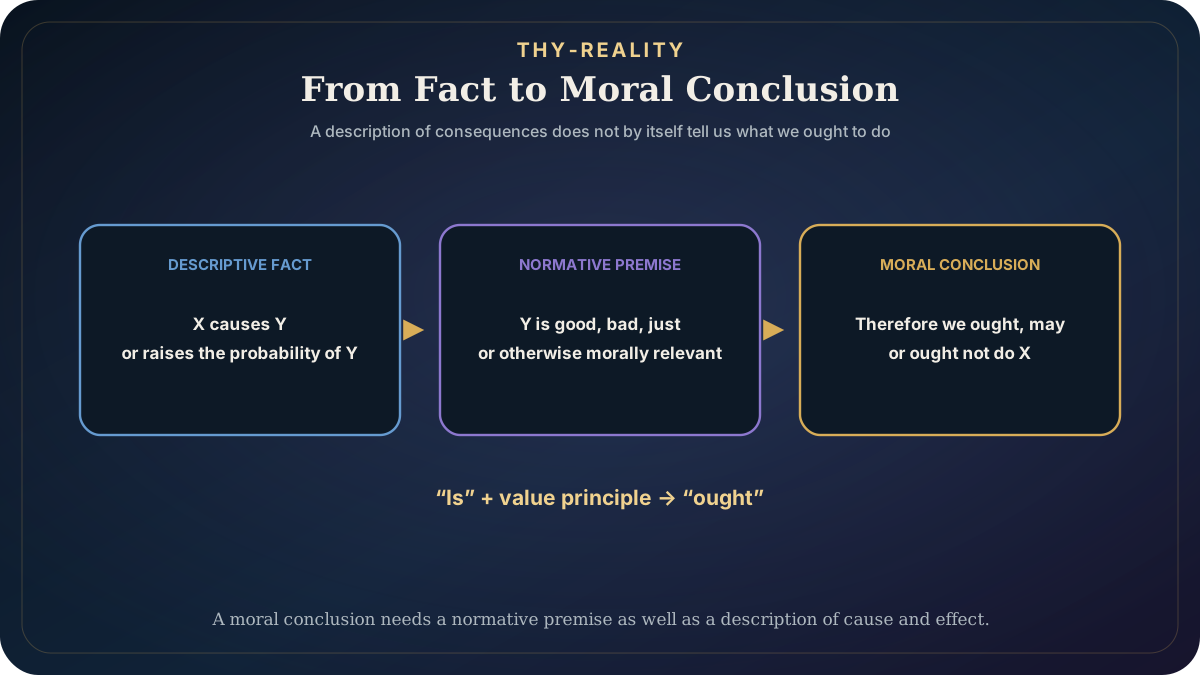
But there is an additional normative step between the statement ‘this action produces certain consequences’ and the statement ‘therefore, this action should not be performed.’
In a famous passage, David Hume discussed a sudden transition from statements about what is to statements about what ought to be. An influential interpretation of this warning holds that a moral conclusion should not simply be presented as following from entirely descriptive premises without also explaining the normative connection between them. The exact meaning and scope of Hume’s passage, however, have long been matters of philosophical debate.
If we establish that an action causes suffering, we have established an important fact. To derive a moral conclusion from that fact, we also need a value-based or normative premise — for example, that unnecessary suffering ought to be avoided.
Natural-law theories attempt to take precisely this further step. Some connect normative principles with human goods, practical reason, human flourishing, or other features of human life. But this remains a philosophical argument, not an empirical fact that can simply be read from a measuring instrument.
Consequences tell us what a particular choice causes. Ethics must additionally explain why some consequences deserve support while others give us reason to oppose them.
Freedom, Knowledge, and Moral Responsibility
If a person is free, are they automatically responsible for every consequence of their actions? No. Moral responsibility is more complicated.
Contemporary discussions often distinguish a control or freedom condition from an epistemic condition of moral responsibility. The first concerns the kind and degree of control an agent had over the conduct. The second concerns what the person knew, was aware of, or was in an epistemic position to recognize about the action and its morally relevant features. The exact status and formulation of these conditions remain matters of debate.
Imagine a person who presses a switch without knowing that doing so will activate a dangerous machine. If they genuinely had no reason to know this, we would normally assess them differently from someone who knew about the danger and deliberately pressed the switch anyway.
But ignorance is not always a complete excuse. Sometimes a person could have — or should have — checked. When assessing responsibility, we therefore need to ask more than who caused the outcome: how much control did the person have, what did they know, what could they reasonably have known, what alternatives were available, were they acting under coercion, and which consequences were reasonably foreseeable?
Responsibility is not simply a question of who caused an outcome, but of how far an action and its relevant consequences can reasonably be attributed to a person as their conduct.
Understanding Reality Can Increase Practical Freedom
Imagine two people facing the same decision. The first knows of only one option and does not understand important consequences of the choice. The second knows several realistic options and understands the consequences much better.
Both may say: ‘I made the decision myself.’ But their practical capacity for informed choice is not the same.
Knowledge does not remove every limitation, and it does not settle the metaphysical question of free will. It can, however, increase something more ordinary and practical: our ability to act on a better understanding of the available options and their consequences.
This is where the third THY-REALITY article connects directly with the first two. If perception is limited, we need to examine what we actually perceived. If our beliefs can be wrong, we need to compare them with evidence. And if our choices are based on an inaccurate model of the world, the quality of our decisions may also be limited.
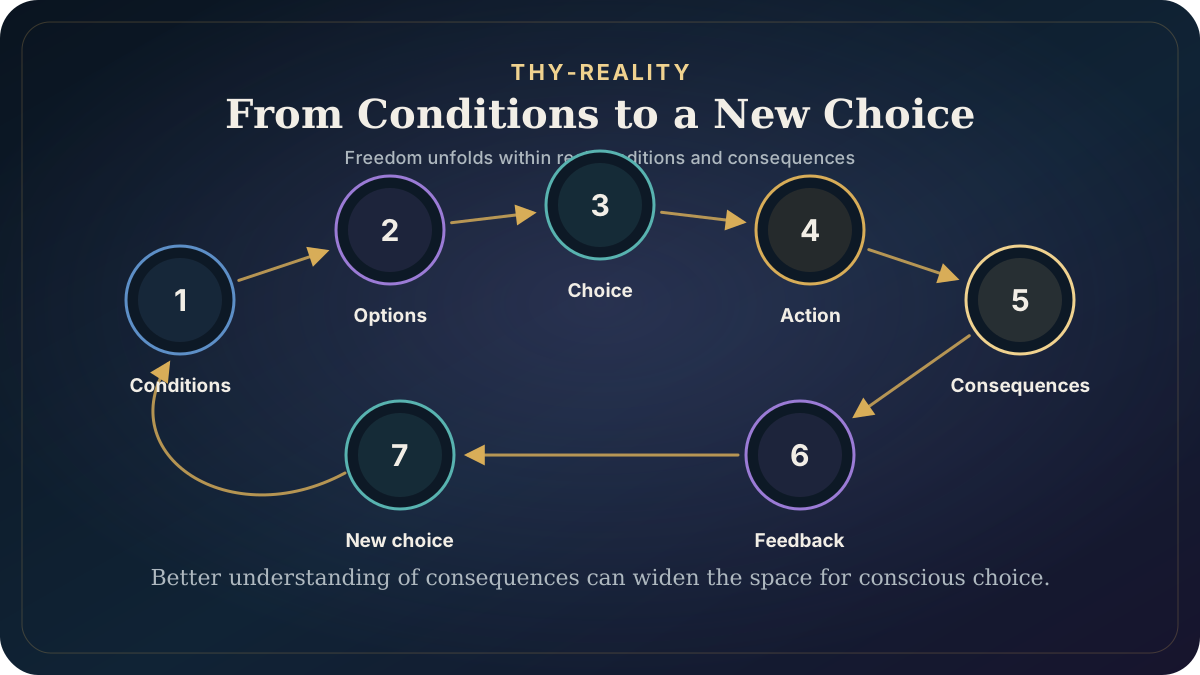
More information does not automatically mean more freedom. Better understanding, however, can widen the space for conscious choice.
Living in closer alignment with reality therefore does not need to be a metaphysical slogan. It can mean seeing conditions as they are, distinguishing desire from fact, taking foreseeable consequences seriously, recognizing the existence and autonomy of other people, and correcting our behavior when our model proves inadequate.
This approach does not require us to assume that the universe morally rewards good people and punishes bad ones. Real life includes injustice. Good actions can have unwanted consequences, while harmful actions can sometimes go unpunished.
Natural Law should therefore not be reduced to the idea that ‘you always get exactly what you deserve.’ A more useful question is which consequences follow from our actions reliably enough that we can take them into account when making more responsible decisions.
Seven Questions for a Freer Decision
Before an important decision, seven questions can help.
- What exactly am I choosing? — Describe the decision as concretely as possible, without softening what it actually involves.
- Which parts of the situation are outside my control? — Separate genuine limitations from limitations that we merely assume.
- What realistic options do I have? — Before choosing between A and B, check whether C also exists.
- Which consequences can I reasonably foresee? — We never have complete knowledge, but we can distinguish what was genuinely unforeseeable from what we simply chose not to investigate.
- Who will bear the consequences of my choice? — Freedom does not exist only within me. My actions can expand or reduce the range of choices available to other people.
- What information is my decision based on? — If a crucial assumption turns out to be wrong, the rationality of the decision may change as well.
- What will I do if the outcome shows that I was wrong? — Freedom is not only the ability to choose. It is also the ability to correct course.
These questions do not create perfect freedom. They can, however, reduce the distance between an impulsive reaction and a considered choice.
From Limitless Freedom to Responsible Freedom
We may never possess a complete metaphysical explanation of free will. The philosophical debate over determinism, alternative possibilities, the source of action, and moral responsibility remains open.
But in everyday decision-making, we can do a great deal before resolving that problem. We can improve our information, test our beliefs, search for alternatives, try to understand consequences, recognize which parts of a situation are under our control and which are not, and take responsibility for the part of our conduct that can reasonably be attributed to us.
In this sense, Natural Law does not have to mean a hidden list of rules embedded in the universe. It can be understood as a serious question of inquiry: what happens when a human being acts in a world that does not depend solely on human wishes?
The answer begins with facts and consequences. But it becomes an ethical question only when we also consider values, freedom, harm, good, and responsibility.
THY-REALITY therefore does not begin with the claim ‘we have already discovered Natural Law.’ It begins with a more demanding position: ‘Let us examine which limitations are real, which consequences are reliable enough to identify, and which ethical principles we can reasonably defend on that basis.’
Freedom in this framework is not the ability to live without consequences. It is the ability to choose more consciously as our understanding of reality improves.
From Responsible Freedom to Self-Government
Responsible freedom also has a social consequence. A person who can examine their reasons, govern their impulses, respect the autonomy of others, and accept responsibility for their own actions carries part of social order within themselves. Proper conduct therefore does not depend only on whether someone is watching, issuing commands, or threatening sanctions.
This does not prove that external institutions, common procedures, or coercion are never necessary. It shows something more important: the need for external control is not completely independent of people’s capacity for self-government.
Self-government begins when freedom is understood not only as the absence of external restraint, but also as the capacity to govern oneself responsibly.
Here we can state a more careful version of one of the core ideas from which THY-REALITY emerged: inner sovereignty can reduce dependence on external control. We should not turn this into an automatic social law. Responsible people still need coordination, dispute resolution, expertise, and safeguards. But where more conduct rests on examined reasons, voluntary agreements, respect for other people’s boundaries, and acceptance of consequences, fewer functions need to operate only through threat, coercion, or blind obedience.
A free society does not begin where every rule disappears, but where people are increasingly able to carry order within themselves.
A community may require coordination, agreements, expertise, and procedures. But the need for these functions does not by itself establish how much external authority is morally justified.
Organizing people is not the same as ruling people.
Sources and further reading
- Murphy, M. C. The Natural Law Tradition in Ethics. Stanford Encyclopedia of Philosophy. Source
- Finnis, J. Natural Law Theories. Stanford Encyclopedia of Philosophy. Source
- O’Connor, T. & Franklin, C. Free Will. Stanford Encyclopedia of Philosophy. Source
- Talbert, M. Moral Responsibility. Stanford Encyclopedia of Philosophy. Source
- Rudy-Hiller, F. The Epistemic Condition for Moral Responsibility. Stanford Encyclopedia of Philosophy. Source
- Hume, D. A Treatise of Human Nature, Book III, Part I, Section I. Source
- Hume, D. An Enquiry Concerning Human Understanding, Section VIII: Of Liberty and Necessity. Source