What Is Natural Law?
Natural law is not a law of physics, a state statute, or the claim that whatever is natural is good. Explore the tradition and how THY-REALITY uses the concept.

Natural law is the idea that questions of good, justice, and right action may not be merely matters of current agreement, legislation, or personal preference. But the term has a long history and several different meanings. If we want to use it seriously, we must first distinguish it from the laws of nature in science, from laws enacted by states, and from the simplistic claim that whatever is “natural” must therefore be good.
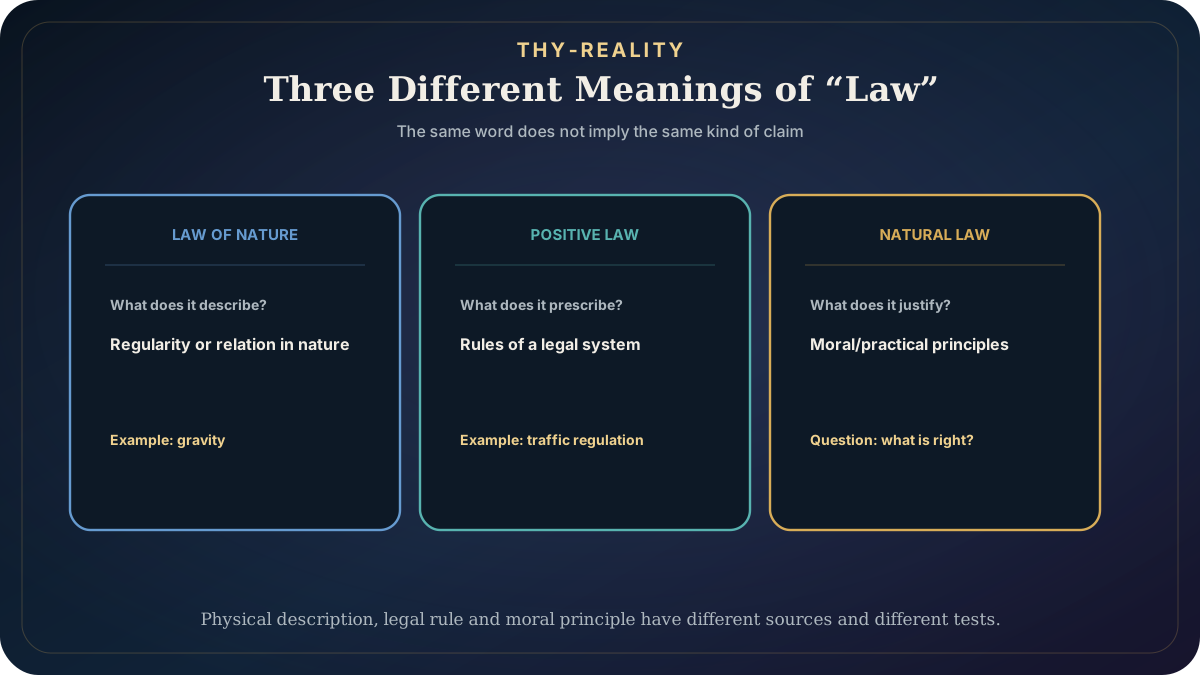
The word law can easily mislead us. When a physicist speaks about laws of nature, they are referring to descriptive regularities or relations in the world. When a parliament passes a law, we are speaking about rules of a particular political community. When a philosopher speaks about natural law, however, a different question appears: are there moral reasons or principles whose validity is not created merely by command, voting, or convention?
The natural-law tradition is not one single doctrine. The label has been applied to different ethical, political, legal, and religious theories. Thomas Aquinas is its paradigmatic historical example, but even within the wider tradition there is no single agreed answer about which goods are basic, how we know them, or how concrete norms are derived from them.
Natural law is not an answer we must accept in advance. It is the question of whether right action can have foundations deeper than command, convention, and personal preference.
One Word, Three Different Kinds of “Law”
We first need to separate three concepts that everyday language can easily mix together.
Laws of nature, as studied by physics and other natural sciences, are descriptive. They tell us how certain phenomena behave, or how our best available models describe those relationships. Gravity does not say that it is morally right for an object to fall. It describes a relation among phenomena.
Positive or human laws are rules within legal systems: traffic regulations, tax law, criminal codes, constitutional provisions. They can change, differ between jurisdictions, and be more or less just. Legal positivism therefore distinguishes the question of whether a norm counts as law within a system from the separate question of whether it is morally good or justified.
Natural law in ethics opens a normative question: are there reasons for action that are not created only by a decision of an authority or majority? This is a question about the foundation of moral judgment, not a physical equation and not a list of state regulations.
Laws of nature describe the world. Human laws establish rules within communities. Natural law asks whether moral judgment has foundations that are not merely products of human command.
Natural Law Is Not One Single Historical Theory
It is misleading to speak as though one unchanged natural-law system had existed from antiquity to the present. Different thinkers have grounded moral order in different ways: divine order, practical reason, human nature, basic goods, or conditions of human life.
For Aquinas, natural law belongs within a broader theological picture and is also an account of practical rationality. His famous formulation begins from the principle that good is to be done and pursued and evil avoided. He then discusses human inclinations and goods such as life, knowledge, and social life. Contemporary surveys also note that it is not entirely clear whether Aquinas intended the goods he names to form an exhaustive list.
Modern natural-law theorists likewise disagree about the list of basic goods, how those goods are known, and how we move from the good to requirements of right action. The label natural law therefore cannot substitute for an argument. We have to say which version we mean and how it is justified.
The natural-law tradition is a family of theories. The shared question is more stable than the individual answers: are there objective foundations of practical and moral reason that are not merely products of convention?
“Natural” Does Not Automatically Mean “Good”
If something occurs in nature, that fact alone does not make it morally good. Disease is natural. Earthquakes are natural. Aggression, competition, cooperation, and care all occur in nature as well. From the mere fact that something happens, we do not yet obtain moral permission or prohibition.
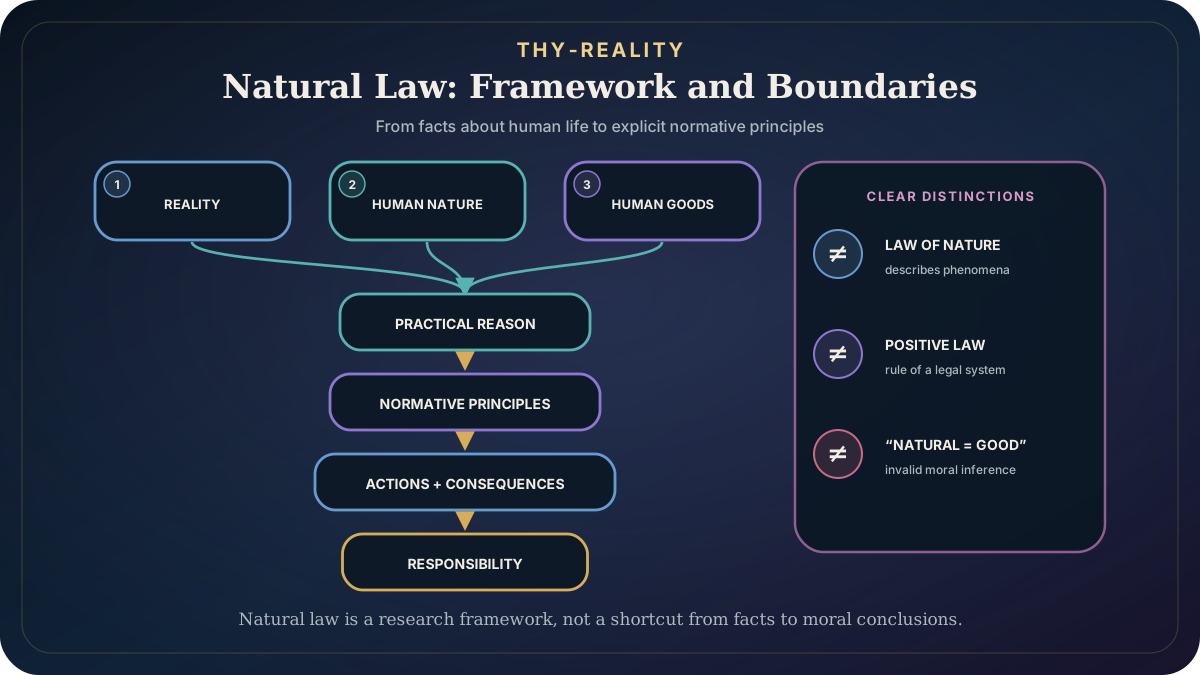
Serious natural-law theories therefore do not use the simple inference natural → morally right. They require an additional account of the good, practical reason, human flourishing, or some other normative premise. How to move from facts about human beings and human goods to standards of action is itself one of the central theoretical questions within the tradition.
Hume famously called attention to a transition from statements about what is the case to statements about what ought to be the case and demanded that such a transition be explained. His observation does not by itself settle every dispute about natural law. It does, however, warn us not to smuggle a normative conclusion into a list of descriptive facts. A connecting normative premise must be made visible.
We encountered a similar problem earlier in the article “Natural Law and the Question of Freedom.” If we discover that X causes Y, we have gained important descriptive information. To conclude that we morally should or should not do X, we still have to explain the normative principle by which the consequence is evaluated.
Reality does not depend on our opinion. But that fact alone does not show that a particular moral theory has already been demonstrated.
If Something Is Legal, Is It Therefore Right?
In ordinary language we can easily say: “It is legal, but it is wrong.” In doing so, we are already distinguishing a legal fact from a moral judgment about that fact.
Legal positivism, in its basic form, holds that the existence and content of law depend on social sources rather than on the moral merits of the norm. This does not mean that legal positivists consider morality unimportant or that every valid law must be obeyed. It means that the question “What is the law?” is not identical to the question “Is this law just?”
Natural-law traditions then ask whether there are moral standards by which human laws can be judged. Even if we answer yes, concrete judgments do not become automatic. People may agree that justice matters while disagreeing strongly about what justice requires in a particular case.
Natural law is therefore not permission for an individual to declare every rule they dislike “against nature.” If the concept is to carry serious normative weight, it must demand more justification, not less.
Natural law is not permission to declare our own opinion a higher law. It is a demand to explain the reasons on which a moral judgment of human law rests.
Must Natural Law Be Religious?
Historically, natural law is closely connected with religious metaphysics in the work of many major authors. For Aquinas, it is part of a theory of divine providence, so his paradigmatic version cannot simply be detached from theism.
But contemporary philosophical literature also discusses non-theistic thinkers whose views are placed within the broader natural-law tradition. This shows why we should distinguish Aquinas’s paradigmatic model from the wider family of related theories. Not every theory now described as natural-law theory is committed to all of his metaphysical assumptions.
For THY-REALITY, it is important that a visitor should not have to accept a particular religious metaphysics before participating in the question. Religious arguments may be part of the discussion, but they should not be hidden as though they were already shared premises.
Natural law also touches the wider debate over moral realism: whether at least some moral claims can be true rather than merely expressions of personal preference. But the concepts are not synonymous. Moral realism is a broader metaethical position; natural-law theories are one family of possible approaches to objective morality.
The question of Natural Law should be discussable among people who disagree about metaphysics. That requires premises, arguments, and limits to be clearly marked.
What Does Natural Law Mean in THY-REALITY?
For this project, Natural Law will mean a research framework that systematically examines five groups of questions:
- Which features of human life and the world do not depend on our opinion? Examples include embodiment, vulnerability, dependence on certain conditions for life, social existence, and the fact that actions have consequences.
- Which human goods can we reasonably identify? Natural-law theories propose different lists — including life, knowledge, relationships, practical reasonableness, and other goods — so no single list will be presented as undisputed.
- Which consequences of actions can we establish with sufficient reliability? Empirical knowledge matters to moral reasoning because false factual premises can undermine even an otherwise consistent moral argument.
- Which normative principles do we use when evaluating those facts and consequences? Why is a particular good good, why is harm relevant, and why should another person matter? Those premises must remain visible.
- Does the principle survive criticism and application outside the cases that benefit us? If a rule is applied only against others but not in comparable cases involving ourselves or our group, we do not yet have a convincing universal principle.
In THY-REALITY, Natural Law will name the investigation of possible objective foundations of moral action — not a collection of claims protected from scrutiny.
How Would We Know That We Had Discovered Something Universal?
If someone says “This is Natural Law,” the label itself proves nothing. A title cannot replace an argument. If a principle is claimed to hold independently of culture, authority, and personal belief, the justificatory standard should be higher, not lower.
- What exactly does the principle claim?
- Which facts about human beings or the world support it?
- Which normative premise connects those facts to the moral conclusion?
- Do we apply the principle symmetrically even when the result is inconvenient for us?
- Are there cases in which the principle fails or requires additional conditions?
- Do we clearly distinguish cause, consequence, correlation, and moral judgment?
- What would force us to revise or abandon the principle?
Even Aquinas’s classical theory is more nuanced than the image of one immutable list of simple rules. He treats the most general principles as highly stable while allowing that practical conclusions can vary as we move toward particular circumstances. A universal principle and its application in a concrete case are therefore not the same thing.
This article therefore does not conclude that Natural Law has been proven. Nor does it conclude that Natural Law does not exist. It asks a more precise question: are there objective conditions of human life, human goods, and principles of practical reason from which moral norms can be reasonably defended without reducing them merely to current opinion or political authority?
The article “Natural Law Is Not a Matter of Belief” continues this distinction. If such principles existed independently of our beliefs, our believing in them would not create them. But it would not follow that every claim labeled Natural Law is correct. We must therefore distinguish the ontological claim that truth can be independent of belief from the epistemological question of how we are justified in knowing it.
If we want to take Natural Law seriously, it must remain open to argument, evidence, criticism, and revision. Universality is a claim to be justified, not a label we simply attach to a statement.
If Law Is Not Moral Truth, Why Should We Obey It?
From the fact that something is law, it follows that a legal system requires it. It does not follow without further argument that we therefore possess a moral duty to comply. The philosophy of political obligation asks precisely what, if anything, creates a moral duty to obey law as law.
Proposed answers include consent, fairness, benefits, duties toward just institutions, membership, coordination, and theories of legitimate authority. None should be rejected merely because it supports authority, but none is proven merely because the state already exists.
Law can create a legal obligation. Whether it also creates a moral obligation is a further question.
Political Legitimacy Is Another Question Again
An institution may govern effectively, its laws may be valid, and its police may enforce them. It does not follow that the institution possesses a moral right to rule. Legal validity, moral rightness, political legitimacy, and a moral duty to obey are distinct claims.
The existence of authority is a fact about the world. Its legitimacy is a moral claim.
If an institution is granted a special right that an ordinary individual does not possess, the source of that right requires explanation. Institutional status alone is not the justification.
Natural Law and Internal Moral Authority
If moral principles are not created by government, a person cannot simply conclude that an action is right because it was ordered. But private feeling is not enough either. The harder path is to examine reasons and accept responsibility for one’s own judgment.
To be your own moral authority does not mean “I decide what is right.” It means “I cannot permanently transfer responsibility for judging what is right to someone else.”
Sources and further reading
- Murphy, M. C. The Natural Law Tradition in Ethics. Stanford Encyclopedia of Philosophy. Source
- Finnis, J. (2012). Natural Law: The Classical Tradition. In The Oxford Handbook of Jurisprudence and Philosophy of Law, pp. 1–60. DOI: 10.1093/oxfordhb/9780199270972.013.0001. Source
- Thomas Aquinas. Summa Theologiae, I–II, Question 94: The Natural Law. Source
- Green, L. & Adams, T. Legal Positivism. Stanford Encyclopedia of Philosophy, Spring 2022 archive. Source
- Sayre-McCord, G. Moral Realism. Stanford Encyclopedia of Philosophy, Winter 2021 archive. Source
- Hume, D. A Treatise of Human Nature, Book III, Part I, Section I. Source
- Finnis, J. (2011). Natural Law and Natural Rights, 2nd ed. Oxford University Press. Source