“I Don’t Know” as the Beginning of Knowledge
Admitting “I don’t know” is not the end of thinking. It is the beginning of more precise inquiry, intellectual humility, and better verification.

“I don’t know” can be one of the most intellectually honest statements we make. It does not necessarily signal weakness or a lack of thought. Often, it means that we have recognized the boundary between what we can justify and what we cannot yet justify. Serious inquiry can begin precisely at that boundary.
Human beings like answers. Uncertainty is uncomfortable, so we are tempted to fill empty spaces quickly with an explanation. If we do not have an answer ourselves, we look for one elsewhere; if we still cannot find one, the first story that seems plausible may become surprisingly attractive. Fast inference is often useful, but the feeling of having an explanation can be mistaken for actual knowledge.
There is a major difference between “I do not have an answer yet” and “Because I do not have an answer, this explanation must be correct.” The first keeps the question open; the second turns a gap in knowledge into the appearance of knowledge.
THY-REALITY therefore does not treat “I don’t know” as the end of inquiry. It can be an accurate diagnosis of our current knowledge — and therefore the beginning of a better question.
Why Is It So Difficult to Say “I Don’t Know”?
Admitting that we do not know something can be psychologically and socially difficult. Knowledge carries value, while certainty often sounds more convincing than caution. We expect experts to have answers and leaders to make decisions; even in ordinary conversation, “I know” often sounds more decisive than “I’m not sure.” But decisiveness and correctness are not the same thing.
Our confidence in an answer is a metacognitive judgment — a judgment about the quality of our own perception, memory, reasoning, or decision. Contemporary research on metacognition shows that such judgments can be informative, but they are inferential and can diverge from actual performance.
The feeling “I’m certain” is not the same as evidence that “I’m right.” Good thinking also requires a reasonably accurate estimate of how much confidence our answer deserves.
The goal, therefore, is not to become less confident about everything. What matters more is calibration: high confidence when we have good reasons, lower confidence when the evidence is weak, and a willingness to say “I don’t know” when the available information is insufficient.
Intellectual Humility: From Socrates to Contemporary Research
Socrates is often associated with the phrase “I know that I know nothing,” but this popular formulation is not a precise quotation from Plato’s Apology. In 21d, the point is more specific: Socrates sees his small advantage in not thinking that he knows what he does not know.
This is not a claim that knowledge is impossible. It is a warning against mistaking ignorance for knowledge. Rather than the absolute statement “I know nothing,” a more useful epistemic position is: some things I know better than others, some I know only tentatively, and for some questions I currently do not have enough reason to give an answer.
In contemporary psychology, intellectual humility is defined in several related ways, but a common core is recognizing limitations in one’s own knowledge and the possibility that one’s beliefs may be wrong or incomplete. This is not self-deprecation, and it does not require abandoning a position whenever someone disagrees with us.
Leary and colleagues found intellectual humility to be associated with openness, curiosity, tolerance for ambiguity, and lower dogmatism; in their studies, more intellectually humble participants were also more sensitive to the strength of persuasive arguments. Porter and Schumann found that intellectual humility was associated with greater openness to opposing views.
Intellectual humility does not require us to distrust our beliefs. It requires us to treat them as revisable when better reasons or better evidence appear.
When We Fail to Recognize Our Own Error
There is a particular difficulty in evaluating our own knowledge: recognizing the quality of an answer often requires at least some of the same knowledge needed to produce a good answer. If we understand a field poorly, we may therefore also have difficulty recognizing some of our own mistakes.
In 1999, Kruger and Dunning reported that participants with the lowest scores on tasks involving humor, grammar, and logical reasoning substantially overestimated their performance. The authors interpreted part of this pattern in terms of metacognitive difficulty in distinguishing correct answers from incorrect ones.
The term Dunning–Kruger effect later became popular, but the internet version — “incompetent people think they are geniuses” — is much broader than the original findings. Scientific debate about the size and explanation of the pattern is also not closed. Later analyses have argued that important parts of the familiar effect can arise from statistical properties of measurement, boundary constraints, regression effects, and the way scores are grouped.
The safest lesson is not that we can easily diagnose other people’s ignorance, but that self-assessment can be wrong — and that additional knowledge can improve our ability to recognize the limits of what we know.
Learning can therefore produce an apparent paradox: as we learn more about a subject, we discover more exceptions, unresolved questions, and methodological difficulties. Confidence may fall even while our model of the subject becomes better. That is not necessarily regression; it can be a sign of more accurate metacognition.
“I Don’t Know” Can Mean Different Things
Not every statement of “I don’t know” describes the same state of knowledge. Distinguishing different kinds of uncertainty often makes the next step clearer.
- I don’t know, but the answer can be checked directly. For example, I may not know the current population of a city, but I can consult an appropriate up-to-date source.
- I don’t know because I do not have enough information. I may know several possible explanations, but lack the evidence needed to decide among them.
- I don’t know because the evidence is mixed. High-quality information does not all point in the same direction, so high confidence is not justified.
- I don’t know because the question remains unresolved. Some scientific and philosophical problems have models and partial answers without a generally accepted final solution.
- I don’t know because the question is not yet clear enough. We may first need to define the terms, the time frame, or what would count as evidence.
“I don’t know” does not force us into passivity. Once we identify the kind of uncertainty we are facing, what we should do next often becomes clearer.
Ignorance Is Not the Same as Avoiding Knowledge
There is another important distinction that the phrase “I don’t know” does not reveal: sometimes we lack information, while at other times we avoid it. Contemporary research uses terms such as information avoidance, deliberate ignorance, and willful ignorance, while emphasizing the need to distinguish simply not seeking information from more intentional avoidance of information that a person knows is available.
The reasons for avoidance are not always morally problematic. People have limited time and attention; information may be irrelevant, overwhelming, or currently offer no useful action. Sometimes it is also reasonable to place a boundary on endless checking. The fact that someone did not seek a piece of information therefore does not by itself establish indifference or blame.
The situation is different when information is reasonably accessible, directly relevant to our conduct or to foreseeable harm to others, and we avoid it mainly because knowing would make a preferred conclusion harder to maintain or would increase our sense of responsibility. Meta-analytic research on willful ignorance finds that in some experimental settings people do choose not to learn about the consequences of their decisions, and that such choices can be associated with more self-interested behavior. This is not a universal explanation of human behavior, but it is a sufficiently documented phenomenon that it should not be treated as identical to innocent lack of knowledge.
“I don’t know” can be an honest boundary of knowledge. But sometimes the next question is also: “Can I really not know — or do I not want to know?”
This distinction will matter later when we discuss responsibility. We cannot assign the same responsibility for a fact a person could not reasonably discover and for a fact they deliberately avoided despite its obvious relevance. Even here, judgment must remain proportional: access to information, capacity to understand it, stakes, available time, and the reason for avoidance all matter.
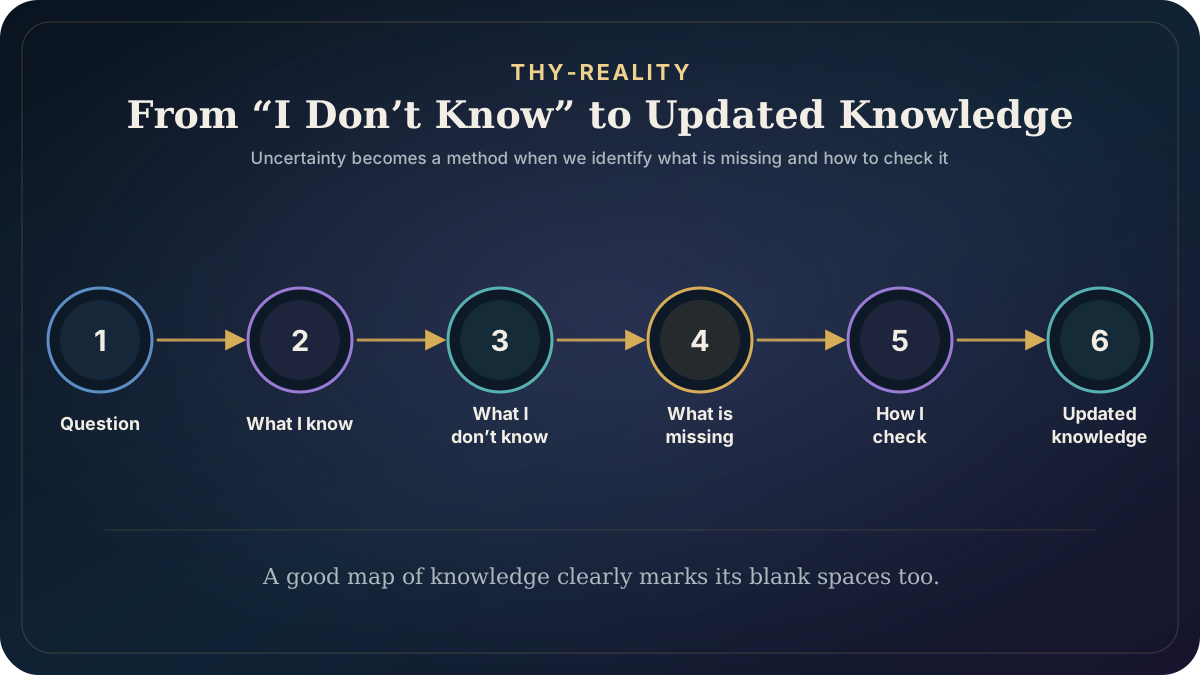
From “I Don’t Know” to “How Could I Find Out?”
The most useful form of admitting uncertainty has a continuation: “I don’t know — how could I check?” This is where intellectual humility becomes a method.
- What exactly do I not know? Replace a general feeling of confusion with a specific question or claim.
- What do I already know, and how do I know it? Separate verified information from memory, assumptions, and impressions.
- What information is missing? The missing piece may be a measurement, a document, another witness, a study, or specialist knowledge.
- Which source or method would reduce the uncertainty? Do not search only for an answer; search for a way to verify it.
- How much uncertainty remains after checking? Some answers are highly reliable, others merely probable, and some remain genuinely open.
This approach transforms not knowing from a problem of identity into a problem of inquiry. It is no longer “If I don’t know this, I must be incompetent,” but “This is the current boundary of my model; what would I need in order to move it?”
Once admitting that we do not know something no longer threatens our sense of worth, we can begin to use that uncertainty as information.
Doubt Should Be Proportional to the Evidence
Intellectual humility also has a counterfeit form. Statements such as “Who can really know?”, “Anything is possible,” or “We can never be certain of anything” may sound open-minded, but they can become a way of treating a well-supported claim as equivalent to a bare possibility.
If a large body of high-quality, mutually consistent evidence supports one explanation and very little supports another, intellectual humility does not require us to assign both the same probability. Nor does it require us to treat expertise built through decades of research as equivalent to an unsupported guess.
Uncertainty should be calibrated. The goal is not to systematically underestimate what we know, but to adjust confidence as closely as possible to the quality of the evidence, the limitations of the method, and the possibility of error.
Intellectual humility does not diminish knowledge. It marks its boundaries more accurately.
“I Don’t Know” as the Beginning of Knowledge
In the first article, we distinguished perception from reality. In the second, we distinguished belief from verification. In the third, we saw that the quality of our understanding also affects the space available for practical choice. We can now add another distinction: certainty is not the same as knowledge.
Sometimes we know something for good reasons and a high level of confidence is justified. Sometimes we have the best explanation currently available while still leaving room for correction. Sometimes we have only a hypothesis. And sometimes the most accurate answer is “I don’t know.”
That answer is not empty if we can explain why we do not know. Perhaps we lack data. Perhaps the evidence is insufficient. Perhaps the question remains open. Perhaps it first needs to be formulated more clearly. Each possibility tells us something about the state of our knowledge.
THY-REALITY therefore does not treat knowledge as a collection of final answers that must be defended. It is more useful to think of knowledge as a map on which the areas we do not yet understand are clearly marked as well.
A good map does not hide its blank spaces. Those blank spaces tell us where inquiry can continue.
That is why “I don’t know” can be one of the most productive statements in the search for reality. Add “How could I find out?” and uncertainty becomes the beginning of a method.
Sources and further reading
- Platon. Apologija, zlasti 21d–23b. Source
- Leary, M. R., Diebels, K. J., Davisson, E. K., Jongman-Sereno, K. P., Isherwood, J. C., Raimi, K. T., Deffler, S. A. & Hoyle, R. H. (2017). Cognitive and Interpersonal Features of Intellectual Humility. Personality and Social Psychology Bulletin, 43(6), 793–813. DOI: 10.1177/0146167217697695. Source
- Porter, T. & Schumann, K. (2018). Intellectual humility and openness to the opposing view. Self and Identity, 17(2), 139–162. DOI: 10.1080/15298868.2017.1361861. Source
- Fleming, S. M. (2024). Metacognition and Confidence: A Review and Synthesis. Annual Review of Psychology, 75, 241–268. DOI: 10.1146/annurev-psych-022423-032425. Source
- Kruger, J. & Dunning, D. (1999). Unskilled and unaware of it: How difficulties in recognizing one's own incompetence lead to inflated self-assessments. Journal of Personality and Social Psychology, 77(6), 1121–1134. DOI: 10.1037/0022-3514.77.6.1121. Source
- Magnus, J. R. & Peresetsky, A. A. (2022). A Statistical Explanation of the Dunning–Kruger Effect. Frontiers in Psychology, 13, 840180. DOI: 10.3389/fpsyg.2022.840180. Source
- Stanford Encyclopedia of Philosophy. Modesty and Humility, section on intellectual humility. Source
- Foust, J. L. & Taber, J. M. (2025). Information Avoidance: Past Perspectives and Future Directions. Perspectives on Psychological Science, 20(2), 241–263. DOI: 10.1177/17456916231197668. Source
- Vu, L., Soraperra, I., Leib, M., van der Weele, J. & Shalvi, S. (2023). Ignorance by choice: A meta-analytic review of the underlying motives of willful ignorance and its consequences. Psychological Bulletin, 149(9–10), 611–635. DOI: 10.1037/bul0000398. Source