Freedom Without Responsibility Is Not Freedom
What connects freedom and responsibility? Explore choice, control, knowledge and consequences—and why mature agency requires an accountable relationship to our actions.

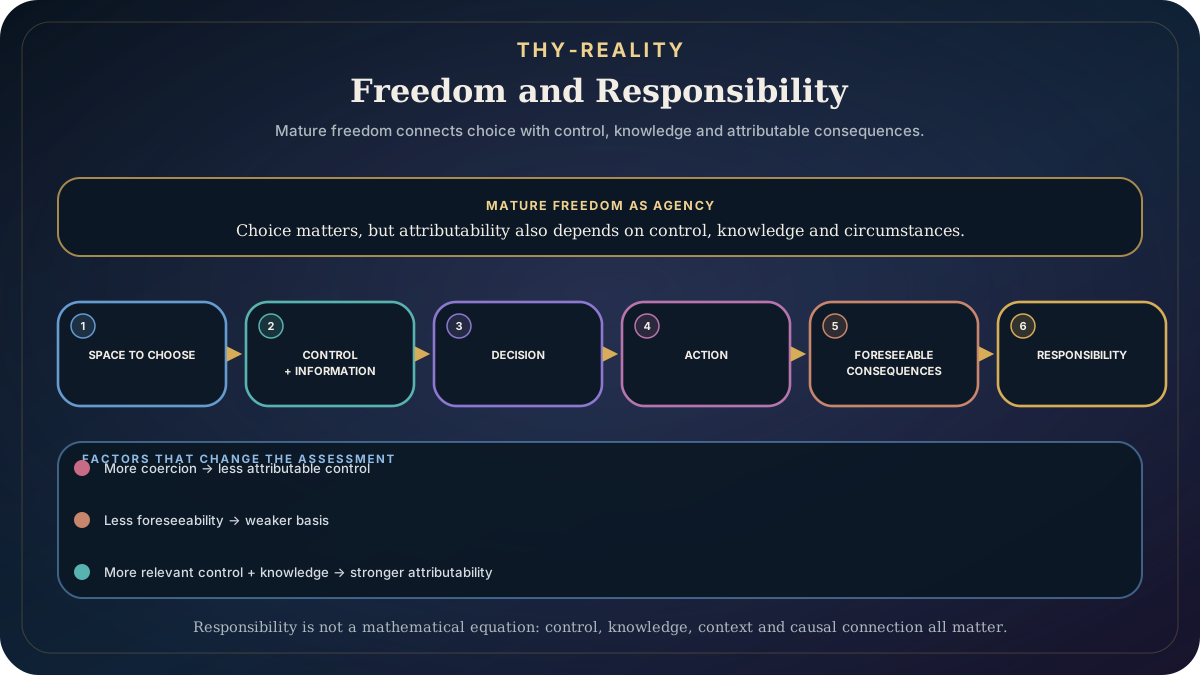
Freedom means that a person can choose and act within a certain space without some forms of coercion or unjustified interference. But the ability to choose does not erase the consequences of choice. If we want to speak about mature human freedom, we must therefore also speak about control, knowledge, other people, and responsibility for the part of the outcome that can reasonably be attributed to our conduct.
The word ‘freedom’ carries enormous power. We use it to describe political rights, personal autonomy, freedom of speech, religious liberty, free choice, and the possibility of living according to our own values. Precisely because the word is so broad, however, it can easily begin to stand for quite different things.
The sentence ‘This is my freedom’ can mean ‘you should not unjustifiably coerce me’. But it can quietly shift into ‘no one has the right to evaluate the consequences of what I do’. Those are not the same claim. The fact that we can freely choose something does not show that the choice is morally good; the fact that we have a right to do something does not show that doing it is wise or harmless.
Freedom describes the space in which we can choose. Responsibility begins with the question of what we actually chose within that space, what we knew, and which part of the consequences is reasonably attributable to our conduct.
Freedom Is Not One Single Thing
Before connecting freedom with responsibility, we need to clarify what we mean by freedom. Philosophy uses several different concepts that partly overlap but are not synonymous.
In political philosophy, an influential distinction is made between negative and positive liberty. Negative liberty refers, roughly, to the absence of obstacles, constraints, or interference that block available courses of action. Positive liberty concerns the possibility or capacity to take control of one’s life and realize one’s fundamental purposes. Both concepts have several interpretations and remain philosophically contested.
Political liberty is also distinct from the metaphysical problem of free will. Debates about free will ask what kind of control an agent must have over decisions and actions: whether the person must be able to do otherwise, whether it matters more that the agent is the right kind of source of the action, and how determinism, coercion, and manipulation affect the assessment.
For that reason, the title ‘Freedom Without Responsibility Is Not Freedom’ is not a technical definition of every philosophical sense of freedom. A person can possess substantial negative liberty and use it irresponsibly. The title expresses a THY-REALITY normative thesis about mature freedom as agency: if we want to claim authorship of our decisions, then under appropriate conditions we must also be prepared to acknowledge their attributability.
Irresponsible action does not eliminate every possible kind of freedom. This article is about mature freedom as the capacity to choose, understand relevant circumstances, and accept one’s justified share of responsibility.
Control and Knowledge as Conditions of Responsibility
Imagine two people. The first deliberately pushes a glass from a table. The second is knocked into the table by someone else and their arm accidentally sends the same glass to the floor. The result is similar—the glass falls—but our judgments of responsibility are not the same.
The reason is that causal involvement is not identical to moral responsibility. Contemporary theories of moral responsibility typically require some relevant form of control or agency. Direct physical compulsion or strong coercion can substantially reduce such control and therefore alter how the action is attributed to the person.
John Martin Fischer and Mark Ravizza developed an influential account on which responsibility does not necessarily require regulative control in the sense of an open alternative possibility. Their theory instead emphasizes a form of guidance control in which conduct issues from the agent’s own suitably reasons-responsive mechanism. This is one important competing theory, not a universally accepted solution.
For this article, the broader point is what matters: the more completely a person is deprived of relevant control over an action, the harder it becomes to attribute that action to the person in the fullest moral sense. If, however, we insist that we genuinely authored the decision and had sufficient control for meaningful choice, the question of responsibility for that choice also becomes relevant.
Freedom and responsibility are not simple opposites. In many theories, an appropriate form of control is one of the conditions that make an action attributable to an agent.
Control is not the only relevant condition. Imagine someone pressing a switch to turn on a light without knowing that another person has secretly miswired the circuit and that pressing the switch will cause a fire. Causally, the person’s action is part of the story; morally, responsibility is much harder to assess.
The literature on moral responsibility therefore often distinguishes a control condition from an epistemic condition. The epistemic condition concerns what an agent knew, was aware of, or could and should reasonably have recognized about the action, its moral significance, and its likely consequences. The exact formulation of this condition remains debated, and some philosophers also question how sharply it can be separated from control.
Ignorance can therefore excuse in some cases, but not in all. A driver who could not detect a hidden manufacturing defect is in a different position from a driver who ignores warnings, obvious symptoms of failure, and repeated advice from a mechanic for weeks. In the second case, a further question arises: was the agent partly responsible for remaining in that epistemic position or for failing to obtain information that they reasonably should have obtained?
This connects directly with the articles “From Belief to Verification” and “When Too Much Information Leads to Less Understanding.” Important decisions never require perfect knowledge, but there is a difference between unavoidable ignorance and ignorance that we help preserve by ignoring accessible warnings or relevant information.
The quality of responsible choice depends not only on the ability to choose, but also on what we knew, what we could reasonably have recognized, and whether we made a reasonable effort to become informed before an important decision.
Consequences, Blame, and the Ability to Do Otherwise
If our action contributes to a consequence, it does not automatically follow that we are morally blameworthy for that consequence. Philosophical discussions of responsibility explicitly distinguish causal responsibility for an outcome from moral responsibility or blameworthiness.
Consider a doctor who chooses a treatment in accordance with the best available evidence and ordinary professional care, after which an extremely rare and unforeseeable complication occurs. Compare that case with a doctor who knows about an important contraindication and negligently ignores it. The bad outcome may be similar, but the relationship among knowledge, control, decision, and consequence is different.
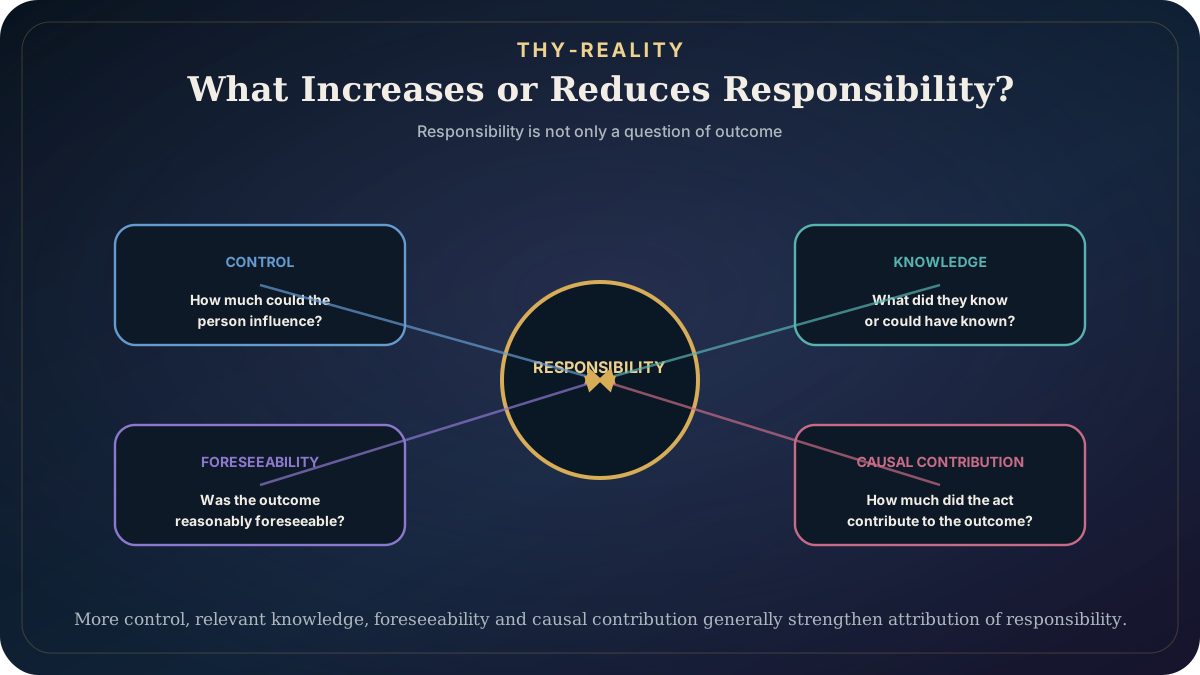
This is why the slogan ‘you are responsible for every consequence of your actions’ is too broad. We need to ask whether the agent caused or materially contributed to the outcome, whether the consequence was reasonably foreseeable, whether it was intended, whether the risk was known, whether it could reasonably have been reduced, whether coercion was present, and how much of the final result depended on factors beyond the agent’s control.
The problem of moral luck makes the picture still more difficult. Our judgments often differ because of outcomes partly determined by circumstances outside an agent’s control. Two equally reckless drivers may behave in the same way, yet only one happens to encounter a pedestrian. The conduct may be similarly criticizable while the actual consequences differ dramatically.
For THY-REALITY, the safer principle is therefore that responsibility should track the real relationship among a person’s control, knowledge, conduct, and the consequences that can reasonably be attributed to that conduct. This avoids both extremes: ‘my action came before the outcome, therefore everything that followed is my fault’ and ‘because I did not control everything, I am responsible for nothing’.
Causal contribution, bad outcome, and moral blame are related but distinct. Responsibility requires analysis of control, knowledge, foreseeability, and the way the outcome is connected to the agent’s conduct.
A historically influential principle holds that a person is morally responsible only if they could have acted otherwise. This is commonly called the Principle of Alternative Possibilities.
Harry Frankfurt’s famous 1969 paper challenged this principle with hypothetical cases designed to describe agents who appear responsible even though a hidden mechanism or intervener would have prevented any alternative choice if the agent had begun to choose differently. Crucially, the intervention is never needed: the person acts from their own reasons.
Frankfurt-style cases generated a vast debate. They did not settle the issue. Philosophers continue to dispute whether the cases truly remove every relevant alternative possibility and what they establish about free will and moral responsibility.
For this article, the useful lesson is narrower. Responsibility may involve more than the question “was another physical option available?” It can also involve the question “why did I act as I did?” Did the action issue from my reasons, values, deliberation, or a process appropriately attributable to me?
This prevents us from reducing freedom to a menu containing several options. Someone can have many nominal options while exercising little meaningful autonomy because of manipulation, severe coercion, or profound ignorance. Another person may face only a narrow range of realistic options while still deliberating meaningfully within that range.
The number of available options is not identical to the quality of agency.
Freedom Among Others
So far, the focus has been on agency and individual moral responsibility. But freedom also has a social dimension. When someone says ‘I am free to do what I want’, another question immediately appears: what happens when that action affects someone else?
John Stuart Mill’s On Liberty offers one of the most influential liberal attempts to protect a broad sphere of individual freedom while also explaining when social interference may be justified. Preventing harm to others plays a central role in his account. But the familiar slogan ‘my freedom ends where another person’s begins’ is not a precise statement of Mill’s full theory.
Even for Mill, harm is not a simple automatic switch that justifies every intervention. Contemporary interpretation distinguishes harm from mere offense and notes that harm prevention can provide a reason for regulation without by itself settling whether regulation is justified all things considered. Mill’s broader utilitarian commitments and the costs of intervention remain relevant.
The larger problem is therefore more useful than the slogan: individual freedom exists among other individuals who also have interests, vulnerabilities, and claims to liberty. My choices enter a shared world. They can alter other people’s options, create risks, impose costs, protect others, or make cooperation possible.
A society of free people needs more than permission to choose. It also needs ways of reasoning about what happens when one person’s choices become part of another person’s reality.
The title of this article is deliberately strong: “Freedom Without Responsibility Is Not Freedom.” After the necessary philosophical distinctions, the thesis can be stated more precisely.
In some senses, a person can be free while acting irresponsibly. Someone may possess substantial negative liberty—little external interference—and still use that freedom recklessly. The THY-REALITY thesis is therefore not that irresponsibility proves the absence of every form of freedom.
The thesis concerns mature freedom as agency. A mature agent has meaningful room to choose, understands at least the important features of the situation, exercises relevant control over conduct, takes reasonably foreseeable consequences seriously, and is prepared to acknowledge what can appropriately be attributed to the decision.
This does not require complete control. No one has that. It does not require perfect knowledge. No one has that either. It requires an honest distinction between what was within our control, reasonably knowable, reasonably foreseeable, our decision, and what genuinely lay outside our reach.
- Is this genuinely my decision, or am I acting under significant coercion?
- What do I know, and what should I reasonably learn before deciding?
- Which consequences are reasonably foreseeable?
- Who besides me may be affected?
- Which parts of the result are actually under my control?
- What will I do if my decision causes harm or proves mistaken?
- Would I recognize the same freedom of choice for another person if their decision affected me?
The final question connects directly with the symmetry test introduced in the article “Natural Law Is Not a Matter of Belief.” Freedom that we claim only for ourselves while denying equivalent liberty to others in relevantly similar circumstances requires further justification.
The articles “What Is Natural Law?” and “Natural Law Is Not a Matter of Belief” opened the question of Natural Law. Here we bring the issue into practical life. If we regard human beings as capable of meaningful choice, we are taking them seriously as agents. But an agent is not only someone who can say “I chose.” An agent can also ask: what did I know, what could I control, what followed from my decision, and what should I do now?
Responsibility is therefore not punishment for freedom. Within this framework, it is the other side of taking our own agency seriously.
Mature freedom does not mean that our choices have no consequences. It means that we can choose—and that we are prepared to recognize our real share in what follows from that choice.
External Control and Internal Restraint
Imagine one person who does not steal a phone only because they fear the police, and another who does not steal it even when nobody is watching. Both outwardly respect the same boundary, but only one requires an immediate external threat.
The less a person governs themselves, the more attractive the idea becomes that someone else must govern them.
Self-Government Is Not Self-Will
Self-government does not mean “I do whatever I want.” It means understanding one’s actions, examining beliefs, considering consequences, respecting legitimate boundaries of others, governing impulses, and accepting responsibility for one’s decisions.
Self-discipline is not necessarily the opposite of freedom. It may be the capacity that allows us to use freedom well.
Internal Monarchy
Internal monarchy does not mean becoming an absolute monarch over the surrounding world. It means first becoming the responsible ruler of oneself: governing one’s impulses rather than other people’s lives and applying to oneself the moral standard one wishes to apply to others.
To rule yourself first means that basic moral conduct does not always require someone standing above you.
Does a Responsible Person Require Less External Authority?
Personal responsibility does not directly prove that the state is unnecessary. Societies must resolve disputes, protect people from aggression, establish facts, and coordinate complex activity. But it is legitimate to ask whether the need for external control is constant or also depends on people’s capacity for self-government.
The need for organization is not the same as proof of a general right to rule.
Sources and further reading
- Carter, I. Positive and Negative Liberty. Stanford Encyclopedia of Philosophy. Source
- O’Connor, T. & Franklin, C. Free Will. Stanford Encyclopedia of Philosophy. Source
- Talbert, M. Moral Responsibility. Stanford Encyclopedia of Philosophy. Source
- Rudy-Hiller, F. The Epistemic Condition for Moral Responsibility. Stanford Encyclopedia of Philosophy. Source
- Frankfurt, H. G. (1969). Alternate Possibilities and Moral Responsibility. The Journal of Philosophy, 66(23), 829–839. DOI: 10.2307/2023833. Source
- Fischer, J. M. & Ravizza, M. (1998). Responsibility and Control: A Theory of Moral Responsibility. Cambridge University Press. Source
- Brink, D. Mill’s Moral and Political Philosophy. Stanford Encyclopedia of Philosophy. For the harm principle and the limits of justified interference in On Liberty. Source