Natural Law Is Not a Matter of Belief
If Natural Law is objective, belief does not create it. But how can we distinguish moral truth from opinion, culture, and self-interest?

If a principle holds independently of our opinion, belief does not create it, and disagreement does not by itself make it disappear. But this does not mean that we have correctly identified which principles are like that. The statement “Natural Law is not a matter of belief” should therefore not end the discussion. It should begin a harder question: how could we distinguish an objective moral principle from our own belief, culture, or interest?
Imagine two people. The first believes that a particular action is morally right. The second believes that the same action is wrong. The first thing their disagreement tells us is simply that they hold different beliefs. We do not yet know whether one is correct, whether both are mistaken, or whether the question requires further information and distinctions.
The article “What We Believe Is Not Necessarily What Is” showed that the fact that we believe something does not by itself determine whether the claim is true. Here we apply the same distinction to morality. If a particular moral claim is objective in the relevant sense, its truth cannot depend merely on how many people believe it. But that gives us a condition of objectivity, not evidence that such a moral truth exists or that we have identified it correctly.
If moral truth is not a matter of belief, then our belief does not create the truth. But for exactly that reason, our own moral beliefs must also remain open to examination.
“Not a Matter of Belief” Does Not Mean “I Am Right”
This is the central danger when speaking about Natural Law. Someone may say, “Truth is not a matter of opinion,” and then quietly add, “Therefore my opinion is the truth.” The second statement does not follow from the first.
If objective moral truth exists, it may be independent of my opinion just as much as it is independent of yours. Objectivity therefore gives no one an automatic epistemic privilege. On the contrary, it increases the burden of justification.
Contemporary discussions of moral realism require care here. A common core is that moral claims are capable of truth and falsity and that at least some moral claims are true. Stronger claims about exactly how moral facts relate to human thought, practices, or responses belong to particular versions of realism rather than to one uncontested definition of the entire family. This article therefore uses the language of objectivity cautiously and does not equate it with every possible form of moral realism.
Natural-law theories form a narrower family still. They do not merely claim that some moral statements are true; they attempt to explain how moral reasons are connected with practical reason, human goods, human nature, or other features of human life.
If a principle is not true because I believe it, then my belief alone cannot be sufficient justification for that principle.
A Majority Cannot Vote Moral Truth Into Existence
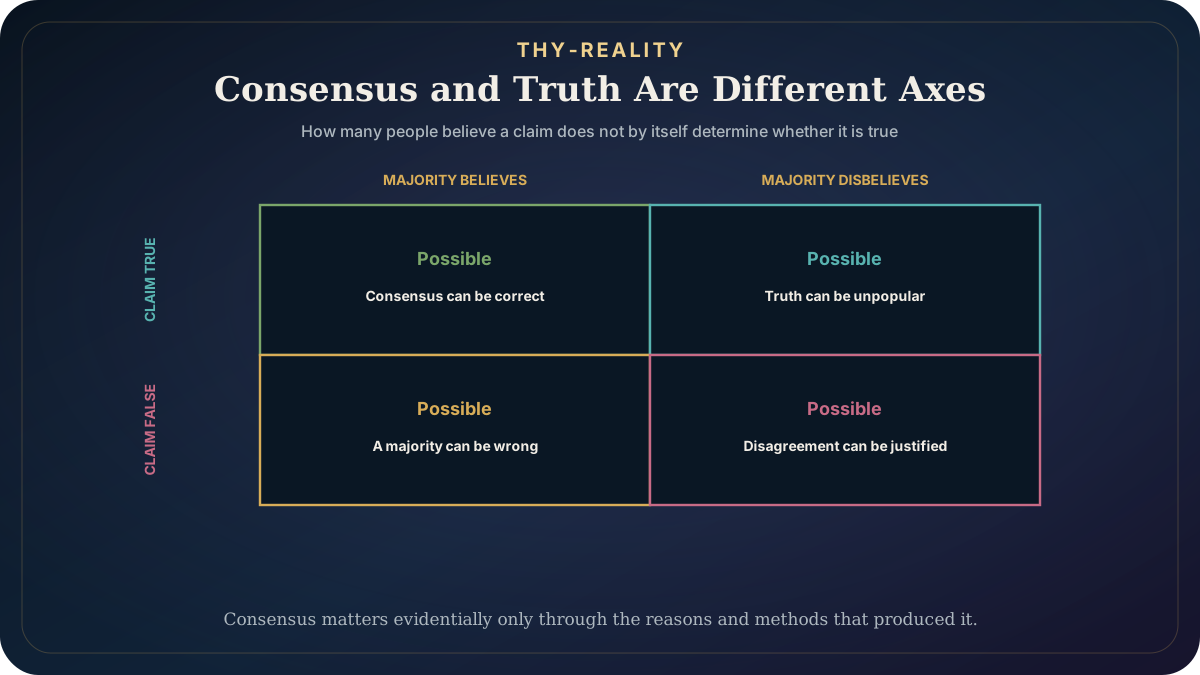
Imagine a society in which a large majority believes that a particular practice is acceptable. If we are reasoning within an objectivist moral framework, the number of votes alone does not establish that the practice is morally right.
This is one reason the natural-law tradition has been historically important: it leaves open the possibility that customs, political authorities, and majority decisions can themselves be morally evaluated by standards that are not created merely by those customs, authorities, or votes.
But the statement “the majority can be wrong” does not imply “therefore the minority is right.” An unconventional position is not an epistemic privilege. A minority, a dissenter, or an individual can also be wrong.
We therefore need to separate two questions: how many people believe a claim, and what reasons support it. The first is a sociological question about the distribution of belief. The second is a question of justification.
Broad agreement is not worthless. It may contain information about long experience, institutional stability, or convergence among different forms of reasoning. But if we are speaking about moral truth in an objectivist sense, agreement itself is not what makes the claim true.
Voting can determine the law of a community. By itself, it cannot settle whether that law is just.
Disagreement Does Not Prove That Objective Truth Does Not Exist
The opposite argument is also common: people disagree deeply and persistently about morality, different cultures have different norms, and therefore objective moral truth probably does not exist.
Moral disagreement is a serious philosophical problem and an important part of debates among realism, anti-realism, relativism, and other metaethical approaches. But the mere existence of disagreement is not, by itself, a logical demonstration that objectivity is impossible.
People disagree in other domains as well, including domains in which the participants assume that there is some fact of the matter. The more important question is therefore what kind of moral disagreement we are dealing with: how deep it is, why it persists, how much can be explained by different factual information, background assumptions, interests, biases, or conceptions of moral language, and whether disagreement remains among well-informed and reasonable interlocutors.
Anti-realist theories can use the breadth and persistence of moral disagreement as part of a broader argument against particular realist or objectivist accounts. Realist theories, in turn, must explain how moral knowledge can remain possible despite serious and persistent disagreement. Neither side is entitled simply to ignore the phenomenon.
Disagreement is evidence that a moral theory must explain. By itself, it does not decide which metaethical theory is correct.
Objective Truth and Our Knowledge of It Are Different Questions
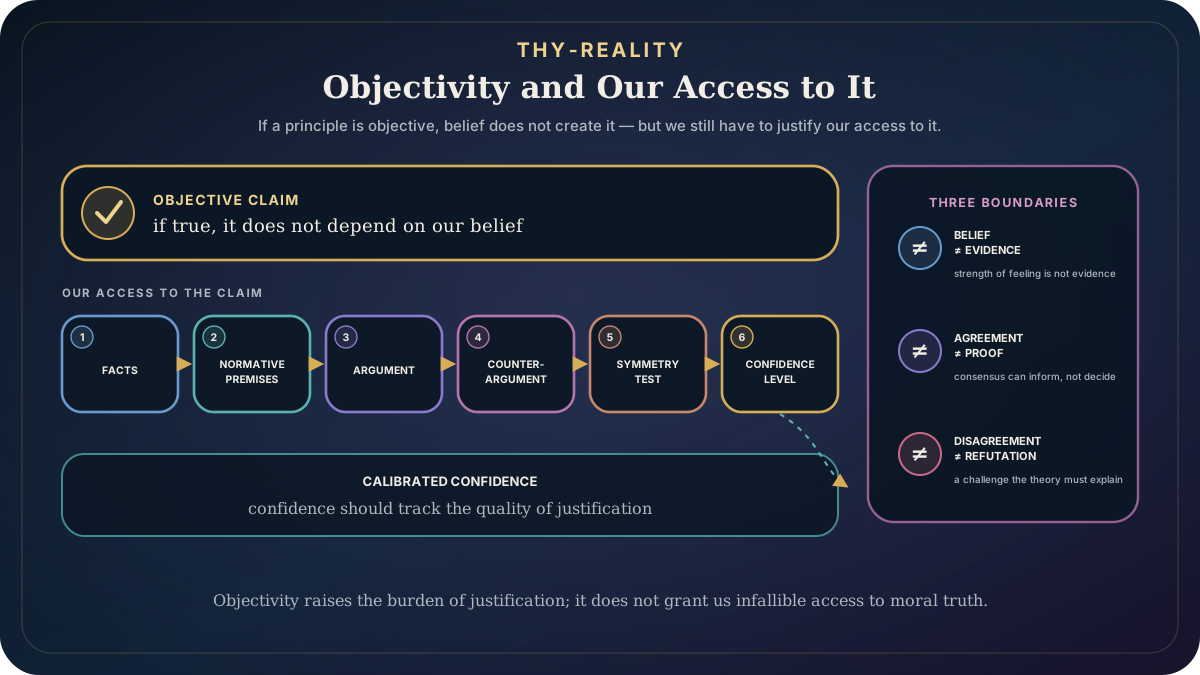
This is the central distinction of this article. Even if objective moral truths existed, it would not follow that human beings automatically or infallibly knew them.
We need to distinguish an ontological question — whether there are moral truths whose truth is not constituted merely by our individual attitudes — from an epistemological question — how such truths, if they exist, could be justifiably known and what would make a moral belief well founded.
Moral epistemology deals with the second family of problems: possible sources of moral knowledge, the roles of intuition, experience, reflection and argument, the significance of disagreement, and skeptical challenges to moral justification.
A comparison with the physical world can help only in a limited way. Before people knew a particular astronomical fact, their ignorance did not alter that fact. But this analogy does not prove that moral facts exist in the same way as astronomical facts. It illustrates only the logical difference between something being the case and our correctly knowing that it is the case.
This makes the statement “Natural Law is not a matter of belief” more demanding, not less. If a principle is supposed to hold independently of our beliefs, then we must explain how we distinguish well-justified knowledge from confident error.
Objectivity, if it exists, does not guarantee our access to it. The existence of moral truth and our justified knowledge of it are separate questions.
Natural Law Cannot Rest on Consequences Alone
The Natural Law framework in this project strongly emphasizes cause, consequence, and responsibility. That is important, but the articles “Natural Law and the Question of Freedom” and “What Is Natural Law?” already established a necessary limitation: a consequence is not yet a moral rule.
If we discover that X causes Y, we have established a descriptive relationship. To move from that claim to “X is morally wrong,” we also need a normative premise — for example, that Y is a form of unjustified harm and that we have moral reason to avoid unjustified harm.
Hume’s famous discussion of the transition from statements about what is to statements about what ought to be is therefore most useful here as a methodological warning: a moral conclusion should not be presented as though it were already contained entirely in purely descriptive premises. The normative bridge must be visible.
This does not make consequences morally irrelevant. For many ethical theories they are crucial. It means only that we should distinguish the empirical question “what happens?” from the normative question “why does that consequence count as good, bad, permissible, or forbidden?”
Suppose someone argues that violence violates Natural Law because it causes suffering. Further questions immediately appear: is every act that causes suffering wrong, what about surgery, self-defense, or preventing greater harm, and which moral premise distinguishes these cases? Such questions do not weaken a theory merely by being asked. They are what turn a slogan into an argument.
Natural Law does not become stronger by hiding its normative premises. It becomes stronger when those premises can be clearly stated, criticized, and defended.
If a Principle Applies to Everyone, It Must Survive Cases We Dislike
The word universal has a demanding implication. If we claim that a moral principle does not depend on personal preference, we cannot apply it only where it benefits us or our group.
Suppose we defend the principle “coercion is morally problematic.” We immediately have to ask what counts as coercion, whether justified exceptions exist, and which criteria distinguish justified from unjustified coercion. The same criteria then have to be applied in cases where the result constrains us.
The same problem appears with property, freedom, harm, truthfulness, and responsibility. If our definitions change according to who benefits from them, an allegedly universal principle quietly becomes a double standard.
THY-REALITY therefore uses an editorial and research heuristic we can call the symmetry test. This is not presented as a separate historical doctrine of classical natural-law theory. It is a methodological question: would we accept the same principle, definition, and evidential standard if the result constrained us or the group to which we belong?
The symmetry test does not prove moral truth. It can, however, reveal cases in which self-interest or identity has quietly replaced the supposedly universal principle.
Universality requires more than strong conviction. It requires consistent application of comparable criteria even when we dislike the result.
Natural Law as a Target of Verification, Not Protection From Verification
The article “What Is Natural Law?” asked what Natural Law is. Here we add the next distinction: if Natural Law refers to moral standards that are not created merely by our beliefs, then those standards cannot be demonstrated merely by believing in them strongly.
They do not become true because a majority believes them. They do not become false simply because disagreement exists. They do not become proven because someone gives them the label “Natural Law.” And our own feeling of conviction is not an infallible instrument for detecting their truth.
Aquinas’s classical account is also more nuanced than the idea that every person simply has an intuitive answer to every moral question. In Summa Theologiae I–II, Question 94, he distinguishes general principles from increasingly particular practical conclusions and recognizes that, as practical reasoning moves into detailed circumstances, exceptions, obstacles, and failures in correct application can arise.
If we want to treat a principle as a candidate for Natural Law, we can therefore use a seven-step research procedure:
- State the principle precisely, so that it is clear what it actually claims.
- Separate descriptive premises from normative premises.
- Check the empirical facts on which the moral argument depends.
- Make the normative foundation explicit: which good, value, or reason carries the conclusion?
- Apply the symmetry test to a case where the result is not in your own interest.
- Seek a serious counterargument, a boundary case, and any necessary exceptions.
- State the appropriate level of confidence and identify what would require revision of the principle.
This procedure does not guarantee that we will reach final moral truth. It does something more modest and important: it makes it harder for the phrase Natural Law to become a rhetorical shield protecting our existing beliefs from criticism.
THY-REALITY therefore does not try to escape one extreme by adopting another. The relativist slogan “everyone has their own truth” does not explain how conflicting moral claims should be evaluated. The dogmatic slogan “I possess the truth” removes the mechanism of correction.
If Natural Law exists, our belief does not create it. If we want to know it, belief alone will not be enough.
The Symmetry Test Must Apply to the State
If an act is morally problematic when performed by an individual — coercion, taking property, threats, restriction of movement, or invasion of privacy — the criterion cannot automatically change merely because the same kind of act is performed by the state.
Individuals and states do not always occupy identical positions. Institutions have procedures, public functions, and coordination problems that may be morally relevant. But if these differences justify special rights, we must show how and why.
If we use a different moral standard for authority, the difference must be justified by reasons, not merely by title.
Democratic Majority and Moral Truth
Democratic voting may be a very important answer to who should make a common decision. It is not automatically an answer to what is morally right. Voting can determine a community’s decision; voting alone cannot create moral truth from nothing.
We therefore still need to ask which moral reason transforms a collective decision into a legitimate right to enforce it against a person who objects.
Democracy may contribute to legitimacy. It is not the moral infallibility of the majority.
The Same Test for Authority and Its Critics
The symmetry test works in both directions. If we require the state to justify coercion, we must also justify our own coercion. If we demand freedom for ourselves, we must take comparable freedom seriously even for people with whom we disagree.
Natural Law cannot be a weapon used only upward. If it is universal, it must constrain us too.
Sources and further reading
- Murphy, M. C. The Natural Law Tradition in Ethics. Stanford Encyclopedia of Philosophy. Source
- Svavarsdóttir, S. (2023). Moral Realism and Objectivity. In The Oxford Handbook of Moral Realism, pp. 44–65. DOI: 10.1093/oxfordhb/9780190068226.013.19. Source
- Joyce, R. Moral Anti-Realism. Stanford Encyclopedia of Philosophy. Source
- Eriksson, J. & Francén Olinder, R. Moral Disagreement. Stanford Encyclopedia of Philosophy. Source
- Stanford Encyclopedia of Philosophy. Moral Epistemology. Source
- Thomas Aquinas. Summa Theologiae, I–II, Question 94: The Natural Law. Source
- Hume, D. A Treatise of Human Nature, Book III, Part I, Section I. Source