Kālāma Sutta — Did the Buddha Really Teach “Believe Nothing”?
Few Buddhist texts have been quoted so often in the modern world — and at the same time simplified so often — as the *Kālāma Sutta*. It is usually accompanied by the slogan: **“Do not believe anything just because you have been told it.”**

Few Buddhist texts have been quoted so often in the modern world — and at the same time simplified so often — as the Kālāma Sutta. It is usually accompanied by the slogan: “Do not believe anything just because you have been told it. Check for yourself.” Sometimes it goes even further: “The Buddha taught us to reject tradition, faith, and authority and to trust only our own reason.” That sounds very modern, almost like a manifesto of free thought. But the sutta itself says something considerably more demanding. The Kālāma Sutta is preserved in the Aṅguttara Nikāya as AN 3.65, or in some numbering systems as AN 3.66. Its context is not an abstract philosophical debate, but a very practical problem.
The inhabitants of Kesaputta, the Kālāmas, are confused. Different ascetics and brahmins come to their town. Each explains and praises his own teaching while criticizing the others. The Kālāmas therefore ask the Buddha: Who is telling the truth and who is lying? The Buddha first gives them a surprisingly simple answer: their doubt is justified. When different authorities make contradictory claims, doubt is understandable.
But what then? Here comes the most famous part of the sutta. The Buddha lists a series of things on which a person should not rely merely because they seem convincing: oral transmission, tradition, hearsay or transmitted reports, a collection of sacred texts, logical reasoning, deduction or inference, analogies, reflection on a view, probability, or the thought that “this ascetic is our teacher.” This is unquestionably an extraordinarily non-dogmatic passage. But it is precisely here that the greatest misunderstandings begin.
The sutta does not say: “Do not use logic”
If we read the list superficially, we might conclude that the Buddha rejects tradition, sacred texts, logic, reasoning, and teachers. But that cannot be the whole point. The sutta does not say that all these things are worthless. It says that they are not sufficient final criteria in themselves. A tradition may be correct. A text may be correct. A logical argument may be good. A teacher may be wise. But none of these things becomes automatically true merely because of its status. This is a considerably more sophisticated position than “discard all authorities.”
Even one’s own reason is not absolute. Among the things that are not sufficient in themselves, the sutta also mentions logical reasoning, inference, analogies, reflection, and probability. This means that the Kālāma Sutta is not a manifesto saying “trust only your own reason.” Our own reason can also be wrong. It can rationalize. It can begin from false premises. It can confirm what we already want to believe. The Buddha therefore does not replace the authority of tradition with the authority of the individual ego. This is one of the most important points in the entire discourse.
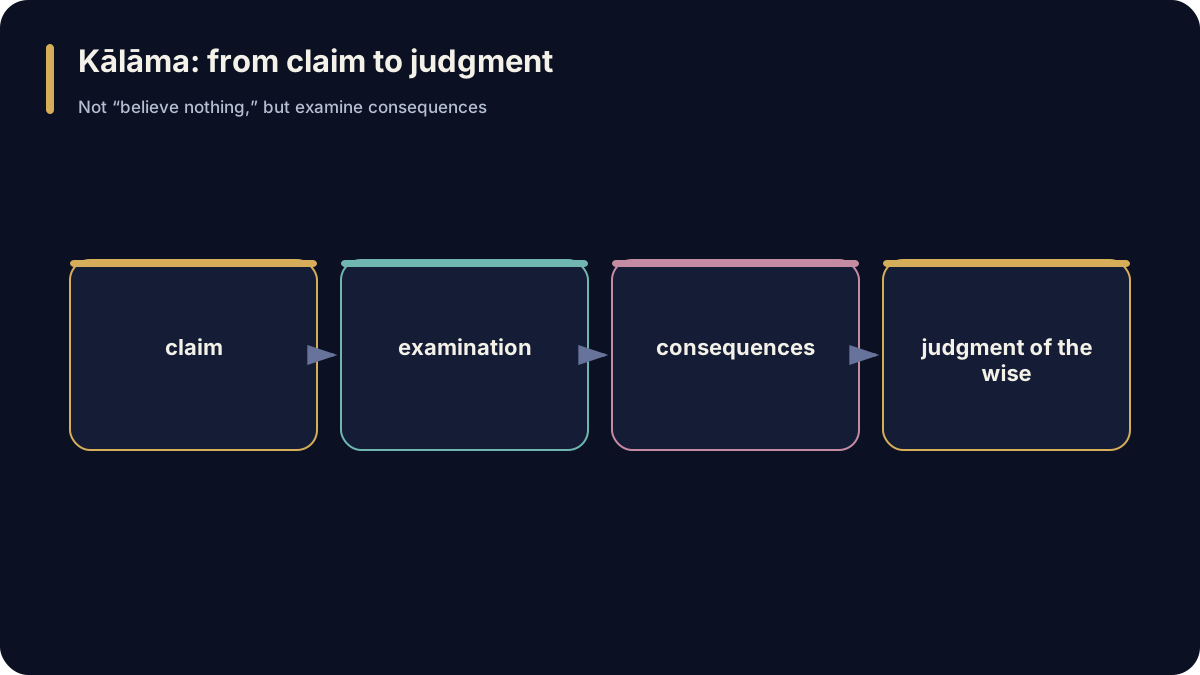
What, then, does it actually establish as the criterion?
The Buddha asks the Kālāmas about three very concrete states: greed, hatred or aversion, and delusion. When greed arises in a person, does it lead to benefit or harm? The Kālāmas answer: to harm. When someone is overcome by greed, they may kill, steal, engage in sexual misconduct, lie, and encourage others to act similarly. The same analysis follows for hatred and delusion. It becomes clear that the sutta is not primarily discussing abstract epistemology. It is asking how to judge a teaching by what it produces in a person and in that person’s conduct.
Four criteria
The Buddha then offers a fairly clear scheme. When you yourselves recognize that certain states are unskillful or unwholesome, blameworthy, criticized by the wise, and that when developed and enacted they lead to harm and suffering, they should be abandoned. And conversely: when you yourselves recognize that certain states are skillful or wholesome, blameless, praised by the wise, and that developing them leads to well-being and happiness, they should be cultivated and sustained. This is far more demanding than “I feel that this is right.”
“When you know for yourselves” does not mean “whatever seems right to me.” The text speaks of personal recognition, but not of taste, instinct, momentary feeling, or personal preference. The criterion is connected with consequences, ethical quality, the judgment of the wise, and the actual effect of a practice. The Kālāma Sutta is therefore not an early version of “my truth versus your truth.” Quite the opposite. It looks for consequences that can be examined.
Why are “the wise” still important at all? This is another point that is often omitted. If the discourse taught complete individualism, it would be enough to say: “I checked it and it seems good to me.” But the text adds: “it is praised by the wise.” This means that personal judgment is not the only safeguard. It must also be compared with people who display wisdom, ethical maturity, absence of greed, absence of hatred, and absence of delusion. Thanissaro Bhikkhu therefore emphasizes that the discourse does not advocate blind individualism; personal testing must be balanced by the judgment of the wise and by actual consequences.
Greed, aversion, and delusion
Why these three? Because they form one of the oldest Buddhist schemes: greed, aversion, and delusion. Later we will frequently encounter them as the three roots of unskillful conduct. Their opposites are non-greed, non-hatred, and non-delusion. When these states prevail, a person is more able to act without harming themselves or others. The Kālāma Sutta therefore does not provide only a method for testing ideas. It also provides an ethical compass.
Then comes a surprising turn toward mettā
When a person is free from greed, hatred, and delusion, the sutta describes how they develop goodwill, compassion, appreciative joy, and equanimity in all directions. This directly connects with our previous article on the Karaṇīya Mettā Sutta. The Kālāma Sutta is therefore not only about “how to test ideas.” It is also about “what happens when a person removes greed, hatred, and delusion.” The result is not cold skepticism. The result is a more open and nonviolent mind.
And then come the four assurances
This part is almost always omitted from popular quotations, yet it is extremely important. The Buddha says that a person with a pure, non-hostile, benevolent mind can attain four kinds of inner assurance in this very life.
The first assurance. If there is an afterlife and there are consequences of good and bad actions, then such a person has reason to expect a favorable continuation after death.
The second assurance. If, on the other hand, there is no afterlife and no karmic consequence after death, then the person still lives here and now without hatred, without malice, and without inner suffering. The Buddha does not tell the Kālāmas: “first you must believe in rebirth.” Instead he shows that even if their metaphysical uncertainty is justified, an ethical life makes sense under either possibility.
The third assurance. If bad conduct really does bring bad consequences, a person who wishes evil to no one and does not act maliciously has no reason to fear the consequences of their own deeds.
The fourth assurance. If bad conduct is not followed by any special karmic consequence at all, the person is still clean in their conduct and inwardly at peace.
This is almost a Buddhist version of a wager. At first glance the argument may resemble the later Pascal’s wager. But the difference is important. It does not say “believe just in case.” It says: “live harmlessly and benevolently because that makes sense regardless of which metaphysical possibility is correct.” The center of gravity is therefore not belief but conduct.
Does the Kālāma Sutta encourage skepticism? Yes — but not limitless skepticism. It encourages skepticism toward authority, tradition, texts, teachers, arguments, and one’s own conclusions. But it does not stop at “nothing can be known.” That would be radical skepticism. Instead it offers a practical path: observe, test consequences, compare, see whether something leads to harm or well-being, take account of the judgment of the wise, and then act. This is disciplined skepticism, not nihilism.
Is this the scientific method? Not quite. That is another modern exaggeration. The sutta certainly emphasizes testing, experience, consequences, and not blindly accepting authority. In that sense it has an obvious affinity with empirical thinking. But it does not use the modern scientific method: controlled experiments, statistical testing, reproducibility, measurement, or peer review. Nor is its main subject the physical world. It is primarily concerned with ethical and psychological states and their consequences. It therefore makes little sense to claim that “the Buddha invented the scientific method.” What we can say is that the text very strongly rejects the blind acceptance of claims merely because of authority.
Does the sutta mean that we can test every teaching for ourselves? Not that either. Some claims cannot be tested quickly. Some meditation practices require years. Some effects are subtle. Some views are so deeply rooted that we do not notice our own bias. The sutta therefore does not say “think for five minutes and you already know the truth.” Personal judgment requires training, honesty, experience, observation of consequences, and contact with wise people. That is much more than an instant feeling.
What about sacred texts? There is an important irony here. The Kālāma Sutta is itself today a sacred text. If we understood it as saying “never trust sacred texts,” it would undermine itself. A much more sensible reading is that a sacred text is not true merely because it is a sacred text. Its claims must be understood, tested, compared, and their consequences observed. This is a completely different relationship to tradition: neither blind obedience nor automatic rejection, but critical use.
What about teachers? The same applies. The sutta does not say “do not listen to teachers.” The Buddha himself is the teacher in this very scene, and the Kālāmas are listening to him. At the end of the discourse they even express confidence in him and in the Dhamma. The point therefore cannot be “teachers are unnecessary.” The point is: a teacher is not automatically right merely because they are a teacher. A teacher, too, is assessed by their conduct, their teaching, its consequences, and whether it reduces greed, hatred, and delusion.
The Kālāma Sutta is not relativism. The modern slogan can quickly slide into “everyone has their own truth.” But the sutta does not teach this. Greed that leads to killing, stealing, lying, and harm is not merely “my personal truth.” The sutta evaluates it as harmful. Non-greed, non-hatred, and non-delusion, by contrast, are treated as beneficial and worth cultivating. This is a clearly normative text. It is not relativistic.
Why is this discourse so attractive today? Because it responds to a very modern problem. There are too many sources of information and authority. Everyone has their own channel, teaching, interpretation, experts, and sources. And almost everyone says “the others are misleading you.” The Kālāmas lived in a completely different world. Yet their problem is strangely similar: How do we judge between competing claims? The Buddha does not give them the simple answer “Believe me.” He gives them a method of assessment.
But even the method requires humility. If we are not to trust blindly in tradition, teachers, logic, inference, or our own impressions, then the conclusion is almost uncomfortable: we can be wrong. Even when we are certain. This is one of the deepest lessons of the text. Critical thinking is not only doubting others. It is also doubting our own certainty.
Connection with the suttas examined so far. We can now see that the Kālāma Sutta is not a detour away from the Buddhist core. The Dhammacakkappavattana Sutta gave a criterion: what leads to dukkha and what leads to its cessation. The Anattalakkhaṇa Sutta showed: do not cling even to your own idea of yourself. The Satipaṭṭhāna Sutta: observe what actually arises and ceases. The Ānāpānasati Sutta: train attention and insight. The Karaṇīya Mettā Sutta: cultivate boundless goodwill. The Kālāma Sutta adds: do not accept a teaching merely because of authority — look at what it actually produces. This is a very consistent logic.
So what does the Kālāma Sutta actually teach?
It does not teach “believe nothing,” “believe only yourself,” “logic is unnecessary,” or “all truths are relative.” More precisely: do not accept a claim merely because it is supported by tradition, a text, an argument, a teacher, or your first impression. Look at what happens when you live by that teaching. Does it increase greed, hatred, delusion, harm, and suffering? Or does it reduce them? Does it lead toward non-greed, goodwill, clarity, harmlessness, and well-being? And is this also recognized by people who are genuinely wise? This is a far more demanding method than the slogan “think for yourself.” Because it also requires: examine your own thinking.
Conclusion. The Kālāma Sutta is non-dogmatic, but it is not anti-traditional. It is skeptical, but not nihilistic. It values personal experience, but is not individualistic. It values testing, but does not proclaim every personal intuition to be true. Its question is not only “Can you prove this?” but also “What does this teaching do to a person who actually lives it?” And it is precisely here that Buddhist epistemology reconnects with ethics. The real test of a teaching is not only how good it sounds, but where it leads. The next theme in the series will be very different. Instead of a short practical discourse, we will turn to one of the longest and historically most important texts of early Buddhism: Mahāparinibbāna Sutta — the Buddha’s final days, his death, and the birth of Buddhist memory.
Sources and further reading
Primary texts and reference editions
- SuttaCentral: AN 3.65 and AN 3.66, Bhikkhu Sujato.
- Thanissaro Bhikkhu, trans., “Kālāma Sutta: To the Kalamas” (AN 3.65), Access to Insight.
Research and verification literature
- Thanissaro Bhikkhu, trans. “Kālāma Sutta: To the Kalamas” (AN 3.65). Access to Insight, 1994; rev. 2013.
Note: verification sources are part of the editorial apparatus. Where the originally used edition was not preserved during reconstruction, a standard reference edition is not presented as the presumed original source of the article.