What Can We Historically Attribute to the Buddha? — Between the Man, Memory, and Legend
When we ask which Buddhist sutras are the oldest, we almost inevitably arrive at an even harder question: **What in their content can historically be attributed to the Buddha himself?** Did the historical Gautama teach the Four Noble Truths?

When we ask which Buddhist sutras are the oldest, we almost inevitably arrive at an even harder question: What in their content can historically be attributed to the Buddha himself? Did the historical Gautama teach the Four Noble Truths? Did he speak about non-self? Did he formulate the teaching of dependent arising? Did he really leave a life of luxury after encountering an old man, a sick person, a corpse, and an ascetic? Did he attain awakening beneath a particular tree? And can any sentence in the surviving sutras be quoted as his actual words? Historically, the safest answer is neither “everything” nor “nothing.” Between those extremes lies a fairly broad range of historical probability.
Did the Historical Buddha Exist at All?
Some radically skeptical views have questioned even the existence of Buddhism’s founder. This is not, however, the prevailing position. Most contemporary scholars accept that behind the early Buddhist tradition stood a real historical person — the ascetic teacher Gautama, associated with the Śākya community of northeastern India. It is much harder to determine his exact dates. Older Western reconstructions often followed a longer chronology and placed the Buddha’s death at roughly 480 BCE. Later scholarship shifted a significant part of the chronology forward. Influential reconstructions place his death somewhere near the beginning of the fourth century BCE, often around 400 BCE. There is no complete consensus. It is therefore better to speak of the historical Buddha of the late fifth or early fourth century BCE as a probable framework, rather than insist on one exact year.
Why is it so difficult to speak about him historically? For Emperor Aśoka we have his inscriptions. For some ancient rulers we have coins. For the historical Gautama we have no known document written during his lifetime. The Buddha’s teaching was originally transmitted orally. The oldest surviving Buddhist manuscripts are several centuries later than the period in which we place the Buddha. Full biographies are also later than the earliest layers of the teaching. We therefore always see the historical Buddha through the memory of a community that preserved, organized, and interpreted his teachings. That is not the same as complete darkness. But neither is it direct access.
The Buddha’s words and the historical Buddha are not the same question. For a religious tradition, a sutra may be buddhavacana — the word of the Buddha. This means that it is accepted as authoritative Buddhist teaching. A historian asks different questions of the same text: How early can it be traced? Are there parallel versions in different transmissions? Which parts are shared? Which differ? Does the text presuppose later stages of philosophical development? Does it fit the social and religious environment of early northern India? A sutra can therefore be fully legitimate as a discourse of the Buddha within a tradition while a historian can at the same time write: we cannot prove that the historical Gautama uttered every sentence of it in its present form. This is not a contradiction. These are two different criteria.
We have no audio recording. The least realistic expectation would be that philological work will one day reconstruct the Buddha’s discourses literally, word for word. Early literature was shaped for oral transmission. A formula used by one teacher could become standardized. Similar discourses could acquire identical introductions. Lists were systematized. A text could receive an explanation. The explanation could later become part of the recited text. Comparison of different early versions reveals both striking stability and real changes during transmission. We can therefore speak of an old shared core. Stenographic precision is much harder to claim.
What Can We Reconstruct Better Than Literal Words?
A great deal. We can reconstruct much more securely the central problems that concerned the early community, characteristic teachings, the structure of the path, meditative practices, ethical orientation, the way of life of the early Saṅgha, and the broader project of liberation. If a theme recurs in different early transmissions and is built into the very structure of the teaching, it is unlikely to be a very late invention of a single school. This is a different kind of historical knowledge. Less spectacular than a verbatim quotation, but much more solid.
“Prince Siddhartha” requires qualification. In the popular biography of the Buddha, Siddhartha is a prince. His father Śuddhodana is a king. The young prince lives in a palace, protected from the realities of life. Historically, the picture is less clear. The Śākyas, to whom Gautama belonged, were not a monarchy of exactly the same kind as the great kingdoms of Magadha or Kosala. They belonged to political communities associated in Indian sources with gaṇa-saṅgha arrangements, in which authority was shared by a group of aristocratic or ruling families. Such a system was not a modern democratic republic. It was much closer to an oligarchic order. It is therefore entirely possible that Gautama grew up within a privileged ruling lineage. But the word “prince” can evoke for a modern reader a far more monarchical palace environment than we can securely reconstruct historically.
It is safer to say: Gautama came from the aristocratic or ruling stratum of the Śākya community.
What about the palaces and a life of complete isolation? Traditional biography strongly emphasizes Gautama’s luxurious youth. His father is said to have tried to shield him from every sight of aging, sickness, and death. Such narratives are religiously very powerful. They dramatize a person suddenly discovering the reality of impermanence. Historically, however, they cannot be independently confirmed. Full biographical narratives also take shape considerably later than the earliest teachings. It is therefore better to distinguish between a probable privileged social position and the later literary image of an almost hermetically sealed palace life.
The Four Sights. An old man. A sick person. A corpse. An ascetic seeker. This is one of the most powerful stories in world religious literature. In a few scenes it captures the entire problem Buddhism seeks to address. A person discovers aging, illness, death, and the possibility of a spiritual quest. Historically, however, we cannot show that Gautama’s decision to renounce worldly life occurred precisely after four such encounters. The story may express the Buddhist meaning of his departure much more accurately than the exact chronology of four excursions. That does not deprive it of value. It only changes the kind of value we attribute to it.
The Departure into Ascetic Life Is a Much Firmer Core
A broader historical core is far more probable. Gautama left ordinary family and social life. He became a wandering renunciant. He entered the wider śramaṇa milieu. He experimented with meditative and ascetic methods. He sought a way out of aging, death, and recurring suffering. This framework is deeply embedded in the early tradition and fits well with the religious environment of northern India at the time. Its historical plausibility does not require accepting every palace detail of later biography.
Āḷāra Kālāma and Uddaka Rāmaputta. Early discourses relate that before awakening Gautama studied with two teachers: Āḷāra Kālāma and Uddaka Rāmaputta. He is said to have attained very advanced meditative states under them, but to have concluded that these alone did not lead to complete liberation. Were they real people? We have no external inscription or archaeological document that proves it. Yet there are interesting arguments for a historical core to the tradition. Comparison of different early Buddhist sources shows that the story is not confined to a single late tradition. Alexander Wynne has further argued that the meditative ideas associated with these teachers fit meaningfully within the early Indian spiritual environment. We may therefore say: the story that the Buddha studied under other meditation teachers is historically quite plausible.
But not: it has been historically proven that Āḷāra and Uddaka existed exactly as the sutras describe them.
Awakening is a historical core — its interpretation is another matter. Historically, we can infer with considerable confidence that Gautama grounded his authority as a teacher in the claim that he had attained a distinctive liberating insight. The very term buddha means “awakened one.” Without a claim to awakening, it would be difficult to explain the formation of the early community’s identity. Historical method, however, cannot verify whether nirvāṇa is metaphysically real, whether Gautama actually saw past lives on the night of awakening, whether Māra appeared to him, or whether the earth bore witness to his attainment. These are religious and philosophical claims that exceed the ordinary methods of historiography. A historian can establish that the early tradition believed Gautama had attained awakening and that this was the foundation of his authority. That is not the same as a judgment about the ontological reality of awakening.
Which Teachings Are Most Likely to Be Very Early?
Here the picture becomes more interesting. Although we possess no transcripts of the Buddha’s speech, the early transmissions share enough material for us to speak of a strong core. Among its most important themes are the impermanence of conditioned phenomena, the problem of dukkha, the ethical significance of intentional action, abandoning craving and clinging, meditative discipline, refraining from appropriating bodily and mental processes as a permanent self, the dependence of phenomena on conditions, and the possibility of liberation or nirvāṇa. Such a shared core is much harder to explain as a late creation of a single sect. The historically cautious formulation remains: such teachings very probably belong to the earliest identifiable Buddhist tradition. The step from this to “the Buddha uttered them in this exact formulation” is still a larger one.
The Four Noble Truths. A particularly sensitive case is the Four Noble Truths. Traditional presentation places them at the very center of the Buddha’s first discourse. In the Nikāyas and Āgamas they are unquestionably an important part of early Buddhist teaching. They should therefore not be presented as a late Mahāyāna or Abhidharma innovation. Scholars are not, however, entirely united on how early precisely the standard four-part textbook formulation existed in the form familiar today. Peter Harvey treats the four ariya-sacca as a core of the early sutta collections. Eviatar Shulman, by contrast, has argued that their earlier layers may be better understood as interconnected meditative insights whose later systematization produced a more explicitly doctrinal scheme. This is an important methodological caution. Scholarly debate exists. An article should therefore state neither:
“the historical Buddha certainly did not teach the Four Truths” nor “it has been proven that he was the first to formulate them exactly in the form known today.” The safest formulation is: the Four Truths are a very early and central Buddhist scheme, while the history of their exact formulation remains a subject of research.
Dependent arising. The same problem appears with pratītyasamutpāda or paṭiccasamuppāda. The idea that a phenomenon or process arises in dependence on conditions is deeply embedded in early Buddhist material. It would be very difficult to explain it as a late marginal idea. But this does not mean that the short formula of conditionality, different chains of conditioning, and the standard twelve-link scheme necessarily arose at the same time. Texts may preserve different historical stages of systematization. Historically, it is therefore safer to attribute to the Buddha a fundamental orientation toward conditioned arising and cessation than to claim that we can reconstruct the first form of every link in the standard chain.
Non-self. Anattā or anātman is likewise a very early and distinctively Buddhist theme. Its centrality to the earliest Buddhist philosophical project is difficult to dispute. A different question is: What exactly did the early teaching of non-self assert? Does it categorically deny any metaphysical self? Does it primarily show that the five aggregates should not be understood as “this is me”? Is anattā above all an ontological theory? Or a liberating method for dismantling clinging? Interpretive disputes exist. Thus even with a doctrine that is very probably early, reconstructing its original philosophical scope is not always easy.
Meditation is almost certainly very old. There are very strong reasons to attribute meditative training to the historical Gautama’s teaching. The early corpus is permeated by concentration, mindfulness, the jhānas, observation of body, feelings, and mind, the cultivation of loving-kindness, and liberating insight. These themes also occur across different early transmissions. It is therefore unlikely that meditation became central only much later. Yet this should not be turned into the opposite extreme: every meditation method practiced today is exactly the Buddha’s technique. Meditative systems have been interpreted, systematized, and transformed throughout history.
An Organized Community Is Also Very Early
Buddhism did not begin as a philosophical theory alone. The earliest history already presupposes a community of disciples: monks, prospective monks, lay supporters, and later clearly also nuns. The community had rules, procedures for admitting members, and methods of collective decision-making. Such organization helps explain how a large oral corpus could be preserved over centuries. This strongly supports the historicity of an early Saṅgha. It does not prove that the historical Buddha personally formulated every individual Vinaya rule later preserved.
Nuns. The existence of an early female monastic community is also important. Different Vinayas and other early texts know communities of bhikkhunīs or bhikṣuṇīs. The narratives of their origin, however, differ. The story of Mahāpajāpatī Gotamī and the additional rules for nuns in particular has been the subject of intensive historical and textual analysis. We therefore need to separate two questions: Is female monasticism very old? Most likely yes. Is every detail of its origin a historical record of the first event? We cannot assume that.
Lumbini. Archaeology can help with some biographical traditions. Aśoka’s pillar at Lumbini shows that by the third century BCE the place was already recognized as the Buddha’s birthplace. This is extremely important evidence for an early tradition. Excavations have also uncovered structures older than Aśoka’s monumental construction, indicating pre-Aśokan cultic use of the area. Caution is nevertheless necessary. Aśoka’s inscription was created generations after the Buddha. It demonstrates very early veneration or identification of Lumbini as the birthplace. It is not a contemporary birth certificate. Nor can we derive from it the exact traditional year of the Buddha’s birth.
The traditional date 623 BCE. This is a good example of how heritage and religious language can sound more definitive than academic chronology. UNESCO’s page on Lumbini cites the traditional year 623 BCE, while the archaeological core of the evidence rests primarily on Aśoka’s inscription and later remains. A historical-critical article should therefore not turn UNESCO’s heritage description into evidence for the year 623 BCE. That would conflate two different kinds of tradition.
The most famous image of the Buddha is not his portrait. Our visual memory is also far younger than the historical Gautama: the serene face, curled hair, uṣṇīṣa, elongated earlobes, meditative posture. These are historically developed religious signs. The earliest surviving anthropomorphic images of the Buddha were created centuries after his life. We therefore do not know what Gautama actually looked like. When we look at a Gandhāran or Mathurā Buddha, we are looking at the history of Buddhist iconography, not a portrait of the man from his lifetime.
Miracles. With miracles the historical boundary becomes even clearer. Buddhist literature attributes to the Buddha recollection of past lives, knowledge of karmic destinies, supernatural abilities, conversations with divine beings, Māra’s assault, extraordinary events surrounding his birth, and other miraculous elements. A historian can analyze these as parts of texts, estimate their age, compare versions, and study their religious meaning. But ordinary historical method cannot demonstrate their supernatural content. This does not mean that history has proven they did not happen. It means that historical method does not possess an appropriate tool for confirming such claims.
The Buddha’s Death
That Gautama died after a long period of teaching and that the community continued without him is an extremely probable historical core. The Mahāparinibbāna Sutta, however, is a multilayered text. It contains a travel narrative, teachings, institutional themes, an account of death, funeral rites, relics, and political relations. Some material may preserve very old memories. Other parts may reflect later developments in relic cults and community interests. It should therefore be read neither as a complete transcript of the final months nor as worthless late fiction. More probably, it is the result of a long process of preserving and shaping historical memory.
The last words. The same applies to the famous final words of the Buddha concerning the impermanence of conditioned things and diligence. They are extremely important within the tradition. Historically, however, we cannot know whether these were his final phonetically exact sentences. We can establish something else: the early Buddhist community believed that an emphasis on impermanence and diligence appropriately represented the Buddha’s final message. That is a highly significant historical fact even if it is not stenographic.
Three Levels of Historical Certainty
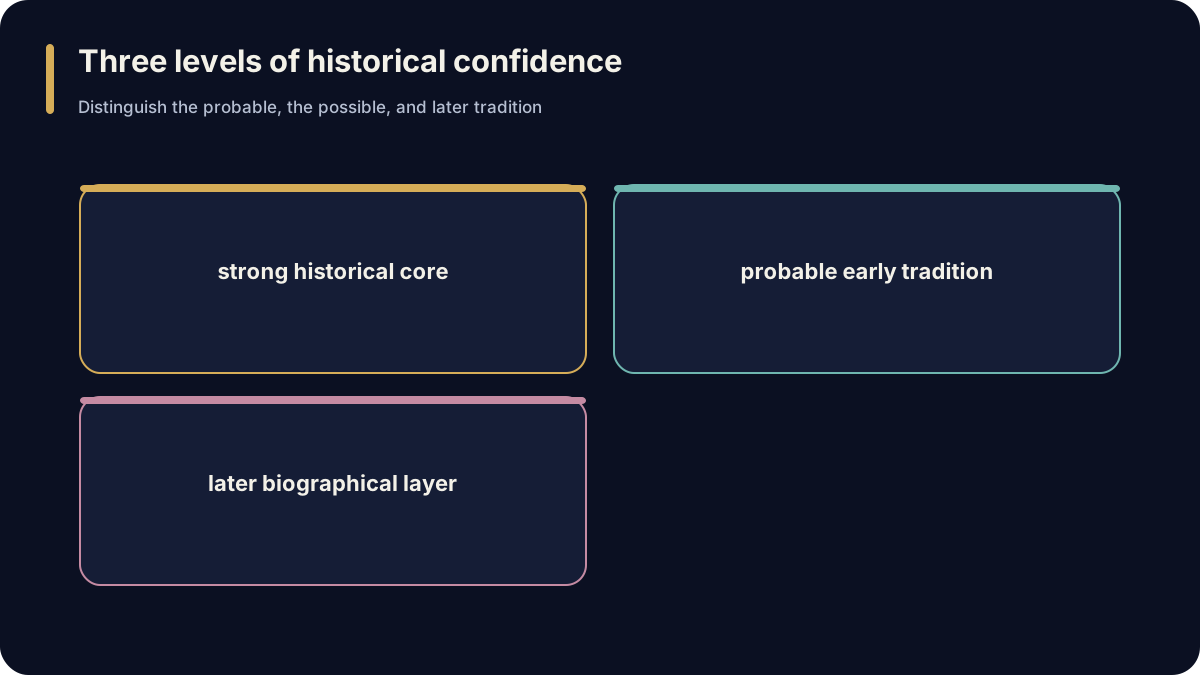
It is best not to divide biographical and doctrinal information about the Buddha simply into true and invented. Three approximate levels are more useful. On the relatively firm level are the existence of a historical ascetic teacher Gautama, his Śākya background, the renunciant path, the claim to awakening, a long period of teaching, the existence of an early community, and a strong shared core of liberating teaching. On the intermediate level are individual biographical details, the story of particular teachers before awakening, specific locations of particular conversations, and exact formulations of early doctrines. On the level hardest to verify historically are the full palace biography, the four literal sights, miracle narratives, the precise night of awakening, past lives, and stenographically exact quotations. The boundaries are not perfectly sharp. But such a model is much closer to historical work than a simple “truth or legend” dichotomy.
Later does not mean worthless. This is especially important with the Buddha’s hagiography: Mahāvastu, Buddhacarita, Lalitavistara, the Jātakas, and later biographies. All these works shape the Buddha known today by much of the world. Historically, they are later than many early discourses. But “later” does not mean “unimportant.” A later story can express a Buddhist ideal with extraordinary power even if it does not function as a reporter’s account of Gautama’s youth.
Very early does not mean completely original either. On the other hand, we should not create a new myth of “pure early Buddhism.” Even our earliest reconstructed texts passed through generations of oral transmission. They do not provide direct access to the private mind of the historical Gautama. Modern comparative research uses differences among Pāli, Sanskrit, and Chinese versions precisely to reconstruct older forms of the teaching. This can take us very far back. But it does not remove the final gap between the earliest shared memory of the community and the actual words of the person the community remembered.
Total skepticism also goes too far. None of this implies that we know nothing about the historical Buddha. If the early collections were almost entirely late and unrelated creations, we would need to explain why different early school transmissions preserve such an extensive shared structure. The comparative differences themselves allow us to search for older common ancestors. A historical-critical approach therefore requires two kinds of discipline. We must not automatically accept traditional narrative as contemporary biography. But neither should we reject every early shared memory simply because it was first transmitted orally.
What, Then, Do We Actually Have Left?
More than it may seem. A historical Gautama very probably existed. He came from the Śākya environment of northern India. He left ordinary social life and joined the renunciants. He participated in an already existing world of meditative and ascetic practices. He claimed to have discovered a liberating path. He taught disciples. An organized community formed around him or his teaching. Very early, that community preserved teachings on ethical responsibility, meditative discipline, the problem of clinging, impermanence, non-self or the non-appropriation of processes as self, conditioned arising, and the possibility of liberation. Historically, this is a fairly rich picture. It is not, however, a complete traditional biography.
What do we not have? An exact year of birth. An exact portrait. An audio recording. Certainty about every event of his youth. A method for labeling every canonical sentence the Buddha personally or a later editor. Nor do we have a complete way of determining for every central teaching: this was the original formulation on the first day it was taught. History rarely offers such a clean picture.
What Does It Mean to “Attribute Something to the Buddha”?
If by this we mean proving his literal words, our reach is very limited. If instead we mean reconstructing the oldest shared core of the tradition that formed around his teaching, we can achieve much more. This is where the two articles in this historical group meet. When asking which sutras are oldest, we found that the answer is not a single title but a method. The same is true of the historical Buddha. We do not receive one perfect biography. We receive degrees of evidence. We compare traditions. We distinguish an older core from later development. We use archaeology, philology, and historical context. And we accept that some boundaries remain.
An Echo Instead of a Recording
Perhaps it is therefore best to change the question itself. Instead of asking “Which words did the Buddha really say?” we can ask “What do the earliest comparable Buddhist traditions jointly attest that he taught?” We can answer the second question much better. We do not hear the recorded voice of a man from ancient India. We hear his echo — an echo that passed through the memory of disciples, through recitation, through school divisions, through languages, through editors, through centuries. An echo is therefore not identical to the original sound. But if its oldest versions overlap strongly enough, we can still discern what kind of voice once set it in motion. And that is both the boundary — and the strength — of historical research into the Buddha.
Sources and Literature
Primary Texts and Reference Editions
- SuttaCentral — comparative corpus of the Nikāyas, early texts, and parallels; Āgama and transmission data are checked against specialist comparative scholarship.
Research and Verification Literature
- Wynne, Alexander. The Origin of Buddhist Meditation. Routledge, 2007.
- Shulman, Eviatar. Rethinking the Buddha: Early Buddhist Philosophy as Meditative Perception. Cambridge University Press, 2014.
- Siderits, Mark. “Buddha.” The Stanford Encyclopedia of Philosophy, Summer 2026 ed., edited by Edward N. Zalta and Uri Nodelman.
Note: verification sources are part of the editorial apparatus. Where the original edition used during reconstruction was not preserved, a standard reference edition is not presented as the article’s presumed original source.