Mahāparinibbāna Sutta — the Buddha’s Final Days, His Death, and the Birth of Buddhist Memory
Most of the suttas we have examined so far have had a fairly clear core: one problem, one teaching, one meditation structure. The *Mahāparinibbāna Sutta* is something entirely different. It is almost a Buddhist epic.
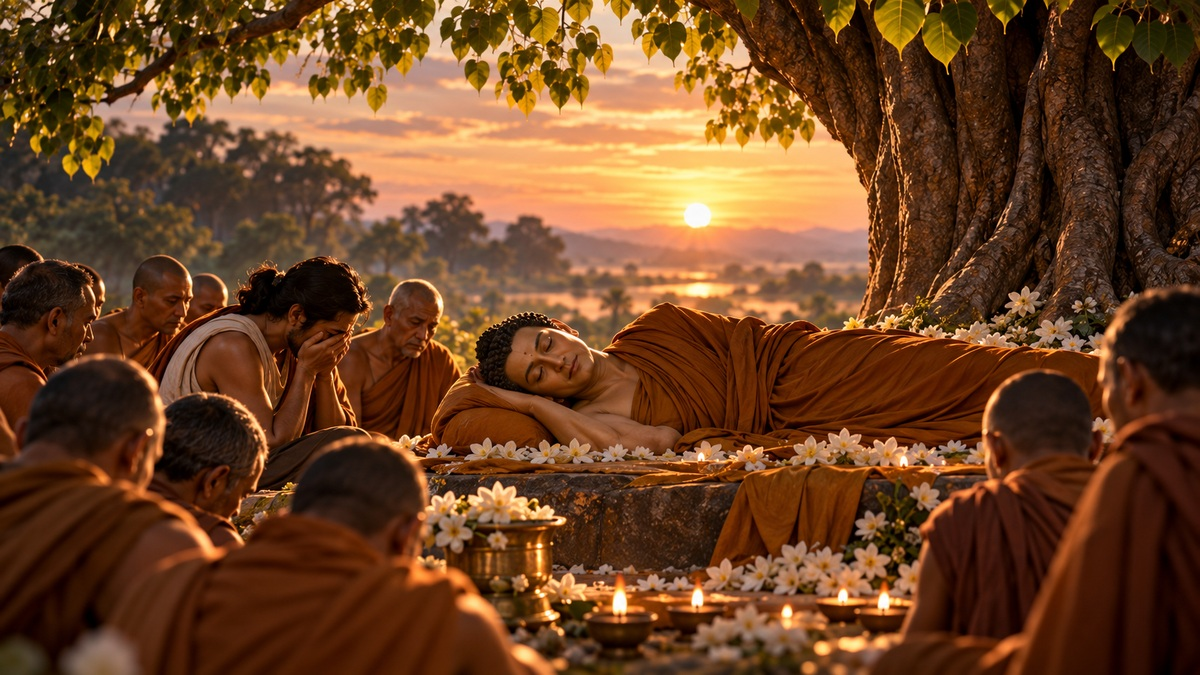
Most of the suttas we have examined so far have had a fairly clear core. One problem. One teaching. One meditation structure. The Mahāparinibbāna Sutta is something entirely different. It is almost a Buddhist epic. It tells the story of the Buddha’s final great journey. It speaks of his old age, illness, farewells, Ānanda’s grief, final teachings, last meal, death, and funeral. Cremation. Relics. And of the question that must have become unavoidable after the founder’s death: What remains when the teacher is gone? The Pāli version is preserved as Dīgha Nikāya 16 and is the longest discourse among the early Buddhist discourses. Related versions of the Mahāparinirvāṇa material are also preserved in other early Buddhist traditions, allowing individual episodes to be compared across different lines of transmission.
This text is therefore important not only as a story of the Buddha’s death. It is also one of the key texts for understanding how the early community began to answer questions such as: who will lead the community, what will serve as the standard of authentic teaching, how should the Dhamma be preserved, what should be done with the Buddha’s body, and how does the memory of the founder become pilgrimage sites, relics, and stūpas?
The final journey
The narrative begins at Rājagaha, on Vulture Peak. The Buddha is already old. Later the text presents him as about eighty years old, feeling physical exhaustion and the approach of death. But the sutta does not begin directly with death. It begins with politics. King Ajātasattu of Magadha wants to attack the Vajjian confederacy and sends his minister Vassakāra to the Buddha. The Buddha does not discuss military strategy. Instead, he asks Ānanda whether the Vajjians still maintain a number of social practices: whether they meet frequently, act in harmony, respect their institutions and elders, and preserve established order. As long as they do so, he says, their growth rather than their decline can be expected.
This is an interesting beginning. Before the sutta speaks about the decline of the Buddha’s body, it speaks about the conditions that prevent the decline of a community. The Buddha then applies similar principles to the monks. From the very beginning DN 16 therefore signals one of its main themes: how can something survive its founder?
From Rājagaha northward. The narrative then follows the Buddha and the monks through a series of places, including Pāṭaligāma, Vesālī, Bhoganagara, Pāvā, and finally Kusinārā. This geographical structure gives the sutta almost the form of a final journey. Along the way he stops, teaches, meets laypeople, speaks to monks, falls ill, recovers, and continues. This is not an image of a teacher standing outside aging. Quite the opposite. DN 16 strongly emphasizes: the Buddha grows old. His body weakens. And that itself becomes a practical demonstration of the teaching on impermanence.
“I am old and worn out.” In one of the most human parts of the narrative, the Buddha compares his body to an old cart that can be kept going only with repairs or supports. This is a striking image for a fully awakened Buddha. But early Buddhism does not teach that awakening makes the body immortal. The Buddha’s body, too, remains born, conditioned, subject to aging and death. His liberation is therefore not the body’s victory over death. It is liberation from clinging to a process that is itself subject to death.
“Be islands unto yourselves”
Among the most famous passages in DN 16 is the advice to Ānanda: live as an island or refuge unto yourselves, with no other refuge; let the Dhamma be your island and refuge. The Pāli word dīpa can in some contexts also mean a lamp, which gave rise to the famous rendering “be a light unto yourselves.” In this passage, however, the meaning island or refuge is very well grounded. The text then connects the advice directly with the four establishments of mindfulness. This is therefore not an invitation to “believe only yourself.” The meaning is closer to this: the teacher will die. Do not build your ultimate refuge on his physical presence. Ground the practice in the Dhamma and direct training.
The Buddha’s death must not mean the death of the teaching
Toward the end this question becomes even more explicit. The Buddha tells Ānanda that after his death some may think: “Our Teacher has passed away. Now we have no teacher.” But the answer is clear: the Dhamma and Vinaya that I have taught and explained shall be your teacher after my death. This is one of the most important institutional statements in early Buddhism. The Buddha does not appoint a successor. He does not say: “After me, Ānanda will be the absolute leader.” Nor does he say: “Mahākassapa will be the successor.” He directs authority toward teaching and discipline. The Buddhist community could therefore develop without a single person occupying the Buddha’s position after his death.
But what is the true Dhamma? A problem arises immediately. If the Dhamma is to be the authority after the Buddha’s death, how will anyone know what genuinely belongs to his teaching? DN 16 is explicitly aware of this question. It presents the four great references — mahāpadesa. If someone claims, “I heard this directly from the Buddha,” or “I heard this from a community of elders,” or from a smaller group of learned monks, or from a single learned monk, the claim should be neither automatically accepted nor automatically rejected. It should be compared with the Dhamma and Vinaya. If it accords with them, it can be accepted. If not, it should be rejected.
This is extremely important for the history of the canon. It depicts a community already aware of the problem of false attributions to the Buddha.
Authority is not only a person. Here DN 16 can be connected with the Kālāma Sutta. The Kālāma Sutta warned that authority by itself is not enough. DN 16, in an institutional context, says that even if someone claims “I heard this from the Buddha,” the claim must be tested against the wider body of teaching and discipline. This is an early form of internal textual control.
The Buddha relinquishes the continuation of life. DN 16 also contains a more supernatural part of the narrative. The text speaks of a possibility that, if properly requested, the Buddha could have maintained life for a very long time. Ānanda is said not to have understood the hint in time and does not ask the Buddha to remain. Later the Buddha formally relinquishes the life-force, followed by a great earthquake and cosmic signs. Traditionally this episode is very important. From a historical-critical perspective, however, caution is necessary. Such cosmic and miraculous elements clearly show that the text is not a simple biographical report. It interweaves historical memory, theology, ritual, legendary narrative, and exaltation of the Buddha.
The final visit to Vesālī. Before leaving the Vesālī region, the Buddha looks back toward the city. The narrative carries a strong sense of farewell. It becomes increasingly clear: there will be no return. This tone is one of the distinctive qualities of DN 16. Between doctrinal lists and institutional instructions runs a powerful emotional story, above all through Ānanda.
Ānanda as the human face of the story. Ānanda is almost the second main character of this sutta. He cares for the Buddha, asks questions, does not always understand the hints, organizes meetings, cries, and grieves. And he tries to understand what will happen to the community. That is precisely why the narrative is so effective. The Buddha represents the teaching of impermanence. Ānanda represents the person who has to apply that teaching at the very moment he is losing someone he loves.
Cunda’s final meal
At Pāvā, the Buddha is invited to a meal by Cunda, traditionally described as a metalworker or artisan. Among the food prepared is a dish called sūkaramaddava. This is one of the most notorious terms in Buddhist biography. It has often been translated as pork or tender pork. But the exact meaning of the expression is unknown. Sūkara does indeed mean pig, yet the compound as a whole is not clear enough to identify the dish with certainty. Over the history of interpretation, suggestions have included pork, a specially prepared meat dish, mushrooms, plants, and other possibilities. In this article we will therefore normally leave the expression as sūkaramaddava — a dish of uncertain kind. We will not write: “The Buddha died because he ate pork.”
Nor will we write: “It has been proven that he ate mushrooms.” Both claims go beyond the text.
Did the final meal kill him? After the meal, the Buddha becomes gravely ill. The sutta describes a severe illness, including bleeding or a serious digestive disorder. But it does not offer a modern diagnosis. From the text alone we therefore cannot reliably determine whether this was food poisoning, an infection, an aggravation of a pre-existing illness, or something else. The safest statement is: in the narrative, the final meal is followed by severe illness, but we do not know the exact dish or the medical cause of death.
The Buddha protects Cunda from blame. This is one of the most carefully shaped parts of the story. The Buddha instructs Ānanda that after his death Cunda should be told not to feel guilty. He says that two meals are especially meritorious: the meal before awakening and the meal before parinibbāna. In this way the text prevents Cunda from becoming “the man who killed the Buddha.” Instead of a culprit, he is presented as the donor of an especially meritorious meal. This clearly also serves a narrative and communal function.
Thirst, water, and a body giving way. After the illness the Buddha continues toward Kusinārā. On the way he is exhausted, wants to drink, and has to stop; his body increasingly fails. This matters because the story does not end in a sudden miraculous disappearance. The Buddha dies physically and gradually.
Kusinārā. Ānanda is astonished that the Buddha will die in such a small and seemingly unimportant place. Why not in a great city? Why not in Rājagaha? Why not in Vesālī? The sutta answers with a story that Kusinārā was once a great royal capital. This can be read as a symbolic elevation of the place of the Buddha’s death. Through the parinibbāna, Kusinārā becomes sacred geography.
The four pilgrimage sites. DN 16 names four places that faithful people should visit with a sense of inspiration: the place of the Buddha’s birth, the place of awakening, the place where the wheel of Dhamma was first set in motion, and the place of parinibbāna. This is extremely important. A Buddhist sacred geography is already taking shape here. The later major pilgrimage sites — Lumbinī, Bodh Gayā, Sārnāth, and Kusinagara — receive early legitimation in traditions such as this.
What should be done with the Buddha’s body? Ānanda asks what the community should do with the Buddha’s body. The Buddha replies that monks should not burden themselves with funeral arrangements. Devoted laypeople will take care of them. The body of the Tathāgata should be treated like the body of a cakravartin — a wheel-turning or universal monarch. A description follows of wrapping the body, placing it in a coffin or metal vessel, cremation, and a stūpa. The sutta thus presents the Buddha after death as a person worthy of monumental remembrance.
Were monks outside the relic cult? We should not conclude too quickly. Older interpretations sometimes inferred from the Buddha’s instruction that the monastic community had nothing to do with relics; this was a lay concern. But textual and archaeological evidence points to a much more complex picture. Throughout Buddhist history, monks were directly involved with stūpas, relics, donations, pilgrimage sites, and commemorative practices. We will therefore understand the instruction in DN 16 primarily in the context of this particular funeral, not as a general prohibition on monastic participation in relic cults.
Ānanda’s grief. As the end approaches, Ānanda withdraws and cries. He thinks: “I am still a trainee who needs instruction, and my Teacher is about to pass away.” The Buddha calls him back and says: do not grieve. Have I not already told you that we must be separated from everything dear and beloved to us? How could something that is born, arisen, conditioned, and subject to decay not fall apart? This is one of the most powerful moments in the early suttas. The teaching on impermanence is no longer abstract. Ānanda must apply it to the Buddha himself.
The Buddha praises Ānanda. But he does not dismiss him coldly. He praises Ānanda’s long service, goodwill, care, and loyalty, and encourages him to continue making an effort. This is an important correction to the caricature of Buddhist non-attachment as emotional coldness. The teaching is not “do not feel grief”, but a reminder that even the deepest loss belongs to the nature of conditioned things.
The final disciple: Subhadda. Shortly before the Buddha’s death, the ascetic Subhadda arrives. At first Ānanda does not want to admit him because the Teacher is exhausted. The Buddha nevertheless receives him. Subhadda asks about other famous teachers of the time. The Buddha redirects the question. What matters is not who has the greatest reputation, but whether the noble eightfold path is present. Where this path is present, he says, the stages of genuine liberating attainment are possible. In the narrative, Subhadda becomes the final disciple ordained directly by the Buddha.
A final opportunity for questions. Before his death the Buddha repeatedly asks the monks whether anyone has any doubt concerning the Buddha, the Dhamma, the Saṅgha, the path, or the practice. No one speaks. He even says that if they are ashamed to ask the Teacher directly, one may ask on behalf of another. Again there is silence. The text thereby dramatizes the idea that the community is not left without the essential instruction.
The final words
Then comes one of the most famous sentences in Buddhism: vayadhammā saṅkhārā, appamādena sampādetha. In the translation used here: “Conditioned things are subject to decay. Complete the path with diligence.” The first part is relatively clear. saṅkhārā here means conditioned or compounded formations. vayadhamma: their nature is to decay, break down, disappear. More difficult is appamāda.
What does appamāda mean? Appamāda means something between diligence, vigilance, care, non-delay, and not neglecting the practice. It is not merely “try hard.” It is the opposite of spiritual heedlessness. We therefore supplement the main translation diligence with the explanation: vigilant, non-negligent perseverance. The verb sampādetha likewise means more than simply “do something.” It means to complete, accomplish, or bring to fulfillment. Hence our translation: “Conditioned things are subject to decay. Complete the path with diligence.”
Why are these final words so fitting? Because the Buddha does not say “Pray to me,” “Wait for my return,” or “My body will remain with you.” Instead he emphasizes: everything conditioned decays. And from this follows: practice. It is an extraordinarily concentrated summary of an early Buddhist emphasis.
Parinibbāna
After the final words, the sutta describes a sequence of deep meditative states. The Buddha moves through the jhānas and the formless attainments. For a moment Ānanda thinks he has already died. Anuruddha corrects him. The narrative then proceeds to parinibbāna. Here we need to be terminologically careful.
Nibbāna and parinibbāna. Later explanations often use a clear distinction: nibbāna — the liberation an arahant attains while still alive; parinibbāna — that arahant’s death, after which there is no further birth. This is a useful description. But in the early suttas the terminology is not everywhere divided so rigidly. Nibbāna and parinibbāna can be used in broader and partly overlapping senses. We will therefore not claim that “in Pāli these two terms always mean two completely different things.” In the context of DN 16, however, it is clear that parinibbāna denotes the Buddha’s final passing at death after liberation had already been attained.
Does the Buddha “cease to exist” after parinibbāna? Early Buddhist texts deliberately avoid formulations of this kind. The question of what happens after death to a fully awakened Tathāgata is not treated as a simple choice among: exists, does not exist, both, or neither. We will therefore not write: “The Buddha was annihilated.” Nor will we write: “His eternal soul went somewhere else.” Both formulations are foreign to the way the early texts handle the problem.
The cosmic response. At the Buddha’s death, the earth shakes. Deities react. Some beings grieve. Others, more developed in the teaching, remind themselves: all conditioned things are impermanent. This is a characteristic combination of the mythological and the doctrinal. The cosmos responds to the Buddha’s death, yet the teaching still emphasizes impermanence.
The funeral. For several days the Mallas of Kusinārā honor the Buddha’s body with flowers, music, fragrances, and other rites. Preparations for cremation follow. Miraculous elements also appear in the narrative. According to the story, for example, the funeral pyre does not ignite until Mahākassapa arrives and pays homage. It then ignites by itself. Such episodes clearly have ritual and legitimating functions. Mahākassapa, who in later tradition becomes the central figure of the First Council, is thus symbolically connected with the end of the Buddha’s physical life as well.
Relics
After the cremation, relics remain. A political question immediately arises: who will receive them? Several groups demand a share of the Buddha’s bodily remains. According to the narrative, the mediator Doṇa divides the relics into eight principal shares. Individual communities then build monuments or stūpas over them. Later, the vessel used for the division and the ashes of the funeral pyre also receive monuments of their own. This is one of the central early narratives about the origin of the Buddhist relic cult.
Relics and history. Precision is needed here. DN 16 is early literary evidence that the memory of the Buddha’s bodily remains was very important. But that does not mean that every element of the narrative can be treated as independently historically confirmed. We cannot prove with certainty that there were exactly eight shares, that the list of all recipients is completely historical, that every described ritual occurred exactly as told, or that all later stūpa traditions were already fully formed at the moment of the Buddha’s death. The safest formulation is: early Buddhist tradition very early connected the Buddha’s death with bodily relics, their distribution, and commemorative stūpas; the narrative now preserved in DN 16, however, is already literarily, ritually, and politically shaped.
Is this the birth of Buddhist material culture? Symbolically, almost. The Buddha taught: do not cling to the body as self. Yet after his death, his bodily relics become sacred. This is not necessarily a contradiction. A relic is not the Buddha’s eternal soul. It becomes a material sign of memory, holiness, merit, presence, and connection with the historical teacher. From relic traditions develops an enormous world of stūpas, pilgrimage, reliquaries, monastic complexes, art, donations, and ritual.
Monks and relics. Here we need to correct an older simplified historical picture. Early Buddhism was sometimes described as: monks = meditation and philosophy; laypeople = stūpas, relics, and ritual. But archaeological and epigraphic research shows a much more intertwined world. Monks participated in donations, relic foundations, stūpas, pilgrimage sites, and commemorative practices. We will therefore not use DN 16 as evidence for a sharp divide between monastic “pure Buddhism” and a lay relic cult. That picture is too simple.
DN 16 as a multilayered composition
This is crucial for historical reading. The Mahāparinibbāna Sutta is very likely composed of several layers of tradition. This is visible already in its structure. Some parts are biographical, others are doctrinal lists, institutional rules, political memory, miracle narratives, funeral ritual, or relic legitimation. This does not mean “everything is a late invention.” It means: the DN 16 we have today should not be read as a literal transcript of one continuous final discourse.
What might belong to a historical core? With reasonable caution, we can treat as historically fairly probable or very early rooted elements: that the Buddha died at an advanced age; that his death was connected with a final journey; that tradition very early associated his end with Kusinārā; that the community had to resolve the question of authority after the founder’s death; that his bodily remains became important very early; and that memory, pilgrimage, and veneration developed around places associated with his life. Much harder to treat as a historical transcript are earthquakes, crowds of deities, the miraculous ignition of the funeral pyre, all the long speeches in their present verbal form, or a perfectly exact list of every recipient of the relics.
What is the biggest question of DN 16? On the surface: How did the Buddha die? At a deeper level: What is Buddhism when the Buddha is no longer there? The sutta’s answers are strikingly clear. The physical teacher is gone. What remains are Dhamma, Vinaya, practice, community, memory, places, relics. Buddhism must move from the presence of the founder into tradition. DN 16 narrates precisely this transition.
The sutta is therefore both an ending and a beginning. From the perspective of the Buddha’s biography, it is the end. From the perspective of Buddhism as a historical religion, it is the beginning of a new phase. While the Buddha is alive, one can ask: “What did the Teacher mean?” After his death, other questions arise: What is authentic? Who is allowed to decide? How is a dispute resolved? What is proper discipline? What should be preserved? How should the teachings be recited? How should the Buddha be remembered? Where should he be venerated? What do his relics mean? These are the questions of a religion that must survive its founder.
The first institutional answer: Dhamma and Vinaya. This is probably the most important legacy of DN 16. Not one person, a bloodline, or a new prophet, but Dhamma and Vinaya. Of course, later Buddhist communities will disagree over what precisely belongs to Dhamma, what belongs to Vinaya, which texts are authentic, and how they should be interpreted. But the ideal is already here: the teaching must be greater than any individual teacher.
The final words are therefore perfectly logical. If we had to condense the entire sutta into a single sentence, the best would be the last: Conditioned things are subject to decay. Complete the path with diligence. The Buddha’s body decays; political states and communities can decay; memory can be distorted; even the teaching can be lost. Therefore: appamāda. Vigilance. Care. Non-negligence. Not passive admiration of the Teacher, but practice.
Conclusion
The Mahāparinibbāna Sutta is not merely a story of the Buddha’s death. It is a narrative about old age, impermanence, grief, succession, institution, memory, relics, sacred geography, and the survival of the teaching. Traditionally, it tells of the Buddha’s final days. Historically and critically, however, it is best understood as a great, multilayered early composition in which generations of the community shaped the memory of the moment when the Teacher disappeared and the Dhamma had to endure without his physical presence. In the first discourse, the Buddha set the wheel of Dhamma in motion. In DN 16, his body falls silent. But the wheel is meant to keep turning — not because the body became immortal, but because teaching, discipline, practice, and community remain.
The next text will be something completely different. Not one discourse. Not one story. But a collection of short verses that became one of the most recognizable summaries of Buddhist teaching: Dhammapada — 423 Verses on Mind, Ethics, and the Path.
Sources and further reading
Primary texts and reference editions
- SuttaCentral: DN 16 (Mahāparinibbāna Sutta), translation by Bhikkhu Sujato.
Research and verification literature
- SuttaCentral. Early Buddhist texts, translations, and parallels. For English Pāli translations, principally Bhikkhu Sujato. Dynamic digital corpus; cite individual text IDs where possible.
Note: verification sources are part of the editorial apparatus. Where the originally used edition was not preserved during reconstruction, a standard reference edition is not presented as the presumed original source of the article.