The Oldest Core — What Remains When We Compare the Earliest Buddhist Traditions?
After all the preceding articles, we can finally ask the question that has hung over the whole series from the beginning: **What is the oldest recognizable core of Buddhist teaching?** We are not asking which present-day school is the most original, which sutra was certainly first, or which words the historical Buddha uttered exactly as we read them today.

After all the preceding articles, we can finally ask the question that has hung over the whole series from the beginning: What is the oldest recognizable core of Buddhist teaching? We are not asking which present-day school is the most original, which sutra was certainly first, or which words the historical Buddha uttered exactly as we read them today. The question is slightly different. If we compare the Pāli Nikāyas with the Chinese Āgamas. If we include the early Vinayas. Old verse strata. Gāndhāran fragments. Surviving Sanskrit parallels. If we take centuries of oral transmission into account. And if we do not assume that any one surviving tradition is by itself a perfect copy of a lost original. What still recurs strongly enough across different early lineages for us to speak of a shared early Buddhist project?
The answer is surprisingly rich. The oldest recognizable Buddhism is not merely a few general pieces of advice for living peacefully. It is not only “Be kind.” It is not only “Everything changes.” And it is certainly not just an ancient form of modern mindfulness. Very early on, we can already see an entire liberating project. Human beings live in a conditioned world. Experience changes. Clinging turns it into a source of dukkha. Intentional actions have consequences. The mind can be trained systematically. Greed, hatred, and delusion are not an unchangeable human fate. And there is the possibility of a radical ending of bondage, which the early tradition calls nibbāna or nirvāṇa. Yet the very word core already requires caution.
The Core Is Not a Lost First Edition of Buddhism
We are not reconstructing a document titled Buddhism 1.0. We do not possess the Buddha’s manuscript. We do not possess recordings of his discourses. We do not possess one single canon from his lifetime. Nor do we have a moment at which we can say: here the first definitive edition of his teaching was completed. We reconstruct the oldest core indirectly, through descendants. If a very similar doctrine, formula, or practice appears in different early transmissions that later belonged to different schools, their common ancestor must reach sufficiently far back. The more widely a theme is distributed. The more deeply it is built into the structure of different early collections. The less dependent it is on a later school system. The stronger the reason to place it very early. But an important boundary still remains.
Very early is not automatically the Buddha’s literal wording. If the same doctrine is known to a Theravāda Nikāya and an Āgama parallel belonging to another early school, we can infer fairly securely that the doctrine predates the later separate development of those transmissions. But this does not automatically allow the leap to the historical Buddha personally created exactly this formulation. A shared form could also have stabilized in the first generations after his death. The historical core is therefore not the same as a collection of verified quotations from the Buddha. It is the oldest sufficiently reconstructable common territory of the tradition. That is less than a strict traditionalist might want, and far more than a radical skeptic would allow.
What are we looking for? Four questions are especially important in reconstruction. First: Is the teaching known in different early transmission lineages? Second: Is it merely an isolated sentence, or is it embedded in an entire system of practice? Third: Does it make historical sense within the religious and social environment of early northern India? Fourth: Can it be understood without presupposing obviously later doctrinal systems? None of these criteria by itself proves antiquity. Together, however, they provide fairly good historical orientation.
Buddhism begins with a problem. We may understand the deepest core better if we begin not with a list of doctrines but with a problem. Early Buddhism returns again and again to dukkha. The word can be translated as suffering, unsatisfactoriness, distress, strain, or the unreliability of conditioned existence. No single English word exhausts it. What matters here is something else. In early Buddhism, dukkha is not merely occasional physical pain. It is a deeper problem in our relationship to a world that cannot be brought under permanent control.
Birth, aging, sickness, and death. Early texts do not begin with abstract metaphysics. Again and again they return to birth, aging, illness, death, separation from what is loved, contact with what is unpleasant, and the inability to keep permanently what we want. These are not later philosophical additions. They stand at the very center of the early problem of liberation. But this does not yield the simple formula “life is suffering.” Early Buddhism also knows joy. Pleasant feeling. The happiness of meditation. Friendship. Loving-kindness. The problem lies elsewhere. Nothing conditioned can provide complete and lasting security if we cling to it as though it could.
Craving. Here one of the most stable early themes appears. Taṇhā. Tṛṣṇā. Thirst. Craving. A person does not merely experience. A person wants. Wants the pleasant to remain. Wants the unpleasant removed. Wants a certain image of self confirmed. Wants to become something. Or to stop being something. Craving then intertwines with clinging — upādāna. When we try to impose permanence on a changing process, conflict arises. The early Buddhist problem is therefore not merely that the world contains pain. It is much more a question of how the mind binds itself to conditioned experience and from it produces further dukkha.
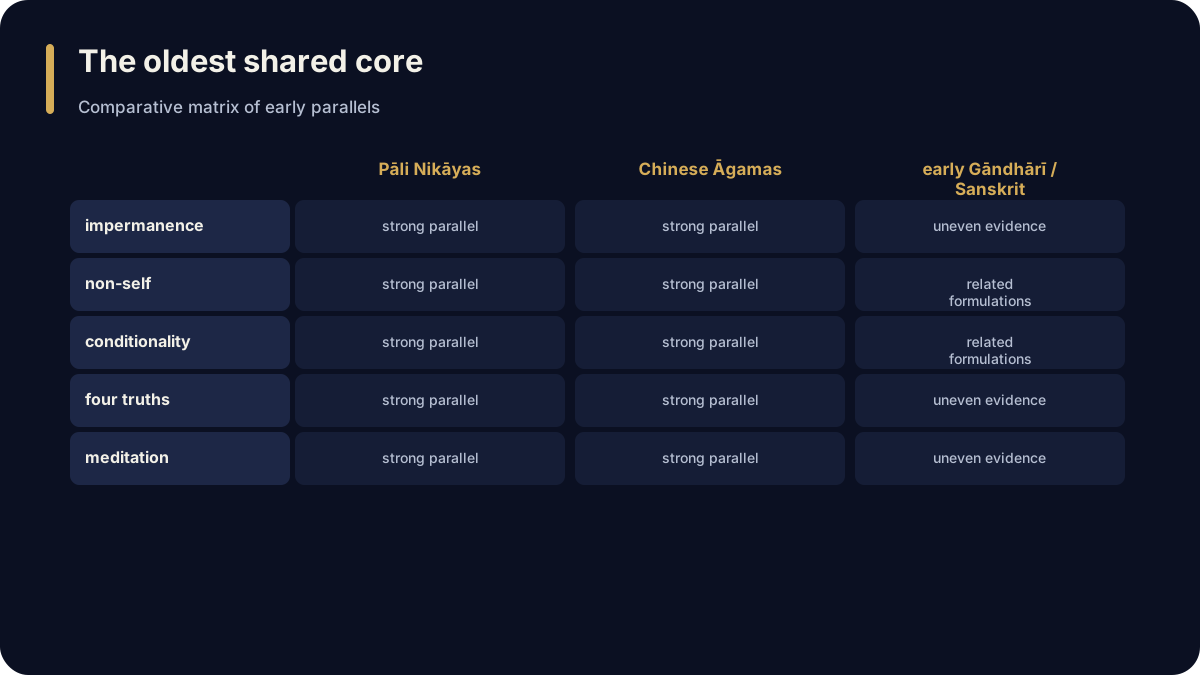
Impermanence
Anicca. Anitya. Conditioned phenomena arise. They change. And they cease. This applies to the body. Feelings. Perceptions. Mental formations. Consciousness. Moods. Meditative states. Relationships. Life. Impermanence in early Buddhism is therefore not merely the philosophical observation nothing lasts forever. It has a liberating function. If something is continually arising and ceasing, it is dangerous to expect it to provide a completely permanent identity or satisfaction. From here the question of self opens up.
Non-Self
Anattā. Anātman. This is one of the most distinctively Buddhist themes and is deeply rooted in early textual material. Early discourses analyze human experience and ask: Is the body permanent? Do we completely control it? Is it appropriate to say this is mine, this I am, this is my self? The same question is applied to feelings. Perceptions. Mental formations. Consciousness. The liberating direction is clear: do not cling to conditioned bodily and mental processes as a permanent, fully controllable self. Historical and philosophical caution nevertheless remain important. Scholars still differ on whether the earliest anattā is best understood as a categorical metaphysical denial of every possible self, or primarily as a radical practice of disidentification. We do not need to force a resolution of that dispute for this synthesis.
Something firmer is enough: abandoning the appropriation of experience as “I” and “mine” is part of the very early Buddhist project of liberation.
The five aggregates. Here the scheme of the five khandhas or skandhas becomes important: form, feeling, perception, mental formations, consciousness. They need not be understood as five substances from which a person is built. In many early discourses they are primarily domains of experience to which identification attaches. A person looks for self in the body. In feeling. In perception. In mental processes. In consciousness. The text then shows that all of this arises conditionally. All of it changes. None of it is completely under our control. Therefore none of it can safely perform the role of the permanent self we want to assign to it.
Is today’s fivefold scheme itself original? We cannot prove that. Individual analytical structures had histories. But the aggregates are represented so widely in the early corpus that it makes little sense to treat them as a late sectarian invention. They are part of a very early Buddhist way of analyzing experience.
Conditionality
The next major core is dependent arising. Paṭiccasamuppāda. Pratītyasamutpāda. Events do not arise from nothing; they appear in dependence on conditions. When conditions are present, a particular result can develop. When conditions cease, the process dependent on them can also be interrupted. Early texts express this in several ways. Sometimes in the concise logic: when this is, that is; with the arising of this, that arises; when this is not, that is not; with the cessation of this, that ceases. Elsewhere they use different chains of conditions. Among them is the famous chain that tradition often standardizes as twelve links.
Dependent arising is not just one table of twelve links. This historical safeguard matters. Early texts know different formulations and chains of different lengths. It is therefore firmer to say conditioned arising and cessation are very early than to say the exact standard twelve-link formula known today was the first and only original form of the teaching. This resembles what we have already seen with other early schemes. The core is old. The history of its systematization may be more complex.
Conditionality itself opens the possibility of liberation. If dukkha were an unchanging property of reality, liberation would be impossible. But if suffering arises dependent on conditions, another question opens: What are those conditions? Ignorance. Craving. Clinging. Intentional action. Certain patterns of perception and response. If the conditions change, the process changes. If the key conditions sustaining bondage are exhausted, the process can cease. Dependent arising is therefore directly connected with liberation. It is not merely a theory of causation.
Karma
Karma belongs to this same early world. Kamma. Literally, action. Early Buddhism inherited the concept from the wider Indian environment but connected it strongly with intention and the moral quality of action. What matters is what a person intends, says, does, and which mental qualities are cultivated. Greed. Hatred. Delusion. Or non-greed, goodwill, clarity. Karma therefore is not merely a ritual mechanism. It becomes part of the ethics and psychology of liberation.
Karma is not fate. Even in the earliest framework, karma does not mean that everything that happens to you is punishment for some past action. Early discourses explicitly reject excessively karmic-deterministic models. Present experience has multiple conditions. Karmic action matters. But it is not a cosmic punishment system that explains every illness, accident, or pain. This matters because modern popularizations of karma can quickly become something the early Buddhist texts themselves do not support.
Rebirth
Here we reach a theme that is especially sensitive for modern reconstruction. The earliest surviving Buddhist textual traditions clearly know rebirth. They know past lives, future births, karma whose consequences can extend beyond one lifetime, different possible forms of existence, and liberation from continued cycling through birth and death. This does not mean that we must accept every later technical theory of rebirth as equally old. Nor does it mean that a modern practitioner has to accept rebirth in one prescribed way. Historically, however, it is very difficult to defend the claim that the earliest Buddhism was an entirely secular psychology and rebirth was only added later. The comparative early material does not support that view.
But the oldest core does not contain every later explanation of rebirth. Theravāda scholasticism later develops its own technical models. Sarvāstivāda develops others. Yogācāra speaks of seeds and ālayavijñāna. Other schools debate an intermediate state. These systematizations are not all part of the oldest shared core. The core is more basic: as long as the key conditions of ignorance and clinging have not been removed, the saṃsāric process continues beyond death.
Cosmology is early — its details are not necessarily equally old. Cosmology is connected with this. Early texts know devas, Brahmās, Māra, heavenly realms, painful realms of existence, and different forms of rebirth. It would therefore be anachronistic to remove the entire religious cosmos from the earliest Buddhism and then declare the result historically original. But the opposite extreme would also be wrong. We do not need to assume that every later map of the heavens, every divine lifespan, and every detailed cosmographic classification is as old as the basic saṃsāric horizon. A safer distinction is: a multi-life, multi-realm cosmos is very early; detailed systematization of the cosmos has its own history.
Nirvāṇa
If birth, aging, and death are the problem of the saṃsāric process, the goal is liberation from it. Nibbāna. Nirvāṇa. In early texts it is not merely a peaceful mood, absence of everyday stress, pleasant meditation, or psychological balance. It is closely connected with the cessation of greed, hatred, delusion, craving, and the conditions that sustain further bondage. The early language is varied. Nirvāṇa can be described as cessation, peace, safety, liberation, the unconditioned, the quenching of thirst. Later schools will interpret these expressions philosophically in different ways. The oldest shared core can be formulated more cautiously: human bondage can be ended definitively.
The path to this goal is not meditation alone. Another highly stable feature of early Buddhism is the linking of several kinds of training: ethical, meditative, and cognitive. The later summary as sīla, samādhi, paññā — discipline, concentration, wisdom — captures an important structure of the early path well. Individual schemes and sequences can differ. But very early on it is clear that liberation is not the result of one isolated technique.
Ethics. Early meditation does not stand in an ethical vacuum. Important elements include non-harming, truthfulness, restraint from theft, sexual harm, and intoxication, right livelihood, discipline of speech, and the broader training of abandoning harmful mental qualities. A much more detailed Vinaya develops for monks and nuns. Ethics is not merely a social supplement before the “real meditation.” It shapes the mind with which a person meditates. A life full of deliberate harm, deception, and greed is not a neutral foundation for liberating contemplation.
Saṅgha and Vinaya. An organized community is also very early. Different schools preserve different Vinayas. Their individual rules can differ. But the shared institutional features run deep enough that monastic and female-monastic environments should not be understood as a very late addition to the Buddha’s movement. Very early on we find ordination, discipline, communal decision-making, treatment of offenses, the rains retreat, relations with lay supporters, and collective life. We do not need to claim that the Buddha personally formulated every rule later preserved. The broader conclusion is much firmer: an organized Saṅgha is an integral part of early Buddhist history.
Meditation
The same is true of systematic mental training. The early corpus knows jhānas, mindfulness, effort, observation of body, feelings, and mind, loving-kindness, concentration, and different forms of liberating insight. These practices are too widespread across different early transmissions for meditation reasonably to be treated as a later Buddhist invention. But this does not mean that all present-day Buddhist meditation techniques are unchanged methods of the Buddha. Meditative traditions developed. Mental training, however, is part of the core.
Jhāna. The jhānas or dhyānas are especially prominent. Deeply concentrated meditative states are closely integrated into several early presentations of the path. Scholars may disagree about their precise phenomenology, the relation between jhāna and insight, and the historical relationship among different models of the path. What is disputed above all is how exactly the early meditative path worked. Much less disputed is whether meditative concentration was part of early Buddhism at all.
Mindfulness. Sati or smṛti is also very early. But our article on modern mindfulness already showed an important distinction. Early mindfulness does not stand alone. It is connected with right effort, concentration, ethical life, discernment, and the goal of liberation. We therefore cannot take only observe the present moment without judgment from the early core and declare it the whole historical method of the Buddha. That is a modern reconstruction of only one part of a larger system.
Wisdom. Meditation is likewise not an end in itself. The mind is trained so that it can see differently: impermanence, arising, cessation, clinging, conditionality, non-self. Wisdom is therefore not merely knowledge of correct Buddhist propositions. A person can know intellectually that everything is impermanent and still behave desperately as though the world ought to provide permanence. The early path aims to change precisely this way of appropriating experience.
The Eightfold Path. The most famous summary of the path is right view, right intention, right speech, right action, right livelihood, right effort, right mindfulness, right concentration. The Noble Eightfold Path is unquestionably attested very early and is one of the fundamental organizing schemes of Buddhist teaching. Yet here too it is important not to confuse two claims. The first: the Eightfold Path is a very early Buddhist model. The second: we demonstrably know its completely original developmental position in relation to every other early model of the path. The second claim is much harder. Early texts also know gradual paths, tenfold formulations, and other ways of organizing training. Scholars still debate the historical relationships among them. This does not diminish the antiquity of the Eightfold Path. It only shows that even a very old model need not have been the only early model.
The Four Noble Truths
Similar caution is needed with the Four Truths. Dukkha. Its arising. Its cessation. The path. This scheme is deeply and early rooted in Buddhist literature and became one of the principal ways of summarizing the Buddha’s teaching. Standard scholarly surveys place it among the central early doctrines. Yet serious revisionist reconstructions also exist. Eviatar Shulman, for example, has argued that early formulations of the Four Truths should be understood primarily as a way of meditative perception of processes of arising and cessation, and that their later textbook interpretation need not be identical with their earliest function. This is an important thesis. But it is not a scholarly consensus that permits the statement the Four Truths have been proven to be a later systematization. The safest formulation is therefore: the Four Truths are a very early-attested and central Buddhist scheme; the precise history of their formulation and early meditative function remains debated.
We do not need one single “original scheme” in order to recognize a deeper structure. Beneath different early formulas, the same liberating logic appears very frequently: there is a problem, the problem arises conditionally, cessation is possible, and there is a way of training that leads to that cessation. This is expressed through the Four Truths, dependent arising, the Eightfold Path, gradual training, and other early schemes. The historical core is therefore firmer than the question of which of these arrangements first reached its final form.
Loving-kindness and compassion. Another correction to a widespread historical caricature is important. Early Buddhism is sometimes portrayed as a cold, individualistic path of the arahant, with compassion supposedly invented later by Mahāyāna. That picture does not hold. Early literature knows mettā or maitrī, karuṇā, non-harming, care for others, goodwill, and systematic meditations directed toward the welfare of beings. The brahmavihāras include loving-kindness, compassion, appreciative joy, and equanimity. Mahāyāna would later place compassion and the bodhisattva project within a new and extraordinarily powerful system. But it did not begin in a world without compassion.
The bodhisattva is not yet a universal ideal. Here we must distinguish development just as clearly. Early Buddhism knows the future Buddha as a bodhisatta or bodhisattva during the period before complete awakening. That is not the same as the later Mahāyāna claim that the bodhisattva project of complete buddhahood should become the normative path for a broad range of practitioners. Here we see very clearly how development works. A later tradition does not create everything from nothing. It radically expands an older motif and gives it a new central role.
The mind can be trained. This may be one of the most fundamental common denominators of early Buddhism. Mental states are not completely fixed. Greed arises. It can also cease. Hatred arises. It can be abandoned. Attention can be strengthened. Loving-kindness cultivated. Concentration developed. Harmful habits reduced. Clarity deepened. A person is therefore not condemned to remain psychologically exactly as they are now. Early Buddhism is a program of transformation.
The Buddha as teacher of the path. In early texts the Buddha is not primarily the creator of the world. He is not a cosmic judge. And liberation is generally not portrayed as the result of his personal forgiveness. He is a teacher. He discovers or rediscovers a path. He explains it. The disciple must practice. This does not mean early Buddhism lacks devotion, reverence, or faith. Saddhā matters. But trust is integrated into a path whose aim is progressively direct knowledge.
The individual is not alone. At the same time, this is not necessarily solitary individualism. The Saṅgha is essential. Teacher. Disciples. Communities of monks and nuns. Lay supporters. A social network. Recitation. Teaching. Community ethics. Liberation requires personal transformation, but early Buddhism develops within very concrete communities. They are precisely what made the preservation of the Dhamma possible.
Ritual did not disappear. Even the earliest Buddhism cannot be described fully as an anti-ritual philosophy. It knows reverence, recitation, giving, visits to teachers, monastic ceremonies, funeral practices, and fairly early, relic cults as well. The important shift in relation to parts of the Brahmanical world of the time lies elsewhere. Liberation does not depend on the correct performance of Vedic sacrifice or on ritual status by birth. Ethical conduct, mental training, and insight acquire a fundamental role.
Birth does not guarantee spiritual superiority. Early discourses repeatedly challenge the idea that Brahmin status by itself makes a person spiritually superior. What matters is conduct, character, practice, understanding. This is not the same as modern political egalitarianism. The early Buddhist world remains historically socially hierarchical. But pedigree is not the decisive criterion for the possibility of liberation. That is an important early idea.
The Middle Way. The Middle Way also belongs deeply to early Buddhist self-understanding. In the traditionally first discourse it is placed between sensual indulgence and self-mortification. But the broader Buddhist method often moves beyond other dualities as well: eternalism versus complete annihilation, fatalism versus randomness, total grasping versus self-denial. The Middle Way therefore need not mean a compromise — half pleasure, half asceticism. It can mean that both extremes have framed the problem incorrectly.
Unanswered questions. Very early texts also know the Buddha’s refusal to resolve certain metaphysical questions. Is the world eternal? Is it not? Is it finite? Infinite? What exactly happens to a fully liberated Tathāgata after death? In certain contexts the Buddha does not settle such questions. This does not mean all metaphysics is meaningless for Buddhism. Early Buddhism clearly makes substantial claims about the world, karma, rebirth, and nirvāṇa. It means that a theoretical question is not automatically important merely because it can be asked. The main criterion remains relevance to liberation.
The poisoned arrow. The famous simile of a man struck by a poisoned arrow expresses precisely this. He refuses treatment until he learns every detail about the shooter, the bow, the arrow, and its origin. Meanwhile he dies. The teaching is not do not investigate the world, but do not allow endless speculation to replace solving the problem for which the path arose in the first place. This is a highly characteristic early priority.
What, then, can most safely be included in the oldest shared core? Not one single list, but an interconnected complex. Conditioned experience is impermanent. Clinging to the conditioned produces dukkha. Bodily and mental processes cannot safely be appropriated as a permanent, fully controllable self. Suffering arises dependent on conditions. By removing key conditions, it can cease. Intentional actions have moral consequences. The early Buddhist horizon includes rebirth and saṃsāra. The mind can be trained. Ethics is part of that training. Meditative concentration is part of that training. Mindfulness is part of that training. Wisdom is part of that training. Loving-kindness and non-harming are important qualities. There is an organized community that practices and preserves the path. The final goal is liberation or nirvāṇa. This is already a fairly complete religious and philosophical project.
What about the famous lists? The Four Truths. The Eightfold Path. Five aggregates. Seven factors of awakening. Twelve links of dependent arising. Four satipaṭṭhānas. Four brahmavihāras. Many of these schemes are unquestionably very old. A historically cautious approach, however, does not require us to claim of each one that this fully standardized form known today was certainly the first form uttered by the historical Buddha. They can be very early. And they can have histories. Both can be true at once.
What is not part of the oldest shared core? Here the differences from later Buddhism become clearer. A developed theory of tathāgatagarbha. The doctrine of the Buddha’s three bodies. Yogācāra’s ālayavijñāna. Madhyamaka’s systematic critique of svabhāva. The vast cosmologies of some Mahāyāna sutras. Amitābha’s Pure Land in its developed forms. A universalized bodhisattva path toward complete buddhahood. Developed tantric practices. Later Abhidhamma or Abhidharma technical systems. Such teachings are not found as the common core of the earliest inter-school texts. This is a historical observation, not a value judgment.
Later does not mean inauthentic. This must remain completely clear throughout the project. If an idea is younger than the early Nikāyas and Āgamas, it does not follow that it is not Buddhist. Mahāyāna is Buddhist history. Madhyamaka is Buddhist history. Yogācāra is Buddhist history. Pure Land is Buddhist history. Zen is Buddhist history. Tantra is Buddhist history. Theravāda scholasticism is Buddhist history. Historical research only distinguishes what is earlier, what is later, what is shared, what is specific, what is reinterpreted, and what is newly developed.
The oldest does not mean the best either. The opposite error would be archaeological fundamentalism: if something is oldest, it is automatically assumed to be the purest, deepest, most correct, and only legitimate form. History tells us no such thing. A later tradition can develop an older idea in extraordinarily fruitful ways. It can notice a problem an earlier text did not systematically address. It can create philosophical language that significantly improves our understanding of an old intuition. Oldest and best are two entirely different categories.
But roots matter. Reconstructing the early core nevertheless allows us to see something very important: what later traditions did not create from nothing. Non-self is not an invention of Theravāda. Meditation is not an invention of modern vipassanā. Mindfulness is not an invention of MBSR. Compassion is not a Mahāyāna invention. Karma and rebirth are not late folkloric additions to an originally wholly secular system. On the other hand, Mahāyāna emptiness is not simply identical with the earliest teaching of non-self and conditionality. A later development can grow from older roots without being identical to them.
The connection with Mahāyāna. This matters for the next step. Mahāyāna does not enter Buddhist history in a vacuum. It inherits the Buddha, Dharma, Saṅgha, karma, rebirth, nirvāṇa, non-self, conditionality, meditation, ethics, compassion, and the ideal of awakening. It then reinterprets some of these elements. Radicalizes others. Moves some to the center. Adds new sutras, new cosmological horizons, new ideals, and new philosophical problems. It is therefore mistaken to ask Is Mahāyāna the same Buddhism or an entirely new religion? Historically, it is much more interesting to ask What does it preserve, what does it reinterpret, and what does it add?
The tree and its roots. A tree may still be the best image. The Buddhisms of today are many branches: Theravāda. Chan. Zen. Pure Land. Tibetan schools. Nichiren. Shingon. Modern vipassanā. Secular mindfulness. The branches are not identical. Some arose centuries after others. If we follow the trunk backward, we reach the early Indian schools. Deeper still, we reach the region where their textual traditions overlap strongly enough. That region is our approximation of the oldest shared core.
The root is not the whole tree. But we must never forget that the root cannot explain the entire tree. If we knew only the early shared corpus, we could not explain the Heart Sutra, the Lotus Sutra, Amitābha, Avalokiteśvara, Buddha-nature, Madhyamaka, Yogācāra, Zen kōans, Tibetan mantras, or modern therapeutic mindfulness. The aim of this historical series is therefore not to remove everything that developed later. It is to understand genealogy.
The oldest core is already large. When we put everything together, something perhaps surprising becomes visible. The oldest reconstructed core is not a tiny minimalist system. It already contains ethics, meditation, analysis of mind, questions of identity, moral causation, rebirth, saṃsāra, organized community, a path of spiritual training, loving-kindness, wisdom, and the final goal of liberation. This is already a recognizably Buddhist world. Later Buddhism will become vastly more diverse. But it does not begin from nothing.
And the core is not merely a collection of beliefs. This may be the most important concluding point. The oldest Buddhism is not just a package of propositions: the world is like this, the person is like that, karma works in this way. These ideas belong to a project of practice. Impermanence is something to be seen. Non-self is something that changes clinging. Dependent arising is something that reveals where a process can be interrupted. Ethics is something that changes our action and mind. Meditation is something that trains attention and concentration. Wisdom is something that changes the way experience is lived. Everything is directed toward the same question: How does the bondage that produces dukkha come to an end?
If we had to express the core in one sentence. We might synthesize it this way: Because conditioned experience arises and ceases, it cannot safely be appropriated as a permanent self or a source of permanent satisfaction; through ethical and meditative training, understanding the conditions of craving, and abandoning greed, hatred, and delusion, the process of bondage can be interrupted and liberation from dukkha and saṃsāra attained. This is not a quotation from one sutra. It is not a reconstructed sentence of the Buddha. It is not a secret original formula. It is a historical synthesis. Its individual components, however, are widely grounded in different early Buddhist transmissions.
What does this tell us about the historical Buddha? We do not obtain his literal words. We do not obtain a precise chronology of the development of every teaching. We cannot prove that he taught all five aggregates, eight factors of the path, and twelve links in a fully standardized form on the very first day of teaching. But we do gain something very important. The very early Buddhist community already knew a relatively coherent project of liberation. It did not arise only centuries later. Its outlines are similar enough across different transmissions to have survived school divisions, linguistic change, oral transmission, writing, translation, and geographical expansion. That is a strong reason to think we can know considerably more about early Buddhism than merely that once there lived a teacher named Gautama.
The root from which a new history begins to grow. We began by asking: Which sutra is the oldest? Then: What can historically be attributed to the Buddha? Why do the texts repeat so much? How do they change between oral and written transmission? Only now do we see why we needed those questions. We do not find the oldest core by selecting one sacred book. We find it at an intersection — in what survives comparison, in what is shared by sufficiently early transmissions, in what is organically connected with their ways of life and practice. The result is not one sutra. Not one list. And not modern minimalist Buddhism. It is an early path of liberation. With a conditioned world. With impermanence. With dukkha. With clinging. With karma and rebirth.
With ethics. With meditation. With wisdom. With the dismantling of identification. And with the radical claim that the process sustaining bondage can end. That is the root. The next question is: What does Mahāyāna add to that root — and what does it reinterpret within it?
Sources and Literature
Primary Texts and Reference Editions
- SuttaCentral — comparative corpus of the Nikāyas, early texts, and parallels; Āgama and transmission data are checked against specialist comparative scholarship.
Research and Verification Literature
- Anālayo, Bhikkhu. Madhyama-āgama Studies. Taipei: Dharma Drum Publishing, 2012.
- Shulman, Eviatar. Visions of the Buddha: Creative Dimensions of Early Buddhist Scripture. Oxford University Press, 2021.
Note: verification sources are part of the editorial apparatus. Where the original edition used during reconstruction was not preserved, a standard reference edition is not presented as the article’s presumed original source.