Dhammacakkappavattana Sutta — the First Discourse and Setting the Dhamma Wheel in Motion
If we had to choose a single early Buddhist sutta that presents the basic architecture of the Buddha’s teaching in just a few pages, the *Dhammacakkappavattana Sutta* would be among the strongest candidates.
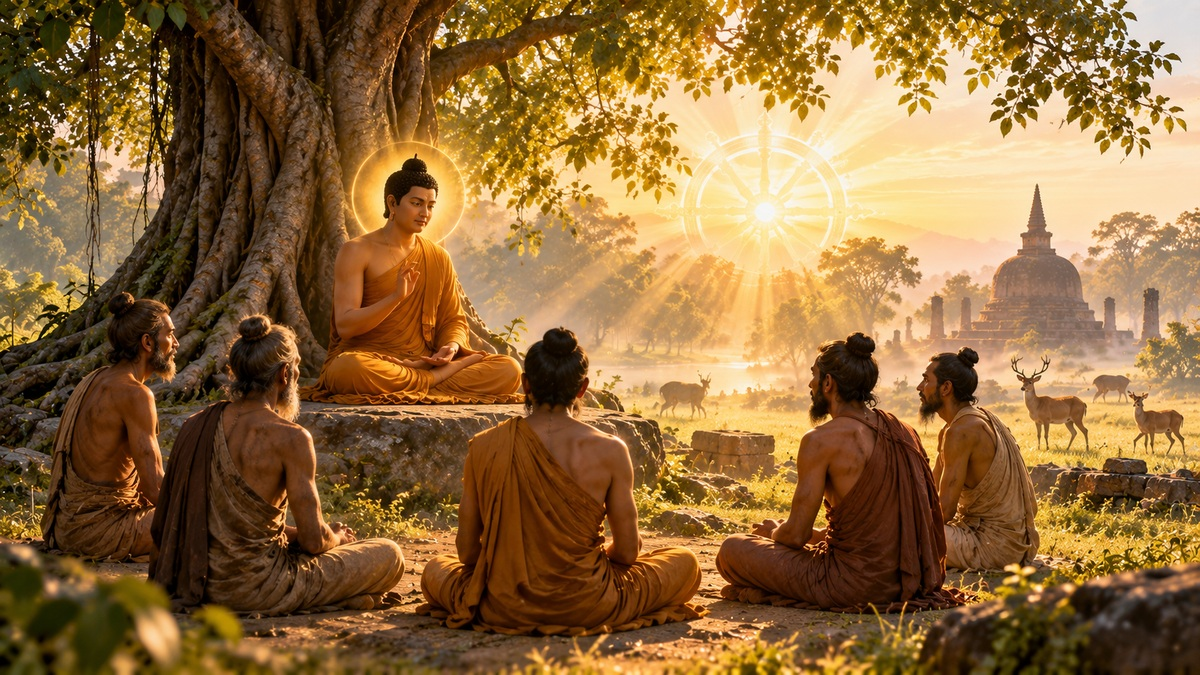
If we had to choose a single early Buddhist sutta that presents the basic architecture of the Buddha’s teaching in just a few pages, the Dhammacakkappavattana Sutta would be among the strongest candidates. It contains the two extremes, the middle way, the Noble Eightfold Path, the Four Noble Truths, an explanation of craving, the cessation of dukkha, and the demand that the truths be not merely understood but realized in practice. Theravāda tradition understands it as the Buddha’s first major discourse after awakening, and the Pāli version is preserved as Saṁyutta Nikāya 56.11. SuttaCentral likewise presents it as the first proper discourse in the narrative sequence following the Buddha’s awakening.
Even here, however, we must distinguish two questions: what tradition says and what can be established historically about the text.
Traditionally: the first discourse after awakening
According to the classical Buddhist narrative, after his awakening Siddhartha Gautama first hesitates over whether his realization can be explained to others at all. He then decides to teach. His former teachers are said to have already died, so he travels toward Vārāṇasī, or Benares. At Isipatana, in the Deer Park, he finds the five ascetics with whom he had once practiced extreme austerity: Koṇḍañña, Vappa, Bhaddiya, Mahānāma, and Assaji. They had previously abandoned him because they believed he had given up the spiritual quest when he stopped extreme self-mortification. Now he returns to them with a very different claim: the extremes themselves were the problem.
Two extremes and the middle way
The sutta begins in a strikingly practical manner. The Buddha does not start with metaphysics or a theory of the cosmos, but with two ways of life that he rejects. The first extreme is indulgence in sensual pleasure; the second is self-mortification, or extreme ascetic practice. According to the text, both are ineffective: the first binds a person to pleasure, while the second causes pain without by itself leading to liberation. This matters especially in light of the Buddha’s own narrative history. According to early sources, he himself experimented with severe ascetic practices before abandoning them. The “middle way” is therefore not an abstract compromise between two opinions, but a conclusion drawn from the failure of two strategies of life.
Today the expression is often used as a general recommendation not to go to extremes and to seek balance. In this sutta, however, it means something much more precise: the Noble Eightfold Path. The text lists right view, right intention or orientation, right speech, right action, right livelihood, right effort, right mindfulness, and right concentration. The individual Pāli terms are translated somewhat differently in modern translations, but the structure remains the same. The sutta presents this as the path leading to peace, direct knowledge, awakening, and nibbāna. The middle way, then, is not merely moderation. It is a method.
The Four Noble Truths
The first Noble Truth concerns dukkha. The word is often translated as “suffering,” but that English term can be too narrow. Dukkha includes obvious pain as well as the deeper unsatisfactoriness of conditioned existence. The sutta lists birth, aging, illness, death, association with what we dislike, separation from what we love, and failure to obtain what we want. It then sums this up in the expression the five aggregates subject to clinging. The problem is therefore not only that life contains unpleasant events. It reaches more deeply into the way we cling to material form, feeling, perception, mental formations, and consciousness.
This also corrects the popular slogan that Buddhism teaches that “life is suffering.” Early texts know joy, contentment, love, meditative happiness, and pleasant feeling. The problem is not that the pleasant does not exist, but that it is conditioned, changeable, and therefore unreliable as a permanent basis of satisfaction. The first truth requires recognition of dukkha, not denial of everything pleasant.
The second Noble Truth asks about the origin of dukkha and answers with the term taṇhā, often translated as “craving,” “thirst,” or “desire.” The text distinguishes craving for sensual pleasure, craving for continued existence, and craving for non-existence or the ending of existence. Importantly, the sutta does not declare every desire problematic. Early Buddhist texts also know wholesome wishes or intentions — for example, the wish to cultivate what is good, to meditate, or to attain liberation. The problem is taṇhā: craving that grips experience and demands more, again, otherwise, or never-ending continuation. This is far more precise than the slogan that Buddhism teaches that we should desire nothing.
The third Noble Truth concerns the cessation of craving. If dukkha has a cause, the logical question is what happens when that cause is removed. The text uses expressions of abandoning, relinquishing, release, and cessation, and associates this process with nibbāna, or nirvāṇa. Here lies one of the decisive moves in Buddhist teaching. The sutta does not ask a person merely to accept life as suffering, but makes a more radical claim: the problem has a cause, and the cause can be removed. Without the third truth, Buddhism would be only a diagnosis; with it, it becomes a teaching of liberation.
The fourth Noble Truth leads back to the Noble Eightfold Path. The middle way is therefore the Eightfold Path, and the Eightfold Path is also the fourth Noble Truth. The Four Truths are consequently not merely four theories about life; the last one is practice. They are often compared with a medical structure — illness, cause, possibility of cure, and treatment — but the sutta itself does not employ this analogy in that form. It is a later explanatory model, not a direct quotation from the discourse.
The Four Truths also have tasks
The discourse does not end with the presentation of the Four Truths. Each has three stages of knowledge: first, recognition that this is a truth; second, understanding what must be done with regard to it; and third, knowing that this has been done. Dukkha is to be fully understood, its origin abandoned, cessation realized or directly known, and the path developed. Four truths multiplied by three stages yields twelve aspects.
According to the narrative, the Buddha did not proclaim complete awakening until his knowledge of all four truths in all three rounds was perfectly purified. This substantially changes the way we read them. Buddhism here does not merely ask us to believe in the Four Noble Truths. The first must be understood, the second abandoned, the third realized, and the fourth developed. This is a program of work, not merely a list of beliefs.
Koṇḍañña and the first transmission of the Dhamma
At the end of the discourse, one of the five ascetics, Koṇḍañña, gains the so-called “Dhamma eye.” His realization is summarized in the formula that whatever has the nature of arising is subject to cessation. This matters for two reasons. First, someone other than the Buddha understands the Dhamma, which means the path is transmissible. Second, the decisive insight concerns arising and cessation, linking the discourse on the Four Truths with the wider Buddhist emphasis on conditionality and impermanence.
The title of the sutta contains the image Dhamma-cakka-pavattana — setting in motion, turning, or causing the wheel of Dhamma to roll. The wheel is an ancient Indian symbol of sovereignty and expanding power; the ideal universal ruler is the cakravartin, the “wheel-turner.” Buddhist tradition transforms the motif. The Buddha does not turn a political or military wheel, but the wheel of Dhamma. At the close of the sutta, divine beings proclaim that the wheel of Dhamma has been set in motion and cannot be stopped by any other being. The Pāli version adds a pronounced cosmic setting with deities, an earthquake, and light.
Comparison of different versions, however, shows that not all of this cosmic conclusion is necessarily equally old. In comparing parallels, SuttaCentral notes that some versions lack the entire passage about divine beings and the cosmic proclamation, raising the possibility that this portion was added or expanded later in some transmission lineages. This is a good example of the relationship between a stable old core and different later textual layers. The central teaching on the middle way and the Four Truths is strongly rooted in the early Buddhist corpus, while the exact narrative and cosmic decoration can vary among versions.
Was this really the Buddha’s first discourse?
Traditionally the answer is clear: yes. The text is placed as the first major teaching the Buddha gives after awakening to his five former companions. Historically, we cannot prove this in the sense of knowing that Gautama spoke exactly this text, in this order, on a particular day. We know the discourse through traditions that transmitted it for centuries. The existence of related versions outside Pāli, however, shows that the narrative of the first turning of the wheel and its fundamental doctrinal core belong to a very old Buddhist textual tradition.
The safest formulation is therefore that Buddhist traditions very early associated the Buddha’s first public teaching with the middle way, the Four Noble Truths, and the group of five ascetics. This is historically stronger than assuming that we possess a verbatim transcript of the first discourse, and more cautious than the opposite extreme of treating the whole story as a late invention.
Why is this sutta so important?
Because within a very small space it links the two extremes, the middle way, the Eightfold Path, dukkha, craving, nibbāna, practice, direct realization, and the first disciple who, according to the narrative, understands the Dhamma. Almost equally important, however, is something the discourse does not yet explain in detail: what exactly non-self means, what the five aggregates mentioned in the first truth are, and why we should not take them to be ourselves.
The next great discourse in the traditional sequence answers that question: the Anattalakkhaṇa Sutta — the discourse on the characteristic of non-self. There it becomes clear that the Four Noble Truths are not only a teaching about suffering, but the beginning of a far more radical analysis of what we ordinarily call the self.
Sources and literature
Primary texts and reference editions
- SuttaCentral: SN 56.11 (Dhammacakkappavattana Sutta), translated by Bhikkhu Sujato.
Research and verification literature
- SuttaCentral. Early Buddhist texts, translations, and parallels. For English Pāli translations, principally Bhikkhu Sujato. Dynamic digital corpus; cite individual text IDs where possible.
Note: verification sources are part of the editorial apparatus. Where the original edition used during reconstruction was not preserved, a standard reference edition is not presented as though it were the presumed original source of the article.