Dhammapada — 423 Verses on Mind, Ethics, and the Path
If we had to choose one Buddhist book that has become almost synonymous around the world with “sayings of the Buddha,” the *Dhammapada* would be among the first candidates. Its short verses and vivid moral images speak about mind, anger, violence, craving, death, wisdom, the path, and nibbāna.
If we had to choose one Buddhist book that has become almost synonymous around the world with “sayings of the Buddha,” the Dhammapada would be among the first candidates. Its short verses and vivid moral images speak about mind, anger, violence, craving, death, wisdom, the path, and nibbāna. But at the outset we need to correct one very widespread idea. The Dhammapada is not a book written by the Buddha. Nor is it a single sutta. It is an anthology of verses. In the Pāli Canon it contains 423 verses arranged in 26 chapters and belongs to the Khuddaka Nikāya of the Sutta Piṭaka. Its history, however, is considerably more interesting than the simple label “423 sayings of the Buddha.”
What does Dhammapada mean?
The title is composed of Dhamma and pada. As we have already seen several times, Dhamma has a broad range of meanings: teaching, truth, phenomenon, principle. Pada can mean a step, footprint, path, word, verse, or saying. The title is therefore translated in various ways: Words of the Dhamma, Path of the Dhamma, Verses of the Dhamma, Words of the Teaching. No translation is perfect. In this series we will retain the traditional name Dhammapada and explain it on first occurrence as a collection of verses or words of the Dhamma.
423 verses, 26 chapters
The Pāli Dhammapada is arranged thematically. Its chapters have titles connected with motifs such as pairs, heedfulness or diligence, mind, flowers, fools, the wise, the arahant, thousands, evil, violence, old age, self, the world, the Buddha, happiness, the pleasant, anger, impurities, the just, the path, miscellaneous themes, hell, the elephant, craving, the monk, and the brahmin. Together they form 26 chapters and 423 verses. But the chapters are not a systematic textbook. The Dhammapada is not organized as chapter 1 = epistemology, chapter 2 = ethics, chapter 3 = meditation. It is a collection of short verses arranged around recurring motifs.
Did the historical Buddha speak every verse? That is a much harder question. Theravāda tradition attributes the verses to the Buddha, and later commentaries often attach to each verse a story about the event on which he supposedly uttered it. Historically and critically, however, we cannot simply accept this as a stenographic record. The Dhammapada contains very old material. Some verses have linguistic features that point to early layers. But the collection almost certainly developed over a longer period and took shape as an anthology of already circulating verses. The safest formulation is therefore: the Dhammapada preserves very early Buddhist verses, but it cannot be demonstrated that every one of its 423 verses is a verbatim saying of the historical Buddha in the form in which we read it today.
The strongest evidence: there are other Dhammapadas
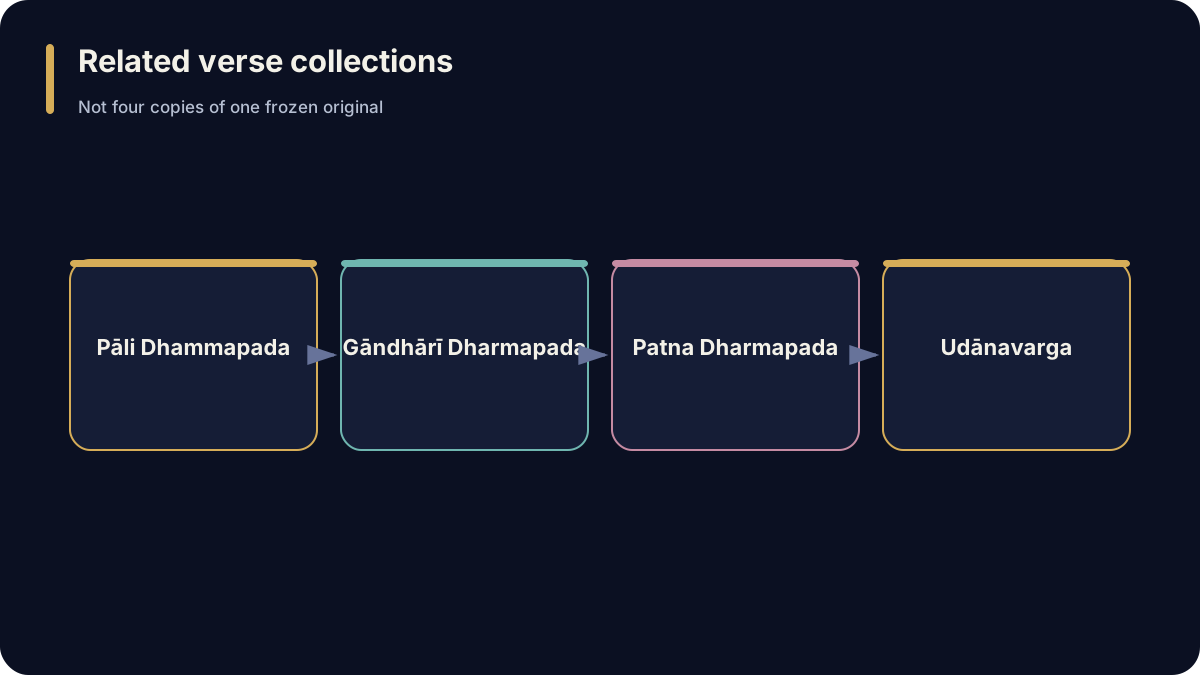
If we possessed only the Pāli Dhammapada, we might understand its history quite simply. But there is more than one. Related Buddhist verse collections have survived in different languages and school traditions, including the Gāndhārī Dharmapada, the so-called Patna Dharmapada, the Sanskrit Udānavarga, and other parallels. The Gāndhārī manuscript is especially important. Written in Kharoṣṭhī script, it belongs to the northwestern Indian or Central Asian Buddhist world. Its arrangement and selection of verses differ from the Pāli Dhammapada. This is extremely important. It means that early Buddhism did not possess only one unchanging book called the Dhammapada that all schools simply copied.
There were related collections of verses that developed within different lines of transmission.
The verses circulated. This helps us understand how a collection of this kind could arise. Individual verses may have circulated orally, within suttas, in the Vinaya, as independent sayings, in mnemonic collections, and later in organized anthologies. Different communities could select them, rearrange them, combine them, add material, or place them in different chapters. This is why between the Pāli Dhammapada and other early collections we find identical or very similar verses, different ordering, different textual variants, and verses that occur only in one tradition. This is very similar to what we have already seen with the Nikāyas and Āgamas: a shared tradition, different lines of transmission.
The Dhammapada is not a summary of all Buddhism. Because of its popularity, it is easy to get the impression that if you read the Dhammapada, you know the whole of Buddhism. You do not. The Dhammapada is an excellent doorway into early Buddhist ethics and practice, but it does not provide systematic explanations of dependent origination, the five aggregates, the four jhānas, satipaṭṭhāna, detailed Vinaya, Abhidhamma, or all the nuances of the four noble truths. It is a collection of compressed verses. That is its strength — and its limitation.
First theme: the mind
The best-known opening of the Dhammapada speaks about the mind. The first two verses essentially say: experience or mental states are led by the mind; if a person speaks and acts with an impure mind, suffering follows; if they speak and act with a pure mind, happiness follows. This is sometimes translated almost as “everything is created by the mind.” But such a rendering can easily slide into idealism: the world exists only because I think it. That is not necessarily what the verse means. More cautiously: mind or intention powerfully shapes the moral and experiential quality of our actions and their consequences. The Dhammapada begins with responsibility, not metaphysics.
“Hatred does not end through hatred.” Verses 3–5 are among the best known in all Buddhist literature. A person may keep repeating: “he insulted me,” “he struck me,” “he defeated me,” “he robbed me.” If we cling to such thoughts, hatred does not cease. Then comes the famous idea: hatred does not end through hatred; it ends through non-hatred. This connects directly with our article on mettā. It is not an invitation to let others do whatever they want to you. It is a psychological and ethical observation: revenge by itself does not remove hatred.
Diligence versus heedlessness. The second chapter is devoted to appamāda — diligence or vigilant care. This is the same word we have just encountered in the Buddha’s final words in DN 16. The Dhammapada places it almost at the center of the path. Diligence leads toward the deathless, or nibbāna. Heedlessness leads toward death. This does not mean biological immortality. It contrasts the path of liberation with a life consumed by attachment, automatism, and death.
The mind is difficult to master. The chapter on mind uses vivid images. The mind is restless, rapidly changing, difficult to restrain, difficult to control. A wise person straightens it as a fletcher straightens an arrow. This is a very different image from the modern slogan “just accept every thought.” Early Buddhist practice includes observing the mind and training the mind. We already saw this in the Ānāpānasati Sutta.
Flowers and death. The Dhammapada often uses everyday images: a flower, foam, an arrow, a house, a cart, an elephant, a river, a path. One reason for its popularity is precisely this ability to turn an abstract idea into an image. A person occupied with gathering pleasures can be compared to someone gathering flowers while death carries them away. This is not a philosophical treatise. It is poetry made for memory.
Fools and the wise. Many verses are built around contrast. The fool is set against the wise, the heedless against the diligent, the violent against the nonviolent, and the clinging against the liberated. Such contrasts are not subtle personality analysis. They are a didactic method. A verse must be short, memorable, and clear. The Dhammapada therefore often speaks in more absolute contrasts than we would expect from a long philosophical discussion.
“Better one meaningful verse than a thousand empty ones.” The Dhammapada repeatedly plays with its own form. Better than a thousand meaningless words is one meaningful word that brings peace. Better than a thousand worthless verses is one verse that a person understands and through which they become calmer. This is almost a manifesto of the Dhammapada itself. What matters is not the quantity of words but the effect of understanding.
Evil and responsibility. The Dhammapada strongly emphasizes: do not underestimate evil. Do not underestimate good. Drop by drop, a vessel is filled. A person can gradually fill themselves with what is harmful or what is good. This is one of the most practical ethical ideas in the collection. Major changes of character do not necessarily result from one dramatic event. They arise through the repetition of small actions.
Violence. A very powerful chapter speaks about violence. All beings fear punishment. All beings fear death. Comparing others with oneself, one should neither kill nor cause killing. This is not developed into a modern theory of human or animal rights. But the moral logic is clear: others experience pain and fear just as I do. This connects directly with mettā and karuṇā.
Old age. The chapter on aging is much darker. The body grows old, the skin wrinkles, life approaches its end, and bones decay. The Dhammapada does not try to beautify aging. But again, the aim is not despair. The point is to stop living as though we had infinite time. That is appamāda.
“You are your own refuge.” The Dhammapada also contains famous verses about the self: a person is their own protector or refuge. But as with DN 16, we should not turn this into the modern slogan “you need no one.” The same canon emphasizes teachers, community, good friendship, and the Dhamma. The meaning is closer to this: no one can do the practice in your place. A teacher can point out the path. You must walk it yourself.
Buddha-vagga. The chapter on the Buddha does not narrate his biography. It emphasizes awakening, absence of craving, the path, refuge in the Buddha, Dhamma, and Saṅgha, the four noble truths, and the noble eightfold path. This shows that the Dhammapada is not merely a collection of general morality. Its core is specifically Buddhist.
Happiness. A surprising number of verses speak about happiness. But happiness is not primarily possession, victory, or prestige. One famous motif says approximately: we live happily among the hostile without hostility. Elsewhere, contentment is great wealth. Nibbāna is the highest happiness. The Dhammapada therefore does not reject the idea of happiness. It transforms it.
Anger. The chapter on anger speaks of overcoming anger with non-anger, evil with good, stinginess with giving, and falsehood with truth. Here too the ethic is not passive. It is about actively cultivating the opposite quality. This connects well with the Kālāma Sutta: not merely recognizing a harmful state, but developing its opposite.
The path
The Maggavagga chapter contains some of the most explicitly Buddhist verses. The noble eightfold path is the best path. The four noble truths are the fundamental vision. All conditioned things are anicca — impermanent. All conditioned things are dukkha. All phenomena are anattā — non-self. These are the famous verses 277–279. Especially important is the distinction: for impermanence and dukkha the verse speaks of saṅkhārā — conditioned formations; for non-self it speaks of dhammā — all phenomena. This is one of the most terminologically interesting formulas in the entire Dhammapada.
Craving. The chapter on craving uses the image of a vine. Taṇhā grows and coils around a person. If we cut away only the visible part, it can sprout again from the root. This is a very effective image of the Buddhist problem: it is not enough temporarily to remove the object of desire. One has to understand the root of clinging.
The monk. The chapter on the monk emphasizes restraint of the senses, speech, and mind, contentment, solitude, meditation, and the abandonment of attachment. It is a reminder that the Dhammapada arose within a primarily monastic Buddhist world, even though it later became highly popular among laypeople as well.
The brahmin — but not by birth. The final chapter is titled Brāhmaṇavagga. But “brahmin” here does not simply mean a person born into the brahmin caste. The Dhammapada redefines the term. A true brahmin is one who has overcome attachments, is liberated, without hatred, disciplined, and has reached the end of the path. The final verses intensify this definition all the way to the arahant who has ended further birth. This is an important Buddhist strategy. It takes a prestigious brahmanical term and transforms it from birth into spiritual attainment.
Does the Dhammapada teach karma? Yes, but often in highly compressed form. Bad action brings painful consequences. Good action brings pleasant consequences. A person is followed by the results of their conduct. But this does not amount to the simplistic formula every misfortune that happens to you is punishment for some previous action. Such fatalism would be too crude. The Dhammapada primarily emphasizes: actions shape a person and have consequences.
Why is it so popular?
Because it can be read on several levels: as an ethical collection, meditation instruction, poetry, a mnemonic handbook, a religious text, or philosophical aphorisms. A single verse can be read in a minute. Yet some verses open onto entire Buddhist doctrines. This is an ideal form for recitation and memorization.
But the commentaries add another layer. The later Pāli commentarial tradition often attaches a story to each verse or group of verses: who was present, what happened, why the Buddha uttered the verse. These stories became very popular and an important part of Buddhist narrative tradition. But we should not automatically equate their age with that of the verses themselves. A verse may be very old, while its later explanatory story may be considerably younger. This is the same problem we encountered with the Mettā Sutta.
The Dhammapada and other Dharmapadas
Comparison with the Gāndhārī Dharmapada, the Patna Dharmapada, and the Udānavarga shows something important: there was not simply one early collection from which all the others copied. A more likely picture is a network of circulating verses and local anthologies. The Gāndhārī manuscript, preserved on birch bark in Kharoṣṭhī script, is one important piece of evidence for this wider world. Its arrangement of verses differs noticeably from the Pāli version. This means: the Pāli Dhammapada is one exceptionally important branch of a broader early Buddhist verse tradition. Not the only one.
Can we reconstruct the “original Dhammapada”? Probably not in any simple sense. Different collections transmitted and preserved verses in different forms over the course of history. Researchers therefore point out that the history of their relationships is complicated by transmission, rearrangement, borrowing, and textual contamination. We can compare individual verses, search for older forms, and identify those with very broad early distribution. It is much harder to reconstruct one single book called “The Original Dhammapada” that everyone once possessed.
The title “423 sayings of the Buddha” is therefore somewhat misleading. As a popular label it is understandable. Historically, however, it gives the wrong impression: as if the Buddha once spoke 423 aphorisms and someone wrote them down in today’s order. Much more precisely: the Dhammapada is an early Buddhist anthology of 423 Pāli verses, traditionally attributed to the Buddha, preserving material from a broader and older verse tradition. That is less spectacular, but more interesting.
Which verses will we translate?
The complete Dhammapada has 423 verses. For this project we will not currently produce a complete translation, because that would become a book project in its own right. Instead, the translation selection will cover the major cores of the collection. A proposed representative selection:
1–2 — mind and the consequences of actions 3–5 — hatred and non-hatred 21–23 — appamāda, diligence 33–35 — the difficult-to-control mind 50 — look at your own actions, not the faults of others 100 — one meaningful verse is better than a thousand empty ones 129–130 — all beings fear violence and death 153–154 — the famous verses on the “house-builder” 160 — a person is their own protector 183–185 — the famous summary of Buddhist ethics 197–200 — living without hatred, craving, and possession 223 — overcome anger with non-anger 276 — Buddhas only show the path; the effort belongs to the practitioner 277–279 — anicca, dukkha, anattā 354 — the gift of the Dhamma surpasses all other gifts 368–376 — a selection from the chapter on the monk 393, 396, and the concluding 423 — what “brahmin” means in the Buddhist sense.
This will give us approximately 25–30 verses, enough to present the collection without creating a pseudo-“abridged Dhammapada.”
Three passages will require special caution. First: Dhammapada 1–2. We will not translate them in a way that sounds like “the mind creates physical reality.” The emphasis will be on the primacy or leading role of mind in experience and action. Second: 153–154 — the “house-builder.” Tradition connects these with the Buddha’s awakening and the destruction of craving. But the historical connection of the verses with the precise moment of awakening belongs to tradition, and we will label it as such. Third: 277–279. Here we must consistently preserve the distinction: sabbe saṅkhārā aniccā — all conditioned formations are impermanent; sabbe saṅkhārā dukkhā — all conditioned formations are dukkha; but sabbe dhammā anattā — all phenomena are non-self.
This change of term is not accidental. And it matters for the later discussion of nibbāna and non-self.
So what is the Dhammapada?
It is not one sutta, a transcript of 423 statements, the whole of Buddhism in miniature, or merely a collection of pleasant quotations. It is an early Buddhist anthology of verses, shaped for memorization, recitation, teaching, ethical orientation, and meditative reflection. Again and again it returns to themes we have already encountered: mind, action, dukkha, impermanence, non-self, craving, nonviolence, diligence, training, the path, nibbāna. But now in their most compressed form: one verse, one image, one thought that can be carried with you.
Conclusion
The Dhammapada became one of the most popular Buddhist books precisely because it is so accessible. But accessibility can be deceptive. Behind a simple sentence there may lie an old oral tradition, several different verse variants, a complex Buddhist technical term, or an entire teaching that other suttas explain over dozens of pages. We will therefore not read it as a collection of internet quotes by the Buddha. We will read it as one of the most important surviving branches of the early Buddhist verse tradition. With this we conclude the first major section: the core of early Buddhism. The next step will change perspective. Until now we have read individual important texts. Now we will ask: How are these discourses actually organized within the great early collections?
We will begin with Dīgha Nikāya — why are some of the Buddha’s discourses so long?
Sources and further reading
Primary texts and reference editions
- SuttaCentral: Dhammapada (Dhp), translation by Bhikkhu Sujato.
Research and verification literature
- SuttaCentral. Early Buddhist texts, translations, and parallels. For English Pāli translations, principally Bhikkhu Sujato. Dynamic digital corpus; cite individual text IDs where possible.
Note: verification sources are part of the editorial apparatus. Where the originally used edition was not preserved during reconstruction, a standard reference edition is not presented as the presumed original source of the article.