Karaṇīya Mettā Sutta — How Far Should Goodwill Extend?
After four articles on dukkha, non-self, mindfulness, and breathing, early Buddhism could begin to seem almost cold. Observe. Analyze. Do not cling. Let things pass. But there is another side.

After four articles on dukkha, non-self, mindfulness, and breathing, early Buddhism could begin to seem almost cold. Observe. Analyze. Do not cling. Let things pass. But there is another side. Mettā. Goodwill. Loving-kindness. The wish that other beings may live safely, free from hatred, and in well-being. The Karaṇīya Mettā Sutta is one of the shortest and most frequently recited texts in Theravāda Buddhism. It is preserved as Sutta Nipāta 1.8 and also as Khuddakapāṭha 9. It consists of ten short verses that first describe the character of a person seeking peace and then extend goodwill to all living beings without exception. Because the text is short and foundational, we will translate it in full.
The forest story is not part of the sutta itself. In traditional explanations, the Mettā Sutta is often connected with a story about monks who went into a forest to meditate. According to a later commentary, their presence disturbed the tree deities or spirits living there. These beings allegedly frightened the monks, who then returned to the Buddha. He gave them the practice of mettā, and when they returned to the forest, the relationship between the monks and the beings is said to have changed. The story strongly influenced the later use of the sutta as a protective chant. But it is not part of the basic ten verses of Sn 1.8. We will therefore distinguish the canonical text from the later commentarial narrative.
What does mettā mean?
The Pāli term mettā is related to the word mitta — friend. It is translated in several ways: loving-kindness, goodwill, friendly benevolence. In this series, our main English rendering will be goodwill, while also using loving-kindness where useful. Why not simply “love”? Because “love” can sound romantic, possessive, or primarily emotional. Mettā does not require us to feel the same emotional closeness toward every being. Its core is closer to: may you be well; may you be safe; may I wish you no harm. This is why Thanissaro Bhikkhu translates it as goodwill.
The sutta does not begin with “love everyone”
The opening verses do not directly speak about other beings at all. They begin with the practitioner. A person who wishes to reach a state of peace should be capable, upright, straightforward, easy to instruct, gentle, not conceited, content, undemanding, with few duties, living simply, with calm senses, prudent, and not greedy for the support of others. Mettā is not merely a meditative feeling. It begins with a way of life.
An ethical foundation. The text then says that one should not do even the slightest thing for which the wise could rightly criticize them. This means that goodwill is not a substitute for ethics. It is not enough to say: “I have love in my heart.” If at the same time we lie, humiliate, manipulate, or cause harm, the practice is incomplete.
“May all beings be happy.” Then the best-known part begins. May beings be happy, safe, and at ease in their hearts. The text then systematically removes exceptions. Weak or strong. Great or small. Long or short. Subtle or coarse. Visible or invisible. Near or far. Already born or seeking birth. All beings. This is the heart of the sutta. It does not merely define a pleasant feeling. It expands its range.
How far does mettā extend?
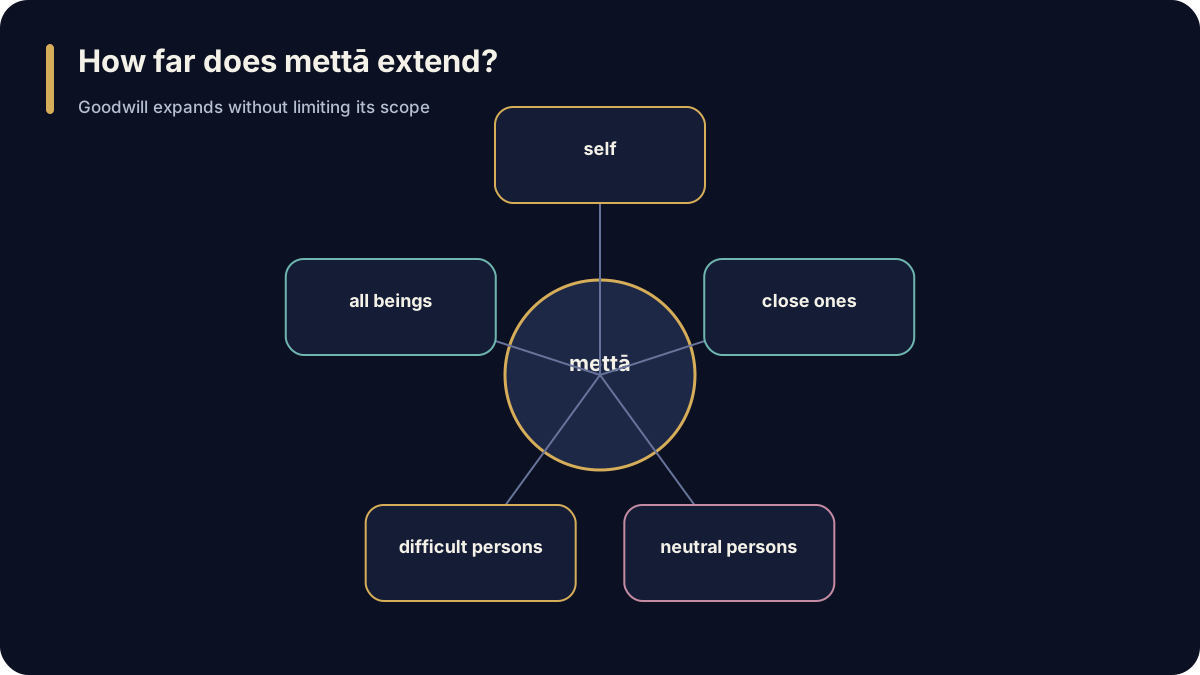
The shortest answer is: until no one remains outside. Goodwill is not reserved only for friends, family, our group, our religion, our nation, or even only for human beings. The text speaks of all living beings. This is a radical expansion of the moral circle.
Goodwill does not mean that everything is permitted. Mettā does not mean: “Every action is acceptable.” We can wish someone well and at the same time say: what you are doing is harmful. We can set a boundary, prevent harm, or refuse someone. The difference is that we do not need hatred, humiliation, dehumanization, or a wish for that person to suffer. Goodwill concerns the being. It does not mean approving every action of that being.
No deception, contempt, or wish to harm. The sutta says this directly. Let no one deceive another. Let no one despise anyone. Let no one, out of anger or aversion, wish suffering upon another. The opposites of mettā are therefore very concrete: deception, contempt, hostility, the wish to harm.
A mother and her only child
Then comes the most famous image in the entire sutta. A mother would protect her only child with her own life. The text then links this comparison with a boundless heart toward all beings. It is often understood as: develop toward all beings a love as strong as the love a mother feels for her only child. That is an understandable reading. But there is also a more precise grammatical interpretation. Thanissaro Bhikkhu points out that the comparison may not be directly child = all beings, but rather a mother protecting her child = the practitioner protecting their boundless mind of goodwill. Just as a mother guards her only child, the practitioner should guard a state of mind that excludes no being. In this article we will preserve both possibilities. We do not need false certainty where the text permits less.
A boundless mind. Goodwill is then to be extended upward, downward, and in every direction, without obstruction, without hatred, without hostility. Here we arrive at the classical concept of brahmavihāra. Mettā is one of the four sublime states of mind: mettā — goodwill, karuṇā — compassion, muditā — joy in the good fortune of others, upekkhā — equanimity. This sutta focuses primarily on mettā.
Why “boundless”? Because ordinary goodwill is almost always selective. We wish well to our own. We are neutral toward strangers. We wish defeat upon enemies. Mettā attempts to move beyond precisely this structure. It does not require us to judge all people in the same way. It does not require us to trust everyone. But it does require that the wish for well-being not be limited only to our own group.
Standing, walking, sitting, and lying down. The text then says that one should maintain this orientation while standing, walking, sitting, and lying down, as long as one is awake. This again recalls the Satipaṭṭhāna Sutta. Meditation is not confined to a special posture. Mettā is meant to become a way of being.
The dwelling of Brahmā
The sutta calls this state brahmavihāra, the dwelling of Brahmā or a sublime abiding. This does not mean worship of a single creator-god Brahmā. It is an ancient Indian expression for an exalted state of mind that Buddhism incorporates into its own meditative system.
But the final verse changes the tone. The text does not end with “wish everyone well.” The last verse adds: not being caught in views, being virtuous, possessing perfected or clear vision, and overcoming greed for sensual pleasures. Then comes an exceptionally strong traditional claim: such a person does not return to the womb again. That means: there is no further birth. Caution matters here. The sutta does not attribute this result to a single pleasant feeling of mettā alone. Before the final line it also names virtue, vision, non-clinging to views, and the overcoming of sensual craving. We will therefore not turn the text into the slogan: “Just love everyone and you automatically attain nibbāna.” Its framework is broader.
Mettā is not the same as karuṇā. We will need this distinction later. mettā: may you be well. karuṇā: may your suffering be removed. Goodwill and compassion overlap strongly, but they are not the same technical term.
Goodwill is not attachment. This may be one of the most important distinctions. Buddhism sharply distinguishes mettā from taṇhā — craving. If my benevolent feeling depends on “be mine,” “love me,” “give me your attention,” or “do not leave me,” then it contains a great deal of clinging. Mettā wants something different: may you be well, even if I do not possess you. That is a fairly radical form of love.
The connection with non-self. At first glance the Anattalakkhaṇa Sutta and the Karaṇīya Mettā Sutta seem completely different. The first dismantles identification. The second expands goodwill. But there is an important connection. Much of our moral world is divided into self, mine, ours, and others. As this identification becomes less rigid, it becomes possible to widen the circle of beings whose well-being we take seriously. Mettā is therefore not the opposite of non-self. It can be understood as one of its ethical consequences.
The connection with mindfulness. The link with Satipaṭṭhāna is also clear. Mindfulness can notice: anger is present. Mettā adds: what will we cultivate instead? Buddhist practice is not merely observing whatever appears. It also includes abandoning certain states and developing others. Goodwill is one of the clearest examples.
Why did the sutta become a protective chant?
In Theravāda traditions, the Karaṇīya Mettā Sutta became an important paritta — a protective chant. This makes sense within the later story of the monks, forest beings, and the protective power of boundless goodwill. But we need to distinguish mettā as the content of the canonical text from the ritual functions the text acquired over the course of history. This allows us to preserve both tradition and historical analysis without confusing the two.
Why is such a short sutta so important? Because it asks an extraordinarily simple question: Whom do you actually wish well? Only yourself? Your own people? Friends? People who agree with you? Or can goodwill remain even when there appears an opponent, a stranger, someone unpleasant, or someone who has done something wrong? At that point the sutta stops being merely a beautiful poem. It becomes a demanding practice.
Mettā is not “positive energy.” The most superficial version would be: “Be nice and spread positive energy.” But the text asks for more. Be upright. Be honest. Do not be conceited. Live simply enough. Do not deceive. Do not despise. Do not wish suffering. Develop boundless goodwill. Do not cling to views. Develop clear vision. Overcome sensual craving. This is a considerably more demanding project than general niceness.
Two major directions of practice. The first four great discourses we examined emphasized understanding, impermanence, non-self, mindfulness, calming, insight, and letting go. The Karaṇīya Mettā Sutta adds our relationship to other beings. It becomes increasingly clear that the Buddhist path is not only a question of what do I understand? It is also: what kind of person am I becoming? If meditation makes a person more concentrated but colder, more disciplined but more contemptuous, calmer but without goodwill, then something is missing. Mettā is one of the answers.
Conclusion
The Karaṇīya Mettā Sutta is short, but its arc is remarkably broad. It begins with a person’s character. It continues with ethical conduct. Then it extends goodwill to all beings, without exception, without hatred, without the wish to harm. Finally it places that goodwill back within the broader path of virtue, clear vision, non-clinging, and liberation. Mettā is therefore not a sentimental addition to Buddhism. It is a training of the mind in which the boundary of “me and mine” ceases to determine whom we wish well. The next sutta opens a different question. What should we do when different teachers, traditions, and authorities make conflicting claims? How should a person decide what to believe? Kālāma Sutta — did the Buddha really teach: “believe nothing”?
Sources and further reading
Primary texts and reference editions
- SuttaCentral: Sn 1.8 / Khp 9 (Karaṇīya Mettā), Bhikkhu Sujato.
- Thanissaro Bhikkhu, trans., “Karaṇīya Mettā Sutta: Good Will,” Access to Insight.
Research and verification literature
- Thanissaro Bhikkhu, trans. “Karaṇīya Mettā Sutta: Good Will” (Sn 1.8). Access to Insight, 2004; rev. 2013.
Note: verification sources are part of the editorial apparatus. Where the originally used edition was not preserved during reconstruction, a standard reference edition is not presented as the presumed original source of the article.