What Do Buddhist Traditions Share? — What Remains Common from Theravāda to Zen and Vajrayāna
When someone first looks at global Buddhism, it can seem as though we use one name for almost unrelated religions. In Sri Lanka, monks recite the Pāli Tipiṭaka. In Thailand, practitioners speak of *dāna*, *sīla*, and meditation.
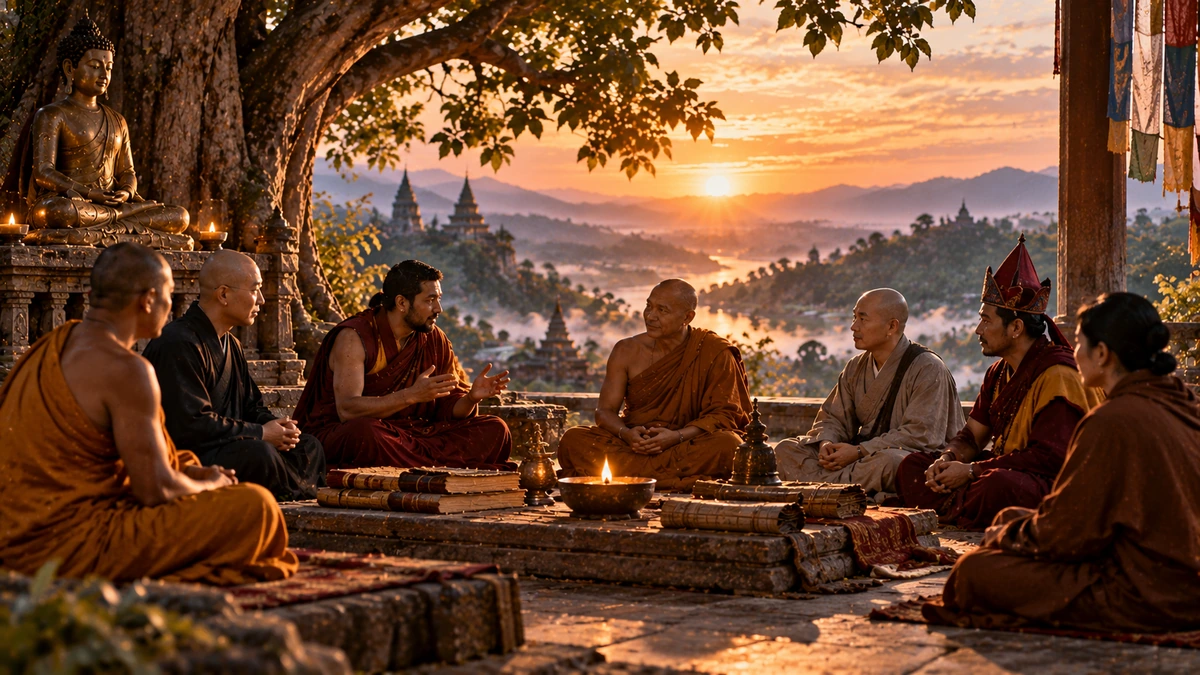
When someone first looks at global Buddhism, it can seem as though we use one name for almost unrelated religions. In Sri Lanka, monks recite the Pāli Tipiṭaka. In Thailand, practitioners speak of dāna, sīla, and meditation. In Japanese Pure Land traditions, devotees recite Amitābha's name. In Zen, a monk sits in silence. In a Tibetan monastery, practitioners use mantras, visualizations, initiations, mandalas, and complex rituals. Elsewhere someone recites the Lotus Sutra. One person turns to Avalokiteśvara. Another speaks of arahantship. A third of the bodhisattva. A fourth of emptiness. A fifth of Buddha-nature. A sixth of the nature of mind. The question is therefore entirely justified: What, if anything, is still common to all of this? If they do not use the same texts. If they do not practice the same meditations. If they do not share the same philosophies.
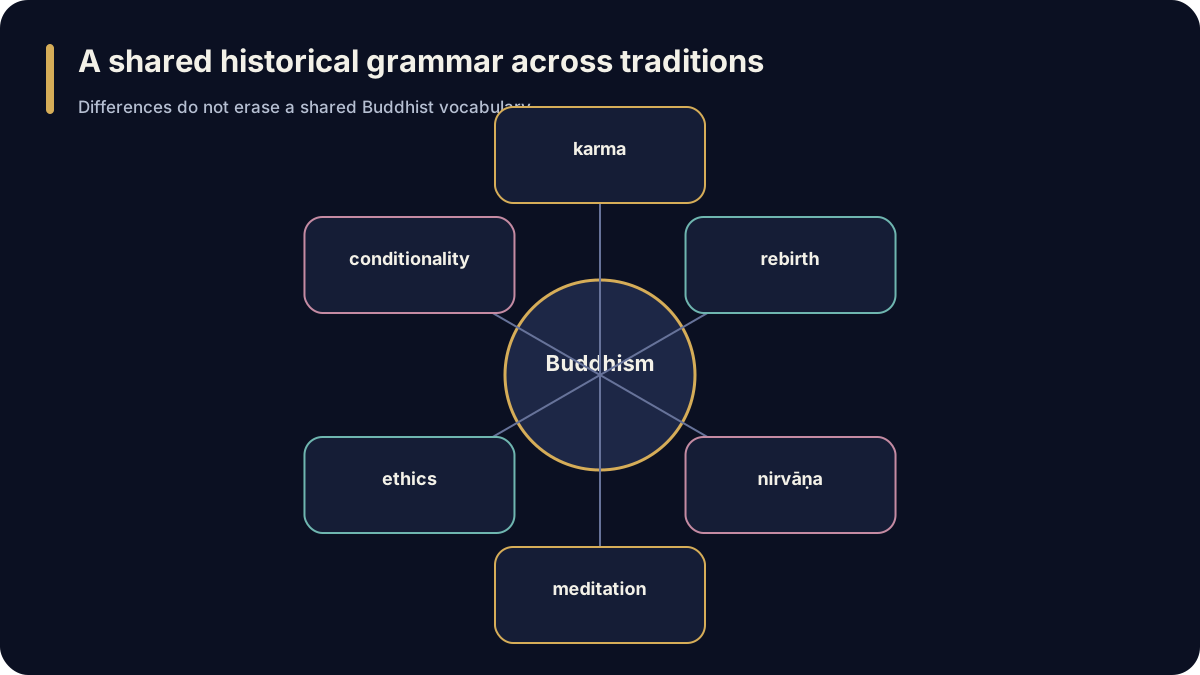
If they do not even share the same final ideals. Is “Buddhism” merely a modern label for traditions with a very distant common ancestor? No. The differences are large and real. Yet beneath them there is a sufficiently strong historical and religious grammar for us still to recognize one great family of traditions. Not because all Buddhists believe exactly the same things, but because their very different paths still respond to surprisingly similar questions.
First: There Is No Single Form of Buddhism
Before looking for a shared core, we must avoid one mistake. We should not construct an artificial “basic Buddhism” so general that no one actually practices it. Theravāda is not completely homogeneous. Chinese Buddhism is not one school. Zen is not uniform. Tibetan Buddhism contains several major traditions. Pure Land exists in different historical forms. Even within the same school, two monasteries can differ greatly in practice. We are therefore not looking for a uniform. We are looking for family resemblance — a shared historical framework.
Buddha. The most obvious link is the Buddha. Yet even here the answer is not entirely simple. A Theravāda practitioner may turn primarily to the historical Gautama. Mahāyāna knows Śākyamuni, Amitābha, Akṣobhya, Vairocana, and many other Buddhas. Vajrayāna develops buddhology still further. Chan and Zen can speak of Buddha-nature. Yet none of these traditions is intelligible without the fundamental idea of awakening. A Buddha is an awakened one — someone for whom ignorance no longer has the final word. Different traditions will explain very differently what buddhahood means in full. But the very possibility of radical transformation remains shared.
The Buddha is not only a founder from the past. His significance is deeper. Buddha means: awakening is possible. The ordinary condition of a human being or sentient being is not its final limit. Theravāda may show this through the arahant's liberation and the Buddha's complete awakening. Mahāyāna through the bodhisattva path to buddhahood. Zen through direct seeing. Vajrayāna through the tantric path to complete awakening. The explanations are not identical. But the fundamental claim is shared: mind or being can be liberated from ignorance and bondage.
Buddha, Dharma, Saṅgha
An even stronger sign of shared identity is the Three Jewels, or Three Refuges: Buddha, Dharma, and Saṅgha. Taking refuge in them is one of the most widespread expressions of Buddhist belonging. The language changes. Pāli. Sanskrit. Chinese. Tibetan. Japanese. The meaning of each term can expand. But the basic structure is extraordinarily persistent. Buddhist identity repeatedly organizes itself around the awakened one, the path, and the community that transmits it.
What is Buddha as refuge? At the most basic level: the awakened teacher. Mahāyāna, however, expands the concept to many Buddhas and broader dimensions of buddhahood. In Vajrayāna, various buddha-forms can embody awakened states. In tathāgatagarbha traditions, the idea of a potential for buddhahood appears. Despite these differences, Buddha remains a measure of awakened being.
Dharma. Dharma, or Dhamma, is likewise a multilayered word. It can mean the Buddha's teaching, practice, path, truth, lawfulness, and in certain contexts even things or phenomena. Traditions differ greatly over which texts carry the highest authority. Theravāda preserves the Pāli Tipiṭaka. East Asian Buddhism uses the vast Chinese canon. Tibetan traditions use the Kangyur, Tengyur, and a large body of later literature. Zen is famous for language about a transmission not limited merely to words and letters. Yet even Zen is impossible without Dharma. In all these cases, the same fundamental assumption remains: there is a path from ignorance and bondage toward liberation or awakening.
Saṅgha. Saṅgha can mean different things. The monastic community. The noble community of those who have directly realized the path. In modern usage, sometimes the broader community of practitioners. But the basic function matters. Buddhism is not merely a private philosophy of an individual. Someone preserves texts. Someone teaches. Someone ordains. Someone recites. Someone practices. Someone supports the community. The institutional Saṅgha has been one of the most important carriers of Buddhist history.
A Shared Problem
Even more important than shared symbols is a shared diagnosis. Ordinary unawakened existence contains a problem: dukkha, ignorance, craving, clinging, hatred, and distorted perception. Different traditions explain this differently. Theravāda may emphasize the Four Noble Truths, craving, and the aggregates. Madhyamaka reification and failure to understand emptiness. Yogācāra the constructed nature of experience. Zen conceptual attachment and direct insight. Tibetan traditions analyze mental afflictions in great detail. But all these maps begin from a similar assumption: the ordinary mode of experience is not liberated.
The problem is not primarily breaking the commandment of a creator. This is another widely shared feature. Classical Buddhist traditions generally do not explain the human problem as sin against an absolute creator of the world. The problem consists in ignorance, bondage, intentionally harmful actions, craving, hatred, and delusion. The solution is therefore not primarily external forgiveness. It is a transformation in how a being acts, perceives, and clings.
What about gods? Buddhism is not simply a religion without superhuman beings. Its worlds can be full of devas, Brahmās, protectors, bodhisattvas, cosmic Buddhas, and tantric deities. But classical Buddhism generally does not rest on a personal, omnipotent creator who made the universe and is the necessary source of human salvation. For this reason, the label atheistic is often not the best one. Buddhism can be full of gods without those gods being absolute creators.
Conditionality. One of the deepest shared ideas is that phenomena arise because of conditions. Nothing conditioned exists entirely from itself. Early Buddhism expresses this through dependent arising. Madhyamaka develops a connection between dependent arising and emptiness. Yogācāra analyzes the conditions of consciousness and karmic dispositions. East Asian systems develop their own models of interdependence. These philosophies are not identical. But a shared intuition remains: what arises through conditions is not an independent, self-sufficient substance.
Impermanence. What is conditioned is also impermanent. Body. Feelings. Thoughts. Relationships. Meditative states. Societies. Heavens. Entire world systems. In Buddhist cosmologies, lifespans can be extraordinarily long. But conditioned existence is not eternity. Impermanence therefore remains one of the most widely recognizable Buddhist themes.
Non-Self — but Not One Single Theory
We must be especially careful with non-self. Early Buddhism clearly problematizes the idea of a permanent, independent self. Theravāda preserves anattā as a fundamental teaching. Madhyamaka extends the critique of self-existence to all dharmas. Yogācāra develops a different language for analyzing consciousness. Tathāgatagarbha traditions use remarkably positive language about Buddha-nature. Some East Asian texts can even use the language of a “true self.” We therefore cannot claim: all traditions have one identical philosophical theory of self. They do not.
What, then, is shared? A much safer common point is this: Buddhist traditions generally problematize the ordinary model of a permanent, independent, self-sufficient personal self that would exist as the owner or unchanging bearer of bodily and mental processes. That does not resolve every debate about Buddha-nature. And it should not.
Buddha-nature is a real tension. Tathāgatagarbha and parts of East Asian Buddhism can speak of original purity, Buddha-nature, true mind, even a “true self.” This is not simply another word for early anattā. It is a genuine later development in Buddhist language. Different interpreters have understood it in more substantialist ways or in more relational, dispositional, and soteriological ones. We therefore should not manufacture a shared core by erasing differences.
Karma. Another extremely broad shared category is karma. Intentional actions have consequences. What a person repeats shapes habits, character, experience, future conditions, and, in the traditional Buddhist framework, future births as well. Karma does not necessarily imply a cosmic judge. It refers to the patterned consequences of morally significant action.
Karma is not fatalism. If the present were completely determined by the past, Buddhist practice would make no sense. Present intention is a new condition. Ethical action is a new condition. Meditation is a new condition. Understanding is a new condition. Buddhism therefore does not simply teach: everything that happens to you is an unchangeable punishment for past karma. The very possibility of creating new conditions makes the path possible.
Rebirth. Traditional Buddhist traditions also share a multi-life horizon. Saṃsāra is the repeated process of birth and death. Karma is closely connected with it. At the same time, Buddhism rejects the need for an eternal soul that migrates unchanged from body to body. The tension between rebirth and non-self became one of the great classical philosophical questions of Buddhism.
A modern Buddhist is not necessarily a traditional Buddhist. Today there are secular and modernist forms of Buddhism that reject rebirth, bracket it, interpret it psychologically, or approach it agnostically. That is a modern reality. But if we ask, What is shared by the historical Buddhist traditions of Asia?, the saṃsāric horizon is very important. Rebirth is not merely a Theravāda peculiarity. Mahāyāna and Vajrayāna arose within the same broader karmic and multi-life world.
Liberation or Awakening
If ignorance exists, so does the possibility of its cessation. But here we should not too quickly say: all Buddhists have exactly the same final goal. That would flatten important differences. Theravāda recognizes the arahant's final liberation. Mahāyāna often foregrounds the bodhisattva's complete buddhahood. Vajrayāna generally preserves the Mahāyāna goal of buddhahood while developing tantric methods. Pure Land traditions can direct immediate aspiration toward birth in Sukhāvatī as a favorable environment for continuing the path. Zen uses its own language of awakening, kenshō, Buddha-nature, and practice. The differences are real.
What do these goals share? Not one identical metaphysical definition of nirvāṇa, but a broader soteriological structure: ignorance, bondage, and afflictions can be radically overcome. The ordinary mode of existence is not final. There is an awakened or liberated condition. Traditions differ in how they explain this condition and which ideal they give the highest status.
Buddhism is a path. For this reason, Buddhism is not merely a collection of beliefs; the path must be practiced. The methods can differ enormously: vipassanā, jhāna, zazen, nembutsu, sutra recitation, visualization, mantra, bodhicitta, analysis of emptiness, mettā, tantric sādhana, and ritual. Yet beneath the different methods lies a shared assumption: a person, or mind, can be changed through training.
Mental cultivation. The Pāli bhāvanā literally suggests development or cultivation. It is a broader concept than the modern word “meditation.” One can cultivate concentration, attention, goodwill, compassion, insight, recollection of the Buddha, bodhicitta, visualization, or other qualities. There is no single universal Buddhist meditation technique. But there is a very broad Buddhist conviction: mental habits are not immutable.
Ethics. Beneath methodological diversity there also remains a strong ethical layer. The five precepts for laypeople are a familiar example: not killing, not taking what is not given, not misusing sexuality, not lying or using harmful speech, and not intoxicating the mind. Formulations and interpretations can differ. Monastic Vinayas are much more detailed. Mahāyāna develops bodhisattva precepts. Vajrayāna adds tantric commitments. But later levels generally do not mean non-harming no longer matters.
Non-harming as a shared direction. Buddhist history is not a history of perfect nonviolence. Buddhist societies have also been involved in wars, political conflicts, and violence. As with other religions, we must distinguish between ideals and the historical behavior of people. Yet the normative direction of Buddhist ethics remains strongly connected with reducing greed, hatred, delusion, and harm.
Goodwill and compassion. Compassion is not a Mahāyāna monopoly. Theravāda knows mettā and karuṇā. Mahāyāna closely connects compassion with the bodhisattva ideal. The East Asian Guanyin, or Avalokiteśvara, becomes one of the great personifications of compassion. Tibetan traditions systematically cultivate great compassion and bodhicitta. Different forms, shared direction. The development of the path reduces hatred and increases care for other beings.
Wisdom. Yet goodwill alone is not enough. Buddhism also requires wisdom. Paññā. Prajñā. What must a person understand? Answers differ. Impermanence. Non-self. Conditionality. Emptiness. Suchness. The nature of mind. But everywhere there is a distinction between ordinary ignorant perception and liberating knowledge. Transformation of conduct and transformation of understanding are therefore closely connected.
The Four Noble Truths. Do Buddhist traditions share them? Historically, they belong to their common Indian Buddhist inheritance. Mahāyāna and Vajrayāna did not simply discard them. But they are not equally visible everywhere. In modern Theravāda they are often presented as the most basic summary of Buddhism. A Zen practitioner may speak far more often in daily practice about zazen. A Pure Land practitioner about Amitābha. A Tibetan teacher about bodhicitta, emptiness, or stages of the path. This does not mean the Four Truths disappeared. It means shared inheritance is not the same thing as shared emphasis.
The Eightfold Path. The same applies to the Noble Eightfold Path. It is a shared old Buddhist inheritance. But Mahāyāna can organize the path through the six pāramitās. Tibetan traditions through various stages of the path. Zen through meditation, ethics, and a monastic framework. Even so, elements such as view, ethical conduct, effort, mindfulness, concentration, and wisdom do not disappear. They are organized in different maps.
Different canons. One of the largest real differences is simple: Buddhists do not share one Bible. Theravāda preserves the Pāli Canon. East Asian traditions use the Chinese Buddhist canon. Tibetan Buddhism uses the Kangyur and Tengyur together with an enormous body of additional literature. Individual schools within these worlds elevate some texts far above others. The unity of Buddhism therefore cannot rest on one shared book.
But the canons are not historically unrelated. The Chinese Āgamas contain many parallels to the Pāli Nikāyas. Different Vinayas arise from the early Indian monastic world. Mahāyāna sutras use and reinterpret older Buddhist language. Tantric texts presuppose many Mahāyāna concepts. We therefore have different libraries, not completely unrelated literatures.
Vajrayāna. Today we often speak of Theravāda, Mahāyāna, and Vajrayāna as the three great forms of Buddhism. As orientation, the scheme is useful. Historically, however, it can mislead if we imagine three completely independent trees. Buddhist tantra developed primarily within a Mahāyāna environment. It preserves many Mahāyāna goals and concepts while adding new ritual and meditative methods.
What does Vajrayāna add? Mantras. Mandalas. Initiations. Deity yoga. Visualizations. The subtle body. Guru yoga. Complex ritual systems. But the goal is not to become an eternal god. In classical tantric Buddhism, buddhahood, bodhicitta, emptiness, karma, saṃsāra, and liberation remain important. The method can be dramatically new. The soteriological environment remains recognizably Mahāyāna.
Zen. Zen too can look like a radical break. “A transmission outside the scriptures.” Sitting. Kōans. Direct insight. But Chan and Zen arose within the East Asian Mahāyāna world. Their history is full of sutras, commentaries, monasteries, ethical rules, Buddha-nature, and Mahāyāna philosophy. Even the famous critique of attachment to words is a Buddhist critique of clinging to words, not an erasure of the whole Dharma.
Pure Land. Similarly, Pure Land can at first glance look very different from meditative Buddhism. Recollection of Amitābha. Recitation of his name. Trust in his vows. Aspiration for birth in Sukhāvatī. Yet beneath this remain karma, rebirth, Buddha, merit, Dharma, and the final horizon of awakening. What is new is the way the path is organized.
Devotion. Buddhism is not only philosophy and meditation. It is also devotion. People bow before Buddha images. Offer flowers. Light lamps. Venerate relics. Visit sacred places. Recite sutras. Express respect for teachers. Mahāyāna and Vajrayāna add many Buddhas, bodhisattvas, and other figures. Theravāda has its own strong devotional traditions. Such practices are not automatically evidence of “late corrupted Buddhism.” They are part of the historical religion.
But devotion is not necessarily creator-theism. When a Buddhist prays or bows to a Buddha, Avalokiteśvara, or another figure, this cannot automatically be translated into the category worship of a creator God. Different figures serve different functions: teacher, ideal of awakening, field of merit, bodhisattva of compassion, cosmic Buddha, protector. The religious life is real. But its theological structure is not the same as classical monotheism.
Merit. Merit is another shared category. Puṇya. Good deeds create favorable karmic consequences. Giving. Supporting the community. Ethics. Recitation. Building a stūpa or temple. Caring for others. Mahāyāna strongly develops the dedication of merit to other beings and to buddhahood. Theravāda cultures have their own forms of sharing or dedicating merit. Differences exist. But a morally beneficial act is not merely a momentary good gesture. It is embedded in a wider karmic stream.
Teacher and transmission. Buddhist traditions share something else that is difficult to compress into one doctrine. The path is transmitted. Early reciter. Monastic teacher. Theravāda ajahn. Zen master. Tibetan lama. Pure Land teacher. Forms of authority differ greatly. But Buddhism is almost never merely a book read by an isolated individual. Transmission occurs through people, institutions, rituals, practices, and communities.
Do They All Have the Same Goal?
We can now answer more precisely. Not in exactly the same doctrinal sense. Arahant. Bodhisattva. Samyaksambuddha. Birth in a Pure Land as a stage of the path. Tantric complete awakening. Zen insight. These categories are not fully interchangeable. This article will therefore not claim: all traditions are merely different paths to an entirely identical conceptual destination. That would be artificial harmonization.
But they address the same type of problem. All major historical Buddhist traditions arise from a world in which ignorance causes bondage, harmful mental qualities deepen dukkha, intentional actions have consequences, the mind can be trained, wisdom can transform perception, and a radical possibility of awakening or liberation exists. That is a great deal in common — enough to speak of one religious family.
Arahant and bodhisattva. Their difference is real. Theravāda does not see the arahant as a spiritual failure. The arahant is liberated. Mahāyāna often gives the highest status to the path toward complete buddhahood. Yet both traditions operate with concepts of karma, saṃsāra, ethics, mental training, wisdom, and the overcoming of greed, hatred, and delusion. The difference matters. But it is not a complete absence of a shared world.
Emptiness and non-self. The same is true philosophically. Theravāda does not need Madhyamaka's language of svabhāva in order to be Buddhist. Madhyamaka is not simply a repetition of Theravāda anattā. Yogācāra has its own analysis. Buddha-nature its own language. Yet all these systems remain involved in the wider Buddhist problem: how to stop falsely appropriating, reifying, and understanding experience in ways that generate bondage.
The Differences Are Not Superficial
This must be said plainly. Buddhist schools genuinely argued with one another. About the nature of dharmas. About self. About consciousness. About nirvāṇa. About the path. About which texts are definitive. About buddhahood. About meditation. About the nature of emptiness. We will therefore not conclude: they all really teach the same thing; only the words differ. They do not teach the same thing.
But the dispute itself reveals a shared language. Mahāyāna can criticize a certain understanding of nirvāṇa because it too uses the concept of nirvāṇa. Madhyamaka criticizes the reification of dharmas because it inherited Buddhist discourse about dharmas. Zen criticizes attachment to sutras because it arose within a Buddhist textual civilization. Vajrayāna presents its method as especially effective because it shares the broader goal of buddhahood. Debate is possible because there is enough in common for traditions to disagree at all.
The modern ecumenical formula of 1967. An interesting control case is the first congress of the World Buddhist Sangha Council in 1967. Walpola Rahula prepared a short document, Basic Points Unifying the Theravāda and the Mahāyāna, which the council, according to the organization's account, approved. It includes the Buddha as teacher, the Three Jewels, rejection of a creator God, compassion and wisdom, the Four Truths, dependent arising, non-self, and different paths of awakening. This is interesting evidence of modern Buddhist ecumenism. But it must be used cautiously.
It is not an ancient universal creed. The 1967 document is not an official definition of Buddhism for all periods and all communities. It is a modern effort by representatives of different traditions to formulate an area of agreement. Some of its formulations are explicitly ecumenical. We therefore should not use it as proof that “all Buddhists have always believed exactly these nine points.” We can use it for a more modest conclusion: representatives of different modern traditions themselves recognized enough common ground to attempt a shared statement.
One Buddhism or Many Buddhisms?
The most appropriate answer is probably: both. There are Buddhisms, because the differences are real. Theravāda is not Zen. Zen is not Pure Land. Pure Land is not Gelug. Gelug is not Nyingma. Nyingma is not Nichiren. Yet there is also a historically justified reason for the singular: Buddhism. All these systems belong to a network of historical traditions arising from the Indian Buddhist world and preserving enough of its basic grammar.
What, Then, Do They Share?
The safest common area includes the following: Buddha or buddhahood as a reference point for awakening. Dharma as a path of liberation. Saṅgha as a community of transmission. The problem of ignorance, bondage, and dukkha. The impermanence of the conditioned. Dependence on conditions. The problematization of a permanent independent personal self. Karma. In traditional forms, saṃsāra and rebirth. Ethical training. Mental cultivation. Wisdom. Goodwill and compassion. And the possibility of liberation or awakening. This is not a small common ground.
What do they not share? They do not share one canon, one metaphysics, one meditation technique, one buddhology, one ritual system, one ideal type of saint, one interpretation of nirvāṇa, one theory of consciousness, or one hierarchy of all the Buddha's teachings. That is an equally important part of the answer.
A family, not copies. Perhaps a large family is therefore a better image than a single river. Family members are not identical. One resembles one parent. Another resembles the other. Someone has a feature that a third does not. But when we look at the entire network of resemblances, the relationship becomes clear. Buddhist traditions are something like that. There is no single feature expressed in exactly the same way in every case. But there are enough overlapping characteristics for historical continuity to remain clear.
We therefore do not choose between two extremes. The first extreme: all Buddhists teach exactly the same thing. No. The second: Theravāda, Zen, and Vajrayāna have almost nothing in common. Also no. A more precise picture is: they share a deep historical inheritance, but have developed it into genuinely different religious and philosophical systems.
Why does this matter? Because it allows us to avoid two distortions. The sectarian one: only my tradition is true Buddhism. And shallow ecumenism: they all really say the same thing. History shows something more interesting. The same old problems can receive different answers. The same ideal can take a different form. The same concept can be reinterpreted over centuries. A new practice can arise within an older soteriological world. This is how religious traditions live.
Buddha, Dharma, Saṅgha. In the end, we can return to the simplest framework. Buddha. Dharma. Saṅgha. Awakening. Path. Community. From this historical core grew Pāli monasteries, forest meditation traditions, Prajñāpāramitā, Madhyamaka, Yogācāra, Pure Land, Chan, Zen, the Lotus Sutra, Tibetan philosophical schools, tantric mandalas, and modern global forms of Buddhism. Outwardly they can look extraordinarily different. Yet deep beneath them remains the question: How does a being caught in ignorance and clinging become free? Some answer: through insight into impermanence and non-self. Others: through understanding emptiness. Others: through bodhicitta. Others: through zazen. Others: through recollection of Amitābha. Others: through tantric transformation. But the question of transformation from ignorance into awakening remains.
The shared core is not a uniform. Buddhist traditions therefore do not wear the same uniform. They do not read the same library. They do not use the same rituals. They do not always understand self, Buddha, nirvāṇa, or the path in the same way. Yet their differences are not random. They are different historical solutions to problems belonging to the same great tradition. What causes dukkha? What is a person? How do phenomena arise? What does karma do? How does mind change? What is wisdom? What does compassion mean? What is awakening? And how is it attained? This is why it makes sense to speak of Buddhist traditions in the plural and, at the same time, of Buddhism in the singular. The next and final synthetic article will show this historical continuity in the most concrete way: from the early discourses to the Heart Sutra.
Sources and Literature
Primary Texts and Reference Editions
- SuttaCentral and 84000 as representative primary corpora; the 1967 World Buddhist Sangha Council document is a modern ecumenical source and not a primary ancient canonical text.
Research and Verification Literature
- Rahula, Walpola. “Basic Points Unifying the Theravāda and the Mahāyāna.” Prepared for and approved by the World Buddhist Sangha Council, 1967. Treat as a modern ecumenical statement, not an ancient creed.
- Goodman, Charles, and Aaron Schultz. “Ethics in Indian Buddhism.” The Stanford Encyclopedia of Philosophy, Spring 2024 ed., edited by Edward N. Zalta and Uri Nodelman.
Note: verification sources are part of the editorial apparatus. Where the originally used edition was not preserved during reconstruction, the standard reference edition is not presented as the article's presumed original source.