How Did Mahāyāna Arise — a Movement, New Literature, or a New Vision of the Buddhist Path?
When we say **Mahāyāna** today, we quickly imagine one of the great branches of Buddhism. Zen. Pure Land. Tiantai. Huayan. Tibetan Buddhism. Bodhisattvas. Emptiness. The Heart Sutra. The Lotus Sutra.
When we say Mahāyāna today, we quickly imagine one of the great branches of Buddhism. Zen. Pure Land. Tiantai. Huayan. Tibetan Buddhism. Bodhisattvas. Emptiness. The Heart Sutra. The Lotus Sutra. But if we ask When did Mahāyāna arise?, the answer is not: in year X, at monastery Y, under the leadership of person Z. Early Mahāyāna does not look like a religion that appeared through one founding event. It is much more likely to have emerged as several parallel currents within an already existing Buddhist world. These currents were not necessarily unified. They had no single center. They did not use one single Vinaya. They did not all read the same new sutras.
And they probably did not all understand themselves as members of one new institutional community. The question “When did Mahāyāna arise?” is therefore already somewhat too simple. A better question is: How did new ideals, new sutras, and new models of the Buddhist path emerge that we now associate with Mahāyāna?
What Does mahāyāna Mean?
In Sanskrit: mahā — great, yāna — vehicle, mode of progression, path. The most common translation is Great Vehicle. But the early use of the term does not necessarily already mean a separate Buddhist denomination. In some early Mahāyāna texts, mahāyāna is closely linked with bodhisattvayāna — the bodhisattva vehicle toward complete Buddhahood. In the initial phase, then, the expression may have designated primarily a type of path, and only later increasingly a broader religious identity.
When Does Mahāyāna First Appear in the Sources?
Here we must distinguish between origin and the earliest securely datable evidence. Scholars often place the development of early Mahāyāna currents roughly around the first century BCE or the beginning of the Common Era. But the first truly firm evidence consists of manuscripts, Chinese translations, and inscriptions from the first centuries CE. Oxford’s overview of contemporary research emphasizes that discovered early Mahāyāna manuscripts from the first and second centuries CE confirm that the tradition was already present by then. This means Mahāyāna could not have arisen only at the time of those manuscripts or translations; its history must reach some distance further back.
But how far? We cannot determine that precisely.
Lokakṣema — the most important early chronological anchor.
Especially valuable is Lokakṣema. He worked in the second half of the second century CE. In 179, he translated the Pratyutpanna Samādhi Sūtra into Chinese. This sutra already presupposes multiple Buddhas in other worlds, meditative encounters with them, the possibility of rebirth in their worlds, and veneration and preservation of the sutra. Lokakṣema’s translation corpus also includes early Mahāyāna material connected with Prajñāpāramitā, Mañjuśrī, the bodhisattva path, and new samādhis. If such texts were already composed, transmitted over great distances, and translated in the second century, their Indian development must be older. But Lokakṣema gives us a terminus ante quem, not Mahāyāna’s birth date.
Early Mahāyāna was not one organization. This is one of the most important findings of modern scholarship. Older explanations often searched for one parent school, one social group, or one geographical center. Today the picture is much more dispersed. Contemporary surveys speak of small currents, monastic fraternities, different textual communities, and different practices existing within the broader Buddhist world. We will therefore prefer to speak of early Mahāyāna movements rather than one single early Mahāyāna.
Mahāyāna did not arise as a lay revolt against monks. This was once a highly influential theory. The story ran roughly as follows: old Buddhism had become too monastic and too oriented toward arahantship, while laypeople created Mahāyāna as a more open and compassionate alternative. Modern scholarship has largely abandoned this explanation. Many early Mahāyāna texts are highly ascetic, monastic, and demanding. Some scholars even think that forest or ascetic monks were among important early carriers of Mahāyāna. This does not mean laypeople were unimportant. It means only that Mahāyāna did not simply arise from a conflict of laypeople versus monks.
Nor was it simply the product of one early school. Another once-influential theory held that Mahāyāna arose from the Mahāsāṃghika. Mahāsāṃghika traditions do contain some ideas about the Buddha that appear closer to later Mahāyāna Buddhology. But the direct equation Mahāsāṃghika = origin of Mahāyāna is too simple. Modern scholarship generally no longer ties the origin of Mahāyāna to one single early nikāya.
What about monasteries? Here we must be especially careful. For a long time Mahāyāna does not look like a system with its own Vinaya, its own separate ordination lineage, or a unified network of monasteries. Some scholars therefore question whether early Mahāyāna had independent institutional status at all. A monk could follow Mahāyāna texts or the bodhisattva ideal while simultaneously belonging to a monastic community regulated by a Dharmaguptaka, Sarvāstivāda, Mūlasarvāstivāda, or another Vinaya. For later centuries we also have clear reports of monasteries in which Mahāyāna and non-Mahāyāna monks lived together. For the earliest phase, however, the safer formulation is: Mahāyāna operated within already existing monastic structures, not necessarily in institutions of its own.
This explains something that remains true today. East Asian Mahāyāna monastic tradition primarily uses the Dharmaguptaka Vinaya. Tibetan tradition uses the Mūlasarvāstivāda Vinaya. Mahāyāna therefore did not create an entirely new system of monastic ordination. It developed on older institutional foundations.
What, Then, Was New?
One of the most important changes concerns the status of the bodhisattva path. Bodhisatta or bodhisattva is not a new word. As we saw with the Khuddaka Nikāya, the older Pāli tradition already knows Gautama before awakening and in his past lives as a bodhisatta. But now the question begins to change. It is no longer only “How did Gautama become a Buddha?” but also “Should I too enter the path to complete Buddhahood?” That is a major normative shift.
The Bodhisattva Path as Mahāyāna
For precisely this reason, the early term mahāyāna is not necessarily best understood as the name of a new sect. In some early texts it can function almost as a synonym for bodhisattvayāna. In this sense it designates the great or exalted path of someone striving to become a samyaksaṃbuddha — a fully awakened Buddha. This is a very important distinction. Early Mahāyāna may initially have meant what you aspire to become more than which church you belong to.
Arahant and bodhisattva. Early Buddhism often presents arahantship as the ordinary goal of the path: liberation, the end of clinging, the end of further birth. Mahāyāna literature increasingly brings complete Buddhahood to the foreground. But we will not turn this into a caricature: arahant = selfish, bodhisattva = compassionate. That is a later polemical simplification. Early texts do not portray the arahant as a person without ethics or compassion. The main difference is the goal of the path: arahantship or the long path to complete Buddhahood. This will be the subject of the next article.
The path becomes almost unimaginably long. If one wants to become a complete Buddha, Mahāyāna literature often describes countless births, vast cosmic ages, pāramitās, vows, service to innumerable Buddhas, and the development of immeasurable compassion and wisdom. The practitioner no longer wishes only to bring their own dukkha to an end. The goal becomes to develop the capacity to liberate countless beings.
Buddhahood expands cosmically. Older texts already know past Buddhas, the future Metteyya, devas, Brahmās, and a vast cosmology. Mahāyāna sutras greatly expand this. Buddhas exist in other world systems, in all directions, and in enormous numbers. A bodhisattva can see, venerate, encounter, and receive teachings from other Buddhas. This becomes important for Akṣobhya, Amitābha, Buddha-fields, and later Pure Land traditions.
New Literature
The most obvious sign of Mahāyāna development is new sutras. Prajñāpāramitā. Pratyutpanna. Akṣobhyavyūha. Sukhāvatīvyūha. The Lotus Sutra. Vimalakīrti. Tathāgatagarbha literature. Avataṃsaka. And many others. But a question immediately arises. If these sutras are clearly historically younger than the Nikāyas and Āgamas, why do they present themselves as the Buddha’s speech?
Buddhavacana does not necessarily mean a modern stenographic transcript. The Buddhist concept buddhavacana — the word of the Buddha did not necessarily mean “an exact phonetic record of a sentence Gautama uttered at a historical moment.” In the wider Buddhist environment, one could also ask whether a teaching accords with the Dhamma, whether it leads to liberation, whether it expresses the Buddha’s true intention, or whether it was revealed or authenticated in a legitimate way. Mahāyāna strongly develops this broader model of authority.
Traditional explanations of late appearance. Mahāyāna traditions developed several ways of explaining why certain sutras appeared only later. Some were said to have been hidden, entrusted to bodhisattvas, guarded among nāgas, or revealed only when beings were ready. Within the religious tradition, this can explain late public appearance without denying the Buddha’s authorship.
The Historical-Critical Explanation
Historical method answers differently. Mahāyāna sutras show multiple layers, development over time, and different linguistic and regional forms. Prajñāpāramitā literature itself shows clear editorial growth through different phases. The historically most likely explanation is therefore that these texts arose and developed within Buddhist communities centuries after the historical Buddha. This is not the same as saying “they have no religious value.” It is simply a claim about textual history.
Why a sutra rather than merely a commentary? Because sutra was the highest form of textual authority. If one wanted to present a new understanding as a profound teaching of the Buddha, the sutra form was much more powerful than an ordinary commentary by a monk. Mahāyāna literature therefore often places new ideas within the Buddha’s discursive world.
Written culture. Mahāyāna develops at a time when writing is becoming increasingly important in the Buddhist world. This does not mean writing created Mahāyāna. But writing enabled long texts, more stable complex compositions, copying, transmission between regions, and new forms of venerating the sutra itself. Research on early Mahāyāna therefore often emphasizes written textuality and the cult of the Mahāyāna sutra as important factors in its development.
The sutra as a religious object. Some early Mahāyāna texts emphasize the merit of copying, reciting, memorizing, preserving, and venerating the sutra. Lokakṣema’s translation of the Pratyutpanna Samādhi Sūtra already speaks of great merit for one who copies, studies, recites, and preserves the text. Here the text becomes more than information. It becomes a religious object and a bearer of the Buddha’s presence.
But early Mahāyāna was not merely a book cult. That would be the opposite extreme. Mahāyāna texts contain ascetic practice, meditation, visualization of Buddhas, samādhi, ethics, generosity, vows, emptiness, veneration, and textual cult. Different currents emphasize different practices. There is therefore no single formula Mahāyāna = cult of sutras.
Prajñāpāramitā
One of the most important early corpora is Prajñāpāramitā — the perfection of wisdom. Here śūnyatā — emptiness becomes extremely important. The bodhisattva is to develop wisdom without clinging to self, beings, path, attainment, or even wisdom itself. This will become one of the great cores of later Mahāyāna philosophy.
Emptiness did not arise from nothing. As we have already seen, suññatā exists in early suttas: MN 121, MN 122. Non-self and dependent arising also already undermine the idea of permanent independent substances. But Prajñāpāramitā does something new: it expands the concept of emptiness, applies it far more systematically, and connects it with the bodhisattva’s perfection of wisdom. It is therefore better to speak of the development of a concept than of an invention from nothing.
New structures from old elements. We see the same pattern elsewhere. The bodhisattva already exists. Past Buddhas already exist. The pāramīs already have a prehistory. Emptiness already exists. Samādhi already exists. But Mahāyāna changes their relationships to one another and their normative weight. Religious innovation very often does not create new elements from nothing; it rearranges old elements into a new system.
Geography. Geographically too, we cannot point to a single place. Research connects different Mahāyāna texts and currents with northwestern India, Gandhāra, central India, Andhra, and other regions. Contemporary surveys of Mahāyāna speak of a loose cluster of small monastic movements within the mainstream environment rather than one founding center. There is therefore no single capital of early Mahāyāna.
Gāndhārī manuscripts. The discovery of early Gāndhārī Buddhist manuscripts significantly changed the picture. Among material from the first centuries CE we also find Mahāyāna texts. This confirms that early Mahāyāna was not merely a later Sanskrit literary construction. Its literature was already circulating early in different languages and regional settings.
The material record remains relatively sparse for a long time. If Mahāyāna existed early, a question arises: why are there relatively few clear references to it in inscriptions for so long? One possibility is precisely that it was not a clearly separate institution. If a person belonged to the same monastery and the same Vinaya as other monks, a donor inscription did not necessarily identify them as a “Mahāyāna monk.” Contemporary surveys therefore emphasize that for its first several centuries Mahāyāna probably remained a minority current with weak institutional separation.
Around 180 CE we also get an important epigraphic signal. From Mathura we know an inscription from the time of the Kushan king Huviṣka, approximately 180 CE, that mentions the Buddha Amitābha. This is important material evidence that some characteristically Mahāyāna ideas were already circulating outside textual transmission alone. Again, this is not Mahāyāna’s birth date, but a historical anchor.
Mahāyāna becomes highly visible only later. By around the fifth century, Mahāyāna becomes much more clearly visible in inscriptions, iconography, major philosophical traditions, and the monastic world. Contemporary surveys note that before then it was probably relatively small and marginal for several centuries. This means origin and dominance are two different things.
Who was an early Mahāyānist? Probably not necessarily a member of a separate “Mahāyāna church.” It could have been a monk, nun, or layperson who accepted one or more Mahāyāna sutras, cultivated the bodhisattva path, practiced a particular samādhi, venerated a particular Buddha, copied sutras, or developed a different understanding of the highest goal. Not everyone necessarily accepted all Mahāyāna ideas. Early Mahāyāna identity was therefore probably quite fluid.
The new sutras were not automatically accepted. We can see this even from the texts themselves. Some warn that people will reject them, despise them, or call them inauthentic. If a text must defend its own authority so strongly, that probably means its status was not self-evident. This too argues against the idea that Mahāyāna appeared and the Buddhist world immediately accepted it.
A hierarchy of teachings develops. Some Mahāyāna sutras begin to say that earlier teachings were provisional, adapted, or partial, whereas the new teaching represents the Buddha’s deeper or final intention. This will later make possible the great systems for classifying the Buddha’s teachings in Tiantai, Huayan, and other traditions. In the early period, however, we are only observing the emergence of this way of thinking.
Mahāyāna is not a simple rejection of early Buddhism. Mahāyāna sutras still use karma, rebirth, ethics, samādhi, non-self, monks, arahants, the Four Noble Truths, and dependent arising. The new system is built out of the older Buddhist world. It is therefore much more accurate to speak of reinterpretation and expansion than of complete replacement.
Arahants remain part of the system. Mahāyāna literature may criticize the arahant goal, relativize it, or present it as a lesser goal. But arahants do not disappear. Śrāvakas. Pratyekabuddhas. Bodhisattvas. Buddhas. All become part of a broader hierarchy of paths and attainments. What changes above all is the question: what is the highest normative goal?
Hīnayāna. Here we need another terminological safeguard. Mahāyāna literature uses hīnayāna as a polemical term for a lesser or inferior vehicle. But we will not use it as a neutral historical name for Theravāda, the Nikāyas, or all early Buddhism. The earliest Mahāyāna texts do not even always use the term in the later, fixed contrast. Theravāda is therefore not simply “Hīnayāna”.
Theravāda knows the bodhisatta. Another simplification is also wrong: “Mahāyāna has bodhisattvas; Theravāda does not.” The Theravāda canon knows the bodhisatta, past Buddhas, Metteyya, pāramīs, and the long path of the future Buddha. The difference lies mainly in the status of that path. In Mahāyāna, the bodhisattva path becomes much more universalized and normatively elevated.
Mahāyāna as a Process
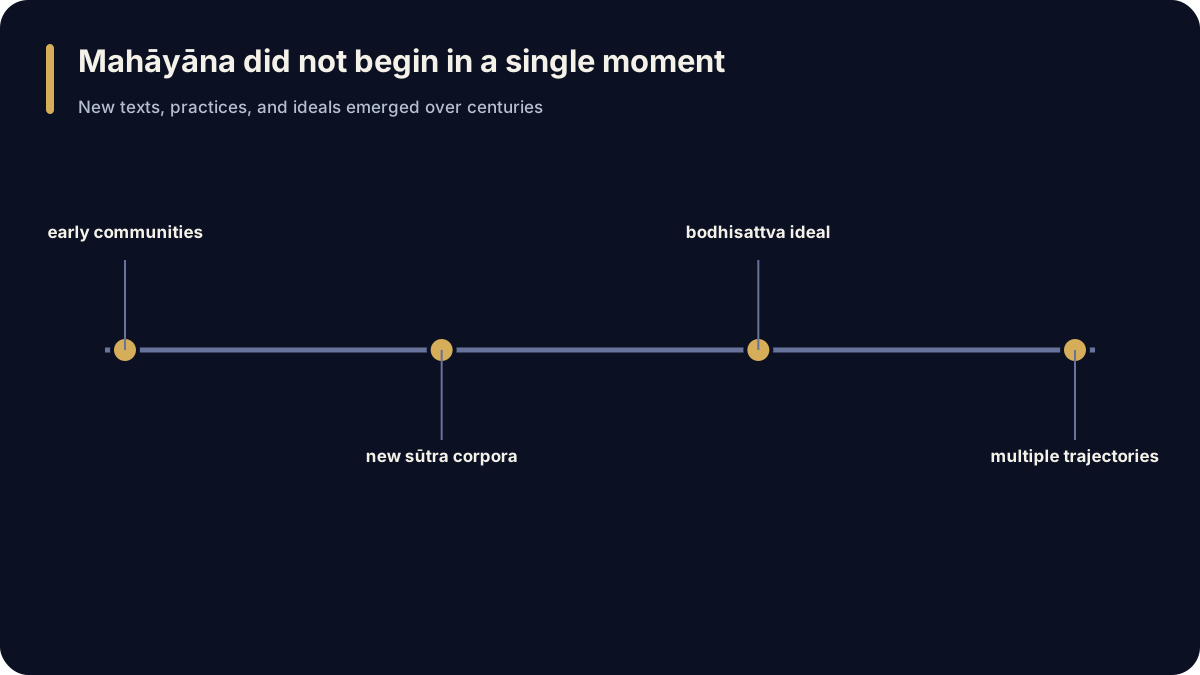
The best model is therefore a process, not an event. First, bodhisatta, past Buddhas, pāramīs, meditations, and a vast cosmology already exist. Then different circles begin to emphasize the bodhisattva path differently. New sutras appear. These develop new Buddha worlds, new samādhis, emptiness, perfections, and textual cults. Small groups preserve and spread them. Over the centuries these currents become larger, more connected, and more visible. And eventually they form the immense world we now call Mahāyāna.
The traditional and historical answers. In the end, we must distinguish two levels.
The traditional Mahāyāna answer. Mahāyāna sutras can be authentic buddhavacana, a deeper teaching of the Buddha that was preserved, hidden, or revealed at the appropriate time.
The historical-critical answer. Mahāyāna sutras show composition, redaction, and transmission in the centuries after the historical Buddha. These answers are not the same. The first concerns religious authority. The second concerns textual history. This series will always state clearly which kind of answer is under discussion.
Conclusion
Mahāyāna did not arise as a new religion in a single moment. It did not have one founder, one place, one Vinaya, one first sutra, or one organization. It developed within the already existing Buddhist world. In several regions. In several monastic settings. Around different sutras. Around new meditations. Around the bodhisattva path. Around an expanded image of Buddhas. Around new ways of understanding buddhavacana. At first: small, dispersed, a minority. Later: one of Asia’s most influential religious traditions. And its central question condenses into a comparison of two ideals: the arahant and the bodhisattva. What does the difference between them actually mean? Is one selfish and the other compassionate?
No. The history is much more interesting. The next topic is arahant and bodhisattva — two different goals, or two paths within the same problem of liberation?
Sources and Literature
Primary Texts and Reference Editions
- 84000: The Perfection of Wisdom in Eight Thousand Lines (Toh 12), as a modern entry point into the early Prajñāpāramitā corpus; early Chinese and manuscript layers are examined separately through philological research.
Research and Verification Literature
- Drewes, David. “Early Mahayana.” Oxford Bibliographies in Buddhism. 2013; reviewed 2021. DOI 10.1093/obo/9780195393521-0145.
- Boucher, Daniel. “Mahayana.” Oxford Bibliographies in Buddhism. Originally 2011; updated 2021. DOI 10.1093/obo/9780195393521-0018.
- Nattier, Jan. A Few Good Men: The Bodhisattva Path according to The Inquiry of Ugra. University of Hawai‘i Press, 2005.
- Falk, Harry, and Seishi Karashima. “A First-Century Prajñāpāramitā Manuscript from Gandhāra – parivarta 1.” Annual Report of the International Research Institute for Advanced Buddhology 15 (2012): 19–61.
Note: verification sources are part of the editorial apparatus. Where the original edition used during reconstruction was not preserved, a standard reference edition is not presented as the article’s presumed original source.