What Does Mahāyāna Add and Reinterpret? — When the Old Path Gains a New Horizon
In the previous article, we tried to reconstruct the oldest shared core of Buddhism. Dukkha. Impermanence. Non-self. Conditionality. Karma. Rebirth. Meditation. Ethics. Wisdom. Saṅgha.
In the previous article, we tried to reconstruct the oldest shared core of Buddhism. Dukkha. Impermanence. Non-self. Conditionality. Karma. Rebirth. Meditation. Ethics. Wisdom. Saṅgha. Nirvāṇa. If the history of Buddhism had stopped there, it would already have been extraordinarily rich. But it did not. In the centuries after the Buddha's death, Buddhist communities grew, divided, traveled into new regions, developed different Abhidharma systems, commented on older discourses, and formed new ways of understanding the path. Somewhere within this world, sutras that we now call Mahāyāna also began to appear. Prajñāpāramitā. Akṣobhyavyūha. Ugraparipṛcchā. Vimalakīrti. The Lotus Sutra. Pure Land sutras. Avataṃsaka. Tathāgatagarbha. And many others. These sutras did not all arise at the same time. They do not speak with one voice. At times they differ considerably from one another.
Yet through them a new form of Buddhist imagination gradually takes shape. The Buddhist world becomes larger. The path longer. The Buddhas more numerous. The bodhisattva ideal more central. Emptiness more radical. Compassion gains a new cosmic scope. And the very question, What does it mean to be fully awakened?, receives new answers. But Mahāyāna does not create all of this from nothing. It takes many older Buddhist elements and expands them, reinterprets them, moves them to the center, or connects them in new ways. It is therefore better to ask: What does Mahāyāna inherit — and what does it do with what it inherits?
Mahāyāna Did Not Arise in a Single Day
First we need a historical safeguard: there was no moment when one could say, “Today there is early Buddhism. Tomorrow Mahāyāna begins.” The first Mahāyāna textual traditions begin to appear roughly around the turn of the Common Era, but their exact beginnings remain difficult to determine. Some elements are certainly older than the oldest surviving manuscripts. Others appear later. Some ideas that we now associate very strongly with Mahāyāna were not characteristic of all the earliest Mahāyāna groups. The phrase “Mahāyāna teaches ...” therefore always requires some caution. Mahāyāna is not one book. Not one founder. Not one council. And in India, at first, it was most likely not even one separate institutional church.
Not simply a lay revolt against monks. For a long time, a popular explanation ran like this: old Buddhism became elitist and monastic, so laypeople rebelled, created Mahāyāna, emphasized compassion, and opened the path to everyone. The historical picture is considerably more complex. Early Mahāyāna sutras can be closely connected precisely with monks, ascetic practices, monasteries, and an extremely demanding spiritual life. Some texts give laypeople an important place. Vimalakīrti is a famous layman. But it does not follow that Mahāyāna arose as an anti-monastic lay movement. One of the earliest important sutras on the bodhisattva path, the Ugraparipṛcchā, can portray a bodhisattva as someone who chooses an exceptionally strict and long path and places a high value on renunciant life. The earliest Mahāyāna is therefore not necessarily an easier version of Buddhism for the masses.
In some forms, it is the opposite. It demands more.
Nor was it simply a new monastic school. If Mahāyāna had been a separate sect, we might expect a distinct Mahāyāna Vinaya, separate ordinations, and a clear institutional boundary. Yet the historical evidence points to a much more intertwined situation. Mahāyāna practitioners could live in monasteries belonging to different early nikāyas or schools and use their Vinayas. A monk could institutionally belong to a particular Vinaya tradition while also accepting Mahāyāna sutras and the bodhisattva ideal. This means we must distinguish monastic institutional affiliation from doctrinal or aspirational identity. For a long time, Mahāyāna developed within the broader Buddhist world.
What, Then, Made Someone “Mahāyāna”?
Here too there is not always a single answer. A new body of sutras was very important. Bodhisattva aspiration was important. The idea of complete buddhahood as a higher or broader goal was important. New ways of understanding wisdom were important. But different early Mahāyāna texts do not emphasize these things equally. It may therefore be better to understand Mahāyāna as a family of overlapping movements and textual traditions rather than as a single organization with a central program.
The First Major Change: Who Is a Bodhisattva?
Early Buddhism already knows the bodhisatta or bodhisattva. This is not a Mahāyāna invention. Before complete awakening, the future Gautama Buddha was also a bodhisatta. Stories of his previous lives gradually develop the image of an extraordinarily long path to buddhahood. But there is an important difference. In the earlier Buddhist world, the bodhisattva career is primarily the exceptional path of a future Buddha. It is not the ordinary norm for every monk or layperson. Mahāyāna begins to change this position.
To be a disciple of the Buddha or to become a Buddha? The early path can lead to arahantship. A disciple hears the teaching of a fully awakened Buddha. Practices. Eliminates greed, hatred, and delusion. Attains liberation. The Mahāyāna bodhisattva ideal, however, sets a different goal: not only to attain liberation as a disciple of a Buddha, but to attain complete buddhahood oneself. This is an enormous shift in perspective. The final ideal is no longer only become liberated, but become a fully awakened Buddha capable of guiding countless beings.
But early Mahāyāna does not always yet say, “Everyone must become a bodhisattva.” Here we must guard against projecting later views backward. Today Mahāyāna can be summarized as: everyone should develop bodhicitta and enter the bodhisattva path. Yet some of the earliest Mahāyāna texts present a more elite picture. A bodhisattva is an exceptional practitioner. The path is extraordinarily long. It requires immense discipline, merit, wisdom, and renunciation. Early Mahāyāna therefore does not necessarily already present a fully universalized bodhisattva program. This ideal too develops.
Bodhicitta. In time, bodhicitta — the thought or aspiration toward awakening — becomes decisive. One does not seek buddhahood merely for one's own liberation. One seeks complete awakening for the welfare of beings. This motive gradually becomes one of the principal signatures of Mahāyāna Buddhism. Compassion and wisdom are joined. Prajñā without karuṇā is not the whole bodhisattva path. Karuṇā without wisdom is not either. The bodhisattva wants to liberate beings. But to liberate them truly, one must understand the nature of reality.
Did Mahāyāna invent compassion? No; that is one of the most persistent caricatures of Buddhist history. Early sutras already know mettā, karuṇā, nonviolence, giving, care for the sick, goodwill, and moral responsibility toward others. Mahāyāna does not arrive in a compassionless Buddhism and add the emotion of compassion. It does something else. It connects compassion with an enormously expanded bodhisattva project of complete buddhahood. The question is no longer only How should I avoid harming others?, but How can I, through an immeasurably long path, develop the capacities of a complete Buddha in order to help countless beings? That is a different scale.
The second major change: the arahant loses the monopoly on the ideal. Here too we need precise language. Mahāyāna does not necessarily deny that an arahant attains genuine liberation. Different sutras speak differently. But they often reassess the relationship among the śrāvaka, pratyekabuddha, and bodhisattva. A śrāvaka is a disciple. A pratyekabuddha attains awakening without a teacher but does not establish a great teaching. The bodhisattva aspires to complete buddhahood. In many Mahāyāna texts, it is this third goal that is placed highest.
The Lotus Sutra takes another step. The Lotus Sutra develops a highly influential solution to the problem of different paths. It speaks of one vehicle — ekayāna. Different vehicles need not be completely different final goals. They can be upāya — skillful means. The Buddha teaches people differently because they have different capacities, needs, and levels of understanding. From the final perspective, however, the path is said to lead to buddhahood. This is a powerful reinterpretation of the earlier Buddhist map. The arahant's path is not erased. It becomes part of a broader pedagogical plan.
Upāya — skillful means. The idea of pedagogical adaptation is not entirely new. The early Buddha already speaks differently to different people. He does not explain every teaching to every listener in exactly the same way. But Mahāyāna sutras, especially the Lotus, turn upāya into a much broader hermeneutical principle. Apparently different or even contradictory teachings can be explained by saying: the Buddha taught different things because different beings need different paths. This becomes an extraordinarily powerful tool. It allows Mahāyāna to explain why older teachings exist, why new teachings exist, and why new teachings can claim to reveal a deeper meaning without having to reject the old ones completely.
The Third Major Change: From Non-Self to the Emptiness of All Dharmas
Early Buddhism analyzes the person. The body is not self. Feeling is not self. Perception is not self. Mental formations are not self. Consciousness is not self. None of the aggregates is a permanent personal substance. But Buddhist schools gradually developed highly detailed analyses of dharmas — basic phenomena or events of experience. Here Mahāyāna Prajñāpāramitā moves still further. It does not ask only: Is there a permanent self? It asks: Do the very phenomena with which we analyze the person and the world possess any independent nature of their own? The answer is emptiness.
Śūnyatā. Śūnyatā means emptiness. But this does not mean that nothing exists, that the world is an illusion in the sense that nothing happens, or that there is some great metaphysical Nothing. Emptiness means that phenomena cannot be found as self-sufficient, independent entities possessing their own unchanging svabhāva. Things exist dependently. Relationally. Conditionally. Conventionally. But not as independent substances.
Is this merely the old non-self under another name? Not quite. There is a clear historical connection. If the personal self lacks independent self-existence, the question can be extended to everything we use in analyzing the self. But Prajñāpāramitā does something more radical. The very categories of Dharma are not the final solid ground either. The five aggregates are empty. The sense fields are empty. The Four Truths are empty. The path is empty. Wisdom is empty. Even nirvāṇa cannot become a metaphysical thing to which one clings. This is a new philosophical pressure against reifying the Buddhist teaching itself.
The raft does not become a sacred island. Early Buddhism already uses the simile of the teaching as a raft. We need the Dhamma to cross the river. Once across, we do not carry the raft on our backs. Mahāyāna emptiness can radicalize this principle. Do not cling even to Buddhist categories as absolute things. Non-self can become an object of clinging. Emptiness can become an object of clinging. Nirvāṇa can become an object of clinging. Prajñāpāramitā therefore often uses deliberately paradoxical language.
“No path, no attainment.” The Heart Sutra will later condense this logic into famous formulations: no eye, no ear, no suffering, no arising, no cessation, no path, no wisdom, no attainment. This does not mean: the Buddha was mistaken when he taught the path. It means: none of these categories can be understood as an independent, self-sufficient metaphysical thing. Mahāyāna therefore does not necessarily discard the old teaching. It can read it on a new level.
But Madhyamaka is not the same thing as all early Mahāyāna sutras. Nāgārjuna will later systematize emptiness philosophically in Madhyamaka. His critique of svabhāva becomes one of the most influential philosophical forms of Mahāyāna. But we must not retroactively turn all early Mahāyāna sutras into Nāgārjuna's philosophy. Prajñāpāramitā is an older textual tradition. Madhyamaka is one powerful philosophical interpretation and systematization of its problem. Mahāyāna did not arise with a single philosopher.
The Fourth Change: There Are More Buddhas
This too is not an entirely new idea. Early Buddhism knows Buddhas of the past. It knows the future Metteyya or Maitreya. Gautama is therefore already not the only Buddha in the whole of cosmic history. Mahāyāna greatly expands this concept. It is no longer only that Buddhas appeared in different ages; Buddhas can exist in different world systems even now. The cosmos fills with Buddhas.
Akṣobhya. One of the earliest important examples is Akṣobhya. His Buddha realm lies elsewhere. A practitioner can orient practice toward rebirth in his world. Here the Buddha's realm, or buddhakṣetra — Buddha-field, becomes an important religious category. A Buddha is no longer only a teacher from India's past. There are other awakened centers in the cosmos.
Amitābha. With the Amitābha traditions, this idea develops in another extraordinarily influential direction. The bodhisattva Dharmākara makes vows. He attains buddhahood. Sukhāvatī — the Pure Land — comes into being. Through faith, recollection of the Buddha, merit, vows, and other practices, a practitioner can orient oneself toward birth in that environment. The goal is not necessarily the Pure Land as an eternal paradise. It is an environment exceptionally favorable for continuing the path to awakening. This is a new religious map.
Is the Pure Land a completely non-Buddhist novelty? No. It still operates with karma, merit, rebirth, Buddhas, practice, aspiration, and final awakening. But the relationship between practitioner and cosmic Buddha gains a new weight. A Buddha is not only a former human teacher whose Dhamma we practice. He can become an actively present figure of devotion, recollection, visualization, and vow.
The Fifth Shift: What Is a Buddha at All?
If there are Buddhas in countless worlds, the question of buddhahood begins to expand. Is a Buddha only a historical human being who lives for eighty years and dies? Or is his appearance in our world only one manifestation of a much greater buddha-reality? Over the centuries, Mahāyāna texts develop several different answers. In some of them, the Buddha is cosmically and temporally far greater than the historical Gautama. The Lotus Sutra, for example, will reinterpret even the Buddha's apparent life story. The Buddha who seems to have awakened only recently and to be about to die has, in the broader perspective, already been awakened for an inconceivably long time.
But we must not place trikāya at the beginning of Mahāyāna. Later Buddhist systems will speak of the Buddha's three bodies: dharmakāya, saṃbhogakāya, and nirmāṇakāya. This becomes one of the key Mahāyāna models of buddhahood. But the developed three-body system should not be projected backward onto all the earliest Mahāyāna sutras. Mahāyāna buddhology too has a history. First the idea of the Buddha's presence and activity expands. Only later do different philosophical traditions systematize it more fully.
The sixth shift: Buddha-fields and a larger cosmos. The early Buddhist cosmos is already vast. Heavens. Brahmās. Different worlds. Long cosmic cycles. Mahāyāna therefore did not invent a large universe. But its structure acquires a new religious significance. Worlds can belong to Buddhas. Bodhisattvas can travel among them. Buddhas can teach countless beings. Bodhisattvas from innumerable worlds can appear in a single assembly. The Avataṃsaka will expand such a vision still more radically into a cosmos of interpenetration. The Buddhist story is therefore no longer localized primarily around the Ganges, Magadha, Kosala, Śrāvastī, and Rājagṛha. It becomes cosmic.
The seventh shift: a bodhisattva does not cultivate wisdom alone. The bodhisattva path requires many perfections — pāramitās. Different texts use different lists. The best known includes giving, ethical discipline, patience, effort, meditation, and wisdom. Later the list can be expanded. What matters is their relationship. A bodhisattva does not seek insight alone. One also creates an enormous accumulation of merit. Develops moral qualities. Perfects the ability to help. The long-term project of buddhahood therefore requires multidimensional transformation.
Merit gains a more universal direction. Merit already exists in early Buddhism. Giving. Ethical life. Supporting the Saṅgha. Good deeds. Mahāyāna, however, especially develops the practice of dedicating merit to the awakening of all beings. A person does not do good merely in order to receive a pleasant future rebirth. One directs merit toward buddhahood, the bodhisattva path, and the welfare of beings. This is an important shift in the orientation of an old category.
The Eighth Shift: A New Kind of Sutra
Here we reach an historically extremely sensitive question. Mahāyāna sutras present themselves as the Buddha's teaching. They often begin with the classical formula “Thus have I heard.” The Buddha is at a particular place. He is surrounded by monks. But now enormous assemblies of bodhisattvas are also present. Cosmic signs occur. Buddhas from other worlds appear. The text still speaks in the language of sutra. Yet its historical setting is clearly later. How can such a text claim: this is Buddhavacana — the word of the Buddha?
Buddhavacana was not merely a modern idea of authorship. A modern reader asks: Who wrote this? When? Was the historical Gautama the author? Ancient Buddhist questions about authority were not always formulated in this way. What mattered was whether a teaching accorded with the Dharma, whether it led toward liberation, whether it was accepted as the Buddha's teaching, and whether it came through a legitimate transmission. In some Mahāyāna settings, a new sutra could therefore be understood as authentic Buddha-Dharma even if it appeared many generations after the historical Gautama.
Why do new sutras appear late? Mahāyāna traditions develop different explanations. Some teachings were said to have been too profound for the original audience. They may have been preserved by superhuman beings. They may have been revealed when people became capable of understanding them. Or the Buddha may already have taught them to certain bodhisattvas, but they did not immediately enter wider transmission. A historian does not use such narratives as proof that the historical Gautama actually uttered a late sutra. Historically, however, they are very important. They show how a community understood the legitimacy of a newly revealed or rediscovered teaching.
The ninth shift: the sutra as an object of practice. Mahāyāna sutras often ask for more than understanding their content. They also exhort practitioners: listen to the sutra, memorize it, recite it, copy it, explain it, give it to others, honor it. The very preservation and dissemination of a Mahāyāna text can become an act of immense merit. This is an important development in textual religiosity. But again, caution is needed. We do not have to accept the older theory that the whole of Mahāyāna simply arose from a single “cult of the book.” Different sutras have different practices and different social settings.
The tenth shift: knowledge becomes even more paradoxical. Early Buddhism already warns: do not cling to views. Do not turn the Dhamma into an identity. Prajñāpāramitā goes still further. The bodhisattva must develop wisdom, but without the idea I am wise. One practices the perfections, but without reifying them: this is a fixed perfection that I possess. One helps beings, but without the idea of permanently existing self, others, beings, and merit. This creates a distinctive Mahāyāna paradox. The bodhisattva acts with extraordinary energy. Philosophically, however, one must not reify even the action itself.
How can one help beings if beings are empty? The Diamond Sutra will express the problem radically. A bodhisattva strives to liberate countless beings. But if one firmly conceives, “I am a bodhisattva; there are truly existing beings over there; I am liberating them,” one has not yet understood emptiness. This does not abolish ethics. Quite the opposite. It creates an ideal of action without appropriation. Compassion without metaphysically solidifying self and other.
The Eleventh Shift: Saṃsāra and Nirvāṇa Are Rethought
In early Buddhism the distinction is extremely important. Saṃsāra is the domain of bondage. Nirvāṇa is liberation. Madhyamaka later analyzes both concepts radically. If things lack independent svabhāva, then saṃsāra too lacks it as an absolute substance. And nirvāṇa must not become another metaphysical substance on the far side of the world. Nāgārjuna can therefore speak of a profound nonduality of saṃsāra and nirvāṇa. But this does not mean suffering and liberation are practically the same thing. At the conventional level, the distinction remains crucial. The point is to reject two independent metaphysical realms.
The bodhisattva therefore does not flee the world. Later Mahāyāna thought develops the ideal of non-abiding nirvāṇa — apratiṣṭhita-nirvāṇa. The fully awakened one abides neither in saṃsāric bondage nor in isolated withdrawal from beings. Through wisdom, one is not trapped in saṃsāra. Through compassion, one does not abandon beings. This is a beautiful expression of Mahāyāna's union of two ideals: emptiness and compassionate activity. But it is a later systematic formulation, not necessarily the language of the earliest Mahāyāna sutras.
The twelfth shift: Buddha-nature. Some Mahāyāna traditions develop a different kind of language. Tathāgatagarbha. Buddha-nature. The embryo or womb of the Tathāgata. Here a mode of speech appears that can seem almost opposite to Prajñāpāramitā. Instead of only saying that everything is empty, we can encounter positive language: purity, permanence, bliss, even “self” in some texts. This is one of the most difficult problems of Mahāyāna interpretation.
Does Buddhism return to an eternal self? Mahāyāna and later commentarial traditions often say no. The positive language is said to have a pedagogical function. It is not meant to reintroduce an ordinary personal ātman substance. But tathāgatagarbha texts are not all alike, and their strongly positive language should not simply be erased. This is a genuine new Mahāyāna development. It also shows something else: Mahāyāna is not just one philosophy of emptiness. Within it, different ways of speaking about the possibility of awakening emerge.
The thirteenth shift: consciousness and Yogācāra. Still later, the Mahāyāna world develops Yogācāra. It begins to analyze in great detail consciousness, perception, mental constructions, karmic seeds, and the process through which experience is formed. The concept of ālayavijñāna — storehouse or foundational consciousness — appears. But this too should not be presented as the teaching of the earliest Mahāyāna. Yogācāra is a later development with its own sutras and treatises. It matters because it shows how far Mahāyāna can develop from the older question: How does the conditioned process of mind create the experience of bondage?
The fourteenth shift: new great bodhisattvas. The early Buddhist world knows important disciples: Sāriputta. Moggallāna. Ānanda. Mahākassapa. Mahāyāna creates or greatly elevates another group of major figures. Mañjuśrī. Avalokiteśvara. Samantabhadra. Kṣitigarbha. Maitreya gains new roles. These bodhisattvas are not merely historical disciples. They become transhistorical or cosmic figures. They can appear in different worlds. They help beings. They personify wisdom, compassion, vow, or practice. The Buddhist pantheon expands greatly.
This also changes devotion. A practitioner can now cultivate a relationship not only with the historical Śākyamuni. One can turn toward Avalokiteśvara, Amitābha, Mañjuśrī, Kṣitigarbha, Tārā later in the wider Mahāyāna-tantric history, and many others. Prayer. Recollection. Name. Visualization. Vow. Recitation. These forms of practice acquire great importance. But again: not all at once, not everywhere, and not as a complete replacement for meditation and ethics.
The fifteenth shift: liberation acquires more paths. Early Buddhism already recognizes differences among people. But the Mahāyāna world develops them into an extraordinary diversity of practices. For one person: deep meditation. For another: Prajñāpāramitā. For a third: veneration of the Lotus Sutra. For a fourth: recollection of Amitābha. For a fifth: the bodhisattva vow. For a sixth: ritual. For a seventh: philosophical analysis of emptiness. At a certain point, the tradition's very ability to legitimize different paths becomes one of its greatest characteristics. Upāya here is more than a technical term. It becomes a way of understanding Buddhist pluralism.
Does Mahāyāna therefore say that everything is equally good? Not necessarily. Mahāyāna sutras can be strongly hierarchical. Some present their own teaching as supreme. They characterize older paths as limited. Other texts distinguish between provisional and definitive, between provisional and ultimate. Yet precisely such hierarchies allow older Buddhism to be incorporated into a new system. The old teaching need not be false. It can be an incompletely revealed stage.
This is one of Mahāyāna's greatest innovations. Not merely a new doctrine, but a new hermeneutics of Buddhist history. Mahāyāna has to answer: If our teaching is the Buddha's, why did older communities not know it? If emptiness is central, why do early discourses use different language? If the goal is buddhahood, why did older texts praise arahantship? If there are countless Buddhas, why do older collections focus almost entirely on Gautama? One answer is: the Buddha taught gradually, according to the capacities of his listeners. This allows new texts to be at once new and, in their own understanding, fully Buddhist.
Mahāyāna therefore also reinterprets the history of its own origin. A modern historian sees texts arising over time. Mahāyāna tradition can see the same diversity differently: all teachings come from the Buddha's awakened teaching, but they were disclosed to different audiences, at different times, and at different levels. This is an important distinction between a historical-critical explanation and traditional Mahāyāna self-understanding. Both must be presented fairly. They must not be confused.
What does Mahāyāna not abolish? It is perhaps time for the other side of the story. Despite all its innovations, Mahāyāna does not discard karma, rebirth, saṃsāra, nirvāṇa, ethics, meditation, monks and nuns, Buddha, Dharma, Saṅgha, non-self, conditionality, merit, goodwill, or the need for wisdom. Much of this remains. What changes is how it is connected.
Karma remains. A bodhisattva still acts in a karmic world. In fact, through an unimaginably long path one must accumulate merit and wisdom. Actions have consequences. Vows have consequences. Giving has consequences. Ethics has consequences. Mahāyāna therefore does not abandon moral causality. It expands the horizon within which it is used.
Rebirth remains. The bodhisattva path can last countless lives. A practitioner can be born in a Buddha-field. Buddhas and bodhisattvas act across immense spans of time. Mahāyāna is not a secularization of older Buddhism. If anything, it often enlarges the cosmic and temporal scale of saṃsāra even further.
Ethics remains. A bodhisattva cannot become a Buddha merely by understanding the philosophy of emptiness. One needs giving, discipline, patience, effort, meditation, and wisdom. Later traditions add further perfections. Moral transformation remains central.
Meditation remains. Although some East Asian traditions later emphasize other forms of practice, Indian Mahāyāna contains an enormous amount of meditative material. Samādhi. Visualizations of Buddhas. Recollection of Buddhas. Mindfulness. Analytical contemplation. Brahmavihāras. Emptiness. Bodhicitta. Mahāyāna is therefore not a replacement of meditation with philosophy.
Saṅgha remains. Mahāyāna monks and nuns continue to live in monasteries. They use the Vinayas of early schools. They receive lay support. Recite sutras. Study. Meditate. In India, Mahāyāna does not construct an entirely new institutional Buddhism from scratch. It largely grows within what already exists.
What about “Hīnayāna”? Mahāyāna polemical texts sometimes use the term Hīnayāna — “lesser” or “lower vehicle.” Today this term should not be used as a neutral synonym for Theravāda. Theravāda is a specific historical tradition. Mahāyāna Hīnayāna, by contrast, is often a polemical category directed against a particular type of goal or interpretation. We will therefore not write Theravāda = Hīnayāna. That is historically and terminologically wrong.
Mahāyāna is not simply “more compassion.” If we summarized it that way, we would lose almost everything important. Mahāyāna changes the ideal of the practitioner, the understanding of buddhahood, the structure of the cosmos, the status of new sutras, the philosophy of phenomena, the relationship between saṃsāra and nirvāṇa, the role of merit, the scope of devotion, and the way older teachings are interpreted. Compassion is a crucial part. It is not the whole.
Nor is it simply “emptiness.” Someone might say: early Buddhism = non-self, Mahāyāna = emptiness. That too is too simple. Many Mahāyāna traditions cannot be reduced to Madhyamaka. Pure Land. Tathāgatagarbha. Yogācāra. The Lotus Sutra. Avataṃsaka. Each has a different emphasis. Emptiness is an extraordinarily important Mahāyāna axis. It is not the whole of Mahāyāna.
Mahāyāna is not even a single reform. We can now understand why historians find it so difficult to answer: Who founded Mahāyāna? Most likely, no one. There is no Mahāyāna Martin Luther. No single council. No single manifesto. Not even one doctrine that appeared and from which everything else directly developed. We have different sutras. Groups. Practices. Teachers. Regions. Monasteries. New aspirations. New interpretations. These currents gradually begin to recognize themselves as something that can be called Mahāyāna — the Great Vehicle.
What, Then, Is Truly New?
If we had to simplify the answer strongly without distorting it, we could say the following. Mahāyāna expands the goal from the liberation of a disciple toward complete buddhahood. It expands the bodhisattva ideal from the exceptional past of a Buddha into a broad path. It radicalizes wisdom through the teaching of the emptiness of all dharmas. It expands the cosmos with Buddhas and Buddha-fields in countless worlds. It expands the Buddha's identity beyond the historical Gautama toward transhistorical and cosmic understandings of buddhahood. It expands the concept of scripture with new sutras that present themselves as Buddhavacana. It expands ethical aspiration through bodhicitta and the dedication of merit to the welfare of all beings. And it reinterprets older teachings as part of a broader, often hierarchically understood pedagogical plan of the Buddha.
But every one of these changes has a root. The bodhisattva? Older Buddhism already knows the figure. Compassion? It already exists. Multiple Buddhas? Past and future Buddhas already exist. Conditionality? It belongs to the early core. Non-self? Likewise. Merit? Old. Recitation of sutras? Old. Adapting teaching to the listener? Old. Mahāyāna therefore often does not create a new element ex nihilo. It changes its scope. Its place. Its meaning. Or its relationship to other elements.
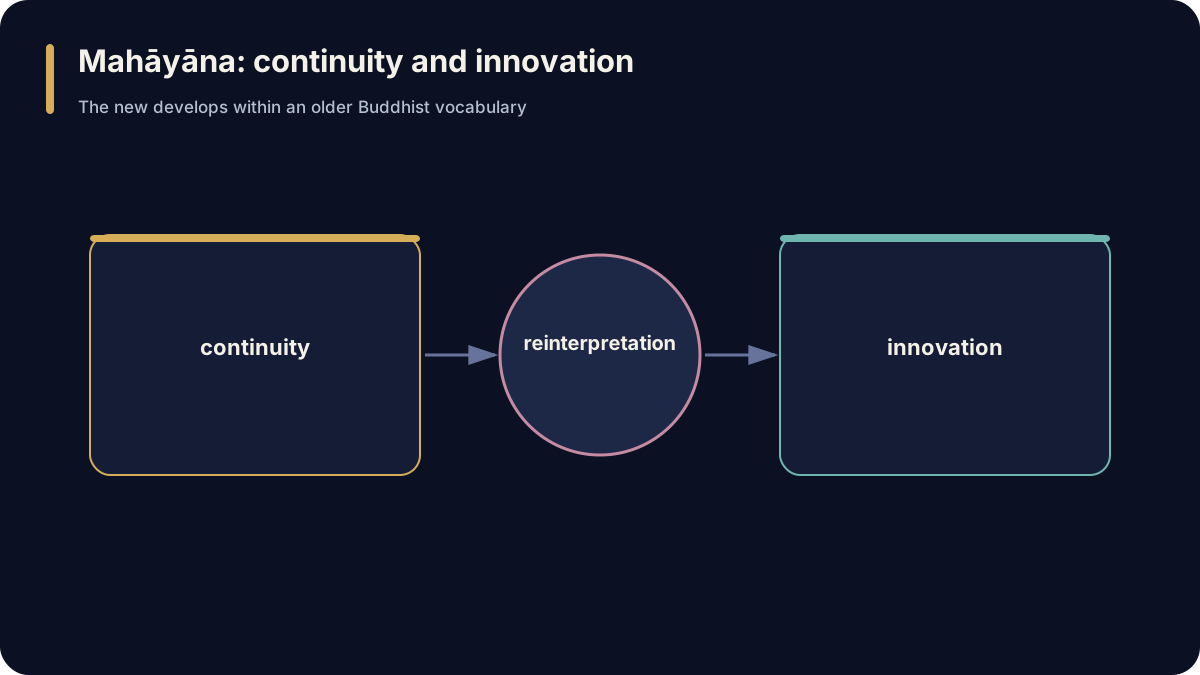
This may be its most characteristic mode of innovation. Not in the sense “old Buddhism is wrong; let us begin again,” but rather “the old teaching is true — but its deepest meaning is greater than you thought.” Non-self becomes the emptiness of all dharmas. The disciple's path becomes a skillful means within the one vehicle. The Buddha of the past becomes a manifestation of a broader buddhahood. Merit becomes fuel for a universal bodhisattva vow. Meditation is linked with cosmic Buddhas. Nirvāṇa is rethought so that it does not become a separate absolute refuge away from beings. This is reinterpretation through expansion.
Sometimes, however, Mahāyāna really does add something substantially new. We should not go to the opposite extreme and claim everything Mahāyāna was already present in early Buddhism. It was not. The early inter-school corpus does not contain the developed Prajñāpāramitā rhetoric of the emptiness of all dharmas. It does not contain Amitābha's Sukhāvatī in developed form. It does not contain tathāgatagarbha doctrine. It does not contain trikāya as a developed system. It does not contain ālayavijñāna. It does not contain the Avataṃsaka's cosmic world in its developed literary form. It does not contain the Lotus Sutra's one vehicle as a comprehensive hermeneutics of history. These are genuine historical developments. Roots are not the same thing as a fully grown tree.
Is Mahāyāna still Buddhism? Historically, the question is almost wrongly framed. Mahāyāna does not appear outside Buddhism. It arises within its communities, language, practices, monasteries, cosmology, and problems. It understands itself as the Buddha's deeper Dharma. Its opponents did not necessarily understand it that way. But historically there is no doubt that it is a development of Buddhist tradition, not an entirely unrelated religion. A much more interesting question is: How far can a tradition change while still claiming to reveal the same project of liberation?
Emptiness is the clearest example. Early Buddhism says: do not cling to the body as self. Not to feeling. Not to perception. Not to formations. Not to consciousness. Mahāyāna asks: What about the very categories with which we analyze these things? Are they metaphysically solid? If we make them solid, have we not built a new world of substances out of non-self? Prajñāpāramitā's answer is: dharmas too are empty. This is simultaneously continuity with and critique of an older Buddhist development.
The bodhisattva is another clear example. Early Buddhism knows a person who becomes a Buddha through an immense number of lives. Mahāyāna asks: Why should this path be limited to a few exceptional individuals? Why should I not form the aspiration may I become a Buddha for the sake of beings? Again: an old motif. A new normative function.
The Buddha is another. Early Buddhism knows Buddhas of the past and the future Maitreya. Mahāyāna asks: Why should Buddhas exist only in temporal sequence? Why could they not also exist in other worlds now? And if complete buddhahood is so vast, is an eighty-year historical biography really the whole reality of a Buddha? Again: an old category. A radically wider horizon.
And precisely for this reason Mahāyāna is not simply “new Buddhism.” It is Buddhism beginning to push its own categories toward new limits. What does non-self mean if dharmas too lack own-nature? What does compassion mean if the goal is the liberation of all beings? What does Buddha mean if the cosmos is full of Buddhas? What does sutra mean if new Buddhavacana appears centuries after Gautama? What does nirvāṇa mean if the bodhisattva does not wish to abandon beings? What does path mean if different paths can be only skillful means? These are Mahāyāna questions.
From the root to a new crown. The previous article ended with the image of a root. The oldest core: dukkha, conditionality, non-self, karma, saṃsāra, ethics, meditation, wisdom, nirvāṇa. Mahāyāna does not uproot the root. A different crown grows from it. Bodhisattva. Bodhicitta. Pāramitās. Emptiness of all dharmas. Countless Buddhas. Buddha-fields. Upāya. One vehicle. New sutras. Expanded buddhology. Tathāgatagarbha. Yogācāra. Madhyamaka. Pure Lands. Yet not even all these branches are equally old. Mahāyāna has its own internal history.
The question “What does Mahāyāna add?” therefore needs three answers. First: It expands some old motifs. The bodhisattva. Compassion. Buddhas. Merit. Pedagogical adaptation. Second: It reinterprets some old teachings. Non-self through emptiness. Nirvāṇa through a new relationship with saṃsāra. Different paths through upāya and the one vehicle. The Buddha's biography through expanded buddhology. Third: It also develops genuinely new doctrinal and religious systems. The specific rhetoric of Prajñāpāramitā. Developed Buddha-fields. Tathāgatagarbha. Trikāya. Yogācāra models of consciousness. Later great bodhisattva cults. And from these, still newer forms of Buddhist practice will later grow.
Mahāyāna as a question, not only an answer. Perhaps it is best understood as a vast historical question that Buddhism asks itself: If awakening is truly possible, how far can its meaning be extended? If the self is empty, what about things? If the Buddha is awakened, what is buddhahood? If compassion exists, why not for all beings? If there is a path, why should only one kind of person have access to the highest goal? If the Buddha teaches according to the listener, can different teachings be part of a larger plan? If nirvāṇa liberates, what does liberation mean if it does not leave behind the world of suffering beings? Over the centuries, Mahāyāna offered many answers. They are not always consistent with one another. That is precisely why we speak of a history of Mahāyāna, not of a single doctrine.
Yet almost all these answers grow out of a dialogue with Buddhism that already existed. There is therefore not only a rupture between early Buddhism and Mahāyāna. There is also a thread. Sometimes thin. Sometimes very obvious. And it is precisely this mixture of continuity and innovation that allows Mahāyāna to be at once deeply Buddhist and historically something new.
Sources and Literature
Primary Texts and Reference Editions
- 84000 Toh 12 (Prajñāpāramitā), Toh 113 (Lotus Sutra), Toh 176 (Vimalakīrti), together with Zimmermann 2002 for tathāgatagarbha as representative primary points of entry.
Research and Verification Literature
- Drewes, David. “Early Mahayana.” Oxford Bibliographies in Buddhism. 2013; reviewed 2021. DOI 10.1093/obo/9780195393521-0145.
- Boucher, Daniel. “Mahayana.” Oxford Bibliographies in Buddhism. Originally 2011; updated 2021. DOI 10.1093/obo/9780195393521-0018.
- Nattier, Jan. A Few Good Men: The Bodhisattva Path according to The Inquiry of Ugra. University of Hawai‘i Press, 2005.
- Falk, Harry, and Seishi Karashima. “A First-Century Prajñāpāramitā Manuscript from Gandhāra – parivarta 1.” Annual Report of the International Research Institute for Advanced Buddhology 15 (2012): 19–61.
- Szanyi, Szilvia. “Yogācāra.” The Stanford Encyclopedia of Philosophy, Summer 2026 ed., edited by Edward N. Zalta and Uri Nodelman.
Note: verification sources are part of the editorial apparatus. Where the originally used edition was not preserved during reconstruction, the standard reference edition is not presented as the article's presumed original source.