Tathāgatagarbha Sutra — Does the Teaching of Buddha-Nature Contradict Not-Self?
Buddhism begins with a very clear critique: **do not look for a permanent self.** Body, feeling, perception, formations, and consciousness are not self.

Buddhism begins with a very clear critique: do not look for a permanent self. Body, feeling, perception, formations, and consciousness are not self. None of the five aggregates is fit to be grasped as this is me or this is my permanent essence. Then, several centuries later, Mahāyāna literature appears speaking of tathāgatagarbha in all sentient beings. At first glance the question almost forces itself upon us: Has Buddhism just returned to the idea of a permanent inner self? This is the central problem of this sutra.
What Is the Tathāgatagarbha Sutra?
It is one of the earliest surviving clear formulations of the teaching that later traditions will call Buddha-nature. The text no longer survives in its original Indian language; we know it from two Chinese and two Tibetan transmissions. The shorter recension was translated into Chinese by Buddhabhadra in 420. A longer recension survives in later Chinese and Tibetan transmission.
What Does Tathāgatagarbha Mean?
It is not a simple term. Tathāgata is a title of the Buddha. Garbha can mean womb, interior, embryo, germ, core, or something that contains something else. It is therefore not best to translate tathāgatagarbha automatically only as Buddha-nature. In the early context it is better to preserve the expression and explain its imagery: something within a being contains or conceals the Tathāgata.
What does the sutra actually do? It does not offer a long philosophical definition. Instead, it uses nine similes. Each shows the same basic pattern: something extraordinarily precious is hidden beneath something impure, ordinary, or unrecognizable.
The Nine Similes
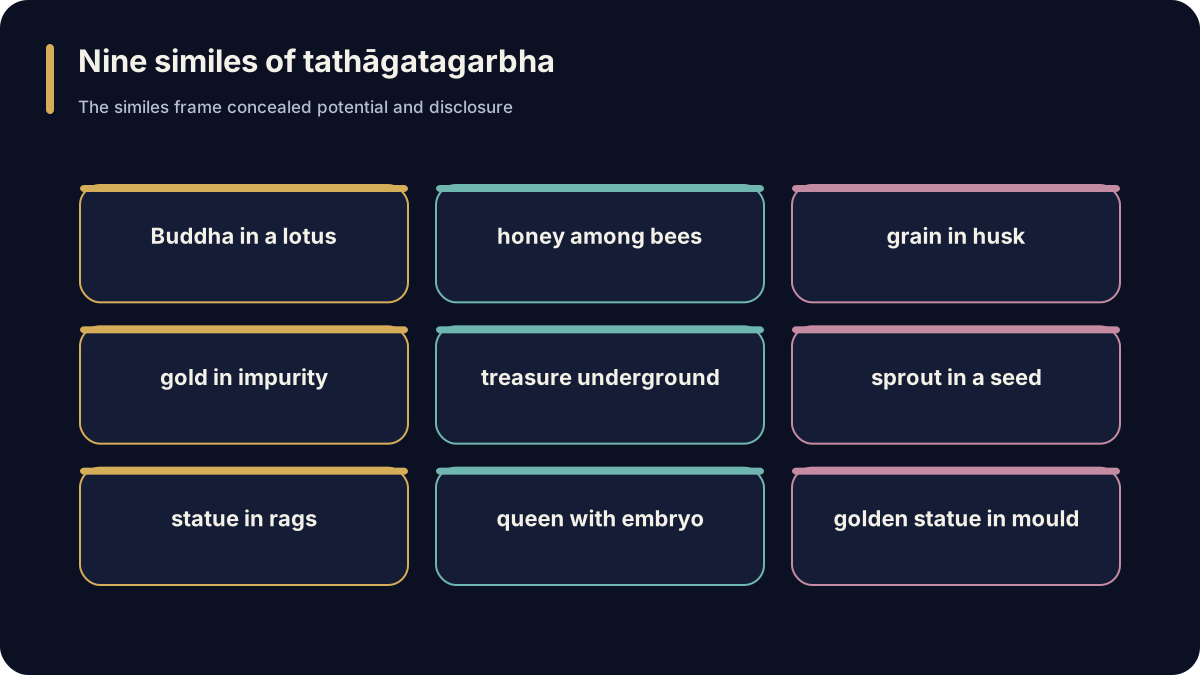
The sutra compares tathāgatagarbha to a Buddha inside a withered lotus; honey among bees; grain inside its husk; gold in excrement or filth; a treasure hidden beneath a house or in the ground; a sprout or tree hidden in a seed; a precious image wrapped in old rags; a future king in the womb of a poor woman; and gold or a precious figure inside a clay mold. All these images share the same basic logic. Outwardly there is something unattractive; within it, something extraordinary.
What is hidden? The sutra speaks of the Tathāgata. But here we must be careful. If we imagine a tiny, fully formed Buddha literally sitting inside every body, we have materialized the simile too much. It is religious and symbolic language. Its message is that a being's present kleśas are not its final limit.
Kleśas. Kleśas are greed, hatred, delusion, anger, envy, attachment, ignorance, and related mental defilements. The sutra presents them as a covering. They conceal. But they do not necessarily define the being's ultimate possibility.
This Is Different Language from Anattā
Early Buddhism often says: stop clinging, remove ignorance, bring craving to an end. The Tathāgatagarbha Sutra says: remove the covering and something precious is revealed. This is an important change in rhetoric.
But is it simply the same teaching in different language? We cannot just say so. The language really is different. Early anattā primarily prevents identification with anything as a permanent self. The Tathāgatagarbha Sutra, by contrast, uses positive images of something inner, precious, concealed, and connected with Buddhahood. The tension is real.
Gold in filth. Imagine a heap of filth. Outwardly there is nothing precious. But inside it is gold. An ordinary person sees only the filth. Someone with better vision sees the gold. This is one of the sutra's basic logics. The Buddha recognizes something in a being that the being itself does not yet recognize.
What should we not say too quickly? We should not rush to say that this gold is an eternal individual soul, nor that this gold is merely emptiness and nothing else. The early sutra itself does not resolve its imagery into one later philosophical definition. That is done by later traditions.
The similes are not all exactly the same. This is very interesting. Gold is already completely gold, the treasure is already a treasure, and the image is already made, whereas a seed is not yet a tree. At least two different ways of thinking therefore appear.
Disclosure. Something precious is already present and must be uncovered.
Development. Something contains a possibility that must mature. The sutra itself therefore permits more than one emphasis.
Honey and bees. The honey is already sweet. The bees cover and guard it. If they are removed, the honey is not newly created. This is a powerful image: kleśas do not determine the being's ultimate nature or possibility.
The seed. A seed works differently. Within it is the possibility of a tree, but the tree must develop. It is therefore too simple to say that the Tathāgatagarbha Sutra teaches only “an already perfect Buddha inside every person.” Some of its images emphasize presence, others development.
What, then, is the safest formulation? The sutra itself says that all sentient beings bear or contain tathāgatagarbha, which is covered by kleśas. The Buddha sees this. The being itself does not yet see it.
Is Tathāgatagarbha the Same as Buddha-Nature?
Later tradition often treats the two almost as synonyms. Historically, however, it is better to distinguish them. Tathāgatagarbha is a specific early expression. Buddha-nature becomes a broader category into which later traditions place tathāgatagarbha, buddhadhātu, gotra, suchness, dharmakāya, and other related concepts. These terms were not completely identical from the beginning.
The Tathāgatagarbha Sutra Is Not Yet the Ratnagotravibhāga
This is one of the most important safeguards. The later Ratnagotravibhāga will systematically connect tathāgatagarbha, dharmakāya, tathatā, gotra, and the Buddha bodies. But this is a later philosophical systematization. We must not retroactively place it into every sentence of the early sutra.
Nor is it yet the Mahāyāna Mahāparinirvāṇa Sutra. The later Mahāyāna Mahāparinirvāṇa Sutra uses even more strongly positive language — in some contexts even ātman — self. We should not automatically attribute this to the Tathāgatagarbha Sutra.
The Problem of Anattā Remains
We can now return to the opening question. Anattā says: do not grasp anything as a permanent, independent self. The Tathāgatagarbha Sutra speaks of something precious, hidden beneath kleśas, connected with Buddhahood. Does this sound like ātman? At the level of language: it can. So we will not hide the tension.
But the sutra itself does not yet entail one metaphysics. The simile of hidden gold by itself does not answer whether tathāgatagarbha is a substance, potential, suchness, emptiness, dharmakāya, or something else. Those answers are developed by later commentaries and schools.
Different readings therefore emerge later. Some emphasize the possibility of Buddhahood. Others suchness and emptiness. Others original purity. Still others use almost substantialist positive language. There is no single interpretation.
Is Buddha-nature emptiness? In some later traditions the relation is very close. In others, not quite. Tathāgatagarbha literature will develop complex formulas about the emptiness of kleśas and the qualities of the Buddha. But such expressions have a difficult textual and translational history, so we will not attribute them as a settled system to the early Tathāgatagarbha Sutra.
Why Did This Positive Language Appear?
Perhaps it has a powerful pedagogical function. If someone hears only “there is no self” or “everything is empty,” they may understand this nihilistically. Tathāgatagarbha speaks differently. It says: your present confusion is not your final limit.
This is a very powerful message. A person may be angry, but anger is not the last word; ignorant, but ignorance is not the last word; deeply trapped in kleśas, yet the sutra still sees them through the horizon of Buddhahood.
This has an ethical consequence. Do not reduce another person to the worst thing they presently display. This is related to the motif of Sadāparibhūta in the Lotus Sutra. There the bodhisattva disparages no one because they may become a Buddha. Here the sutra says tathāgatagarbha is present in all sentient beings.
Is this the same as ekayāna? No. The Lotus Sutra asks: where do the different vehicles lead? Answer: toward one Buddha vehicle. The Tathāgatagarbha Sutra asks: what is there in a being that makes Buddhahood possible at all? These are related but different questions.
Does Tathāgatagarbha Contradict Anattā?
The most honest answer is: it depends on the interpretation. If it is understood as an eternal individual soul that exists by itself and independently of everything else, the conflict with anattā is very strong. If it is understood as language for the universal possibility of Buddhahood, suchness, the emptiness of kleśas, or a non-reified Buddha dimension, the relationship can be explained differently.
But we will not choose the answer for the traditions. This matters. Our article will not say: “Tathāgatagarbha really means only X.” We will show the early sutra itself, its similes, and the later diversity of interpretations.
What, then, does the early sutra actually say? The safest formulation is: all sentient beings contain or bear tathāgatagarbha, which is covered by kleśas; the Buddha recognizes this and teaches so that this hidden Buddha-potential or dimension may be revealed. This is close enough to the text and philosophically cautious enough.
The nine images in one sentence. A Buddha in a lotus. Honey among bees. Grain in a husk. Gold in filth. A treasure in the ground. A tree in a seed. An image in old rags. A king in the womb of a poor woman. A precious figure in a clay mold. All of them say: do not judge only by the covering.
Conclusion
The Tathāgatagarbha Sutra speaks in a different tone from the Anattalakkhaṇa Sutta. The early teaching says: do not identify anything as a permanent self. Tathāgatagarbha, however, speaks of something precious, covered by kleśas, connected with Buddhahood. This is a real tension. But the tension itself does not tell us how it must be resolved. The early sutra does not present a fully developed ontology of Buddha-nature. It gives images. Later Buddhist traditions interpret those images differently: some through emptiness, others through suchness, others through potential, others through original purity, and some through highly positive, almost substantial language. So the question “Does Buddha-nature contradict not-self?” cannot honestly be answered in a single sentence. But we can say: if we turn it into an eternal individual soul, we move very far from classical anattā.
If, however, we understand it as a way of speaking about the universal possibility of awakening and about the fact that kleśas are not the being's final nature, the relationship is different. The Tathāgatagarbha Sutra itself above all teaches us: do not mistake the dirt for the gold, the wrapper for the contents, or present kleśas for a being's final possibility. But exactly how to understand that gold will become one of the great questions of later Mahāyāna philosophy.
Sources and Literature
Primary Texts and Reference Editions
- Zimmermann, Michael. A Buddha Within: The Tathāgatagarbhasūtra. IRIAB, 2002 (study and annotated English translation).
Note: verification sources are part of the editorial apparatus. Where the original edition used during reconstruction was not preserved, a standard reference edition is not presented as the article's presumed original source.