Anattā and Buddha-Nature — Does Buddhism Deny the Self Only to Reintroduce It in the End?
At the beginning of the Buddhist path we are given a very clear warning: **this is not self.** The body, feeling, perception, mental formations, and consciousness are not self. Yet later Mahāyāna texts speak of **tathāgatagarbha — Buddha-nature.**
At the beginning of the Buddhist path we are given a very clear warning: this is not self. The body: not self. Feeling: not self. Perception: not self. Mental formations: not self. Consciousness: not self. None of these is appropriately grasped as this is me, this is mine, this is my enduring self. Then, much later, we encounter Mahāyāna texts that say: in all sentient beings there is tathāgatagarbha. Buddha-nature. The Buddha embryo or germ. The interior or womb of the Tathāgata. Something obscured by the kleśas. Some later texts even use positive language of permanence, purity, bliss, and: ātman — self. So the question is entirely legitimate: Did Buddhism first deny the self and then reintroduce it under another name? This is one of the most difficult questions in Mahāyāna philosophy.
What Does Anattā Actually Deny?
First we must be precise. Anattā does not mean that nothing exists, that there is no person, that there is no continuity, or that there is no responsibility. Early Buddhist teaching primarily dismantles appropriation. What is impermanent, conditioned, subject to change, and not fully under our control is not appropriately understood as a permanent, independent, unchanging self.
The five aggregates. The person is analyzed in terms of rūpa — form or body, vedanā — feeling, saññā — perception, saṅkhāra — mental formations, and viññāṇa — consciousness. Each aggregate arises, changes, and ceases. The question is therefore not: “Does anything exist?” It is: “Can I justifiably take any of this to be a permanent self?” The answer is no.
Anattā is an anti-reification teaching. Do not look for an unchanging core within a stream of conditioned processes. That is the basic safeguard.
Then Comes Tathāgatagarbha
Several centuries later, Mahāyāna texts appear that say: in all beings there is tathāgatagarbha. The early Tathāgatagarbha Sūtra presents this through nine similes. A Buddha in a withered lotus. Honey surrounded by bees. A grain inside its husk. Gold in filth. Treasure buried in the earth. A tree within a seed. A precious image wrapped in rags. A future king in the womb of a poor woman. A precious statue inside a clay mold. The basic logic is: the kleśas conceal something that the Buddha recognizes as connected with Buddhahood.
Why does this sound like a self? Because the language speaks of something inward, precious, hidden, pure, and apparently not destroyed by defilement. If we say that beneath all change there is something pure that the kleśas merely conceal, we come very close to the language of ātman. The tension is therefore not imaginary.
Buddha-Nature Is Not a Single Doctrine
This is the first major problem. The expression Buddha-nature today sounds like a single doctrine. Historically, however, it encompasses several different concepts: tathāgatagarbha, buddhadhātu, gotra, tathatā, dharmakāya, original purity, luminous mind. These concepts are connected, but from the beginning they were not simply synonyms.
First reading: potential. The least substantialist interpretation says that Buddha-nature means the capacity or possibility of becoming a Buddha. It is not a hidden soul or permanent thing, but the possibility of awakening. Understood this way, the conflict with anattā is small.
But the similes say more. A seed supports the idea of potential, but gold is already gold, treasure is already treasure, and the hidden image is already precious. So not all tathāgatagarbha rhetoric can be translated without remainder into “something may someday be developed.” Some images emphasize development. Others emphasize the uncovering of something already present.
Second reading: suchness and emptiness. Some later traditions understand tathāgatagarbha as tathatā — suchness, or as the emptiness of all phenomena. In this reading, Buddha-nature is not an individual soul but the non-reified nature of phenomena. Because no being stands outside suchness, Buddha-nature is universal.
In that case the conflict with anattā is smaller. Anattā denies a permanent personal self. Buddha-nature, by contrast, is not a person. But this is an interpretive harmonization. We should not automatically claim that all of the earliest tathāgatagarbha texts already meant exactly this.
Third reading: original purity. Other texts emphasize that the kleśas are adventitious, temporary, and acquired, while the Buddha dimension is undefiled. This gives a very powerful practical message: anger is not your final nature. ignorance is not your final nature.
But the philosophical problem remains. What is this original purity? If we turn it into a permanent, unchanging, self-subsistent inner thing, we are very close to precisely the ātman that early Buddhism criticizes.
The Mahāyāna Mahāparinirvāṇa Sūtra
Here the issue becomes even more demanding. This sutra does not speak only of tathāgatagarbha. In certain contexts it also uses ātman — self as a positive term in connection with nirvāṇa and Buddha-nature. This means that positive “self” language is not merely a modern misreading, but an actual part of a particular Mahāyāna corpus.
Did Buddhism therefore return to the Hindu soul? It is not that simple. The Mahāyāna Mahāparinirvāṇa Sūtra does not present its “self” as the ordinary ego, a personal psychological identity, or a conditioned individual soul. It is positive language for the nirvāṇic or Buddha dimension. Historically, however, one point remains important: the rhetoric really did change dramatically.
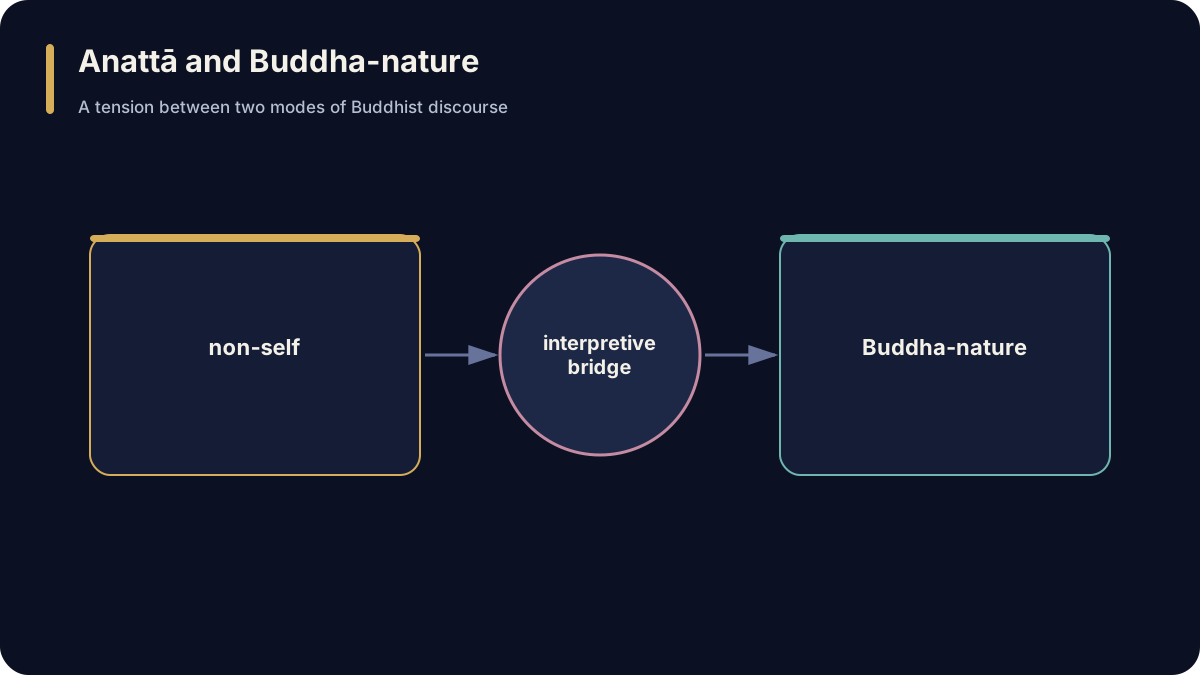
So we will not say: “there is no tension at all between anattā and Buddha-nature.” There is a tension.
Ratnagotravibhāga
Later comes the Ratnagotravibhāga, also known as the Uttaratantra. It gives the tathāgatagarbha teaching its first highly systematic organization. It explains the Buddha, Dharma, Saṅgha, dhātu or Buddha-nature, awakening, the qualities of the Buddha, and Buddha activity.
Why should all beings possess Buddha-nature? The Ratnagotravibhāga gives three classical reasons.
First. Dharmakāya extends into or operates in all beings. The Buddha dimension is not enclosed within one isolated being.
Second. Tathatā — suchness — is undifferentiated. The ultimate nature of phenomena is not one thing for Buddhas and something completely different for ordinary beings.
Third. There is gotra in beings. A disposition, lineage, or basis for Buddhahood. It is precisely the combination of these three reasons that grounds the fully developed universal theory of tathāgatagarbha.
This is more than simply “everyone has potential.” The Ratnagotravibhāga connects potential, suchness, and dharmakāya. The system is therefore philosophically much richer.
And here a difference from some Yogācāra systems becomes visible. Some Yogācāra classifications posit different gotras. Some beings may even be presented as atyantāparinirvāṇadharman — those who will supposedly never attain nirvāṇa. Fully developed tathāgatagarbha theory, by contrast, affirms Buddha-nature in all sentient beings. Yogācāra and tathāgatagarbha were therefore not, from the beginning, one and the same doctrine.
The Laṅkāvatāra Tries to Build a Bridge
We have already seen this. The Laṅkāvatāra connects tathāgatagarbha with ālayavijñāna. But it explicitly recognizes the danger that tathāgatagarbha might be mistaken for a non-Buddhist ātman. Its solution is to connect it with emptiness, non-self, non-arising, and nonduality.
This is extremely important. Mahāyāna authors themselves see that positive language can sound like a return of a metaphysical self. That is why they have to explain it.
Tathāgatagarbha as upāya. One possible answer is that positive Buddha-nature language is skillful means. Why? Because someone may mishear the teaching “there is no self” as “I do not exist,” and “everything is empty” as “nothing is real and nothing matters.” Tathāgatagarbha rhetoric says: awakening is possible. The kleśas are not the final limit of a being. This is a different pedagogical register.
But not all traditions understand it only as pedagogy. Some explain Buddha-nature almost entirely as emptiness. Others as original purity. Others use strongly positive ontological language. So there is no single Mahāyāna answer.
The Tibetan debate. Later Tibetan Buddhism develops this further. Some interpreters understand tathāgatagarbha as emptiness itself, or as a non-implicative negation. Others develop shentong — emptiness of other. There, ultimate reality is empty of adventitious defilements, but not of its own Buddha qualities. The Ratnagotravibhāga becomes a central text in these disputes.
Chinese and East Asian reception. In China, Buddha-nature becomes enormously influential in the Tiantai, Huayan, and Chan traditions. In different forms they all emphasize the possibility of awakening, but they do not explain it in exactly the same way.
Chan and “seeing one’s nature.” Chan can speak of seeing one’s nature. To a modern reader this can sound like: find the true inner self. But if we turn “nature” into an eternal personal substance, we come into conflict with Buddhism’s anti-reification core. Chan formulations are therefore often positive and, at the same time, anti-reifying.
What is anattā actually protecting us from? From grasping something as self in an absolute sense. If Buddha-nature becomes a new thing of which I can say, “this is my true eternal self,” we may simply have replaced the object of grasping.
And what does tathāgatagarbha protect against? The opposite extreme: saying because there is no self, there is nothing of value, no possibility of transformation, and the kleśas are all that we are. Tathāgatagarbha says no. The kleśas are not the final word.
Two Dangers
Anattā primarily guards against eternalism. Tathāgatagarbha literature can function as a response to a nihilistic reading of emptiness and non-self. But both teachings can be reified incorrectly.
A mistaken anattā: “Nothing exists.” That is not the classical Buddhist teaching.
A mistaken Buddha-nature: “Within me is an eternal, individual, pure soul.” That too is not a neutral account of the Buddhist tradition as a whole.
A better question. Perhaps the question is not “Which text is right?” but “What is each text trying to prevent, and in what historical setting is it speaking?” Early anattā: grasping at a permanent self. Tathāgatagarbha sutras: identifying a being with its kleśas. The Mahāparinirvāṇa Sūtra: a nihilistic conception of nirvāṇa. The Ratnagotravibhāga: systematizing the universal possibility of Buddhahood. The Laṅkāvatāra: connecting tathāgatagarbha with Yogācāra while rejecting an ātman reading.
This does not mean they are all saying the same thing. This is very important. We will not erase the differences. The texts arose in different periods, in different philosophical environments, and in response to different questions. Some differences are real.
A Historical-Critical Perspective
A historian can say: Buddha-nature is a later Mahāyāna development. It is not the earliest documented Buddhist teaching. Its terminology and systematization change over the centuries.
A traditional perspective. A Mahāyāna interpreter can say: Buddha-nature does not deny anattā. Anattā removes the false ego. Buddha-nature, by contrast, reveals the possibility or dimension of awakening. This is a traditional harmonization.
We must distinguish the two levels. The historical question is: how did the idea develop? The traditional philosophical question is: how can it be reconciled with the rest of Buddhist teaching? These are not the same question.
Is Buddha-nature the “true soul of Buddhism”? We cannot responsibly proclaim that. Such a conclusion would have to ignore anattā, emptiness, critiques of ātman theories, and the diversity of internal Buddhist interpretations.
Is Buddha-nature merely another name for emptiness? We cannot claim that universally either. For some interpreters, almost so. Elsewhere, the language is much more positive.
The most honest answer. Buddha-nature is not one historically unchanging concept. It can be interpreted as potential, suchness, emptiness, original purity, the Buddha dimension, dharmakāya, or as an ultimate reality described in strongly positive terms.
The least controversial common thread. The kleśas are not the final word about a being. A person may be angry, but anger need not be their final nature; they may be ignorant, but ignorance is not an eternal destiny; they may be trapped in saṃsāra, yet awakening remains possible.
Anattā and Buddha-nature as two warnings. Anattā: do not turn anything into a permanent self. Buddha-nature: do not turn your present defilements into your final identity. These two statements do not necessarily exclude one another.
But historically they are not the same teaching. They did not arise at the same time. They do not use the same language. And later harmonizations must not erase historical development.
Conclusion
Does Buddhism deny the self? Early teaching denies a permanent, independent, unchanging personal ātman as something appropriately grasped as “this is me.” Does Mahāyāna later speak of an inner Buddha-nature? Yes. Do some Mahāyāna texts even use the term ātman? Yes. Can this language sound like a return of the self? Also yes. But the story does not end there. Mahāyāna authors had to ask: how can we speak positively about awakening without recreating a permanent individual soul? Some answered: Buddha-nature is emptiness. Others: suchness. Others: potential. Others: original purity. Some texts use substantially stronger positive language. So we cannot say: Buddhism first denied the self and then simply admitted that it had been wrong.
Nor can we say: Buddha-nature was obviously just another name for anattā from the beginning. The history is more complicated. Across centuries, Buddhist tradition seeks a balance between two dangers. The first: turning something into a permanent self. The second: understanding emptiness and non-self as nihilism. Anattā warns primarily against the first. Tathāgatagarbha literature often responds to the second. And precisely in the tension between them arises one of the deepest questions of Mahāyāna philosophy: How can we speak about the unlimited possibility of awakening without turning that possibility into a new eternal thing that can be grasped as “self”?
Sources and Literature
Primary Texts and Reference Editions
- Zimmermann 2002 (Tathāgatagarbha Sūtra); Blum 2013 (Mahāyāna Mahāparinirvāṇa Sūtra, vol. 1); Takasaki 1966 (Ratnagotravibhāga); Red Pine 2012 (Laṅkāvatāra).
Research and Verification Literature
- Szanyi, Szilvia. “Yogācāra.” The Stanford Encyclopedia of Philosophy, Summer 2026 ed., edited by Edward N. Zalta and Uri Nodelman.
Note: verification sources are part of the editorial apparatus. Where the original edition used during reconstruction was not preserved, a standard reference edition is not presented as the article’s presumed original source.