Emptiness and Dependent Origination — Does Śūnyatā Mean That Nothing Is Real?
The word “emptiness” is one of the most easily misunderstood terms in Buddhism. *Śūnyatā* does not simply mean nothingness. The central question is not whether things exist, but **in what way they exist.**

The word “emptiness” is one of the most easily misunderstood terms in Buddhism. When we read that things are empty, it can quickly sound as though Buddhism is claiming that the world does not really exist, that everything is merely an illusion, or that there is nothing behind our experiences. But the Sanskrit term śūnyatā does not simply mean nothingness. The main question is not whether things exist or do not exist. The question is in what way do they exist? In Mahāyāna Prajñāpāramitā literature and later Madhyamaka philosophy, emptiness denotes the absence of an independent, self-sufficient intrinsic nature. Phenomena arise, have effects, and cease, but their existence cannot be understood as the existence of something wholly from its own side, without conditions, relations, parts, or conceptual determination.
To understand why such a claim arose at all, we have to return to a much older Buddhist teaching: dependent origination.
Dependent Origination
Pāli uses the term paṭiccasamuppāda, while Sanskrit uses pratītyasamutpāda. It is usually translated as dependent or conditioned origination. Its basic logic can be stated simply: when certain conditions are present, a certain phenomenon can arise; when the relevant conditions cease, the phenomenon can also cease. In early Buddhist discourses this teaching is closely connected above all with explaining the arising and cessation of suffering. Its best-known form is the chain of twelve links, which includes ignorance, formations, consciousness, contact, feeling, craving, clinging, becoming, birth, and aging and death. But its meaning is not limited to a list of twelve links. The central idea is that the phenomena we experience do not arise without conditions.
This does not mean that everything causes everything else. Buddhist analyses generally speak about particular causes and conditions and particular results. That is precisely why dependent origination is practically important: if we know the conditions that lead to suffering, we can intervene in them. If suffering were an unchanging property of a person or of the world, liberation would not be possible. Because it is conditioned, it can change.
Between Existence and Nonexistence
One important early text for understanding this problem is the Kaccānagotta Sutta. In it, the Buddha warns that the world is often caught between two extremes: “it exists” and “it does not exist.” The answer is not simply to choose one of them. Instead, the discourse directs attention to arising and ceasing through conditions. This is an important early criticism of absolute thinking. But we should not turn it into a simple historical equation. The early teaching of dependent origination, Mahāyāna Prajñāpāramitā literature, and later Madhyamaka belong to different historical, textual, and philosophical settings. There are real connections among them. But they do not constitute one single doctrine that merely expanded linearly from the beginning.
From non-self to emptiness? We need to be similarly careful about the connection with the teaching of anattā or anātman, non-self. Early Buddhist discourses analyze body, feelings, perceptions, mental formations, and consciousness, warning that they should not be understood as a permanent and fully controllable self. In Mahāyāna literature, the analysis of non-reification is extended to dharmas, phenomena more generally. This allows us to see an important historical and philosophical connection. But we should not write the simple formula: anattā = śūnyatā. Non-self and emptiness overlap in their criticism of permanent and independent identity, but the terms occur in different texts and doctrinal contexts.
What Does It Mean for Something to Be Empty?
When Madhyamaka speaks of emptiness, the question empty of what? is always important. The key term is svabhāva. It is translated in different ways: own-nature, intrinsic nature, own essence, or inherent existence. None is perfect. In the Madhyamaka context, the term primarily refers to a mode of existence in which something would possess its identity and nature in and of itself, independently of other factors. So when Madhyamaka says that phenomena are empty, it does not say “phenomena do not exist.” It says: phenomena lack independent *svabhāva*. That difference is decisive.
A simple example — and its limit. Take a tree. A tree arises because of a seed, soil, water, light, temperature, and a long series of biological conditions. It is made of parts and changes over time. This already shows that a tree is not completely causally independent. But in Madhyamaka the analysis does not stop at causation. We can also ask how the whole depends on its parts, how the parts are determined in relation to the whole, and how we use the term “tree” at all for a changing complex of properties and processes. So the bare statement “something has a cause” still does not capture the full meaning of emptiness. Madhyamaka investigates several forms of dependence.
Nāgārjuna’s Critique of Svabhāva
Nāgārjuna, one of the most important philosophers in the Buddhist tradition, developed the question of emptiness systematically in the Mūlamadhyamakakārikā — the Fundamental Verses on the Middle Way. There he analyzes causation, motion, time, self, composite phenomena, nirvāṇa, and many other concepts. His method is not simply to prove that none of these exists. The question is whether any of them can be found as a wholly self-sufficient phenomenon with an independent intrinsic nature. If something depends on conditions, it is not wholly independent. If a whole depends on its parts, it is not self-sufficient. If something is understood only in relation to something else — for example cause in relation to effect, long in relation to short, or part in relation to whole — its identity likewise is not completely isolated. Madhyamaka therefore does not search for a final unchanging thing on which the rest of the world rests; it calls precisely such a metaphysical foundation into question.
Dependent Origination and Emptiness
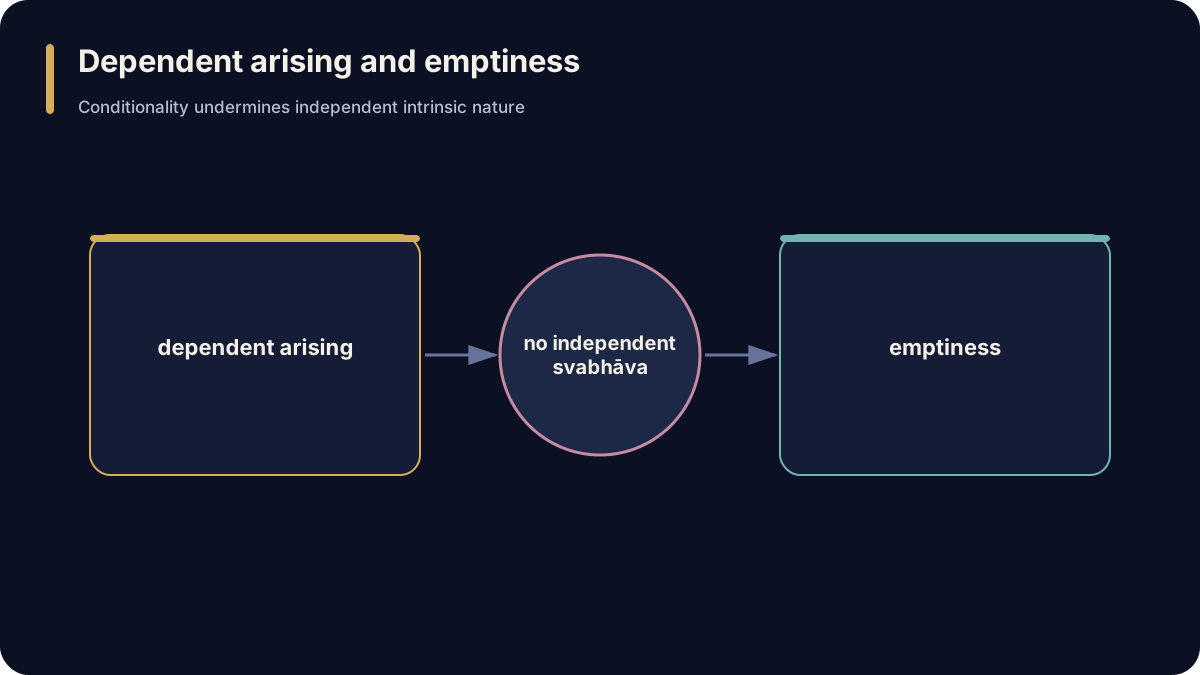
In Nāgārjuna’s philosophy, the connection between dependent origination and emptiness becomes extraordinarily important. What exists dependently does not exist as a wholly independent svabhāva. Yet caution is needed here as well. The simple fact that a phenomenon is causally produced does not automatically entail the whole Madhyamaka theory of universal emptiness. Other Buddhist philosophical traditions accepted the causal conditioning of phenomena while at the same time attributing intrinsic nature to certain dharmas in a technical sense. Madhyamaka goes further. Its critique includes causal dependence, the dependence of wholes on parts, and various forms of conceptual and relational dependence. The connection between emptiness and dependent origination is therefore deep, but philosophically more demanding than the formula: “everything has a cause, therefore everything is empty.”
Emptiness does not destroy causality. One of the most common objections runs like this: if things have no intrinsic essence, how can anything cause anything else? Madhyamaka reverses the problem. If a phenomenon possessed a completely unchanging and self-sufficient intrinsic nature, it would be difficult to explain how it could change. A seed can become a sprout precisely because it is not an immutable metaphysical object frozen forever in a single form. Hunger can cease, anger can arise and disappear, a person can learn, and the body can age. The conditioned world is a world of change. In Madhyamaka, emptiness therefore does not mean that causality fails to function. Its critique is directed against the idea of self-sufficient, independent existence.
Emptiness is not a hidden substance. When we hear the word “emptiness,” we may be tempted to understand it as something lying beneath phenomena: some ultimate reality, a space, substance, or metaphysical ground from which things arise. But that would be almost the opposite of Madhyamaka. Emptiness is not the substance of which the universe is made, a secret foundation behind phenomena, or a Buddhist version of an absolute substance. Emptiness denotes the absence of independent svabhāva.
Even Emptiness Is Empty
Madhyamaka therefore takes another radical step. If we turned emptiness into a final metaphysical thing, we would once again create something supposedly existing in and of itself. Emptiness too is therefore not exempt from analysis. We can say that emptiness itself is empty. This does not mean that the teaching has refuted itself. It means that emptiness must not be reified. A chair is empty of independent svabhāva. A person is empty of independent svabhāva. A thought is empty of independent svabhāva. But “emptiness” is not an additional object standing behind them. It is a description of the absence of a mode of existence that we mistakenly attribute to them.
The Two Truths
Madhyamaka also explains its view through the distinction between conventional and ultimate truth. At the conventional level there are people, trees, illnesses, medicines, promises, pain, roads, causes, and effects. If a person is hit by a car, the fact that the phenomenon is empty of svabhāva does not mean that there is no injury; the conventional world functions. At the level of ultimate analysis, however, we do not find phenomena possessing a wholly independent intrinsic nature. This does not mean there are two separate worlds. There is not a false everyday world below and a secret emptiness above. These are different ways of describing or analyzing phenomena. Conventionally, we can speak about a chair. When we search for a completely independent essence of the chair, we do not find one. Both statements concern the same phenomenon.
Is the world an illusion? Buddhist texts often use images of dreams, mirages, bubbles, reflections, and magical displays. Such language can be misunderstood as the claim that nothing is real. But these comparisons usually point to something subtler. Phenomena can appear more solid, autonomous, and unchanging than they prove to be under closer analysis. The reflection of the moon in water is not the moon itself. Yet the reflection really appears because certain conditions are present. Similarly, the word “illusory” in a Buddhist philosophical context does not necessarily mean “completely nonexistent.” It highlights a difference between the way something appears and the way it exists.
Emptiness is not relativism. Nor does it follow from emptiness that “anything goes.” If things lack independent essence, that does not mean that all claims are equally correct or that actions have no consequences. Fire can burn. Poison can harm. Compassionate action can reduce suffering. Some conditions lead to certain results, others do not. That is precisely why dependent origination matters. If nothing had consequences, Buddhist ethics and practice would make no sense.
Emptiness and ethics. At first glance, emptiness can seem like highly abstract philosophy. But its purpose in Buddhist traditions is not merely theoretical. If our lives are constituted by relations, conditions, and mutual influence, then actions are not isolated. How we speak, act, and think changes the conditions in which we and others live. Dependence means vulnerability. At the same time, it means the possibility of change and help. In a Mahāyāna context, the philosophy of emptiness is therefore often connected with the bodhisattva ideal and compassion.
Prajñāpāramitā and Madhyamaka Are Not the Same Thing
It is also important to distinguish Prajñāpāramitā literature from the philosophical school of Madhyamaka. The Prajñāpāramitā sutras speak about emptiness, the non-reification of dharmas, and wisdom that does not grasp phenomena as self-sufficient realities. Madhyamaka later develops systematic philosophical arguments about svabhāva, causation, dependence, and the two truths. There is a close historical and doctrinal connection between them. But they are not the same thing. A sutra is not a philosophical treatise by Nāgārjuna, and Nāgārjuna’s analysis is not simply a sutra rewritten in another form.
“Form is emptiness.” This distinction also helps us with the famous line from the Heart Sutra: form is emptiness and emptiness is form. The statement does not mean that physical form is made of a metaphysical substance called emptiness. Nor does it mean that form does not exist. It emphasizes that form cannot be separated from its emptiness of independent svabhāva. The form we experience is precisely this conditioned, relational, non-reified form. We do not need to remove the world in order to find emptiness. Emptiness is the way this world lacks independent essence.
Why is emptiness important for liberation? If emptiness were only a metaphysical theory, it would be difficult to understand why it became a central part of the Buddhist path. But its purpose is soteriological. We do not cling only to objects. We cling to ideas about what things finally and unchangeably are. “This is what I am.” “That person is always like that.” “This must be mine.” “This will never change.” “I cannot exist without this.” Such statements can turn conditioned processes into solid identities. Insight into emptiness seeks to reduce precisely this kind of reification. Not because people and things do not exist, but because their mode of existence is not as self-sufficient and unchanging as it often appears to us.
The danger of nihilism. Buddhist philosophers were very well aware that the teaching of emptiness could be misunderstood. If from the statement “phenomena lack independent svabhāva” we draw the conclusion “nothing exists and nothing matters,” we have turned anti-reification into nihilism. If nothing existed even conventionally, there would be no suffering, path, actions, consequences, or liberation. Yet the entire Buddhist project rests precisely on the possibility of changing conditions. Madhyamaka therefore seeks a middle way between two extremes. On one side is reification: the idea that things exist with a completely self-sufficient essence. On the other is nihilism: the idea that nothing exists or has any effect. Emptiness is neither of these two positions.
What, then, is real? Perhaps the real surprise of Madhyamaka is that it reverses a very deep intuition. We often assume: if something is real, it must exist in and of itself. Madhyamaka suggests a different view. Things can exist and have effects precisely as conditioned, relational phenomena. A flower exists, but not independently of the conditions of its arising. A person exists, but not as an unchanging substance outside body, experiences, relations, and history. Words exist and can change a life, but their meaning is not hidden inside them as a self-sufficient substance. Dependence is therefore not the opposite of reality. It is one of the ways conditioned reality works.
What Remains If Everything Is Empty?
The question “what remains, then?” often still assumes that at the end of analysis there must be some final thing: a foundation, a substance, an unchanging reality on which everything else depends while it depends on nothing. Madhyamaka calls precisely this demand into question. Perhaps no final thing needs to remain. People, relations, processes, causes and effects, joy, pain, suffering, and the possibility of its cessation remain. But none of these needs an independent metaphysical core in order to exist and function conventionally. This may be the most important paradox of emptiness. Emptiness does not deprive the world of reality. It deprives it of self-sufficiency.
Sources and Literature
Primary Texts and Reference Editions
- SuttaCentral for early material on dependent origination and emptiness; 84000 Toh 12 for Prajñāpāramitā. Madhyamaka is treated bibliographically as a later philosophical systematization, not as a primary early sutta source.
Research and Verification Literature
- Siderits, Mark. “Buddha.” The Stanford Encyclopedia of Philosophy, Summer 2026 ed., edited by Edward N. Zalta and Uri Nodelman.
Note: verification sources are part of the editorial apparatus. Where the original edition used during reconstruction was not preserved, a standard reference edition is not presented as the article’s presumed original source.