From the Early Discourses to the Heart Sutra — How “This Is Not Self” Became “Form Is Emptiness”
At the beginning of the history, the language is quite different. Body. Feeling. Perception. Mental formations. Consciousness. Early Buddhist discourses lead a person through these fields of experience and repeatedly ask similar questions.

At the beginning of the history, the language is quite different. Body. Feeling. Perception. Mental formations. Consciousness. Early Buddhist discourses lead a person through these fields of experience and repeatedly ask similar questions. Is this permanent? Is it completely under our control? Is something that arises and ceases suitable to appropriate as “This is mine. This I am. This is my self”? The answer is no. Several centuries later, one of the most famous Buddhist texts presents a different formulation: “Form is emptiness; emptiness is form.” The Heart Sutra then continues. No eye. No ear. No nose. No tongue. No body. No mind. No ignorance. No cessation of ignorance. No aging and death. No suffering. No arising of suffering. No cessation.
No path. No wisdom. No attainment. If someone knew only the earliest Buddhist discourses and then opened the Heart Sutra for the first time, the question would be entirely reasonable: What happened? Is Mahāyāna now denying older Buddhism? Do the Four Noble Truths suddenly no longer apply? Do the five aggregates not exist? Does “emptiness” mean that nothing is real? Or is the Heart Sutra the result of a long development of a question that had already been present in Buddhism for a long time: what exactly are we clinging to as something independent, solid, and ours? That is the story of this article.
The Heart Sutra Is Built from Older Buddhist Language
First we must notice something that is easy to miss because of the radical character of the text. Almost all the major categories that the Heart Sutra lists and then negates are older than the sutra itself: the five aggregates, the sense fields, the elements of perception, dependent arising, and the Four Noble Truths. Wisdom. Path. Attainment. These are not new Mahāyāna inventions. They are an inherited Buddhist map. The Heart Sutra therefore does not speak a foreign language. It uses an old Buddhist vocabulary. But it does something new with it.
The five aggregates. In early texts we encounter rūpa — form or materiality, vedanā — feeling, saññā or saṃjñā — perception, saṅkhāra or saṃskāra — formations or conditioned mental processes, and viññāṇa or vijñāna — consciousness. These five aggregates are not best understood as five metaphysical substances out of which a human being is made. In the early discourses they primarily have an analytical and liberating function. A person clings to the body. Feeling. Memory and perception. Mental formations. Consciousness. In each one, one seeks: self, mine, what I am. Buddhist analysis then shows that they all change. They arise because of conditions. They cease. And they are not completely under our control. They are therefore not a secure foundation for permanent identity.
The Heart Sutra begins precisely there. Avalokiteśvara likewise looks at the five aggregates. But he speaks differently. He sees them as empty. Then comes the famous formulation: form is emptiness and emptiness is form. The same applies to feeling, perception, formations, and consciousness. At first glance, it can seem that we have suddenly leapt from an early psychological or phenomenological analysis into a completely new metaphysics. But between the two lie several centuries of Buddhist history.
Emptiness is not a word invented by Mahāyāna. This is the first major correction to an overly simplified story. Early Buddhist texts already use suñña — empty — and suññatā — emptiness. In the early discourses, we can find a very clear formulation that something is empty of self and of what belongs to self. This applies, for example, to the sense fields. Eye. Visible forms. Visual consciousness. And onward through the other senses. Early Buddhism also knows a more explicitly meditative use of emptiness. The Cūḷasuññata Sutta guides a practitioner through successive experiences in which a field of experience is seen as empty of what is absent from it while also recognizing what remains present. Emptiness is therefore not a Mahāyāna word that suddenly appeared from nowhere.
But early emptiness and Mahāyāna emptiness are not simply the same doctrine. This is equally important. In the early discourses, the adjective empty is very often foregrounded. Something is empty of something. Bhikkhu Anālayo has noted that the adjective suñña is much more common in Pāli discourses than the abstract noun suññatā. This is not merely a linguistic curiosity. It suggests that early usage often remains concrete and relational. Empty of self. Empty of what belongs to self. Empty of a particular perception. Empty of particular disturbances. Mahāyāna Prajñāpāramitā, however, gradually develops a much broader question. It no longer asks only what is this phenomenon empty of?, but how does this phenomenon exist at all?
What about the aggregates themselves? The early teaching asks: Is form self? No. Mahāyāna wisdom begins to press further. If form is not self, then what is form itself? Is it self-sufficient? Does it exist independently? Does it possess something by virtue of which, in the final sense, it is entirely from itself what it is? Or does it too exist only because of conditions, relations, designation, parts, and processes? Here space begins to open for the broader Mahāyāna concept of emptiness.
Between the Two Worlds Lie Several Centuries of Analysis
Buddhism did not stand still in the meantime. Different early schools developed their own Abhidharmas or Abhidhammas. They systematically analyzed body, consciousness, feelings, mental factors, perception, karma, causality, meditative states, the path, and nirvāṇa. From the old discourses they built enormous analytical systems. Detailed classifications of dharmas — basic phenomena or events — emerged. But different Abhidharma traditions did not possess exactly the same ontology. There is therefore no single “Abhidharma theory” against which Mahāyāna then simply rebelled.
Abhidharma is an important intellectual environment, not one single step. Some Buddhist scholastic traditions attributed a very strong status to individual dharmas. The complex person could be understood as a conceptual whole composed of more fundamental dharmas. The later philosophical dispute therefore begins to shift. If the personal self is not an ultimate substance, are dharmas ultimate substances? Prajñāpāramitā literature develops in a world in which such analytical thought is already highly advanced. But historically it is not safe to claim: Prajñāpāramitā arose only as a protest against Abhidharma. Its environment is broader. Bodhisattva practice. Non-clinging. Meditation. Wisdom. New ideas of buddhahood. New textual communities. All of these participate in the development.
But the problem of reification becomes real. If we say that a person has no permanent self and then analyze the person into dharmas, a new possibility of clinging appears. One may begin to think: the person is indeed not ultimate. But the dharmas are. We have dismantled one presumed substance and built new ones out of its analytical elements. Prajñāpāramitā literature radicalizes precisely the Buddhist distrust of such clinging. Do not cling to the person. But do not cling to your analytical categories either.
Prajñāpāramitā. Prajñāpāramitā means perfection of wisdom. The word prajñā, or Pāli paññā, is an old Buddhist category. Mahāyāna did not invent wisdom, but the Perfection of Wisdom literature gives it a new expression. The bodhisattva practices. Develops virtues. Meditates. Understands. Yet at the same time grasps nothing as an independent and finally possessable thing. Not oneself. Not beings. Not aggregates. Not dharmas. Not the path. Not wisdom. Not attainment.
Non-grasping becomes still more radical. Here appears one of the key expressions of the Prajñāpāramitā world: non-apprehension or non-finding. The bodhisattva does not find a fixed object: this is absolute form. This is an absolute bodhisattva. This is absolute wisdom. This is absolute awakening that I now possess. Any such object could become a new basis for clinging. Prajñāpāramitā therefore attacks the possibility that even Buddhist teaching could become a new metaphysical possession.
This does not mean there is no practice. This is the first great paradox. The bodhisattva must practice, but does not reify practice. Must develop wisdom, but does not turn wisdom into a substance. Must help beings, but does not build a solid self: I am the one who liberates others. Must attain buddhahood, but does not turn buddhahood into an object that can be possessed like a trophy. The Buddhist project remains. What changes is the way it is conceived.
Early Prajñāpāramitā is surprisingly old. Prajñāpāramitā literature belongs among the earliest well-attested Mahāyāna textual families. From Gandhāra we know a fragmentary birch-bark manuscript in Gāndhārī and Kharoṣṭhī script. Radiocarbon dating places it roughly in the first century CE, with the most probable range approximately between 47 and 147. This is an extraordinarily early physical witness. It does not tell us when the tradition was first composed. The manuscript is already a copy of an older textual form. But it clearly shows that Prajñāpāramitā literature was present very early in Mahāyāna history.
There is not just one Prajñāpāramitā book. Over time we find an enormous family of texts. Versions later named by their approximate number of lines. Eight thousand. Ten thousand. Eighteen thousand. Twenty-five thousand. One hundred thousand. Alongside them, shorter texts. The Diamond Sutra. The Heart Sutra. And still more condensed versions. Historically, however, it is not safe to draw a simple straight line: first it was short, then always longer, and then shorter again. Manuscripts and translations show a more branching picture. Several textual families developed in parallel. Expanded. Contracted. Influenced one another.
Even so, we can see a direction. Earlier extensive Prajñāpāramitā collections systematically use a vast amount of older Buddhist material. Aggregates. Sense fields. Elements. Dependent arising. Four Truths. Meditative stages. Factors of awakening. Paths. Attainments. Then they subject them all to the same pressure: do not cling to them. This is why the later short Heart Sutra can seem almost like an extraordinarily compressed extract from a vast intellectual world.
“No attainment.” This is one of the sharpest expressions of that logic. Buddhism is, after all, a path to attainment. Why would a sutra then say there is no attainment? Read superficially, this gives us a contradiction. But in the Prajñāpāramitā context, the issue is subtler. If a practitioner thinks, there is a solid thing called awakening, and I as a solid person will acquire and possess it, clinging has simply moved to the spiritual level. The Buddhist path can therefore paradoxically require attaining without reifying attainment.
Philologically, even this famous formulation is complicated. Modern textual criticism has pointed out that the Sanskrit Heart Sutra passage around “non-attainment” is difficult. By comparing Chinese and Sanskrit versions of larger Prajñāpāramitā texts, Shì Huìfēng proposed that some formulations should be understood more through non-apprehension or non-grasping than through an abstract ontological claim that attainment does not exist. This matters. The Heart Sutra is not only philosophically difficult. Its textual history is complex as well.
From “This Is Not Self” to “This Is Empty”
We can now formulate a first line of development. An early discourse says: form is not self. Form is impermanent. Conditioned. Not fully controllable. Therefore do not appropriate it. The Prajñāpāramitā tradition goes further. Not only is form not self; form itself is not a self-sufficient thing with an independent mode of existence. Later Madhyamaka will express this through a systematic critique of svabhāva — own-nature or inherent nature. But an important historical safeguard remains: Prajñāpāramitā sutras are not simply Nāgārjuna's philosophy in scriptural form. Their history is older.
Nāgārjuna Comes Later
Around the second or third century CE, Nāgārjuna creates one of the great philosophical systems of Mahāyāna Buddhism. In his Madhyamaka, the connection between dependent arising and emptiness becomes extraordinarily powerful. What arises dependently lacks independent svabhāva. If something had a completely intrinsic nature independent of conditions, conditions could neither create nor change it. Emptiness and conditionality are therefore not opposites. Emptiness, in fact, makes change possible.
But we should not turn the Heart Sutra into a Madhyamaka textbook. This is a very common retrospective error. Because major later commentators interpreted the Heart Sutra through Madhyamaka, it can seem as though the entire later philosophical system was already explicitly written into every line of the sutra. Not necessarily. The Heart Sutra is an older or different kind of text than the later commentaries on it. It is above all a condensation of Prajñāpāramitā. Later systems then interpret it. Madhyamaka with enormous influence. Elsewhere Yogācāra. In different East Asian traditions, still differently.
“Form Is Emptiness”
This sentence has become almost a slogan of Mahāyāna Buddhism. But it is easily distorted. If we understand form is nothing, we get nihilism. If we understand behind form there is a mysterious substance called Emptiness, we get another kind of metaphysics. The formula tries to block both escapes. Form is empty. But emptiness is not another world standing behind form. Emptiness is precisely the way form exists: conditionally, dependently, without a self-sufficient core.
Emptiness is not the hidden material of the universe. This is why the second half of the formula is so important: emptiness is form. If emptiness were some absolute thing behind phenomena, we would merely replace the substance of self with the substance of emptiness. The Mahāyāna critique would fail. This is why later Madhyamaka thinkers also say: emptiness itself is empty. It too must not be turned into a final metaphysical support.
Now We Can Read the List of Negations
The Heart Sutra then moves through the entire Buddhist map. First the aggregates. Then the senses. Then the objects of the senses. Then consciousnesses. Then dependent arising. Then the Four Truths. Then wisdom. Then attainment. This is not a random sequence but almost a catalogue of the older Buddhist analytical world.
The aggregates represent the old analysis of the person. The six senses comprise eye, ear, nose, tongue, body, and mind; their objects are visible form, sound, smell, taste, touch, and mental phenomena. The consciousnesses include visual, auditory, and other consciousnesses that together form the classical Buddhist analysis of perception.
Dependent arising. From ignorance onward all the way to aging and death. The Heart Sutra does not need to spell out the entire long sequence. A traditional listener recognizes the formula.
The Four Noble Truths. Dukkha. Its arising. Cessation. The path. One of the oldest major frameworks of the Buddhist project of liberation. And then: no suffering, no arising, no cessation, no path.
Read literally, this creates a problem. The Buddha teaches a path. The Heart Sutra says: no path. The Buddha teaches cessation of dukkha. The Heart Sutra says: no cessation. The Buddha teaches wisdom. The Heart Sutra says: no wisdom. The bodhisattva aspires to awakening. The Heart Sutra says: no attainment. Is the conclusion older Buddhism was wrong? Classical Mahāyāna tradition generally answers: no.
“In emptiness” changes the question. The negations appear in a particular context. The text does not merely say there is no form. It speaks of what is the case in emptiness. Later commentators will understand this in several ways. One influential interpretation, especially in Madhyamaka, distinguishes the conventional functioning of phenomena from their lack of inherent, independent existence. Conventionally there is a path. Suffering. Ethics. Karma. Practice. Analytically, however, none of these is found as a completely self-standing substance.
But the two truths are not directly explained in the Heart Sutra. This is an important historical safeguard. The developed Madhyamaka theory of two truths is a powerful interpretive framework. It does not follow that the Heart Sutra itself is a complete textbook of that system. The text is too short. Its function is more performative. It dismantles clinging. Repeats negations. It almost refuses to let the reciter find a final category on which to rest.
There are also different modern interpretations of the negations. Modern philology has complicated the picture further. Huìfēng has argued that some problematic expressions are probably more closely connected with Prajñāpāramitā non-apprehension than with abstract ontological negation. In a different interpretive direction, Jayarava Attwood has proposed that some formulations can be read more phenomenologically or meditatively rather than as the simple metaphysical statement these things absolutely do not exist. Such proposals are not a scholarly consensus. But they show something important: the worst possible reading is the Heart Sutra simply teaches that nothing exists.
If nothing exists, Buddhism collapses too. If suffering did not function even conventionally, why help someone who suffers? If actions had no consequences, why ethics? If ignorance caused nothing, why wisdom? If there were no practice at all, why recite the Heart Sutra? Nihilism would destroy the very soteriological project that the sutra presupposes. Emptiness is therefore far subtler than nothingness.
The Heart Sutra Is a Short Text with a Very Long Prehistory
This may be the most important historical observation. The Heart Sutra is small. Yet almost every one of its lines stands on a large mass of older Buddhist material. Aggregates. Senses. Dependent arising. Four Truths. Prajñā. Bodhisattva. Prajñāpāramitā literature. Non-clinging. And then a ritual formula at the end. In a few hundred Chinese characters, or a very short Sanskrit text, several centuries of Buddhist intellectual history are compressed.
But the Heart Sutra itself is quite late. Here we must distinguish the age of its components from the age of the concrete text. The aggregates are very old. Dependent arising is very old. The Four Truths are very old. Prajñāpāramitā literature is attested already in the first century CE. But the short Heart Sutra known today appears much later in the historical evidence. The earliest securely dated physical witness to its short Chinese text is a stone stele from Fangshan dated 661. This is roughly half a millennium after the oldest surviving Gāndhārī Prajñāpāramitā manuscript.
The traditional story was different. For a long time, the prevailing picture was: Indian Sanskrit Heart Sutra → Chinese translation. The most famous short Chinese version, Taishō 251, is traditionally attributed to Xuanzang. Later bibliographical tradition also gives 649 as the date of his translation. Modern textual history has made this picture much more complicated.
What do we actually know about Xuanzang? Xuanzang is indeed a central figure in the early history of the Heart Sutra in China. He died in 664. The Fangshan stele of 661 already attributes the short text to him. His biography, composed later in the seventh century, reports that in 656 he presented the imperial family with a gold-inscribed Prajñā Heart Text. This means that the text, or a very closely related form, existed by this period at the latest. But this alone does not establish that Xuanzang translated an Indian Sanskrit original in 649.
Nattier's hypothesis. In 1992, Jan Nattier proposed a very different explanation. The short Heart Sutra, she argued, may have been composed in China. Its core may have been taken from an already existing Chinese translation of a large Prajñāpāramitā sutra. The Chinese compilation was then translated, or back-translated, into Sanskrit. This was a radical claim. But it rests on a very concrete philological problem.
Why a Chinese origin? A large part of the Heart Sutra has parallels in the large Prajñāpāramitā in Twenty-Five Thousand Lines. We can therefore compare four things: an older Sanskrit text, its Chinese version, the Chinese Heart Sutra, and the Sanskrit Heart Sutra. If the Heart Sutra had been normally translated from Sanskrit into Chinese, we would expect certain patterns. Yet in the core passage, the Chinese Heart Sutra aligns unusually closely with an already existing Chinese translation of the large sutra, while the Sanskrit formulation of the Heart Sutra is unusual in several places. Nattier therefore proposed the reverse direction of transmission.
Attwood extended the argument. In several studies, Jayarava Attwood extended Nattier's method to additional parts of the text. In a comparative analysis published in 2021, he examined twenty-two comparison points and concluded that the overall pattern strongly suggests a Chinese origin for the short Heart Sutra and a later Sanskrit version. He also noted formulations that sound unusual in Sanskrit but natural in a Chinese setting.
Today the Chinese hypothesis is very strong. The contemporary 84000 translation project likewise judges in its historical introduction that the most likely explanation is this: the short Heart Sutra was composed in China in the middle of the seventh century, largely from already translated Prajñāpāramitā material, and soon afterward received a Sanskrit form. 84000 even proposes a possible fairly narrow window in the mid-650s. But here we must remain historically disciplined.
The case is still not completely closed. In 2021, Kengo Harimoto reanalyzed one of the key arguments. He noted that the central passage need not necessarily be explained through one specific Chinese translation by Kumārajīva. According to his analysis, similarly concise formulations are present in other, independent Chinese translations of the large Prajñāpāramitā. He therefore concludes that the core of the Heart Sutra can be explained as a direct development from an Indian or Sanskrit textual tradition. The Chinese hypothesis is thus highly influential and strongly supported today. But it is not without scholarly opposition.
So we will not write: “Xuanzang has been proven to have written it.” We do not have sufficient grounds for that. Nor will we write: it has been proven to have originated in India. A safer formulation is: the strongest contemporary philological model understands the short Heart Sutra as a Chinese compilation from the mid-seventh century that soon received a Sanskrit form; however, there are scholarly arguments for an Indian or Sanskrit textual prehistory, so the question should not be presented as completely closed. That is precise enough.
The Short Version Is Textually Older Than the Long One
Here too the traditional impression can be misleading. The longer Heart Sutra looks more like a proper sutra. It begins with the conventional “Thus have I heard.” The Buddha is present. Śāriputra asks a question. Avalokiteśvara answers. At the end, the Buddha approves the teaching. One could therefore conclude that the long version is the original and the short one an abridgment. Textual history points the other way. The short recension is older. Longer versions later placed its core into a more conventional sutra narrative frame.
This is a beautiful example of the development of sacred text. First there is a highly condensed text. Then the community shapes it so that it looks more like a classical sutra. It adds a place, the Buddha's presence, an assembly of monks and bodhisattvas, a question, a conclusion, and the Buddha's approval. This increases the text's formal appearance as buddhavacana. Even the formula “Thus have I heard” is therefore not by itself reliable proof that a text is closer to the historical Buddha.
Who speaks? This is another interesting shift. In the early discourses, the central teaching is usually delivered by the Buddha. In the Heart Sutra, Avalokiteśvara speaks. A bodhisattva. Opposite him stands Śāriputra, one of the most famous disciples of early Buddhism and a great figure of wisdom. The literary arrangement is almost perfect. The old master of analytical wisdom listens to the new Mahāyāna perfection of wisdom.
This is not a historical meeting. It is important to distinguish literature clearly from history. The historical Śāriputra did not listen to the Heart Sutra as we know it today. Many centuries lie between him and the text. But that is precisely why the choice is so interesting. A Mahāyāna sutra deliberately places itself in dialogue with the older Buddhist world. It does not speak past that world. It speaks to it.
Why Avalokiteśvara? Later Buddhism associates Avalokiteśvara primarily with compassion. But in the Heart Sutra he is the teacher of emptiness. This beautifully expresses a major Mahāyāna connection: prajñā and karuṇā — wisdom and compassion. A bodhisattva does not cultivate emptiness in order to become indifferent to the world. Understanding emptiness belongs within the project of helping beings.
The formula at the end. The Heart Sutra ends with gate gate pāragate pārasaṃgate bodhi svāhā. In traditional use, the formula is closely connected with recitation and ritual. The Heart Sutra was therefore not merely a philosophical treatise. It was recited, memorized, copied, commented upon, venerated, and used liturgically. Its history is religious, not only philosophical.
Even the word “mantra” has a philological history. Another interesting textual detail shows how cautious we must be. Attwood has pointed out that parallel Prajñāpāramitā passages in a similar place often use the word vidyā, whereas the Sanskrit Heart Sutra uses mantra. He has suggested that this could be the result of back-translation from a Chinese expression. Our interpretation of the Heart Sutra does not need to stand or fall on this proposal. But it shows how much history can be hidden in a single word.
And yet the aggregates are still there. After all those centuries of development. After new sutras. After bodhisattvas. After Prajñāpāramitā. After new buddhologies. After Chinese translations. After the possibility of back-translation into Sanskrit. What stands at the very beginning of the Heart Sutra? The five aggregates. The old Buddhist analysis of experience. It has not disappeared. Its function has changed.
The senses are still there. Eye. Ear. Nose. Tongue. Body. Mind. Objects. Consciousnesses. The early analysis of perception is still recognizable. But now it is included within the Prajñāpāramitā critique of clinging.
Dependent arising is still there. Ignorance. Aging. Death. Cessation. This old Buddhist structure is present too. The Heart Sutra does not forget it. It places it under the same pressure of emptiness.
The Four Truths are still there. Suffering. Arising. Cessation. Path. The text assumes that the listener knows these categories. If they were not known, their negation would lose most of its force. The Heart Sutra is therefore not evidence that older Buddhism was forgotten. It is evidence of a deep memory of it.
But it is not merely early Buddhism with a new vocabulary. The opposite extreme would also be wrong. The early formula form is not self and the Prajñāpāramitā formula form is empty are not exactly the same statement. Mahāyāna expanded the question. Not only the identity of the person, but also the ontological or conceptual status of dharmas. Not only the liberation of a disciple, but the bodhisattva path. Not only wisdom, but perfection of wisdom without clinging to wisdom. Not only attainment, but non-attainment as a safeguard against possessing awakening. This is genuine historical innovation.
Continuity without identity. This may be the most precise description of the entire development. Between the early discourses and the Heart Sutra there is continuity, but not identity. The aggregates are inherited. Their philosophical function expands. Dependent arising remains. Its implications are interpreted differently. Prajñā remains wisdom. But it receives a new bodhisattva and Prajñāpāramitā form. Nirvāṇa remains the horizon of liberation. But later Mahāyāna rethinks its relationship with saṃsāra and bodhisattva activity.
History is not a game of telephone. This may be the most important historical lesson. We cannot tell the story this way: the Buddha gave a pure teaching; generations then misunderstood it more and more; centuries later, the Heart Sutra arose from accumulated errors. Such a model underestimates religious thought. Traditions are not merely copying machines. They are interpretive communities. They inherit a problem. Then they ask: what else follows from it?
Sometimes a new idea appears because an old analysis opens a new problem. Non-self dismantles personal substance. But then one can cling to dharmas. So dharmas must be analyzed. Dependent arising shows conditionality. Then comes the question: can something conditioned at the same time possess independent self-existence? The bodhisattva wants to help beings. Then comes the question: how can one help without solidifying self and other? The path leads to attainment. Then: can attainment itself become an object of spiritual greed? In this way, a tradition develops out of its own questions.
The Heart Sutra is almost a perfect symbol of this process. Small. Condensed. Paradoxical. Composed of very old categories. Distinctively Mahāyāna. Philosophically open. Meditative. Liturgical. Recitational. Textually complex. And perhaps arising at the very intersection of the Indian and Chinese Buddhist worlds. Many centuries of history meet in it.
What in it is oldest? Not the sutra itself. Its building blocks. Aggregates. Senses. Consciousnesses. Dependent arising. Four Truths. Prajñā.
What is an important intermediate development? Scholastic analyses of dharmas. The bodhisattva ideal. Early Mahāyāna. Prajñāpāramitā literature. Non-clinging to dharmas. Expanded reflection on emptiness.
What comes later still? The concrete literary form of the Heart Sutra known today. Its Chinese and Sanskrit versions. Longer recensions. Tibetan translations. Madhyamaka commentaries. East Asian liturgical tradition. Zen interpretations. Tibetan commentaries. Modern global interpretations. All of this belongs to the same story. But the layers are not all the same age.
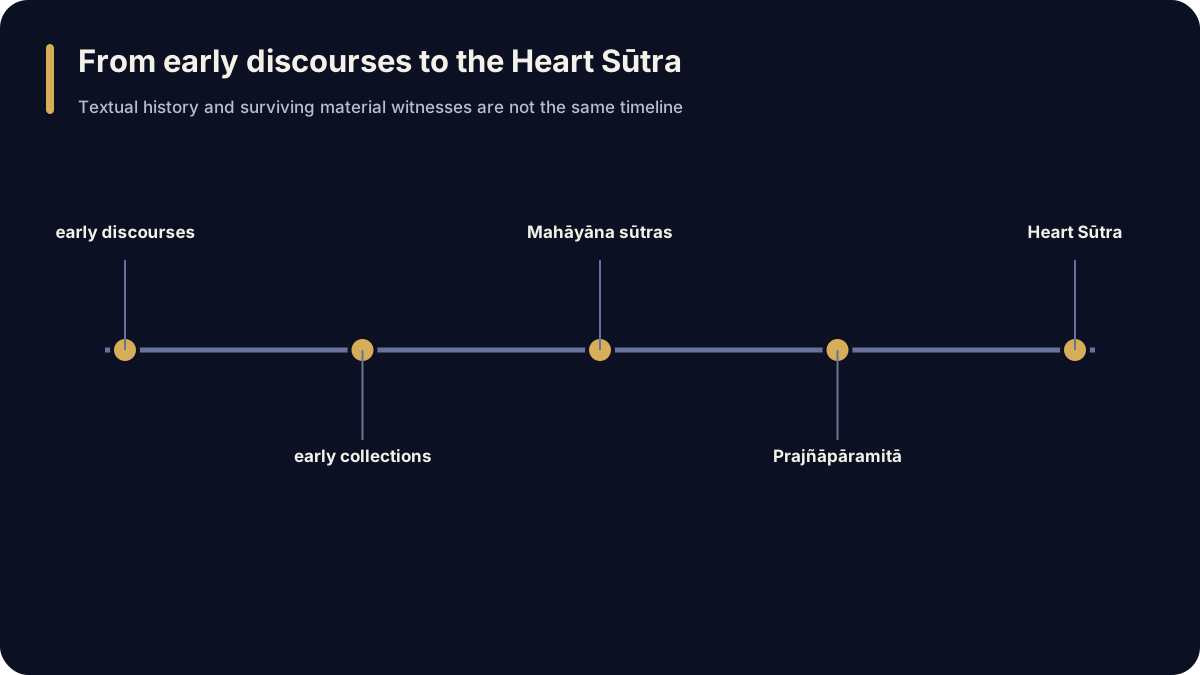
One small sutra, many historical layers. This is why the Heart Sutra is such a fitting conclusion to the entire series on Buddhist sutras. In a few lines meet early Buddhist discourses, analysis of the aggregates, dependent arising, scholastic systematization, early Mahāyāna, Prajñāpāramitā literature, the bodhisattva ideal, Chinese translation culture, Sanskrit transmission, Tibetan canonization, philosophical commentary, and living ritual practice. When someone recites it today, they are not reciting only a short text. They are reciting an extraordinarily condensed history of Buddhist thought.
What, Then, Happened Between “This Is Not Self” and “Form Is Emptiness”?
Not one leap. Not one revolution. And not merely corrupted transmission. What happened was several centuries of Buddhist reflection. First the question: what in experience can be appropriated as self? Then more precise analysis of experience. Then the systematization of dharmas. Then the question: do analytical categories themselves become objects of clinging? Then the bodhisattva ideal. Then Prajñāpāramitā's radicalization of wisdom. Then the development of large textual families. Then the condensation of their material. Then the concrete short Heart Sutra. And then centuries of interpretations of it.
It is not the beginning. The Heart Sutra is not the oldest discourse of the Buddha. It does not represent historically the first Buddhism. Its concrete form is much younger.
Nor is it a complete rupture. But neither can we say the Heart Sutra has nothing in common with early Buddhism. Its text is full of old Buddhist material. Five aggregates. Sense fields. Dependent arising. Four Truths. Wisdom. Path. Liberation. It inherited them. Then reinterpreted them.
Therefore “emptiness” is not simply the negation of everything that came before. When we understand it historically, the picture changes. Early Buddhism warns: do not cling to this as self. Prajñāpāramitā asks: why cling to anything as an independently existing dharma? Later Madhyamaka asks: how could something that arises only dependently possess a completely independent own-nature? These are not identical sentences. But there is a developmental thread among them.
And then comes the final danger. A person can understand: self is empty. Dharmas are empty. The path is empty. Attainment is empty. And then say: Emptiness, therefore, is the final real thing. But then we have again created something to cling to. Mahāyāna tradition therefore warns against clinging to emptiness too. Emptiness is not a final substance. Not a hidden God. Not cosmic Nothingness. It is a safeguard against turning any conditioned concept into an independent absolute.
If emptiness destroys ethics, we have probably misunderstood it. If emptiness meant: suffering does not matter, karma does not matter, beings do not matter, no practice is needed, it would be in complete conflict with the bodhisattva project in which it developed. The bodhisattva cultivates emptiness in order to cut through ignorance, not to justify indifference. Wisdom and compassion therefore become two great sides of the same Mahāyāna project.
The Heart Sutra is difficult precisely because it is short. Long Prajñāpāramitā literature can explain the same idea across thousands of lines. The Heart Sutra takes the context and removes almost all of it. What remains: form. emptiness. negation. non-attainment. the formula at the end. The result is extraordinarily powerful — and extraordinarily dangerous for superficial reading. It can become nihilism. A mystical slogan. A metaphysics of emptiness. Or merely decorative wisdom. Historically, however, it is far more interesting.
In a few words it carries centuries. The early Buddha or early tradition: do not appropriate this as self. The Prajñāpāramitā tradition: do not appropriate even dharmas as independent absolutes. The Heart Sutra: do not find a final support even in path, wisdom, or attainment. And the later commentator: do not cling even to emptiness. Each stage tries to cut off an even subtler possibility of clinging.
Perhaps this is the thread that links the whole story. Across centuries, Buddhism changes languages, canons, philosophies, rituals, ideal figures, and geographical settings. Yet one question returns with remarkable persistence: What are we taking to be something solid, permanent, and ours — and what happens if we examine it closely enough? First: body. Feelings. Consciousness. Self. Then: dharmas. Path. Attainment. And finally perhaps even emptiness.
From the early discourses to the Heart Sutra. We will therefore not conclude the history with the answer the Heart Sutra is exactly the same as the early Buddha's teaching. It is not. Nor with the Heart Sutra discarded everything that came before. It did not. A better formulation is: the Heart Sutra is a late and radical reinterpretation of problems, categories, and practices with deep roots in older Buddhism. Its words are not the first. Its questions are not entirely new. Its answers, however, represent genuine historical development.
And with that the circle closes. We began with sutras as texts that communities memorized, recited, edited, and transmitted. We asked which collections exist, which sutras may be old, what can historically be attributed to the Buddha, why texts repeat, how they changed, what the oldest core is, what Mahāyāna added, and what different traditions still share. The Heart Sutra brings all of this together in a single object. It is a text with old roots and a late form. It is Indian intellectual inheritance that may have received its best-known short form in China. It is philosophy and liturgy. Reinterpretation and continuity. A text that negates Buddhist categories precisely because it knows them so deeply.
Its final meaning is therefore not nothing exists. Much closer to its historical spirit is: turn nothing — neither self, nor dharma, nor path, nor attainment, nor emptiness itself — into an absolute to which one can finally cling.
Sources and Literature
Primary Texts and Reference Editions
- SuttaCentral: early suñña/suññatā and non-self material; 84000 Toh 12 for Prajñāpāramitā and Toh 21 for the Heart Sutra.
Research and Verification Literature
- Anālayo, Bhikkhu. Early Buddhist Oral Tradition: Textual Formation and Transmission. Wisdom Publications, 2022. ISBN 978-1-61429-827-4.
- Falk, Harry, and Seishi Karashima. “A First-Century Prajñāpāramitā Manuscript from Gandhāra – parivarta 1.” Annual Report of the International Research Institute for Advanced Buddhology 15 (2012): 19–61.
- Nattier, Jan. “The Heart Sūtra: A Chinese Apocryphal Text?” Journal of the International Association of Buddhist Studies 15.2 (1992): 153–223. DOI 10.2143/JIABS.15.2.3286001.
- Attwood, Jayarava. “The Chinese Origins of the Heart Sutra Revisited: A Comparative Analysis of the Chinese and Sanskrit Texts.” Journal of the International Association of Buddhist Studies 44 (2021): 13–52. DOI 10.2143/JIABS.44.0.3290289.
- Harimoto, Kengo. “Was the Prajñāpāramitāhṛdaya Composed in Sanskrit?” Journal of Indian and Buddhist Studies 69.3 (2021): 1038–1044. DOI 10.4259/ibk.69.3_1038.
- Huìfēng, Shì. “Apocryphal Treatment for Conze’s Heart Problems: ‘Non-attainment’, ‘Apprehension’ and ‘Mental Hanging’ in the Prajñāpāramitā Hṛdaya.” Journal of the Oxford Centre for Buddhist Studies 6 (2014).
- Dharmachakra Translation Committee, trans. The Heart of the Perfection of Wisdom, the Blessed Mother (Toh 21). 84000: Translating the Words of the Buddha, 2022.
Note: verification sources are part of the editorial apparatus. Where the originally used edition was not preserved during reconstruction, the standard reference edition is not presented as the article's presumed original source.