Laṅkāvatāra Sutra — What Does It Mean That the World Is “Mind-Only”?
Few Buddhist formulas are misunderstood as quickly as **“everything is mind-only.”** At first glance it can sound as if the world does not exist, trees are unreal, other people are only my thoughts, and the universe exists only inside my head.

Few Buddhist formulas are misunderstood as quickly as “everything is mind-only.” At first glance it can sound as if the world does not exist, trees are unreal, other people are only my thoughts, and the universe exists only inside my head. But if we read the Laṅkāvatāra Sutra that way, we very likely miss its problem. The sutra is not trying to prove: “I am the only thing that exists.” That would be almost the opposite of Buddhist anattā — not-self. Its question is subtler: how much of what we take to be an independent world “out there” is actually experienced through structures of consciousness, karmic dispositions, and conceptualization?
What Is the Laṅkāvatāra Sutra?
In Sanskrit Laṅkāvatāra Sūtra, roughly The Sutra of Entering or Descending onto Laṅkā. The setting is the mythical Laṅkā, and the Buddha's main interlocutor is Mahāmati — “Great Wisdom.” The text is dense, layered, philosophically demanding, and often quite uneven. It is not a single simple doctrine. It is more like a crossroads of several Mahāyāna currents.
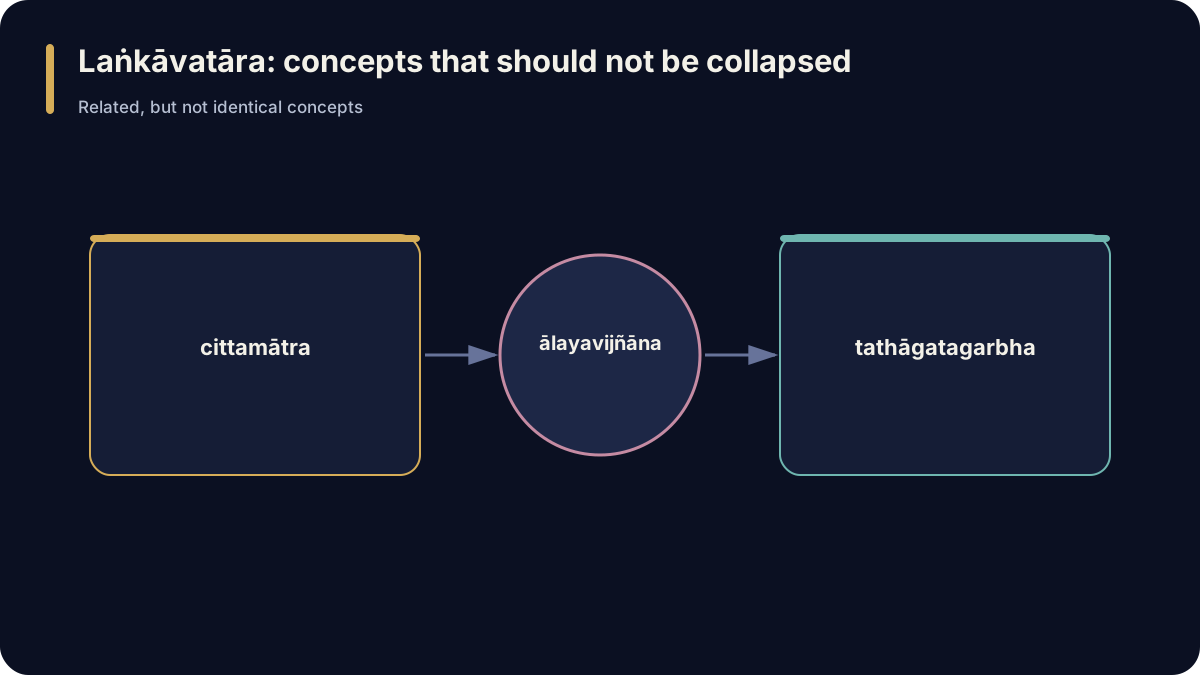
What does it combine? Among other things it brings together cittamātra — mind-only, ālayavijñāna — storehouse or foundational consciousness, multiple levels of consciousness, the three natures, emptiness, two kinds of not-self, tathāgatagarbha, a critique of language and conceptualization, bodhisattva practice, and in some recensions a strong section on vegetarianism.
How Old Is It?
Its exact date is uncertain. It is safer to speak of a layered Mahāyāna text that, in the forms known to us, developed roughly around the fourth to fifth centuries, although earlier strata have also been proposed. Importantly, modern scholarship is not unanimous about the earliest layers. The Laṅkāvatāra nevertheless clearly reflects a highly developed environment of Yogācāra and tathāgatagarbha ideas.
Chinese translations. Between roughly 420 and 704, four Chinese translations were produced. Three survive today. The earliest surviving one is Guṇabhadra — 443. This version has four scrolls and is shorter than the later ones. It lacks some chapters or material found in later recensions. Then came Bodhiruci — 513, and Śikṣānanda — 700–704. Śikṣānanda's translation was prepared using several Sanskrit manuscripts. This means the Laṅkāvatāra was not one completely unchanging book.
What Does Cittamātra Mean?
Literally citta-mātra — mind-only. But “mind” here is not ego, soul, or an eternal cosmic Self. Buddhism continues to deny a permanent, self-subsisting self.
The central problem is projection. Mind distinguishes, names, classifies, and connects impressions; it constructs subject and object, and then often forgets that it participated in doing so. The result is a world that appears to us as completely fixed, independent, and simply “the way it is in itself.”
Example. We see a person. But very quickly we no longer see only colors, shapes, sound, and movement. We see “a dangerous person,” “a friend,” “an enemy,” “successful,” “worthless,” “the kind of person who always does this.” Mind adds memory, fear, desire, expectation, and categories. Then we react to the whole construction.
Cittamātra warns us. Do not mistake mental construction for independent reality. This is much closer to the soteriological core than “the universe exists only inside my head.”
Does the sutra deny the external world? This is one of the most disputed questions in Yogācāra. Some passages can sound strongly idealist. Others allow a more epistemological reading. Modern scholarship therefore still debates whether Yogācāra is metaphysical idealism, a phenomenological analysis of experience, or a combination of approaches. We will therefore use a more cautious formulation: the Laṅkāvatāra teaches that the world as we experience it as a network of solid subjects and objects appears in close connection with consciousness, karmic seeds, and conceptual constructions.
Ālayavijñāna
Here we encounter one of the key Yogācāra concepts: ālayavijñāna. It is often rendered as storehouse, repository, or foundational consciousness. No English translation is perfect.
What does it do? Within it are bīja — seeds: karmic seeds, habits, tendencies, impressions, and possibilities for future experience. An action does not disappear without a trace. It leaves a disposition. That disposition can later ripen.
Why was this concept needed? If there is no permanent self, what connects karmic consequences? How do habits continue? How does continuity of experience exist? How can rebirth be explained without a soul? Ālayavijñāna offers a model of continuity without an unchanging self.
Isn't this just a hidden ātman? This is the natural objection. If something carries seeds, links moments, and enables continuity, have we not reinvented the soul? Yogācāra answers: no. Ālayavijñāna is conditioned, changing, dependent on causes, and subject to transformation. It is not an unchanging person.
Kliṣṭa-manas. Another important level is the afflicted manas. It appropriates this stream of continuity. It turns it into “I” and “mine.” The system thus makes an interesting move: it creates a model of continuity and then warns us not to confuse continuity with a self.
Ocean and waves. The sutra uses the image of an ocean and its waves. The deeper continuity of consciousness is the ocean. Active consciousnesses are the waves. But the ocean is not an eternal substance. It is a model of process.
Karma shapes the way we perceive. If a person cultivates fear for a long time, the world begins to be experienced through fear. If they cultivate hatred, the world appears hostile. If they cultivate greed, the world becomes a collection of objects to possess. Karma therefore shapes not only actions. It also shapes the way the world appears.
That is why “mind-only” is a soteriological teaching. The key question is not whether a chair exists without me. It is how much suffering arises because I take my constructions to be fixed reality.
The Three Natures
Yogācāra also uses the three natures.
Parikalpita. The constructed or imagined nature. Above all: the solid division between subject and object.
Paratantra. The dependent nature. The flow of causes, conditions, karmic seeds, and consciousness.
Pariniṣpanna. The perfectly accomplished nature. The insight that the dependent flow lacks the solid subject-object duality we attribute to it.
This is not a new absolute object. Pariniṣpanna is not a new thing to grasp, but the absence of falsely attributed duality.
The Laṅkāvatāra and Emptiness
The sutra does not speak only about mind. It also speaks about śūnyatā. Why? Because neither mental constructions nor mind itself are a new eternal substance. This is the crucial safeguard.
“Mind-only” does not mean “Mind is the Absolute.” If we said the external world is unreal but an eternal Mind with a capital M exists, we would create a metaphysics that is very difficult to reconcile with Buddhist not-self. The Laṅkāvatāra does not solve the problem by creating an eternal ego.
Parāvṛtti
An important term is parāvṛtti. Best understood as a turning-about or transformation at the basis of consciousness. It is not merely a new opinion or the destruction of mind, but a radical transformation of the process from which duality, projection, grasping, and karmic continuity arise.
Awakening is not the erasure of experience. It is a change in the way we perceive, know, conceptualize, and cling.
Tathāgatagarbha and Ālayavijñāna
Here the Laṅkāvatāra makes a very important historical move. It connects tathāgatagarbha with ālayavijñāna. Modern surveys even speak of an identification of the two concepts in the sutra. But this does not mean that in every passage they are simply completely identical technical terms.
Why is the connection difficult? Ālayavijñāna carries karmic seeds, is conditioned, and is involved in the saṃsāric process. Tathāgatagarbha, however, is often described in positive language associated with Buddhahood and purity. The sutra therefore tries to connect two apparently different models.
One structure, two emphases. In ignorance, the deep continuity of consciousness carries karmic seeds and saṃsāric habits. In the context of awakening, the same problematic receives the language of tathāgatagarbha, purity, and Buddha-potential. But the sutra is not always completely systematic about this.
Is tathāgatagarbha just ātman? The Laṅkāvatāra knows this objection. The text explicitly addresses the danger of confusing tathāgatagarbha with the ātman of non-Buddhist systems. Its solution connects it with not-self, emptiness, non-arising, and nonduality.
This continues the problem of the previous article. In the Tathāgatagarbha Sutra it remained open what exactly “the hidden Buddha” means. The Laṅkāvatāra takes the next step. It tries to connect it with Yogācāra theory of consciousness. This is a synthesis — not necessarily perfectly smooth, but historically very important.
Is the world an illusion? The sutra uses images of dreams, mirror images, mirages, cities of gandharvas, and other appearances. But “illusion” does not mean that nothing exists. An illusion appears. It can have effects. The mistake is to attribute to it the wrong mode of existence.
Dreams. In a dream we can suffer. Fear is real as an experience. When we wake, we realize that we misunderstood the nature of the event. The Laṅkāvatāra aims at a similar cognitive reversal.
Vijñāna and jñāna. Awakening is not blank unconsciousness. The sutra distinguishes discriminating consciousness from awakened wisdom. The point is not the destruction of knowing. It is the transformation of the mode of knowing.
This is the sutra's real revolution. The world does not have to disappear; rather, the mistaken way in which we construct and grasp it loses its power.
The Laṅkāvatāra and Chan
Guṇabhadra's version later acquired a special status in early Chan tradition. Traditional accounts say that Bodhidharma transmitted the text to Huike. We will not present this as completely historically proven fact. But the connection of early Chan with the Laṅkāvatāra is real and important.
Why was it attractive to Chan? Because it emphasizes direct insight, the limits of conceptualization, transformation of mind, tathāgatagarbha, emptiness, and the overcoming of rigid duality. These themes would become extremely influential in Chan.
But the Laṅkāvatāra is not a Chan sutra by origin. It arose before Chan. Chan adopts, interprets, and incorporates it into its own development.
Is the Laṅkāvatāra idealism? The word idealism is a modern philosophical label. It can help, but it can also confuse. If it means “only my personal mind exists,” it is inappropriate. If it means “the object of experience cannot simply be separated from structures of consciousness,” it is closer to some modern readings. But the scholarly debate remains open.
Vegetarianism. Longer forms of the Laṅkāvatāra also contain a strong section against eating meat. The arguments are tied to bodhisattva compassion, the kinship of all beings, karmic consequences, and the unsuitability of killing or eating meat for a bodhisattva. This section had significant influence in East Asia. We should not erase it merely because the sutra is best known for “mind-only.”
The sutra's greatest lesson. Perhaps it is: do not mistake appearance for fully independent reality. Mind participates in the world it experiences. Karma shapes perception. Concepts shape subject and object. Habits generate new habits. And then we can live inside our own constructions as though they were completely independent.
Awakening is therefore not merely new information. It is not only “now I know the correct theory,” but a transformation of the very process of experiencing. This is parāvṛtti.
Conclusion
The Laṅkāvatāra Sutra is one of the most complex Mahāyāna texts. It speaks of “mind-only,” but not “only I exist.” It speaks of ālayavijñāna, but not as an eternal soul. It speaks of tathāgatagarbha, but warns that this is not simply ātman. It speaks of emptiness and at the same time of consciousness. It speaks of the world as projection, but the goal is not to deny every appearance. The goal is to transform the way we construct experience and cling to it. Karmic seeds create tendencies. Tendencies shape perception. Perception constructs subject and object. The subject grasps. And from this arises samsāra. Awakening is a turning-about at the basis of this process. It is not the destruction of consciousness but a transition from discriminating grasping to awakened wisdom. That is why the phrase “everything is mind-only” can be a dangerous simplification.
More precisely: the world as we experience it as a network of solid independent subjects and objects is inseparable from structures of consciousness, karmic seeds, and conceptualization. And for that very reason liberation in the Laṅkāvatāra is above all a transformation of the way we experience the world and make it “ours.”
Sources and Literature
Primary Texts and Reference Editions
- Red Pine, trans. The Laṅkāvatāra Sutra: Translation and Commentary. Counterpoint, 2012; to be used with awareness that the translation centers on Guṇabhadra's Chinese recension together with comparative material.
Research and Verification Literature
- Sutton, Florin Giripescu. Existence and Enlightenment in the Laṅkāvatāra-Sūtra: A Study in the Ontology and Epistemology of the Yogācāra School of Mahāyāna Buddhism. Albany: State University of New York Press, 1991.
- Szanyi, Szilvia. “Yogācāra.” The Stanford Encyclopedia of Philosophy, Summer 2026 ed., edited by Edward N. Zalta and Uri Nodelman.
Note: verification sources are part of the editorial apparatus. Where the original edition used during reconstruction was not preserved, a standard reference edition is not presented as the article's presumed original source.