Who was Bodhidharma: between the historical monk and the legend of Zen
Bodhidharma is traditionally the first patriarch of Chinese Chan and one of Zen’s most recognizable figures, yet the early sources are sparse and divergent. This article separates the historical core, the teaching of two entrances and four practices, and later stories about nine years facing a wall, Shaolin, and martial arts.
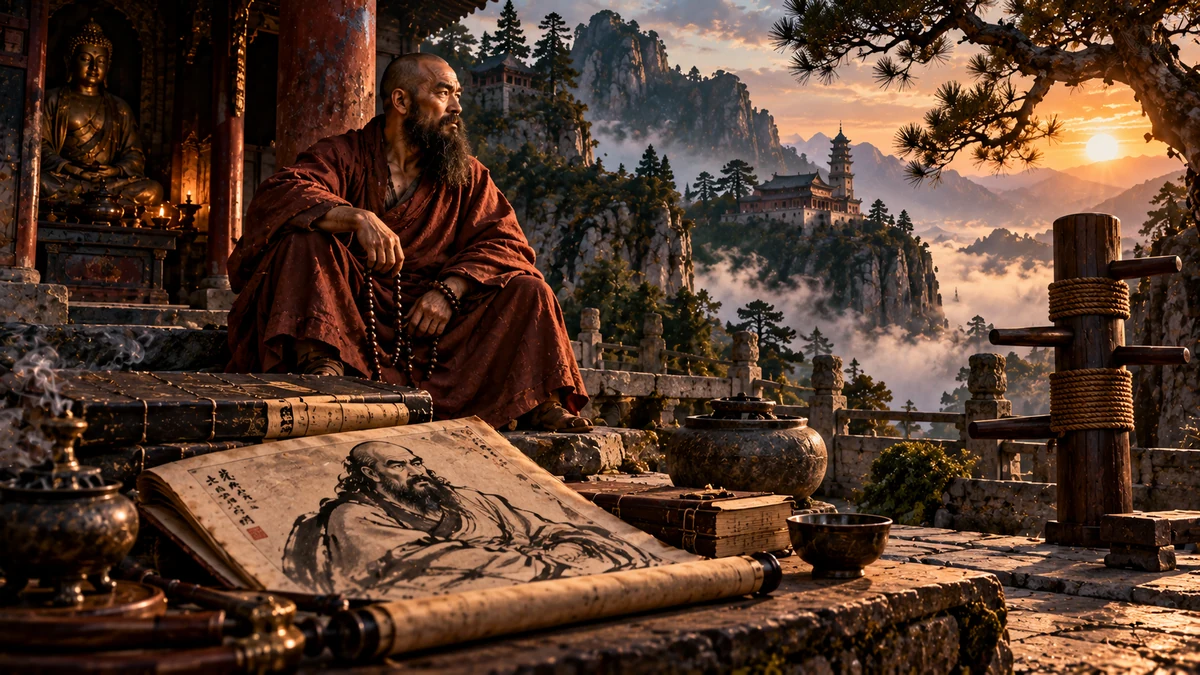
Bodhidharma is one of those figures in whom history and tradition grow almost inseparably together. In later Chan and Zen he becomes the Indian patriarch who carried a direct transmission of awakening to China; in paintings he is the bearded foreigner with striking eyes, in legend he meditates for nine years facing a wall, and in popular culture he is often connected with Shaolin and martial arts. [1][2]
The early sources are much more restrained. They point to a foreign Buddhist monk or teacher active in China in the first half of the sixth century, associated with meditation and with a disciple lineage from which Chan later developed. Yet his origin, precise travels, and many famous episodes differ among sources or appear only centuries later. Bodhidharma is therefore best approached in two layers: as a historical core within early Chinese Buddhism and as a powerful symbol that Chan shaped over time. [1][2][3]
The earliest traces: a man from the western regions
The earliest mention of Bodhidharma is usually associated with Yang Xuanzhi’s Record of the Buddhist Monasteries of Luoyang, completed around 547. The text describes a foreign monk from the western regions admiring the magnificence of Yongning Monastery in Luoyang. Because Yongning was built in 516 and lost its original role amid political upheaval in the late 520s, scholars often place Bodhidharma’s presence in the city roughly between 516 and 526. [2][3]
This early figure is not yet the “first patriarch of Zen.” There is no lineage of twenty-eight Indian patriarchs, no famous dialogue with Emperor Wu, and no story about founding kung fu. That restraint is precisely what makes the source valuable: it shows how little was written about Bodhidharma close to the period in which he is thought to have lived. [2]
Where did he come from? The sources disagree
Bodhidharma’s origin is one of the clearest examples of divergence among early sources. Yang Xuanzhi presents him as a monk from the western or Central Asian regions; the later Daoxuan, in the seventh-century Further Biographies of Eminent Monks, describes him as a brahman from southern India who came by sea to southern China and later travelled north. [2][4]
The southern Indian version became standard in Chan tradition, often expanded with the claim that Bodhidharma was a prince or a king’s son. Historically, it is safer to say that Chinese sources understood him as a foreign Buddhist teacher from the broader western or South Asian world. The surviving material does not securely establish a precise birthplace. [2][4]
Meditation, “wall-gazing,” and Luoyang
Daoxuan’s biography associates Bodhidharma with an unusually austere meditative practice and with an expression often translated as “wall-gazing.” Later tradition turned this into the vivid story of nine uninterrupted years seated before a wall near Shaolin. The earlier phrase need not require such a literal reading; it may describe meditative concentration, immovability, or a manner of contemplation. [2][3]
The distinction matters. The historical core is Bodhidharma’s association with meditation and with an early movement from which Chan developed. Nine years, a particular cave, and many physical details belong to a richer hagiography formed later. [1][2]
Two Entrances and Four Practices
The most important early teaching associated with Bodhidharma is the Treatise on the Two Entrances and Four Practices (Er ru si xing lun). Modern scholarship is cautious about direct authorship, but this is the earliest textual layer that can be linked relatively closely to Bodhidharma’s circle. [1][3]
The first is “entrance by principle”: recognizing that sentient beings share the same true nature, obscured by delusion and attachment. The second is “entrance by practice,” divided into four attitudes: accepting difficult circumstances without resentment, adapting to changing conditions, seeking nothing or non-attachment, and acting in accord with the Dharma. [1][3] This teaching is much less spectacular than the later legends, but for that reason it provides one of the closest views of the contemplative world associated with early Bodhidharma traditions.
Huike and the birth of a patriarchal lineage
Daoxuan names Huike among Bodhidharma’s disciples, and Huike later became the second patriarch of Chan. The story of their relationship grew considerably over the centuries: in the famous version Huike stands in the snow and cuts off his arm to prove his determination. Yet older sources offer different explanations for his injury, so the scene is best understood as part of hagiographic tradition rather than as a simple biographical fact. [2][4]
More important is the later construction of an unbroken lineage from the historical Buddha through Mahākāśyapa and Indian patriarchs to Bodhidharma and then the Chinese patriarchs. The Stanford Encyclopedia notes that this account was firmly established by the tenth century, while modern scholarship treats it as a developing tradition through which Chan articulated authority and identity. [1]

Emperor Wu, nine years, and one sandal
The most famous Bodhidharma stories are not necessarily the earliest. In the classic Chan narrative he meets Emperor Wu of Liang. The emperor lists his temple building, support for monks, and copying of sutras, then asks what merit he has gained; Bodhidharma answers: “None.” The scene expresses Chan suspicion toward equating spiritual insight with the accumulation of religious merit, but it takes its familiar form in later literature. [1][2]
The same applies to the story that after nine years facing the wall Bodhidharma died, only to be encountered later by a traveller in the mountains, walking westward with one sandal. When his tomb was opened, only the other sandal was said to remain. Such motifs are not irrelevant: they are not early biography, but they reveal how East Asian Buddhism transformed a historical teacher into a saint who crosses ordinary boundaries of life and death. [2]
Shaolin and martial arts
Bodhidharma is now often presented as the founder of Shaolin kung fu. The association is culturally powerful, but early records about him do not say that he taught martial arts to monks. Daoxuan too presents him primarily as a meditation teacher. [2][4]
The association of Bodhidharma with body-strengthening exercises and martial arts appears in recognizable form much later, especially in traditions around the Yijin Jing and the early modern period. The history of Shaolin martial practice is itself real and well documented, but that does not by itself establish Bodhidharma as its sixth-century founder. Modern historical studies of Shaolin therefore treat the two stories separately: the development of monastic martial traditions and the later attribution of their origin to Bodhidharma. [2][6]

From Damo to Daruma
As Chan spread to Korea, Japan, and elsewhere in East Asia, Bodhidharma’s image travelled with it. In Japan he became Daruma. Artists often depicted him with a forceful face, heavy beard, wide eyes, and enveloping robe, especially in Zen ink painting. Hakuin Ekaku’s eighteenth-century Bodhidharma gives the patriarch an almost monumental immediacy. [7]
The same cultural environment eventually produced daruma dolls, which right themselves when tipped over and are now associated with perseverance, goals, and good fortune. This is a striking example of a religious figure moving beyond an original monastic context: Bodhidharma becomes patriarch, artistic subject, folk symbol, and part of everyday culture.
The historical Bodhidharma and the Bodhidharma of tradition
If the latest layers are set aside, a modest but important core remains: a foreign Buddhist monk was active in China in the sixth century and was associated with meditation; he soon became linked with Huike and with teachings emphasizing direct realization of Buddha-nature through principle and practice. [1][2][3] From that core, later generations developed the patriarchal history of Chan.
Legend is therefore not simply the opposite of history. It tells us how later communities understood what Chan should be: direct, independent of external status, disciplined, prepared to cut attachment, and confident in lived realization. The historian can separate earlier and later layers; the tradition, however, created from those layers the Bodhidharma known across the world today. [1][2]
Sources and further reading
- Development of Chan, Bodhidharma in patriarchal tradition, and the Two Entrances and Four Practices. Source
- Early sources, origins, Daoxuan, Huike, legends, and the later Shaolin association. Source
- Early Bodhidharma materials and the Treatise on the Two Entrances and Four Practices. Source
- Daoxuan, his historical writings, and the Further Biographies of Eminent Monks. Source
- Context for Chinese Buddhist biography and hagiography. Source
- History of the Shaolin Monastery and development of its martial tradition. Source
- Provenance and public-domain status for Hakuin’s depiction of Bodhidharma. Source
- Provenance and CC BY 2.0 license for a modern photograph of Shaolin Monastery. Source