Avataṃsaka Sutra — What Does a Universe Look Like in Which Every Phenomenon Contains All Others?
Imagine a single drop of dew. In it are reflected the sky, a tree, the sun, the person observing it, and the other drops around it. Now imagine that in each of those other drops the first drop is reflected as well.
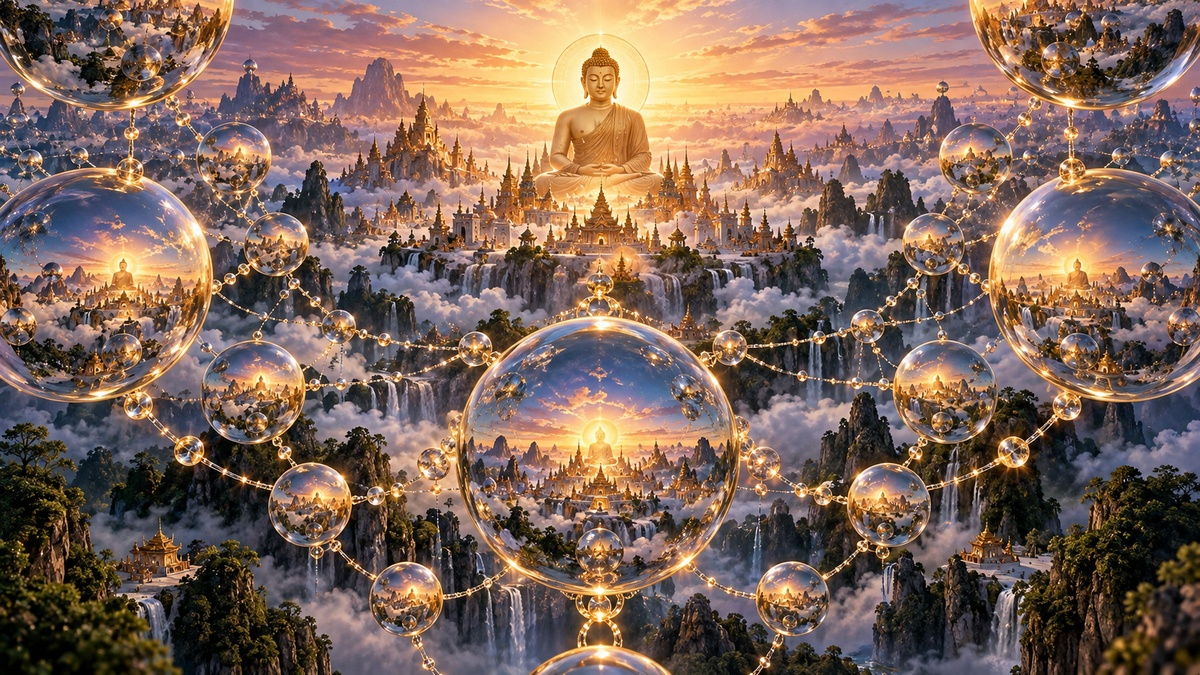
Imagine a single drop of dew. In it are reflected the sky, a tree, the sun, the person observing it, and the other drops around it. Now imagine that in each of those other drops the first drop is reflected as well. In every reflection are all the other reflections, and within them still others again, without a clear end. This is roughly the world of the Avataṃsaka Sutra. Not a world of isolated things, but a world of relationships within relationships.
What Is the Avataṃsaka Sutra?
Its fuller title is Buddhāvataṃsaka Sūtra. In East Asia it is known as Huayan jing in China, Hwaeom gyeong in Korea, and Kegon-kyō in Japan. In English it is often called the Flower Garland Sutra or Flower Ornament Scripture. But avataṃsaka is not an entirely simple word. It can mean ornament, wreath, or garland; in a Buddhist context the title has also been understood in terms of a great multitude or magnificent array of Buddhas. The Tibetan title is therefore rendered roughly as A Multitude of Buddhas.
One sutra or a collection? This is the first important question. The Avataṃsaka did not arise as a single book written by one author at one moment, but as a large compilation of Mahāyāna texts. Individual parts once circulated independently. Among the best known are the Daśabhūmika Sūtra — the Sutra of the Ten Bodhisattva Stages — and the Gaṇḍavyūha Sūtra — the account of Sudhana's journey. Individual components of the Avataṃsaka were translated into Chinese before the great complete recensions appeared. It is therefore better to speak of the Buddhāvataṃsaka family of texts.
The large Chinese recension in 60 fascicles. The first complete large Chinese version was translated by Buddhabhadra. It was completed in 421. It has 60 fascicles and 34 chapters. The manuscript on which it was based came to China from Khotan.
The 80-fascicle version. The second great complete Chinese version was translated by Śikṣānanda between 695 and 704. It has 80 fascicles and 39 chapters. This version became especially important for Chinese Huayan.
The Tibetan Avataṃsaka. The Tibetan recension has 45 chapters. This does not mean 45 entirely different sutras. The differences arise from different divisions, different textual strata, and additional or differently placed material. There is therefore no single completely unchanging Avataṃsaka. There are several major recensions of the same textual family.
What do they share? An extraordinarily expansive vision of Buddha awakening, the bodhisattva path, innumerable Buddha-worlds, infinite relationships, and the dharmadhātu. The world described by the Avataṃsaka is not a collection of isolated objects but a network.
But Here We Must Distinguish the Avataṃsaka from Huayan
This is the most important safeguard in the entire article. The Avataṃsaka offers cosmic imagery, infinite Buddha-worlds, mutual inclusion, reflections, non-obstruction, and vast visions of the dharmadhātu. Later Chinese Huayan thinkers develop from these motifs a highly systematic philosophy of interpenetration. The sentence “every phenomenon contains all other phenomena” is therefore best understood as a powerful Huayan systematization of the Avataṃsaka world, not as a single simple definition from the earliest Indian layer.
Indra's Net
The most famous metaphor is Indra's net. Imagine an infinite net. At every node, a jewel. Every jewel reflects all the others. But in every reflection are again reflections of all the jewels, and within those all the others again. The net has no simple center.
Is Indra's net really Avataṃsaka? Yes, the motif is connected with the Avataṃsaka. But the way it is often explained today as a complete philosophical scheme — each contains all, all are in each, without obstruction — is above all a result of later Huayan interpretation, especially Fazang and his successors.
So we will not say that the Avataṃsaka already presented a fully developed Fazang ontology in India. More precisely: Avataṃsaka imagery and teachings supplied material from which Huayan developed a philosophy of the complete mutual inclusion of phenomena.
What does interpenetration mean? It does not mean that a cup physically contains a galaxy, that every atom is literally a miniature universe, or that the Avataṃsaka describes holographic physics. It is a radically relational understanding of phenomena.
Example: a cup. We see one cup. But without clay, water, fire, a potter, tools, transport, trade, language, society, and a person using it, “cup” as a cup does not exist. Its identity is not self-subsisting but relational.
Huayan takes the next step. It does not merely say that a thing needs other things, but that what an individual thing is is determined through the entire network of relations. The part therefore participates in the whole, and the whole determines the meaning of the part.
Fazang's rafter. Fazang illustrates this with a building and a rafter. A rafter is part of the building. But something is a “rafter” precisely because it has a certain function within the building. Remove it, and it may become something else. The whole therefore participates in the identity of the part. The part participates in the existence of the whole.
Emptiness makes relationship possible. Why is this possible? Because things do not possess a completely independent own-nature. If every thing were utterly self-sufficient, relations could not constitute it. This is precisely why Huayan is connected with śūnyatā and pratītyasamutpāda.
Dependent arising. Early Buddhism already says: this arises because conditions are present. Huayan develops an even stronger emphasis from this logic. It is not only that A depends on B. The entire identity of A exists only within the network of all its relations.
One and many. From this comes the famous Huayan formula: the one is in the many. The many are in the one. But the one does not cease to be one, and the many do not cease to be many.
This is not simple monism. Huayan does not say that in reality only one great thing exists. The jewels remain distinct. But each reflects the others. It is difference without complete separation.
Dharmadhātu
The central term is dharmadhātu. It can be understood approximately as the realm, sphere, or total dimension of dharmas. In the Avataṃsaka it becomes the cosmic horizon of all phenomena, Buddhas, bodhisattvas, worlds, and relationships.
Vairocana
The central Buddha figure of the Avataṃsaka is Vairocana. But he is not the creator of the universe. This is not a monotheistic God. Vairocana represents Buddhahood on a cosmic scale, the awakened presence of the Buddha throughout the dharmadhātu.
Śākyamuni is silent. The Tibetan Avataṃsaka has a very unusual feature: throughout all 45 chapters, Śākyamuni himself does not deliver the teachings. In the first 44 chapters he is present and in meditation. The teachings are spoken by Mañjuśrī, Samantabhadra, and other bodhisattvas.
What does this mean? It does not mean the Buddha knows nothing. Quite the opposite. His meditative presence is the ground of the event. Dharma appears through the entire awakened environment.
The cosmos immediately after awakening. Much of the Avataṃsaka is narratively placed in the weeks after the Buddha's awakening. But this is not historical reportage. The Buddha is simultaneously beneath the bodhi tree and in different heavenly spheres. The sutra speaks in a cosmic religious register.
A single dust particle. The Avataṃsaka delights in impossible scales. In a tiny space: innumerable Buddha-worlds. In one particle: immeasurable realms. In a moment: inconceivable ages.
Is this physics? No. This is an important safeguard. The Avataṃsaka is not quantum mechanics, fractal mathematics, or a holographic model of the universe. Modern analogies can be interesting, but they are not historical proof of the sutra's meaning.
What is such language trying to do? To break our intuitive assumption that small and large, one and many, here and there, now and once, are absolutely separate categories. The sutra's awakened perspective is far broader.
Gaṇḍavyūha
The most narrative part of the entire Avataṃsaka is the Gaṇḍavyūha Sūtra. In the Tibetan recension it is the 45th and final chapter.
This chapter alone makes up roughly one third of the Avataṃsaka.
Sudhana
The central figure is a young layman, Sudhana. He wants to understand the bodhisattva path. Mañjuśrī does not keep him with himself. He sends him to another teacher. That teacher sends him onward. And so begins a long pilgrimage.
How many teachers? The number is not completely simple. Traditionally the famous formula is Sudhana's 53 visits or teachers. In the surviving Tibetan Gaṇḍavyūha, 84000 describes a sequence of fifty male and female, young and old, human and divine, monastic and lay kalyāṇamitras, with the final three being Maitreya, Mañjuśrī, and Samantabhadra. Other ways of counting the same narrative yield 52. Textual history itself also shows that the number of teachers expanded across different Indian versions.
So we will say: Sudhana traditionally visits 53 spiritual friends or stations, although the exact count varies by recension and method of counting. This is more precise than “exactly 53 without exception.”
Who are his teachers? This is one of the most surprising parts of the text. They include monks, nuns, laypeople, women, children, merchants, rulers, physicians, deities, ascetics, and a courtesan. Some do not look at all like typical Buddhist teachers.
Why does this matter? Because knowledge is not located in one person. Each kalyāṇamitra reveals another possibility of the bodhisattva path. Sudhana must keep going.
Kalyāṇamitra. The word means good or spiritual friend. It need not mean a guru with absolute authority, but someone who helps you move forward.
Sudhana's path is relational. He does not receive awakening from one person. It emerges through a network of encounters. In that sense his path is a human version of the Avataṃsaka's cosmic world. Each relationship opens into another relationship.
But no teacher declares themselves the whole. This is important. Each often tells Sudhana: this is my liberation or my field, but I do not know the other bodhisattva attainments. Go onward.
Mañjuśrī. The journey begins with Mañjuśrī. Mañjuśrī directs him to the first teacher. Later he appears again.
Maitreya. Near the end comes Maitreya. Sudhana enters a miraculous palace or tower in which spaces, times, and Buddha-worlds mutually contain one another. This is one of the most striking narrative scenes of non-obstruction.
Samantabhadra
The journey ends with Samantabhadra. He pronounces a great prayer or vow of good conduct. The Gaṇḍavyūha therefore does not end merely with metaphysical insight. It ends with action, vow, and bodhisattva practice.
Wisdom must become action. This is the key. If phenomena are radically interconnected, then an action is not isolated either. My action creates conditions for others. Their actions create conditions for me. The Avataṃsaka vision is therefore not only cosmic poetry. It has ethical consequences.
Daśabhūmika. Another important independent component is the Daśabhūmika Sūtra. It describes the ten bhūmis, or ten stages of the bodhisattva path. The Avataṃsaka is therefore not only a vision of an infinite universe. It also contains a highly structured theory of spiritual development.
Huayan
In China the Avataṃsaka becomes the central text of the Huayan school. Its important thinkers include Dushun, Zhiyan, Fazang, Chengguan, and Zongmi.
Fazang. Fazang develops especially the idea of mutual inclusion between part and whole. His examples — the rafter and the building, the golden lion, mirrors, and Indra's net — become classic ways of explaining Huayan philosophy.
Indra's net and mirrors. Imagine several mirrors. Place a lamp in the middle. Each mirror reflects the lamp and all the other mirrors. In the other mirrors, all the reflections are reflected again. This becomes almost a physical model of Huayan mutual inclusion.
But once again: this is Huayan's philosophical interpretation of the Avataṃsaka. It is not fair to place every formulation of Fazang directly into the Indian text.
The four dharmadhātus. Later Huayan develops the famous scheme:
- the dharmadhātu of phenomena;
- the dharmadhātu of principle;
- the non-obstruction of principle and phenomena;
- the non-obstruction of phenomenon and phenomenon.
But this is not a four-part chapter in the Indian Avataṃsaka.
Who systematizes this scheme? It is developed most clearly by Chengguan in later Huayan philosophy. He draws on earlier Huayan meditative and philosophical traditions associated with Dushun and others. We will therefore present it as a later Chinese systematization of the Avataṃsaka vision.
The fourth dharmadhātu. The most famous is the non-obstruction of phenomenon and phenomenon. In Chinese: shi shi wu ai. Phenomena do not obstruct one another. Each can be included in the others. This is one of the high points of Huayan metaphysics of relation.
But does everything become the same? No. If everything lost its difference, there would no longer be a network. There would be one homogeneous thing. Huayan wants the opposite: complete relationality together with preserved difference.
This is why Indra's net works. Every jewel remains a jewel. But its image contains all the others. Individuality therefore does not require isolation.
Influence on Chan. Huayan later strongly influenced Chan as well, especially through Zongmi and later East Asian thought. But the Avataṃsaka did not arise as a Chan sutra. Chan adopts and reinterprets it.
Korea and Japan. On the Korean peninsula there develops Hwaeom. In Japan, Kegon. The Avataṃsaka vision thus becomes one of the great philosophical currents of East Asian Buddhism.
What can we take from it today? Many people connect the Avataṃsaka with ecology, systems theory, networks, and complexity. Such comparisons can be fruitful. But we must say: these are modern applications. The Avataṃsaka is not an ancient textbook of systems science.
Its question is Buddhist. If nothing exists independently, what then does “I” mean? If my life depends on innumerable other beings, conditions, actions, and relationships, how can I understand myself as an isolated entity?
The ethical consequence. If the world is a network, actions travel through the network. My decision changes the conditions of others. Their conditions change me. Bodhisattva ethics is therefore not something added to the philosophy but a logical consequence of a relational world.
Sudhana's journey shows this practically. Sudhana does not complete the path alone. Every teacher changes him. Every encounter becomes a condition for the next. Yet no teacher can awaken in his place. We thus get a beautiful paradox: No one awakens completely alone. And no one can awaken in another's place.
What, then, is the safest formulation? For the Avataṃsaka itself: phenomena appear within an immeasurable dharmadhātu of mutual conditions, Buddha-worlds, actions, and perspectives, where ordinary boundaries between one and many, small and large, local and cosmic lose their absoluteness. For later Huayan: every phenomenon non-obstructively includes and reflects all other phenomena. These two sentences are connected, but historically they are not exactly the same claim.
Conclusion
The Avataṃsaka Sutra presents one of the most magnificent visions in Mahāyāna Buddhism. The Buddha sits in silence. Yet around him the entire cosmos speaks: Buddha-worlds, bodhisattvas, time, space, light, dust particles, vows, meditations. Everything connects. But not in the banal sense that “everything is one.” More precisely: nothing is completely on its own. The Gaṇḍavyūha turns this into a human story. Sudhana seeks the path. He does not receive one final teacher. He receives a network of encounters — monks, women, children, merchants, deities, a courtesan, bodhisattvas. Each shows another aspect of the path. Later Huayan then develops from the Avataṃsaka vision the image of Indra's net: infinitely many jewels, each reflecting all the others, each remaining itself. The whole appears through every part, while the part is intelligible only within the whole. This is not quantum physics, a holographic model of the universe, or a modern systems textbook, but a Buddhist vision of radical dependence without erasing difference. And perhaps its hardest question is not “How is the universe constructed?” but “What remains of my idea that I am a completely separate being when I see that everything I am arises only within a network of relationships?”
Sources and Literature
Primary Texts and Reference Editions
- Roberts, Peter Alan, trans. The Stem Array (Gaṇḍavyūha, Toh 44–45). 84000.
- Cleary, Thomas, trans. The Flower Ornament Scripture: A Translation of the Avatamsaka Sutra. Shambhala, 1993, for the complete Chinese Avataṃsaka collection.
Research and Verification Literature
- Roberts, Peter Alan, trans. The Stem Array (Gaṇḍavyūha, Toh 44–45). 84000: Translating the Words of the Buddha, 2021.
Note: verification sources are part of the editorial apparatus. Where the original edition used during reconstruction was not preserved, a standard reference edition is not presented as the article's presumed original source.