Arahant and Bodhisattva — Two Different Goals, or Two Paths within the Same Problem of Liberation?
One of the most widespread explanations of the difference between early Buddhism and Mahāyāna goes roughly like this: **the arahant wants to save only himself, while the bodhisattva wants to save everyone else.** It sounds clear, but historically it is far too crude.
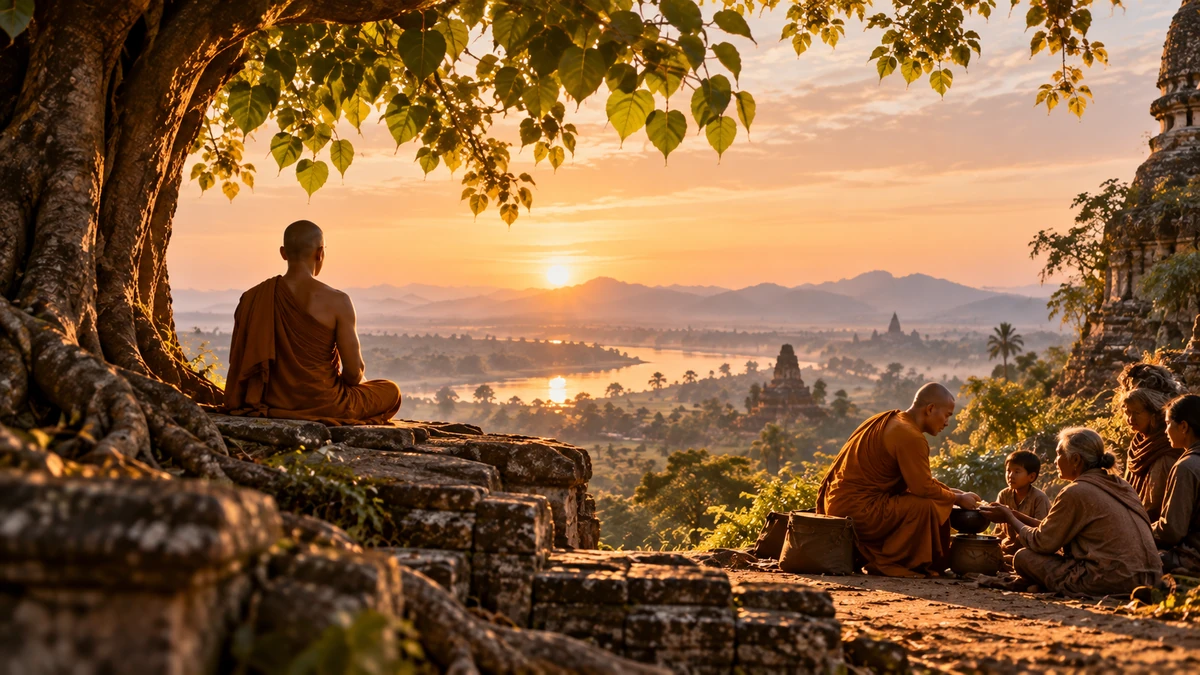
One of the most widespread explanations of the difference between early Buddhism and Mahāyāna goes roughly like this: the arahant wants to save only himself, while the bodhisattva wants to save everyone else. It sounds clear, but historically it is far too crude. The arahant in early Buddhist texts is not portrayed as a selfish person without compassion. Nor is the bodhisattva simply someone who postpones awakening and waits until everyone else has been saved first. The real difference is deeper. It concerns above all the question: What is the highest goal of the Buddhist path? Is it complete liberation as an arahant, or complete Buddhahood, which requires the long bodhisattva path? Both paths address the same fundamental problem: dukkha, ignorance, craving, clinging, and rebirth. But their final ideals are not entirely the same.
What Does Arahant Mean?
In Pāli, arahant; in Sanskrit, arhat. The term means roughly worthy, venerable, worthy of offerings. In early Buddhism it acquires a very precise meaning. An arahant is one in whom the āsavas have been destroyed, the decisive bonds cut, the holy life completed, the task done, and there is no further rebirth. This is not a temporary state. It is not partial liberation. It is nibbāna, or nirvāṇa.
The Buddha is also an arahant. This is the first important correction to the popular picture. In early formulas the Buddha himself is called arahaṃ sammāsambuddho — an arahant and a perfectly self-awakened Buddha. The early canon therefore does not set up a simple opposition: Buddha versus arahant. The Buddha is also an arahant. The question is what, in addition, makes him a sammāsambuddha?
SN 22.58 — The Key Comparison
In SN 22.58, the Buddha directly answers a question about the difference between the Tathāgata, perfectly self-awakened, and a liberated arahant disciple. Both are liberated with respect to form, feeling, perception, formations, and consciousness. But the Tathāgata is the one who brings into being a path not previously discovered, discovers it, knows it, and explains it. The disciples then follow the path already revealed. This means the arahant is not less genuinely liberated. The difference lies primarily in the Buddha’s pioneering and teaching role.
Two people, the same far shore. We can use an image. The first person discovers a lost passage through dangerous terrain. He crosses it himself. Then he marks the route and shows others: you can cross here. The others make it across by following his instructions. All reach the other side. But the first has a special historical role: discoverer of the path. This is roughly how SN 22.58 distinguishes the Buddha from his liberated disciples.
Is the Arahant Selfish?
No. If an arahant has eliminated greed, hatred, and delusion, it makes little sense to define that same person by selfishness as an essential trait. Early arahants teach, explain the Dhamma, guide disciples, and help the community; among them are Sāriputta, Mahāmoggallāna, Ānanda in his later stage, Dhammadinnā, and many others. Mahāyāna literature will later often use the śrāvaka or arahant as a contrast to the bodhisattva. But this should be read as a normative and polemical comparison between different goals, not as a neutral description of the personalities of all early arahants.
What, then, does Mahāyāna criticize? Above all, the scope of aspiration. The śrāvaka hears the Buddha’s teaching, practices the path, and attains liberation. The bodhisattva sets a different goal: to become a fully awakened Buddha. Not merely to follow the path, but one day to become a being who can rediscover it in a world where the Dhamma has disappeared and reveal it widely again.
What Does Bodhisattva Mean?
In Sanskrit: bodhisattva; in Pāli: bodhisatta. In early Pāli texts the term often refers to Gautama before awakening. The Buddha says: “when I was still a bodhisatta ...” Later Theravāda literature develops his prehistory through the Jātakas, Buddhavaṃsa, Cariyāpiṭaka, and the teaching of the pāramīs. The bodhisattva is therefore not a Mahāyāna invention.
What does Mahāyāna change? Above all, who this path is for. The older story says: Gautama cultivated qualities over countless lives that eventually made him a Buddha. Mahāyāna increasingly asks: Why should this path not also be mine? In this way, the Buddha’s biography becomes a program of Buddhist practice.
Bodhicitta. A central term becomes bodhicitta — roughly, the mind or aspiration directed toward awakening. Not merely “I want to be liberated,” but “I want to attain complete Buddhahood for the benefit of sentient beings.” This becomes one of the foundational criteria of the Mahāyāna bodhisattva path.
But the bodhisattva does not bypass personal transformation. The bodhisattva still has to stop feeding greed, overcome hatred, cultivate concentration, develop wisdom, understand non-self, and transcend clinging. If one remains egocentric, confused, and trapped in craving, one cannot effectively help others. The bodhisattva path is therefore not “instead of awakening myself, I will save others,” but “my path to complete awakening is inseparably connected with the welfare of others.”
Does the bodhisattva postpone nirvāṇa? This is a very popular formulation. But as a general definition it is too superficial. The bodhisattva does not want to remain ignorant, unawakened, and trapped in saṃsāra because awakening would somehow be selfish. The goal is precisely the highest form of awakening — complete Buddhahood. Later Mahāyāna schools develop different and quite subtle explanations of the relationship between nirvāṇa, saṃsāra, Buddhahood, and non-abiding nirvāṇa. For our basic article it is therefore more accurate to say: the bodhisattva does not reject awakening; the bodhisattva strives for Buddhahood rather than merely for the arahant goal.
Wisdom and compassion. The Mahāyāna ideal often emphasizes two inseparable poles: prajñā — wisdom and karuṇā — compassion. Compassion explains why the bodhisattva is oriented toward the welfare of beings. Wisdom prevents helping from becoming clinging to oneself as savior, to others as permanent objects, or to attainment as a lasting thing. The connection compassion + emptiness will therefore become one of the central Mahāyāna ideas.
Compassion is not a Mahāyāna invention. Mettā, karuṇā, nonviolence, generosity, teaching, and care for others already exist in earlier Buddhism. After awakening, the Buddha teaches for decades. Arahant disciples teach. The Saṅgha preserves and transmits the Dhamma. We will therefore not write “Mahāyāna added compassion to Buddhism.” More accurately: Mahāyāna places compassion within the very structure of the aspiration to complete Buddhahood.
Pāramitās. The bodhisattva path is gradually systematized as the cultivation of pāramitās — perfections. A very well-known Mahāyāna list contains six: dāna — generosity śīla — ethical conduct kṣānti — patience vīrya — perseverance dhyāna — meditative concentration prajñā — wisdom. Later schemes often speak of ten pāramitās. Here too, Mahāyāna does not begin from nothing. These qualities are already part of the broader Buddhist world. What is new above all is their systematic placement within a universalized path to complete Buddhahood.
Theravāda Knows a Genuine Bodhisatta Path
It is important to prevent another false binary: Theravāda = arahants; Mahāyāna = bodhisattvas. Theravāda tradition knows the bodhisatta, aspiration to future Buddhahood, the long fulfillment of pāramīs, prediction of future Buddhahood, and the unimaginably long path to becoming a sammāsambuddha. In later Theravāda systematization, a bodhisattva is someone who consciously directs a spiritual career toward complete Buddhahood.
What, then, is the difference? The status of that path. In Theravāda tradition, the normal and directly recommended goal of disciples remains arahantship. The path of a future Buddha is exceptional, long, rare, and demanding. Bhikkhu Bodhi, in explaining Theravāda tradition, emphasizes that the bodhisattva path was recognized, but the ordinary ideal of a disciple remained the arahant. Mahāyāna makes a different normative shift. It presents aspiration to complete Buddhahood as the central or highest direction of practice. Mahāyāna-type motivation is therefore above all a compassionate aspiration to complete Buddhahood — although bodhisattva aspiration can also appear outside a Mahāyāna doctrinal setting.
It is not just one vow. We therefore will not reduce the difference between Theravāda and Mahāyāna to “one takes a bodhisattva vow and the other does not.” They also differ in canons, Buddhology, understandings of buddhavacana, emptiness, later philosophical systematizations, rituals, cosmology, and models of the path. The bodhisattva ideal is only one central node within this broader transformation.
Three kinds of awakened beings. The wider Buddhist world recognizes an important distinction between the śrāvaka — a disciple who attains arahantship through the Buddha’s teaching, the pratyekabuddha — independently awakened in a period without a functioning Buddha’s teaching, and the samyaksaṃbuddha — a fully awakened Buddha who rediscovers and reveals the path. This distinction has pre-Mahāyāna roots. Some early Buddhist schools, including Sarvāstivāda, knew schemes of three vehicles or three spiritual careers. Thus the model of three vehicles was not simply a Mahāyāna invention from nothing.
What Does Mahāyāna Do with the Three Vehicles?
It ranks them more strongly and places bodhisattvayāna at the top. Thus we get śrāvakayāna, pratyekabuddhayāna, and bodhisattvayāna. The first leads to arahantship, the second to pratyekabuddhahood, the third to complete Buddhahood. In Mahāyāna systems this threefold scheme becomes highly influential.
Then the Lotus Sutra turns the model again. The Lotus Sutra says that the three vehicles are not the final reality. They are upāya — skillful means. The ultimate goal is ekayāna — one vehicle to Buddhahood. The story thus develops: first several possible spiritual careers, then the Mahāyāna elevation of the bodhisattva path, and then, in some traditions, all paths ultimately lead to Buddhahood. This is an important warning: Mahāyāna itself does not have only one theory of the relationship between arahant and bodhisattva.
Pratyekabuddha. The third possibility is often forgotten. A pratyekabuddha attains awakening without a Buddha’s teaching system, in a time when the Dhamma has not been revealed, but does not establish a great world-encompassing teaching in the way a samyaksaṃbuddha does. Buddhist comparison therefore does not begin with two camps. Older tradition already knows several types of awakening or spiritual careers. Mahāyāna places one of them — the bodhisattva path to complete Buddhahood — at the center.
Why choose the harder path at all? This is one of the most interesting questions. If a person can attain genuine liberation as an arahant, why choose the unimaginably long bodhisattva path? The Mahāyāna answer is roughly: because one wants to attain not only liberation, but the greatest possible capacity to awaken other beings. A complete Buddha is not only liberated. A Buddha is also discoverer of the path, perfect teacher, source of a new Buddhist age. Here Mahāyāna can make use of precisely the difference already found in SN 22.58.
Mahāyāna magnifies an already existing difference. The early canon says: the Buddha and the arahant are liberated. But the Buddha discovers the path, reveals it, and establishes it. Mahāyāna logic can then ask: if this role is so special, why should a practitioner not wish to become just such a Buddha? So here too, this need not be a complete rupture. It is an increase in the significance of a difference that already existed.
Is the Buddha “more liberated”? We will not say that. SN 22.58 does not say the arahant has 80 percent liberation and the Buddha 100 percent. Both are liberated from clinging to the five aggregates. The difference concerns discovery of the path, the teaching role, and in later traditions a broader range of Buddha qualities. The expression “more nirvāṇa” therefore makes no sense.
The Bodhisattva and the Liberation of All Beings
Mahāyāna vows often say: beings are innumerable, yet I vow to liberate them. This is not a realistic number of tasks on a checklist, but an infinite orientation of practice. The bodhisattva does not ask: what is the minimum I must do so that I personally can be finished? The aspiration has no simple personal endpoint.
But Prajñāpāramitā introduces a paradox. The bodhisattva wishes to liberate all beings. At the same time, the perfection of wisdom begins to say: beings are empty of their own permanent essence. The bodhisattva is empty. Liberation is empty. The path is empty. How, then, does someone save someone? This very paradox is at the heart of the next phase of Mahāyāna thought.
Compassion without a permanent savior. The Mahāyāna answer is not: “beings do not exist, so there is no need to help them.” Quite the opposite. Emptiness is meant to enable non-clinging compassion. You help. But you do not construct an eternal identity: I, the great savior. You do not fix the other as an unchanging suffering being. And you do not even fix the act of helping itself. This will become especially clear in the Diamond Sutra.
What do the arahant and bodhisattva have in common? A great deal. Both must live ethically, train the mind, overcome greed, transcend hatred, develop wisdom, understand conditionality, and stop constructing a solid self. They are therefore not two completely different religions. The difference lies primarily in the type of spiritual career and the final ideal.
The Fairest Comparison
Arahant. Follows the Buddha’s revealed path. Eliminates greed, hatred, and delusion. Attains nibbāna. There is no further rebirth. A fully liberated disciple.
Bodhisattva. Develops the aspiration to complete Buddhahood. Along the long path cultivates pāramitās, wisdom, compassion, meditation, and skill in helping. The goal is to become a samyaksaṃbuddha.
And Theravāda? A Theravāda practitioner can also, within the traditional framework, aspire to future Buddhahood. But that path remains special and rare. The standard goal of the Buddha’s disciples is arahantship.
And Mahāyāna? Mahāyāna elevates bodhisattva aspiration into a central ideal. This is a far more accurate historical distinction than saying Theravāda has no bodhisattvas while Mahāyāna does.
Conclusion
The arahant and bodhisattva are not simply a selfish person and a compassionate person. In early Buddhism, an arahant is a genuinely and completely liberated practitioner. The Buddha himself is an arahant, but also a sammāsambuddha — one who discovers and reveals the path. The bodhisattva path also exists outside Mahāyāna. But Mahāyāna makes a historically decisive shift: it turns this special path to complete Buddhahood into its central normative ideal. The question “How can I attain liberation?” expands into “How can I become a complete Buddha capable of guiding countless beings?” But if the goal is so great, wisdom must also be great. Mahāyāna literature will answer: prajñāpāramitā — the perfection of wisdom. And its central concept: śūnyatā — emptiness. The next topic is Prajñāpāramitā and the development of emptiness — how did the early teaching of non-self expand into the claim that all phenomena are empty of intrinsic essence?
Sources and Literature
Primary Texts and Reference Editions
- SuttaCentral: SN 22.58, translation by Bhikkhu Sujato; early bodhisattva literature is treated with separate text-historical sources.
Research and Verification Literature
- Bodhi, Bhikkhu. “Arahants, Bodhisattvas, and Buddhas.” 2010.
- Bodhi, Bhikkhu, trans. The Connected Discourses of the Buddha: A New Translation of the Saṃyutta Nikāya. Wisdom Publications, 2000.
- Nattier, Jan. A Few Good Men: The Bodhisattva Path according to The Inquiry of Ugra. University of Hawai‘i Press, 2005.
Note: verification sources are part of the editorial apparatus. Where the original edition used during reconstruction was not preserved, a standard reference edition is not presented as the article’s presumed original source.