Arahant and Bodhisattva — Does One Seek Personal Liberation While the Other Saves Everyone?
A common comparison says that the arahant seeks personal liberation while the bodhisattva renounces nirvāṇa to save all beings. Historically and doctrinally, that picture is too crude.
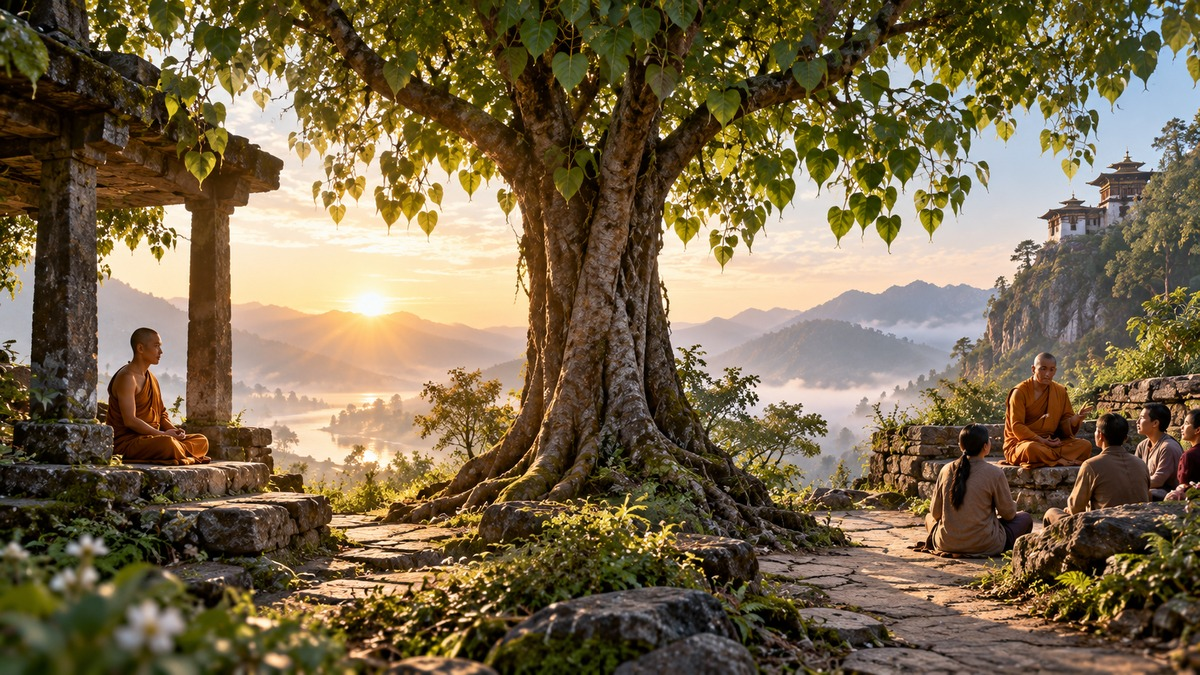
One of the most common comparisons between early Buddhism and Mahāyāna appears very simple. The arahant is said to want primarily his own liberation. The bodhisattva is said to renounce his own nirvāṇa in order to save all beings. From this, a moral hierarchy quickly emerges: the arahant as an individualist and the bodhisattva as the embodiment of universal compassion. But historically and doctrinally, that picture is too crude. The difference between arahant and bodhisattva is genuinely important, but it cannot be understood as a simple conflict between selfishness and altruism.
What Is an Arahant?
In early Buddhist sources, an arahant is a person who has attained liberation. The causes of further rebirth have been eliminated, attachment to saṃsāra has ended, and the goal of the path has been reached. In early texts the Buddha too is called an arahant. But he is also a sammāsambuddha — a perfectly self-awakened Buddha. What, then, is the difference between him and a liberated disciple? In the Saṃyutta Nikāya the answer is very interesting. The Buddha is the one who discovers a previously undiscovered path, establishes it, points it out, and explains it. Liberated disciples then follow that path after him. The difference is therefore not that only the Buddha is truly liberated. The arahant is liberated as well. The Buddha’s distinctiveness lies in discovering and revealing the path at a time when it has been lost to the world.
Is the arahant selfish? If we stay with early Buddhist sources, the answer is not difficult. An arahant is not defined as a selfish person. The path leading to arahantship includes ethical discipline, nonviolence, the reduction of greed and hatred, the development of mettā, karuṇā, wisdom, and concentration. Arahants can also be teachers. Some of the Buddha’s most celebrated disciples in the early texts teach others, advise monks and laypeople, and help preserve the community. So the equation arahant = selfish personal liberation is not a neutral description of early Buddhism. It is much closer to later Mahāyāna polemic against a particular model of the śrāvaka.
Who Is a Bodhisattva?
The term bodhisattva did not originate only with Mahāyāna either. Pāli uses the form bodhisatta. In the early discourses the Buddha refers to himself before awakening as a bodhisatta. The term therefore designates the Buddha during the period before he attained complete awakening. But caution is needed here as well. It does not follow that the early Nikāyas already contain the full later theory of the bodhisattva path through countless lives, perfections, and stages. That system developed gradually. Later Buddhist literature greatly expanded the story of the future Buddha: past lives, vows, perfections, and immense periods of preparation for Buddhahood appear. So the key point is: bodhisattva is a pre-Mahāyāna term, but Mahāyāna greatly expands its meaning and normative role.
The bodhisattva in Theravāda too. The bodhisattva path is not wholly foreign to Theravāda either. Theravāda tradition generally understands arahantship as the ordinary final goal of a Buddha’s disciple, but it also knows the possibility of aspiring to future Buddhahood. Such a path is understood as exceptionally long and demanding. This prevents the simple equation Theravāda = arahant and Mahāyāna = bodhisattva. The difference lies more in which ideal becomes normative for a broader range of practitioners.
The Great Mahāyāna Shift
One of Mahāyāna’s most important changes concerned precisely the role of bodhisattva aspiration. What had previously been above all the path of a future Buddha increasingly becomes an ideal that other practitioners too are expected to adopt. The goal is no longer merely to attain liberation as a disciple. The goal becomes complete Buddhahood. And the motivation for such an aspiration is closely connected with the welfare of all beings. A Mahāyāna practitioner can therefore develop bodhicitta — the intention or thought of awakening — with the wish to attain Buddhahood for the benefit of sentient beings. This is a profound shift. But it does not mean that Mahāyāna invented compassion.
Mahāyāna did not invent compassion. Compassion is already present in early Buddhist traditions. Karuṇā is one of the four brahmavihāras, the sublime abodes, together with mettā, appreciative joy, and equanimity. Ethical concern for others, nonviolence, generosity, and help are not Mahāyāna innovations. The formula arahant = wisdom without compassion versus bodhisattva = wisdom plus compassion is therefore misleading. More precisely, the Mahāyāna shift lies in linking compassion with a particular final goal: to attain complete Buddhahood for the welfare of other beings.
Where, Then, Does the Image of the Selfish Śrāvaka Come From?
Some Mahāyāna texts establish a hierarchy among different spiritual paths. Three vehicles appear: śrāvakayāna — the disciple’s path, pratyekabuddhayāna — the path of the solitary Buddha, and bodhisattvayāna — the bodhisattva path to complete Buddhahood. In some such texts the goal of the śrāvaka is described as narrower. The śrāvaka is said to aim primarily at his own exit from saṃsāra, while the bodhisattva aspires to Buddhahood for the sake of all beings. This can become quite sharp polemic. But we need to recognize such descriptions as Mahāyāna evaluations of a competing spiritual ideal. They are not necessarily neutral historical portraits of actual arahants or of all non-Mahāyāna Buddhist schools.
Polemic and History Are Not the Same Thing
This distinction is very important. Religious traditions often describe other paths through their own categories. When a Mahāyāna text presents a śrāvaka as someone who thinks only of himself, this certainly tells us something about how the author wanted to emphasize the bodhisattva ideal. But by itself it does not prove that practitioners of other Buddhist traditions actually understood arahantship as a selfish path. We therefore need to distinguish how Mahāyāna describes śrāvakayāna from how early and non-Mahāyāna Buddhist sources describe their own path.
Did Mahāyāna arise as a lay revolt? This too was long an attractive explanation. Mahāyāna was supposedly a more open and compassionate lay movement that rebelled against conservative monastic Buddhism. But early Mahāyāna texts do not support this story so simply. The Ugraparipṛcchā, one important early Mahāyāna text, presents a highly demanding bodhisattva path and contains strong ascetic and monastic elements. Modern scholarship therefore warns that early Mahāyāna cannot simply be equated with a lay reformation. More likely, it arose within already existing Buddhist communities in several different forms.
Does the Bodhisattva “Postpone Nirvāṇa”?
This is probably the most popular explanation of the bodhisattva ideal. The bodhisattva is imagined as standing at the gates of nirvāṇa and refusing to enter until all sentient beings have been saved. As a symbol of universal compassion, the image is powerful. As a general doctrinal definition, however, it is too simplified. The classical goal of the bodhisattva is not to remain unawakened. The goal is complete Buddhahood. The bodhisattva cultivates wisdom, meditation, ethics, perfections, and compassion precisely in order to attain complete awakening. The bodhisattva does not want less awakening. The aspiration is to Buddhahood.
What, then, does “remaining in saṃsāra” mean? Mahāyāna texts often emphasize the bodhisattva’s willingness to accept an extraordinarily long path for the sake of others. They may express this as a willingness to remain among beings, take rebirth, and act in the world as long as suffering exists. But this is not necessarily a rejection of nirvāṇa in a technical sense. Much depends on the text and philosophical tradition. In some later systems, even the opposition between saṃsāra and nirvāṇa is itself philosophically reinterpreted. It is therefore safer to speak of renouncing a faster or more narrowly conceived personal final goal in favor of aspiration to complete Buddhahood than simply of “rejecting nirvāṇa.”
Prajñā and karuṇā. In the Mahāyāna bodhisattva ideal, prajñā — wisdom and karuṇā — compassion are often joined. Wisdom dismantles grasping at self, others, and phenomena as independent realities. Compassion prevents such understanding from becoming indifference. But here too we should not create a false contrast. The arahant is not a symbol of the absence of compassion. Nor is a bodhisattva simply a person with stronger emotions. The difference lies in the structure of the spiritual project.
Arahant and Buddha. In early sources, both Buddha and arahant are liberated. But the Buddha occupies a special position. He rediscovers the path. He formulates it. He establishes the community and the teaching. Later traditions develop this difference much more strongly. Buddhas come to be attributed special knowledges, abilities, cosmological roles, and extraordinary qualities that far exceed the ordinary description of an arahant. As the image of a perfect Buddha expands, the distance between Buddhahood and arahantship also increases. This is an important part of the historical development of the bodhisattva ideal.
Is Buddhahood higher than arahantship? Different Buddhist systems answer this question differently. Early sources emphasize the shared liberation of Buddha and arahant while preserving the Buddha’s special role as discoverer of the path. Mahāyāna systems generally establish a clearer hierarchy. Complete Buddhahood becomes the broader and more demanding goal. Arahantship may be acknowledged as genuine liberation or an important attainment, but it is not necessarily understood as the final ideal. This is already an internal Mahāyāna evaluation.
The three vehicles. Many Mahāyāna systems therefore speak of three vehicles: the vehicle of the śrāvakas, the vehicle of the pratyekabuddhas, and the vehicle of the bodhisattvas. Each represents a different spiritual career. But Mahāyāna itself is not uniform here either. Some texts preserve three distinct final paths. Others reinterpret them.
The Lotus Sutra and the One Vehicle
The Lotus Sutra makes one of the most influential moves. It presents the three vehicles as skillful means. Ultimately there is one Buddha vehicle — ekayāna. This means that the paths of the śrāvaka, pratyekabuddha, and bodhisattva are not necessarily three completely separate final destinies. The Lotus Sutra incorporates them into a broader plan of Buddhahood. An interesting reversal occurs. First, the bodhisattva vehicle is distinguished from the others. Then the Lotus Sutra reunites the different vehicles within one ultimate Buddha vehicle. There is therefore no single Mahāyāna theory of the arahant’s final destiny.
The bodhisattva path is not necessarily easier. Mahāyāna is sometimes presented as a more accessible alternative to strict early Buddhism. Yet early bodhisattva literature often suggests the opposite. The bodhisattva path can be conceived as extraordinarily long. The practitioner must cultivate the perfections across immense stretches of time. The bodhisattva must be prepared to sacrifice comfort, safety, and in some narratives even the body. This is not an easier version of the path. In many texts it is presented as harder.
What Actually Changed?
Once later polemic is removed, a much more interesting history appears. Early Buddhism knows the fully liberated arahant. It also knows the Buddha as a special kind of awakened being. The term bodhisatta designates the Buddha before his awakening. Later literature develops the long career of a future Buddha. Mahāyāna then makes the decisive move: it gradually turns that career into a normative ideal for a broader range of practitioners. The question is no longer only: How did Gautama become a Buddha? It also becomes: Should I too aspire to complete Buddhahood for the sake of all beings?
Two different structures of aspiration. The comparison is therefore best formulated at the level of the final goal. In the arahant model, the practitioner follows the Buddha’s path to liberation. In the bodhisattva model, the practitioner aspires to complete Buddhahood. Both models require overcoming greed, hatred, and ignorance. Both include ethics and wisdom. Both can include profound concern for other beings. They differ primarily in how they define the final spiritual career.
Why did the difference become so important? Because the answer to the question of the highest goal changes almost everything. It changes the meaning of vows. It changes the conception of the path’s duration. It changes the meaning of Buddhahood. It changes the relationship between personal liberation and helping others. It also changes how a tradition understands the Buddha himself. The dispute is therefore not merely terminological. It concerns different conceptions of what it means to complete the Buddhist path.
Once We Remove the Caricature
The arahant is not a Buddhist egoist. The bodhisattva is not someone who rejects awakening. Mahāyāna did not invent compassion. Theravāda does not know only arahantship. Early Buddhism already knows the term bodhisatta, but not necessarily everything that a systematic bodhisattva path would later come to mean. Mahāyāna, however, placed the path to complete Buddhahood at the very center of spiritual aspiration. The difference between arahant and bodhisattva is therefore not best summarized as self versus others. More precisely, it is liberation as a disciple of the Buddha versus aspiring to become a fully awakened Buddha. Framed this way, the dispute becomes less moralistic — and historically much more interesting.
Sources and Literature
Primary Texts and Reference Editions
- SuttaCentral: SN 22.58; Nattier, A Few Good Men (Ugraparipṛcchā) for the early bodhisattva ideal; 84000 Toh 113 for the Lotus Sutra.
Research and Verification Literature
- Nattier, Jan. A Few Good Men: The Bodhisattva Path according to The Inquiry of Ugra. University of Hawai‘i Press, 2005.
- Drewes, David. “Early Mahayana.” Oxford Bibliographies in Buddhism. 2013; reviewed 2021. DOI 10.1093/obo/9780195393521-0145.
- Bodhi, Bhikkhu. “Arahants, Bodhisattvas, and Buddhas.” 2010.
Note: verification sources are part of the editorial apparatus. Where the original edition used during reconstruction was not preserved, a standard reference edition is not presented as the article’s presumed original source.