The Pāli Canon, the Āgamas, and Mahāyāna Sutras — Why They Are Not the Same Collection
When we speak about Buddhist sutras, we quickly encounter three terms: the **Pāli Canon**, the **Āgamas**, and the **Mahāyāna sutras**. At first glance these may seem like three names for the same thing, but they represent **different layers, collections, and traditions of Buddhist literature**.
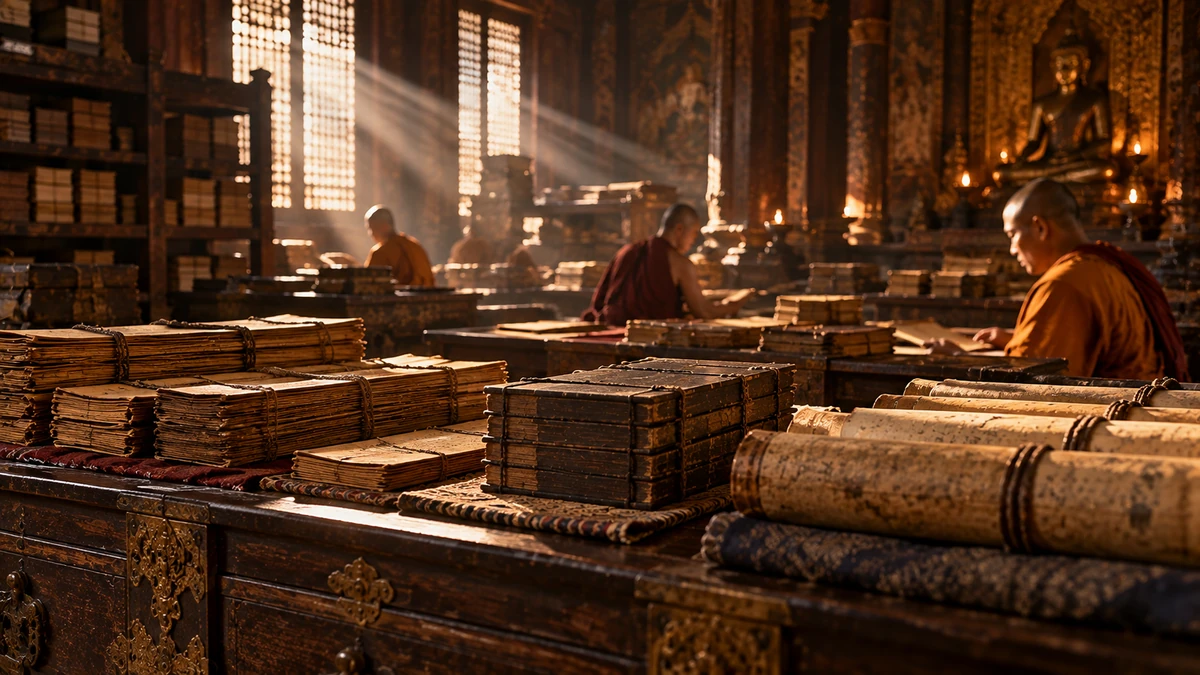
When we speak about Buddhist sutras, we quickly encounter three terms: the Pāli Canon, the Āgamas, and the Mahāyāna sutras. At first glance these may seem like three names for the same thing, but they represent different layers, collections, and traditions of Buddhist literature. The Pāli Canon is not a collection of Mahāyāna sutras. The Āgamas are not a Chinese translation of the entire Pāli Canon. And Mahāyāna sutras are not simply additional chapters of the original Nikāyas. If we want to understand what we are reading, we first need to know which of these textual worlds we have entered.
What does “canon” mean?
The word canon denotes a collection of texts that a particular religious community recognizes as especially authoritative. Buddhism has no single universal canon. Theravāda preserved the Pāli Canon; East Asian traditions use the much broader Chinese Buddhist Canon; and Tibetan Buddhism relies chiefly on the Kangyur and Tengyur. These collections overlap in part, but they are not identical. It is therefore not especially useful to speak of a single “Buddhist Bible.” Buddhist textual history is better understood as a family of libraries that share some older material while each also contains texts absent from the others.
The Pāli Canon and the early collections of discourses
The Pāli Canon, or Tipiṭaka, means “three baskets.” It is traditionally divided into three parts: the Vinaya Piṭaka — monastic discipline; the Sutta Piṭaka — discourses; and the Abhidhamma Piṭaka — systematic analyses of the teaching. Within the Sutta Piṭaka are five Nikāyas: the Dīgha Nikāya, Majjhima Nikāya, Saṁyutta Nikāya, Aṅguttara Nikāya, and Khuddaka Nikāya. The first four form the main body of early discourses. SuttaCentral describes them as the core of the Pāli collection and notes that similarly organized collections were known to other early Buddhist schools as well.
The Pāli Canon is therefore not “all Buddhist texts,” but the canon preserved chiefly by the Theravāda tradition. Its great importance lies in the fact that it is one of the most extensive and best-preserved complete collections of early Buddhist material. That does not mean, however, that the Theravāda version was the only one that ever existed.
The word āgama means something like “transmitted tradition” or a collection of transmitted teachings. Early northern Indian Buddhist schools possessed collections of discourses that are structurally very similar to the Pāli Nikāyas. In the simplest terms, the Nikāyas and Āgamas are related early collections of discourses. But we should not say that the Āgamas are translations of the Pāli Nikāyas. They are related collections that emerged from an older shared textual world and then developed within different schools. SuttaCentral notes that their exact scope and arrangement differ considerably. A discourse found in the Majjhima Nikāya in one tradition may appear in another tradition in a collection corresponding in structure to the Saṁyutta or the Dīgha. Early collections were therefore not completely frozen book-units; they were also organizational systems for groups of texts.
The four principal Pāli Nikāyas correspond approximately to four principal Āgamas: the Dīgha Nikāya has a relative in the Dīrgha Āgama, the Majjhima Nikāya in the Madhyama Āgama, the Saṁyutta Nikāya in the Saṃyukta Āgama, and the Aṅguttara Nikāya in the Ekottarika Āgama. Their predecessors circulated in different Indian languages and belonged to different early Buddhist schools. Much of the Indian source material did not survive, but many texts were preserved mainly in Chinese translations, alongside fragments in Sanskrit and other languages. This is why the Chinese canon is so important for research on early Buddhism: it contains not only later Mahāyāna sutras, but also extremely old relatives of texts known from Pāli.
If an idea appears only in the Pāli Canon, we know that it was preserved by the Theravāda tradition. If a similar text also appears in the Āgama of another early school, we gain a different kind of evidence: the common core is probably older than the later separation of the two traditions. Comparing the Nikāyas and Āgamas therefore does not necessarily prove that we possess the Buddha’s exact words, but it helps answer a more important historical question: how early was a particular teaching already circulating among Buddhist communities?
Where, then, does Mahāyāna fit?
Mahāyāna sutras are not merely another version of the Nikāyas or Āgamas. They form a vast corpus of texts that begins to appear historically later and develops new emphases. Among the best known are the Prajñāpāramitā sutras, the Heart Sutra, the Diamond Sutra, the Lotus Sutra, the Vimalakīrti Sutra, the Avataṃsaka, the Laṅkāvatāra, the Sukhāvatīvyūha sutras, and many others. Themes such as the bodhisattva path, emptiness, the perfection of wisdom, universal buddhahood, buddha-fields, multiple buddhas and bodhisattvas, and in some currents buddha-nature, become especially important.
The Tibetan Kangyur, for example, contains large separate divisions of Mahāyāna sutras, including Prajñāpāramitā, Buddhāvataṃsaka, Ratnakūṭa, and a large general collection of sutras; the general sutra section of the Degé Kangyur alone contains more than 260 works. Yet Mahāyāna sutras did not simply displace older discourses. In East Asian and Tibetan canons, different historical layers are preserved together. The Tibetan general sutra section, for example, contains both Mahāyāna works and texts catalogued as Śrāvakayāna, that is, non-Mahāyāna early traditions; and the Chinese canon includes the Āgamas alongside a great many Mahāyāna sutras. Thus the “Chinese Buddhist Canon” is not the same thing as “Mahāyāna sutras,” and the Tibetan Kangyur is not merely a collection of Mahāyāna texts.
Where do the older and later layers meet?
The easiest way to picture the situation is as three partly overlapping circles. The first is the early Buddhist textual core, whose descendants survive in the Pāli Nikāyas, Chinese Āgamas, and other fragmentary traditions. The second is the Theravāda Pāli Canon, which in addition to early discourses includes the Vinaya, Abhidhamma, and other texts that the Theravāda tradition incorporated into its canon over time. The third is the Mahāyāna corpus, which develops later and introduces many new texts and new interpretations.
These circles are not completely separate. Mahāyāna sutras often presuppose older Buddhist concepts such as karma, nirvāṇa, meditation, and the five aggregates, and develop them in new directions. The five aggregates are a good example. In the early suttas, analysis of material form, feeling, perception, volitional formations, and consciousness shows why none of these groups can be declared a permanent, unchanging self. The Heart Sutra takes up the same list but declares all five aggregates to be empty of their own independent nature. The basic vocabulary remains, while the philosophical extension is new.
Something similar is true of nirvāṇa and of the idea of the Buddha. Nirvāṇa is the central goal of the early suttas, while Mahāyāna literature may interpret the relation between nirvāṇa and saṃsāra differently. In the early discourses, the Buddha is above all the awakened teacher who discovered and revealed the path; in some Mahāyāna sutras, the idea of the Buddha becomes far more cosmic, and multiple buddhas appear in countless worlds. This is not merely a change of terminology, but a development of an entire religious world.
In broad terms, the main body of the four Pāli Nikāyas and their Āgama parallels represents an older textual layer than most Mahāyāna sutras. But it does not follow that everything in the Pāli Canon is equally old. The canon itself contains texts from different periods; the Khuddaka Nikāya is especially diverse and includes material of varying age. SuttaCentral notes that this fifth Nikāya expanded over time and became much more flexible than the first four. It is therefore more accurate to speak of older and younger textual layers, rather than simply two boxes labeled “old” and “new.”
Mahāyāna sutras have their own history
The expression “Mahāyāna sutras” likewise does not refer to one book or a single literary period. These texts were composed and developed over centuries. Prajñāpāramitā literature exists in both very long and very short forms. The Tibetan tradition knows works ranging from the enormous Prajñāpāramitā in One Hundred Thousand Lines to exceptionally brief texts, including the Diamond and Heart Sutras. The Avataṃsaka offers another good example: today it is read as a great sutra, but some of its sections may once have circulated as independent texts before being incorporated into a larger collection. Mahāyāna canons therefore also have a history of growth, combination, and redaction.
Here the concept of buddhavacana reappears. Theravāda tradition recognizes its canon as the Buddha’s teaching, while Mahāyāna traditions also recognize Mahāyāna sutras as the Buddha’s teaching. Historical-critical study asks a different question: when did a particular text arise, and through which stages did it develop? Religious tradition speaks chiefly about the authority and truth of the teaching; historians ask about the formation and transmission of the text. Confusion quickly follows if these two questions are treated as though they were the same.
Not “original versus forgery,” but a branching history
The simplest story would say that there was first a pure original Buddhism and that Mahāyāna later changed everything. The history is more complicated. The Pāli Canon is an extraordinarily important witness to early Buddhism, but it too is the result of long transmission, editing, and the tradition of one Buddhist school. The Āgamas show that early Buddhist textual material existed in multiple forms from a very early period, while Mahāyāna sutras represent later and highly important phases in the development of Buddhist thought. Historical comparison is therefore not a contest over who possesses “true Buddhism,” but an inquiry into which elements are shared by the oldest layers and where later reinterpretations begin.
The doctrine of non-self illustrates this well. We begin by looking at the Pāli Nikāyas and their early parallels in the Āgamas. If we find a very similar teaching in both, we have good reason to place it in a very early layer. We then turn to Mahāyāna Prajñāpāramitā literature. The analysis of non-self does not disappear there; it expands. The question is no longer only whether there is a permanent self, but also whether any phenomenon possesses an independent, intrinsic nature. From anattā or anātman we thus move toward śūnyatā. The teaching is not identical, but the later tradition develops in dialogue with the older problem.
For orientation, we can therefore simplify the picture in this way. The Pāli Canon is the preserved canon of the Theravāda tradition and contains exceptionally important early Buddhist material. The Āgamas are related early collections from other Buddhist schools, preserved today mainly in Chinese and partly in other languages. The Mahāyāna sutras are a later and very extensive corpus that develops new ideals, philosophical languages, and cosmologies, while often continuing older Buddhist themes. These are not three completely separate religions, nor three copies of the same book, but three different levels of the same branching history.
From this point on, with each text we will ask whether it belongs to the early Nikāya/Āgama layer, whether it survives only in one tradition, whether it has parallels, whether it belongs to the Mahāyāna corpus, when it first appears, which older concepts remain visible within it, and what is new. This will allow us to read the Dhammacakkappavattana Sutta, the Heart Sutra, and the Lotus Sutra as three important Buddhist texts without pretending that they arose at the same time, in the same community, and for the same purpose. Only then can we ask the next question: If Buddhist traditions have different canons, different sutras, and sometimes very different teachings — can we still speak of a single Buddhism at all?
Sources and literature
Primary texts and reference editions
- SuttaCentral — early Buddhist texts, translations, and parallels; for Pāli texts, Bhikkhu Sujato as the principal digital reference translation.
- 84000: Translating the Words of the Buddha — a reference digital corpus for published Tibetan canonical Mahāyāna translations.
Research and verification literature
- SuttaCentral. Early Buddhist texts, translations, and parallels. For English Pāli translations, principally Bhikkhu Sujato. Dynamic digital corpus; cite individual text IDs where possible.
- Anālayo, Bhikkhu. Madhyama-āgama Studies. Taipei: Dharma Drum Publishing, 2012.
Note: verification sources are part of the editorial apparatus. Where the original edition used during reconstruction was not preserved, a standard reference edition is not presented as though it were the presumed original source of the article.