Which Sutras Are the Oldest? — Why the Answer Is Not a List of Five Titles
The question “Which Buddhist sutra is the oldest?” sounds simple, but historically it splits into several different questions: the age of a teaching, a formula, a composition, a recension, and a surviving manuscript are not the same.

The question seems simple: Which Buddhist sutra is the oldest? Perhaps the Dhammacakkappavattana Sutta, since tradition presents it as the Buddha’s first discourse after awakening. Perhaps the Sutta Nipāta, some parts of which sound quite different from later systematic Buddhist literature. Perhaps a text mentioned by Emperor Aśoka. Or perhaps the oldest physical manuscript that has actually survived. But the moment we examine the question historically, it splits apart. What does “oldest” mean? Oldest in doctrine? In language? In literary form? By the moment a teaching was first spoken? By the time a textual unit resembling the one we know today took shape? Or by the age of the oldest physically surviving manuscript? These are not the same questions. A historian therefore cannot simply point to one sutra and say:
this is the oldest discourse of the Buddha.
The Buddha Left Us No Manuscripts
We have to begin with a very simple fact. We do not possess a manuscript written by the historical Buddha. We do not have a stenographic record of his speech. We do not have a document from his lifetime in which the sutras we know today were written down. The earliest Buddhist teaching was transmitted primarily orally. Teachings were heard. Memorized. Recited. Repeated. Taught to later generations. Organized into formulas, lists, verses, and larger collections. So when we speak about the earliest “texts,” we are not necessarily speaking about books. We may be speaking about sufficiently stable oral compositions that existed before anyone wrote them down.
“Thus have I heard” is not an audio recording. Many sutras begin with the famous formula: “Thus have I heard.” Traditional explanation connects it with Ānanda, the Buddha’s close attendant, who is said to have recited his discourses after the Buddha’s death. For Buddhist tradition, this formula is a very important marker of authentic transmission. Historically, however, it does not by itself prove that a text is a verbatim transcript of a particular event. It tells us primarily something about how the text presents itself: as a teaching that was heard, remembered, and transmitted. That is very different from a modern transcript.
Oral Transmission Is Not the Same as Uncontrolled Change
Here we can quickly make the opposite mistake. If texts were not written down, we might conclude that their content changed completely in every generation. That too is too simple. Early Buddhist literature has many features ideally suited to oral memorization: repeated formulas, numbered lists, parallel sentence structures, rhythmic prose, verses, repetition of identical blocks, and highly predictable compositional patterns. Buddhist communities also had specialists responsible for reciting different collections. Oral culture can therefore be highly conservative. But “conservative” does not mean completely unchanged.
Comparison Across Different Traditions Is the Key
Today we possess something that no single early Buddhist school possessed. We can compare texts preserved in different transmission traditions. These include the Pāli Nikāyas, Chinese Āgamas, Sanskrit fragments, Gāndhārī texts, and various other early sources. When related discourses are compared, we often find a striking common core: the same theme, a similar sequence, the same central teachings, related examples, sometimes very similar formulations. But we also find differences. One version is longer. Another shorter. A paragraph is present here and absent there. The order changes. The same teaching appears within a different narrative setting. Precisely this combination of similarities and differences is one of our most important clues to earlier forms of the text.
Why are the Nikāyas and Āgamas so important? The Theravāda Pāli Canon contains four major collections of early discourses: the Dīgha Nikāya, Majjhima Nikāya, Saṃyutta Nikāya, and Aṅguttara Nikāya. Related collections belonging to other early Buddhist schools are known as the Āgamas. Much of their material overlaps in content. These transmissions are not completely independent in the modern historiographical sense — all arise from an interconnected early Buddhist environment. But later they belonged to different school and linguistic lineages. If a very similar text appears in several such lineages, we have good reason to infer that their common ancestor predates their later differentiation. In the study of early Buddhism, the comparative method therefore often tells us more than studying a single canon alone.
A shared text is not necessarily a verbatim sentence spoken by the Buddha. Here we need to distinguish two claims. The first: some material is very early. The second: the historical Buddha spoke every sentence exactly in the form in which we read it today. The first claim can be well supported historically. The second is much harder to demonstrate. A text can preserve an early teaching, a key argument, an old formula, a memory of a historical setting, or a characteristic mode of instruction very well without therefore being a literal transcript. This is one of the fundamental differences between religious tradition and historical-critical method.
What Are Early Buddhist Texts?
Scholarship often uses the expression Early Buddhist Texts, or EBTs. This is not one official canon. The term refers above all to material for which there are good reasons to think it belongs to earlier strata of Buddhist literature. Especially important are parallel discourses in the Nikāyas and Āgamas, early Vinayas, parts of verse collections, and other texts known from multiple early transmission lineages. But even within such a corpus, not everything is equally old. Texts have layers.
The canon was not completed in a single day. The traditional account of the First Buddhist Council can create the impression of a very clear moment. The Buddha dies. The disciples gather. Ānanda recites the discourses. Upāli recites the monastic rules. And the canon is formed. Historically, the process probably lasted much longer. Individual discourses were transmitted. Grouped into cycles. Organized by topic. Arranged by length or numerical structure. Short teachings may have acquired narrative frames. Existing texts may have expanded. Different communities organized the material somewhat differently. The canon is therefore not only a storehouse of very ancient discourses. It is also the result of an editorial history.
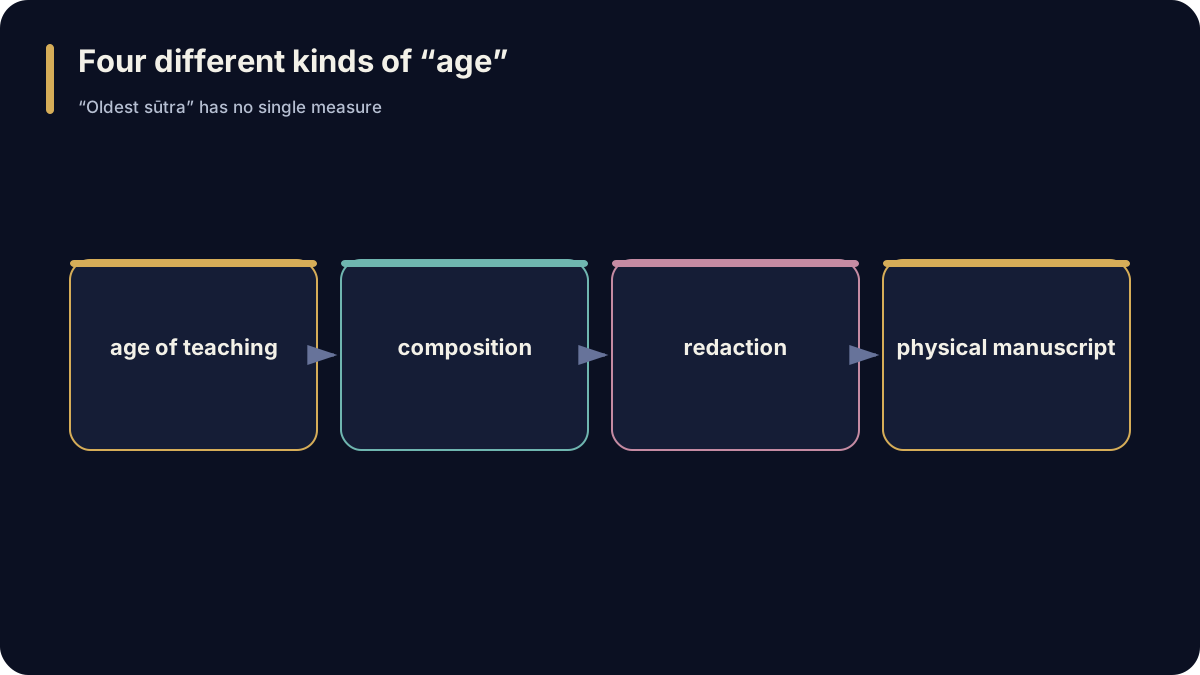
The age of a teaching and the age of a sutra are not the same thing. This is one of the most important distinctions. A teaching may be very old: non-self, the Four Noble Truths, dependent origination, a particular form of meditation. But the sutra in which that teaching is now found may, as a complete literary composition, be younger. The reverse is also possible. A very old formula can later be inserted into a longer text. We therefore need to distinguish at least the age of an idea, the age of a particular formula, the age of the larger composition, and the age of the preserved recension.
Is the Buddha’s first discourse also the oldest sutra? Traditionally, the Dhammacakkappavattana Sutta is the Buddha’s first discourse after awakening. That gives it an exceptional place in the Buddha’s biography. But narrative sequence is not the same as the date of textual composition. If a sutra narrates an event said to have happened first, it does not follow that its preserved literary form was composed before all other discourses. Part of its teaching may be very old. That is a different claim. So: “first discourse” does not automatically mean “oldest text.”
The Sutta Nipāta and the Question of Archaic Strata
Among the most frequently mentioned candidates for very early Buddhist material is the Sutta Nipāta, especially two of its sections: the Aṭṭhakavagga and the Pārāyanavagga. These are primarily verse materials. Their style is often more compressed than much later systematic prose. There is strong emphasis on nonattachment, abandoning attachment to views, ending disputes, ascetic life, and going beyond identities. Because of language, meter, literary form, and content, several scholars have placed these sections among the oldest strata of Pāli literature.
But we do not possess a birth certificate for the Aṭṭhakavagga. We should not turn this into an absolute chronology. We cannot write: the Aṭṭhakavagga has been proven to be the oldest Buddhist text. There are several reasons. Archaic language can indeed indicate age. But poetry can preserve older forms for longer. An unusual doctrine may indicate an early developmental stage. It may also reflect a particular literary or communal tradition. Scholars also do not always agree about exact stratification. It is therefore more careful to say: the Aṭṭhakavagga and Pārāyanavagga are among the most frequently proposed very early strata of Buddhist literature. That is a much stronger claim than it may sound. It simply is not absolute.
The Khaggavisāna Sutta and different transmissions. The Khaggavisāna Sutta — the Rhinoceros Horn Sutta — is also very interesting. The text emphasizes the solitary life of an ascetic. The Pāli version survives in the Sutta Nipāta. A related verse text is also known in the Gāndhārī tradition. This matters historically. If a similar poetic core exists in several early transmission lineages, their common ancestor must reach further into the past than the surviving individual manuscripts. But we still do not know the “first version.” What we have are descendants of an older textual family.
Aśoka Gives Us a Rare Firm Historical Point
For the chronology of early Buddhism, the period of Emperor Aśoka in the third century BCE is exceptionally important. In the so-called Bairāṭ or Bhabru Edict, Aśoka expresses reverence for the Buddha, Dhamma, and Saṅgha and recommends seven named Buddhist texts or textual units. He recommends them to monks, nuns, and male and female lay followers. He wants them to listen to these teachings frequently and reflect on them. This is one of the most important pieces of historical evidence for the existence of recognizable Buddhist textual traditions in the third century BCE.
But the edict does not prove the existence of a library containing seven books. An important caution is needed here. Because Aśoka’s recommendation itself is inscribed in stone, it is easy to assume that the recommended Buddhist texts must also already have existed in written books or manuscripts. The edict does not prove that. The textual units were stable and recognizable enough to be named. They may have circulated orally. Written copies may also have existed. But the edict alone cannot determine this with certainty. Moreover, Aśoka primarily recommends that his audience frequently hear and reflect on these teachings. The edict therefore demonstrates the stability and recognizability of textual or recitational material. It does not necessarily demonstrate its book form.
The identifications of Aśoka’s titles are not all completely certain either. Scholars have connected several of the recommended titles with texts known from the later Pāli Canon. Some identifications are quite persuasive. Others remain more debated. It is therefore better to say: Aśoka’s edict points to textual units, several of which can be connected with later preserved canonical material. It does not mean that Aśoka provided us with today’s list of sutras in exactly the same form.
Aśoka is still later than the Buddha. Even if the edict can be securely placed in the third century BCE, we are still several generations after the period of the historical Buddha. Aśoka therefore gives us an important terminus ante quem: by his time, certain textual material already existed. But he does not necessarily tell us how long before him it arose. Perhaps decades. Perhaps much longer. Other forms of evidence have to address that question.
The Oldest Manuscripts Lead Us to Gāndhāra
Now let us change the question. Instead of asking Which sutra was composed first?, ask: What are the oldest physically surviving Buddhist manuscripts? The answer leads to ancient Gāndhāra — the region of present-day northwestern Pakistan and eastern Afghanistan. Buddhist manuscripts survived there mainly on birch bark. They are written in the Gāndhārī language and Kharoṣṭhī script. The oldest examples currently known are dated approximately from the first century BCE onward. They are the oldest presently known physical manuscript witnesses to Buddhist literature.
But the manuscript is not the birth date of the text. This distinction is crucial. If we possess a manuscript from the first century BCE, that does not mean that the text was composed in the first century BCE. The manuscript may be a copy of an older manuscript. That older manuscript may have rested on an even older oral tradition. The physical object establishes a latest possible boundary for the material it contains. It does not automatically tell us when its textual core arose.
An example of two lost libraries. Imagine two ancient texts. The first was composed in 300 BCE. But all early copies perish, and the oldest surviving copy dates to 400 CE. The second text was composed in 50 BCE, and a manuscript survives from the first century CE. Physically, the second manuscript tradition is preserved far better. But the first text is older by date of composition. We therefore always need to distinguish the age of the object from the age of the work transmitted by that object.
What did the Gāndhāran manuscripts change? A great deal. They showed that early Buddhist literature was far more linguistically and textually diverse than we might infer from the complete canons preserved later. Gāndhārī material includes sutras, verses, commentaries, Abhidharma material, narratives, and other genres. Some texts have parallels in Pāli, Sanskrit, or Chinese materials. Others preserve variants previously unknown to us. This gives us a glimpse into a period when Buddhist collections were still highly dynamic textual environments.
Some manuscripts also reveal early canonical organization. It is especially interesting that some Gāndhārī manuscripts already mention collections and divisions resembling the structure of later canons. This suggests that by the first centuries of the Common Era certain organizational schemes were already well developed. At the same time, the diversity of the material shows that the idea of a completely closed and everywhere identical canon does not fit all early Buddhist communities. Different processes of stabilization were unfolding in parallel.
What about the Pāli Canon? Theravāda tradition reports that the Pāli Tipiṭaka was written down in Sri Lanka around the first century BCE. But the original manuscripts have not survived. Palm leaves decay in tropical environments. Texts have to be recopied regularly. The physically surviving Pāli manuscripts are therefore much younger than the texts they contain. This shows perfectly why the history of a sutra cannot be determined solely by the age of the oldest copy in a library.
Language helps us — but does not solve everything. Philologists can look for signs of relative age: archaic grammatical forms, vocabulary, metrical features, older geographical terms, literary style, and relationships among different versions. Such evidence is extremely valuable. But it also has limits. An oral formula can preserve older language for centuries. Poetic style can be deliberately archaic. A copyist can modernize the language. And the same text can contain both very old and younger parts. Dating therefore usually does not take the form this text was composed in 437 BCE. A more realistic claim is: this layer is probably older than that other layer.
Short does not necessarily mean old. Length is not a safe criterion either. It is true that a text can expand during transmission. Explanations, lists, repetitions, doctrinal elaborations, or new narrative frames can be added. But it does not follow that short = old and long = late. Oral literature can already be extensive at a very early stage. A late text can deliberately be extremely short. Length by itself dates nothing.
Repetition can also mean two opposite things. Early Buddhist literature is famous for repetition. A modern reader may think: this must be later padding. In some cases, comparison among versions does indeed reveal the expansion of formulas. But repetition is also one of the strongest tools of oral transmission. A very old formulation can itself be highly repetitive. Every case therefore has to be examined individually.
Texts can have layers. It is useful to abandon the idea that every sutra originated at one single moment. A much more realistic model is layering. There may be an old core. An explanation is added to it. Later, a narrative frame. Introductory and concluding formulas may be adjusted when the text is incorporated into a collection. Some lineages preserve a shorter version. Others a longer one. Parts of different ages can therefore exist within the “same” sutra.
An older formula can be surrounded by a younger story. This is especially important with verses. Imagine an old saying or poem recited for generations. A later community places it inside a narrative: the Buddha was at a certain place, a particular person approached, asked a question, and the Buddha spoke the old verse. In such a case the complete discourse has multiple historical layers. Dating the narrative frame alone does not necessarily date the verse core. And vice versa.
The earliest units may not have been complete sutras at all. This leads to an even deeper problem. We may be searching for the wrong thing. The earliest units of transmission may have been short formulas, verses, lists, meditation instructions, ethical rules, dialogues, or concise explanations. Only later were some of them joined into sutras resembling those we know today. The question “Which completed sutra was composed first?” may therefore presuppose a level of literary organization that did not yet exist in the earliest phase.
What About Mahāyāna Sutras?
In general, their surviving textual history belongs to a later phase than the common core of the early Nikāyas and Āgamas. But Mahāyāna too did not arise at one single moment. Different Mahāyāna sutras belong to different periods and settings. Gāndhāran manuscripts are exceptionally important here as well. Among them is an early version of Prajñāpāramitā literature, radiocarbon dated approximately to the first or early second century CE. This is one of the earliest physical witnesses to Mahāyāna sutra literature. Yet even this manuscript is already a witness to an existing textual tradition. It is not necessarily the moment of that tradition’s origin.
A sutra’s fame tells us nothing about its age. The Heart Sutra is today one of the most recognizable Buddhist sutras in the world. But that does not mean it belongs among the earliest. It belongs to a later development of Prajñāpāramitā literature. If we want to investigate the earliest phases of Buddhism, more important are Nikāya–Āgama parallels, early Vinayas, archaic verse material, and the oldest common inter-school core. Popularity and age are two entirely different questions.
How close can we get to the historical Buddha? Probably considerably closer than we might assume from the fact that no manuscript from his lifetime survives. If the same teaching appears in different early transmissions, uses early linguistic and cultural features, is known to different schools, does not depend on later developed systems, and fits well with the historical environment of northern India, there are good reasons to regard it as very ancient. But the final step — “the historical Buddha said this exactly this way” — is methodologically much more demanding. History often speaks in degrees of probability, not certainty.
The Buddha’s voice or the community’s voice? Here too, we do not have to choose only between two extremes: either everything is literally the Buddha’s speech, or everything is a later invention. There is much room between them. A text can be grounded in early teaching, shaped from old formulas, preserved through oral recitation, later editorially connected, expanded, supplied with an introduction, and then incorporated into a larger collection. All of these can be true at once. Historical-critical study therefore does not necessarily seek to strip texts of their value. It seeks to reconstruct the process through which teaching became literature.
So Which Sutras Are the Oldest?
If we ask about the oldest reconstructed textual strata, we should look primarily at shared material in the Nikāyas and Āgamas, early Vinayas, certain verse collections, and texts that appear across multiple early transmission lineages. The Aṭṭhakavagga and Pārāyanavagga are among the frequently mentioned candidates for very early verse strata. If we ask for externally dated historical evidence for recognizable Buddhist textual units, Aśoka’s Bairāṭ Edict from the third century BCE is exceptionally important. If we ask for the oldest physically surviving Buddhist manuscripts, the answer takes us to Gāndhāra from roughly the first century BCE onward. But if we ask which sutra known today was the first one actually spoken by the historical Buddha, historical method has no way to give us a certain title.
The Oldest Sutra May Therefore Be the Wrong Target
The desire for a single oldest text is understandable. It promises direct access to the source, as if somewhere beneath all later layers there were one perfectly pure sutra from Buddhism’s first day waiting to be uncovered. But oral tradition probably did not arise that way. At the beginning there were no bookshelves. There were a teacher, disciples, conversations, verses, mnemonic formulas, repetition, memory, and a community that wanted to preserve the teaching. From that process the collections we read today gradually took shape. We therefore do not look for the earliest Buddhism only in the oldest scrap of birch bark. We look for it in the overlap among different traditions, in shared formulas, in differences among parallel texts, in archaic verses, in historical inscriptions, in linguistic layers, and in manuscripts that show us how texts once actually circulated.
And the differences among surviving versions are not merely a problem. They are evidence of history. They show us different descendants, and from them we can try to reconstruct their older common ancestors. The answer to the question “Which sutra is the oldest?” is therefore not one title. It is a method.
Sources and Literature
Primary Texts and Reference Editions
- SuttaCentral — comparative corpus of Nikāyas, early texts, and parallels; Āgama and transmission data are checked against specialist comparative literature.
Research and Verification Literature
- Allon, Mark. The Composition and Transmission of Early Buddhist Texts with Specific Reference to Sutras. Hamburg Buddhist Studies 17. projektverlag, 2021.
- Anālayo, Bhikkhu. Early Buddhist Oral Tradition: Textual Formation and Transmission. Wisdom Publications, 2022. ISBN 978-1-61429-827-4.
- Anālayo, Bhikkhu. Madhyama-āgama Studies. Taipei: Dharma Drum Publishing, 2012.
Note: verification sources are part of the editorial apparatus. Where the original edition used during reconstruction was not preserved, a standard reference edition is not presented as the article’s presumed original source.