Nirvāṇa in Different Traditions — Extinguishing, Liberation, or Something Else?
Few Buddhist terms are as famous — or as often misunderstood — as nirvāṇa. It is not adequately described as Buddhist heaven, annihilation, simple inner peace, or an absolute reality behind the world.

Few Buddhist terms have become as famous as nirvāṇa. And few are misunderstood so often. Nirvāṇa is sometimes presented as a Buddhist heaven. At other times as a state of perfect inner peace. Elsewhere as the annihilation of a person. Or as some kind of absolute reality existing behind the changing world. None of these formulas is sufficient. The problem is greater still because Buddhist traditions themselves have not explained nirvāṇa in exactly the same way. Early discourses, Theravāda, different Abhidharma schools, Madhyamaka, Yogācāra, and tathāgatagarbha literature use different philosophical languages. But all revolve around a fundamental question: what exactly ceases when nirvāṇa is attained? The early Buddhist answer is not simply “the person.” A much closer formulation is: greed, hatred, delusion, and clinging cease — the processes that sustain suffering and further conditioned existence.
What Does Nibbāna Mean?
The Pāli form is nibbāna, the Sanskrit nirvāṇa. The word is often explained through the image of extinguishing. This metaphor fits well with Buddhist language about the “fires” of greed, hatred, and delusion. But the image can quickly mislead a modern reader. If a fire goes out, we ask: What disappeared? And if a person is “extinguished”: Is Buddhism talking about that person’s destruction? Early texts frame the issue differently. In the Saṃyutta Nikāya, “the unconditioned” is directly described as the cessation of greed, hatred, and delusion. Nirvāṇa is therefore first of all connected with eliminating the mechanisms that generate clinging, suffering, and continued rebirth. And this can happen while one is still alive.
An arahant does not wait for nirvāṇa until death. An arahant is a person who has already attained liberation. They still breathe. They still see and hear. They can feel physical pain. They can speak, walk, eat, and teach. But the greed, hatred, and delusion that would generate new clinging and new conditions for further birth have been uprooted. Nirvāṇa in early Buddhism is therefore not simply the name for what happens at death. Liberation is attainable in this very life.
Two nirvāṇa elements. The Itivuttaka distinguishes two nirvāṇa elements. The first is nirvāṇa “with remainder.” The arahant is fully liberated, but the sense faculties and living aggregates still remain. Pleasant and unpleasant feelings still occur. “Remainder” therefore does not mean that some greed or ignorance still remains. The defilements have been removed. What remains is conditioned life continuing until death. The second is nirvāṇa “without remainder.” When such an arahant dies, there are no longer conditions for a new birth. The text speaks about the ending of further modes of conditioned existence. But precisely here begins one of Buddhism’s most difficult questions.
What Happens to an Arahant After Death?
Does the arahant exist? Not exist? Both exist and not exist? Neither exist nor not exist? Early Buddhist discourses do not accept these four possibilities as an appropriate way of describing the liberated person after death. This does not merely mean: “the Buddha refused to answer.” The problem is deeper. The question assumes that there is some self-standing bearer of identity about whom we could ask where it went. But the Buddhist analysis of non-self has already called precisely such an enduring subject into question.
Nirvāṇa is not the annihilation of a person. The Yamaka Sutta presents the problem very directly. The monk Yamaka thinks that after death an arahant is annihilated, perishes, and no longer exists. Other monks reject his view as a misrepresentation of the Buddha’s teaching. Sāriputta then exposes the problem: even in the present life, the Tathāgata or liberated person cannot be found as a permanently identical form, feeling, perception, formations, or consciousness, nor as something entirely separate from them. If no such self-sufficient being can be found even now, the question of its later “destruction” is wrongly framed. So we should not formulate the Buddhist model as: a permanent self exists → attains nirvāṇa → is then destroyed. That would be annihilationism. But neither should we replace it with the opposite theory: an eternal soul exists → after death it enters eternal nirvāṇa.
That would reintroduce a permanent ātman. Early Buddhism tries to stay outside both extremes.
Is nirvāṇa a place? Early texts also describe nirvāṇa in strongly positive terms: as peace, safety, refuge, the deathless, the unconditioned. Such language can sound almost spatial, as if there were a special realm into which a person enters after death. But that conclusion does not automatically follow from the texts. Nirvāṇa can be described as a goal, liberation, cessation, peace, or the unconditioned without thereby turning it into a location. The religious expression “enter nirvāṇa” therefore does not by itself mean that nirvāṇa is a world inhabited by deceased arahants.
Theravāda and the Unconditioned
In the Theravāda Abhidhamma, the terminology becomes more systematic. Nibbāna is classified as asaṅkhata — unconditioned. In later Theravāda systematization it is the only unconditioned dhamma. This means that it is not a conditioned phenomenon that arises because of causes and then decays like ordinary bodily and mental phenomena. But the word “unconditioned” hides a new danger. It can be understood as an eternal substance, an absolute object, a cosmic ground, or a Buddhist version of eternal being. This is not a necessary conclusion of Theravāda philosophy. Nibbāna is not ātman. It is not an eternal personal soul. And liberation is not the union of an individual self with a universal substance.
Is nirvāṇa an experience? An arahant directly realizes nirvāṇa. We can therefore speak of its realization. But it does not follow that nirvāṇa is merely a special state of consciousness or an exceptionally powerful feeling of peace. Feelings arise and cease. Meditative bliss appears and disappears. Even the deepest state of concentration is still conditioned. Nirvāṇa is therefore not simply the most intense version of meditative pleasure. The Buddhist goal is more radical than attaining a pleasant state of mind.
Mahāyāna Changes the Philosophical Question
Mahāyāna traditions do not discard the problem of liberation. But they place it within new philosophical frameworks. Emptiness changes how the relationship between saṃsāra and nirvāṇa can be understood. The bodhisattva ideal changes the conception of a fully awakened Buddha and the Buddha’s relation to the world. Yogācāra develops new models of consciousness. Tathāgatagarbha literature begins to use surprisingly positive language about awakening and Buddha-nature. Nirvāṇa therefore remains liberation, but its philosophical description becomes increasingly diverse.
Madhyamaka — Saṃsāra and Nirvāṇa
Nāgārjuna’s Mūlamadhyamakakārikā contains one of the most radical formulations in the history of Buddhist philosophy. At the ultimate level, there is said to be not even the slightest difference between saṃsāra and nirvāṇa. Read superficially, the statement is almost absurd. How could suffering and liberation, ignorance and wisdom, bondage and freedom be said to be the same? But Nāgārjuna is not saying that these states are conventionally identical.
There are not two substances. Madhyamaka criticizes svabhāva — the idea of an independent, self-sufficient intrinsic nature. Saṃsāra has no such nature. But neither does nirvāṇa. So they cannot be understood as two independent metaphysical substances: the world on one side and a completely separate absolute reality on the other. At the conventional level, the difference between ignorance and awakening is decisive. An ignorant being suffers and clings. An awakened being does not. But ultimate analysis does not discover two self-sufficient ontological realms.
Nirvāṇa is not a new absolute either. This is one of Madhyamaka’s most important safeguards. If we analyze all phenomena as empty and then declare nirvāṇa to be the one thing that truly exists in and of itself, we have merely moved the problem. Nirvāṇa would become a new svabhāva. Madhyamaka does not allow this. Nirvāṇa too is empty of independent intrinsic essence. This does not mean that nirvāṇa does not exist; it means that nirvāṇa is not a self-sufficient metaphysical thing.
Yogācāra — The Problem of Consciousness
Yogācāra approaches the problem somewhat differently. A central question is how experience and the mistaken division into “me” and “the world outside me” arise. An important role belongs to kliṣṭamanas — the afflicted mind that appropriates the stream of experience as “I.” Another key concept is ālayavijñāna, storehouse or foundational consciousness. It explains the continuity of karmic potentials or “seeds” through a changing stream of experiences and, in classical Yogācāra explanations, through rebirth.
Ālayavijñāna is not a Buddhist soul. Because it performs functions that other philosophies often attribute to a self, Yogācāra was confronted early with an obvious objection: is ālayavijñāna merely ātman under another name? The traditional Yogācāra answer is no. Ālayavijñāna is not an unchanging substance. Its content is a stream of karmic seeds and tendencies. Some texts compare it to a river: there is continuity of flow, but the water is not the same at every moment. More importantly, several classical Yogācāra works teach that ālayavijñāna ceases at liberation. It should therefore not be turned into an eternal self or immortal consciousness.
Transformation of the basis. Yogācāra also often describes liberation through the concept of a profound transformation of the basis or foundation of experience. It is not merely a matter of replacing one opinion with another. The way experience is organized changes. The processes that generate mistaken appropriation, dualistic distinctions, and the karmic reproduction of the afflicted stream of consciousness cease. In this sense, Yogācāra can connect nirvāṇa with a radical transformation of cognitive structure. But Yogācāra is not one completely homogeneous theory, so this model should not be turned into a universal definition of all its branches.
Non-Abiding Nirvāṇa
Later Mahāyāna systems also develop the concept of apratiṣṭhita-nirvāṇa — non-abiding or nowhere-established nirvāṇa. The idea attempts to resolve a characteristic bodhisattva problem. A fully awakened Buddha is no longer bound to saṃsāra through ignorance. But neither is the Buddha presented as a being sealed off in a separate, passive state and deprived of every relation to suffering beings. Wisdom does not bind the Buddha to saṃsāra. Compassion means that liberated activity is not understood as a complete withdrawal from the world. In this way, the Mahāyāna model increasingly moves beyond the simple opposition: either saṃsāra or nirvāṇa.
Tathāgatagarbha and Surprisingly Positive Language
Some Buddha-nature texts take an even more unexpected step. The Mahāyāna Mahāparinirvāṇa-sūtra uses language that can be surprising alongside Buddhism’s familiar emphasis on impermanence and non-self. Buddha, nirvāṇa, and Buddha-nature can be described in terms of permanence, bliss, purity, and even self. This is not something we should remove from the text simply because it does not fit a simple textbook picture of Buddhism.
Has ātman returned? But the opposite conclusion is too quick as well. If a tathāgatagarbha text uses the word “self,” we cannot conclude without further analysis: Buddhism has accepted once again the same eternal ātman it had previously rejected. Tathāgatagarbha literature is not uniform. Different texts and later traditions interpret its positive language differently. Some understand it as skillful means. Some connect Buddha-nature with emptiness. Others give it a considerably stronger positive or ontological meaning. The tension is real and should not be artificially removed.
Why speak of a “self”? Some Mahāyāna texts themselves offer a pedagogical explanation. Students can misread the teaching of non-self as: “there is nothing,” “no one exists,” “awakening is annihilation.” Positive language can therefore function as a counterweight to a nihilistic interpretation. Awakening is not nothing. Nirvāṇa is not a worthless void. The elimination of greed, hatred, and delusion is not the same as erasing a being in the annihilationist sense. But such language creates the opposite danger: reifying Buddha-nature into an eternal metaphysical self. Buddhist thinkers have wrestled with this tension for centuries.
Pure Land is not the same as nirvāṇa. Another common equation appears in Pure Land traditions. At first glance Sukhāvatī can sound like a Buddhist version of heaven: a person dies, is reborn in a beautiful world, and lives there under exceptionally favorable conditions. But birth in the Pure Land and nirvāṇa are not simply the same thing. The Pure Land is above all an ideal environment for continuing the path. Conditions for practice are extraordinarily favorable there, Buddha Amitābha is present, and attaining awakening is far easier than in an ordinary world. The goal is therefore not merely eternal life in a pleasant realm. The final goal remains awakening.
East Asian non-separation of world and awakening. In Chinese and later East Asian traditions, the influences of Madhyamaka, Yogācāra, tathāgatagarbha, and indigenous philosophical categories became intertwined. Some traditions therefore strongly emphasize that nirvāṇa should not be sought as another world standing completely outside immediate reality. This does not mean that every ordinary state of confusion is already complete awakening. The difference between ignorance and awakening remains. But transformation need not be imagined as a journey from one ontological world into another. What changes is the mode of knowing, grasping, and acting.
Is nirvāṇa consciousness? After all these developments it is understandable that the question arises: is nirvāṇa some kind of pure or eternal consciousness? Some Buddhist traditions do use very positive language about awakened mind. But the formula “nirvāṇa is eternal cosmic consciousness” cannot represent Buddhism as a whole. The opposite formula — “nirvāṇa is complete unconsciousness and nothingness” — is equally problematic. The first quickly introduces a metaphysical absolute rejected by many Buddhist philosophies. The second quickly slips into annihilationism, already rejected by the early discourses.
What Do the Different Explanations Share?
The differences matter. But they are not total. Nirvāṇa is always connected with liberation from the fundamental mechanisms of saṃsāra: with the cessation of ignorance, the cessation of clinging, the ending of greed and hatred, and the interruption of the conditions that repeatedly generate suffering. The schools then differ sharply over the philosophical question: what does this mean? Is nirvāṇa an unconditioned dhamma? How does it relate to saṃsāra? How can a Buddha still act for other beings after complete awakening? What happens to consciousness? How should Buddha-nature be understood? To what extent can we speak positively about nirvāṇa at all? There is no single Buddhist answer to these questions.
Nirvāṇa is not merely inner peace. Modern popular usage also greatly diminishes the term. “Nirvana” can mean a perfect vacation. A massage. A good meal. A stress-free moment. Such experiences can be pleasant. They are not Buddhist nirvāṇa. A person can be completely relaxed and still cling to self, status, pleasure, opinions, and identity. Even profound meditative calm does not by itself mean that the roots of greed, hatred, and delusion have been uprooted. Nirvāṇa is a much more radical concept.
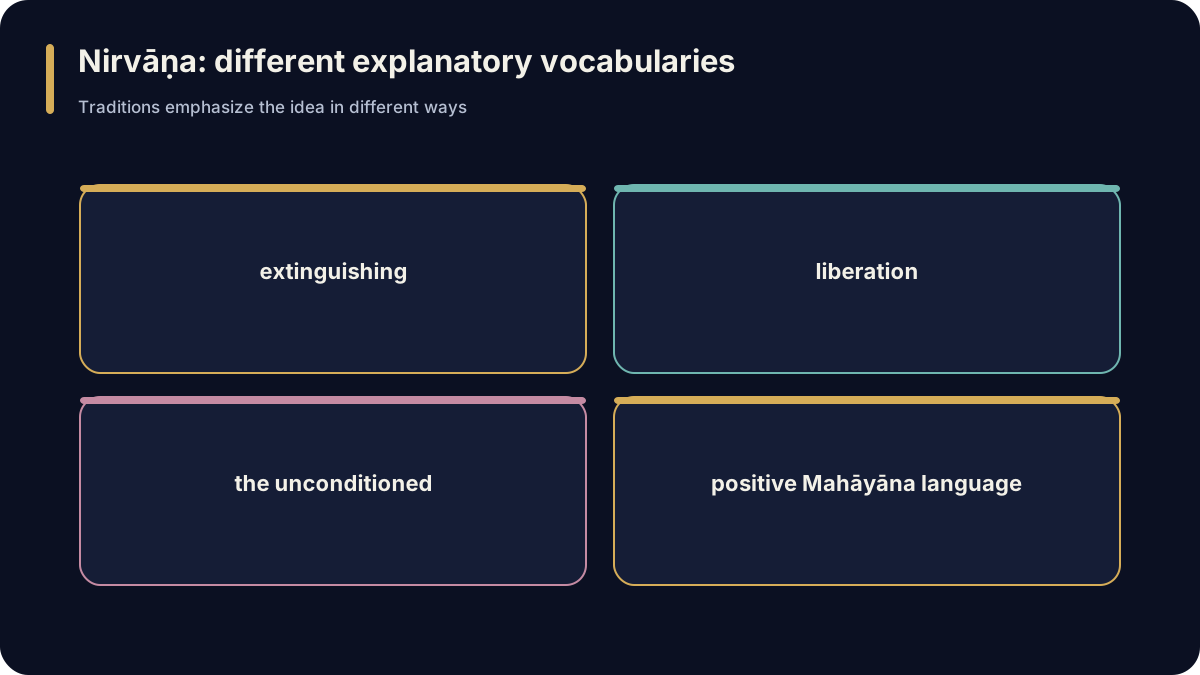
What, then, is extinguished? Perhaps this is a more useful question than: Where does the person go? The early answer is concrete. What is extinguished are greed, hatred, delusion, craving, clinging, and with them the conditions that sustain suffering and continued saṃsāric becoming. Later traditions explain this fundamental liberation in different ways. Theravāda systematizes it as unconditioned nibbāna. Madhyamaka warns that even nirvāṇa must not be turned into an independent substance. Yogācāra analyzes a profound transformation of the structures of consciousness. Tathāgatagarbha literature uses surprisingly positive language about Buddha-nature and awakening. Mahāyāna models of non-abiding nirvāṇa try to connect complete liberation with unlimited activity for the welfare of other beings. These are not always the same philosophical theories. But all attempt to answer the same soteriological question. Not only What is nirvāṇa?, but above all: what must cease so that suffering no longer has the conditions to continue?
Sources and Literature
Primary Texts and Reference Editions
- SuttaCentral: SN 43, Itivuttaka 44, and SN 22.85; for later Buddha-nature, Blum 2013 and Takasaki 1966 as reference texts.
Research and Verification Literature
- SuttaCentral. Early Buddhist texts, translations, and parallels. For English Pāli translations, principally Bhikkhu Sujato. Dynamic digital corpus; cite individual text IDs where possible.
- Szanyi, Szilvia. “Yogācāra.” The Stanford Encyclopedia of Philosophy, Summer 2026 ed., edited by Edward N. Zalta and Uri Nodelman.
Note: verification sources are part of the editorial apparatus. Where the original edition used during reconstruction was not preserved, a standard reference edition is not presented as the article’s presumed original source.